Showing posts with label pagan. Show all posts

Friday, June 21, 2013

Kupala Night during the Summer Solsitce: Festival of Fire and Water


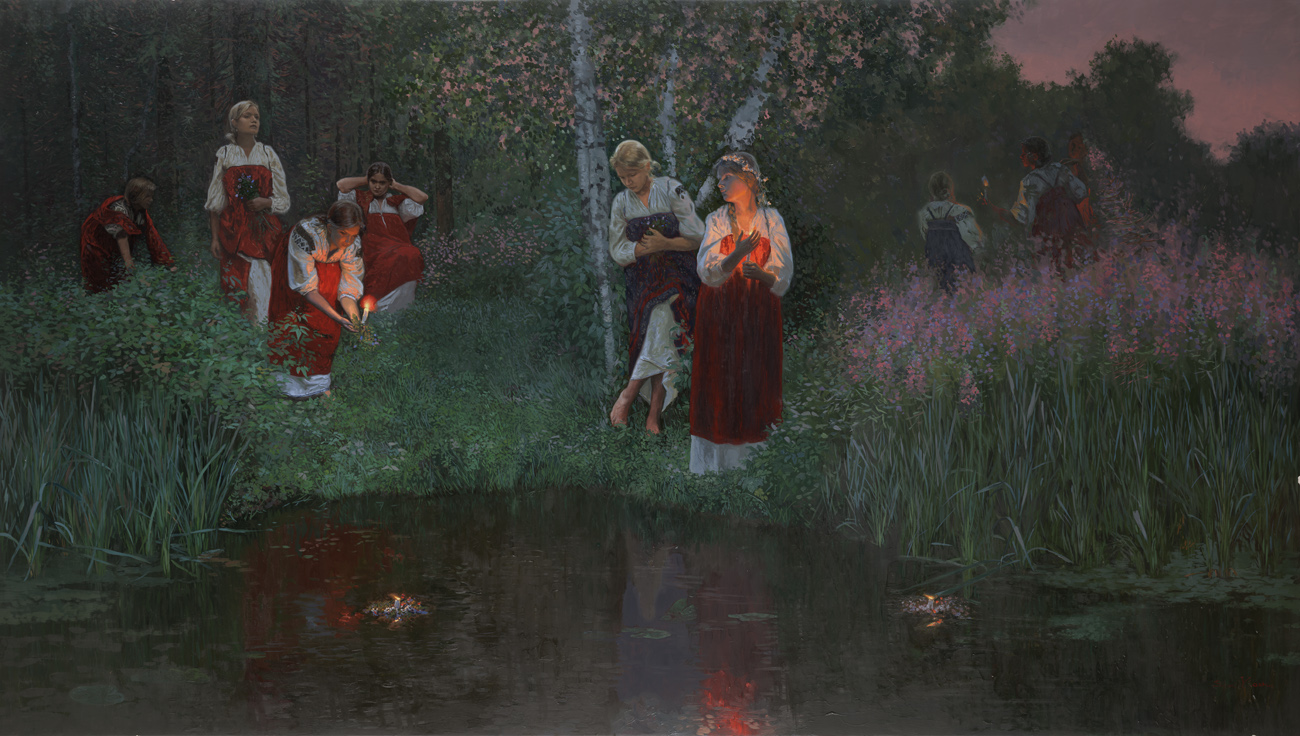
Kupala Night by Siomon Kozhin

Summer Solstice festival as we know it: it is linked to paganism and bonfires, and dances. It was celebrated once all over Europe in very similar forms. Slavs, Celts and Germanic people treated it as a sacred time where fire and water meets. Some remnants of the festival I still remember from my childhood and teenage years, but it was more a social event with flower wreaths floating,candle  light, bonfire, and and wild jumping over fire, this was was left from the days of old,  then after all, who doesn't like a good bonfire?  Summer Solstice was renamed as Night of the John the Baptist, as the ritual of bathing in the lake of rivers was so important, in Slavic countries, Greece and Balkans this was very important rite.Name  Kupala was supposed to be derived form old Slavic word for bathing, bu tit might be even come from Proto-Slavic word kup, which meant comming together. I am not so familiar how it was on British Isles and other countries, if this was a more solar and less lunar festival, more bonfires, or immersion in natural waters was also important.


The movie is kind of nicely done, romanticized, in reality this festival of fire, water, purification, love and fertility was wouldn't be so acceptable by today's standards: animal sacrifice was practiced,  etc. The church was trying to eradicate it, as a pagan festival, also certain behavior was considered indecent, people kindled big fonefires also in the cities, etc. and during for ex. XIIIc among Polish peasantry the importance of this festival was diminishing, even as it was practiced. But than during the Renaissance, when the idea that close relation with nature is important, combined with Renaissance in Poland ideas about the  myth of Arcadia, also gave more persmision to this pagan festival, solar in nature. All fire in all houses was put out, people congregated close to water, and ritualistically rekindled a new fire. They also bathed in the lake, or river, it was believed that the water had healing powers.

 Before that day bathing was allowed only during the night. It was a day of purification, all negativity was  believed to be cleansed by bathing, or by jumping over fire. As it was also a festival of love and fertility, a couple who jumped over fire was considered married in old pagan law. Young unmarried women also made wreaths of flowers and were wearing them on their heads, to put them on a piece of wood with  candle in the middle, floated them over the  waters of lakes, or rivers. And young men were bringing them back, if they caught one dancing with the owner of a garland they caught. It was like today's carnival, and crazy things happen during carnivals. In general this was not only one day, an end of day of celebrations.

Magic was in the air, as this was believed to be a special time, so many ideas about what was supposed to be magic or healing, I could bore you if I would list it. Did you hear about the magic flower? It was supposed to be flowering fern,(which never blooms, by the way), one a year this day, only for short time, but the flower was beautiful, radiating light, and the person who picked it was able to find a hidden treasure. Finding the flower wasn't easy, as it was hidden in the depths of the dark forest,(solar mythology again)  but there was a lot of scary forest spirits and dangerous entities who could frighten the candidates for wealth. The problem was not with real danger, but with human capacity to get terribly scarred. Those who had stiff upper lip were more likely to find it, as the legend goes.


Here is  a clip about celebrations in Russia, people were trying to recreate more of old flavor, but don't worry, no animals harmed or even present, some kisses and shows of male prowess (wrestling, in my country was jumping over fire), and lots of fun.

On Monday, finally the story about holy Grail in  Bezlawki. Brother of Lithuanian ruler according to the legend got it from those who escaped Britain after the battle of Hasting, among them were children of Harold Godwinson. It is just a legend, but the fact is that Gytha of Wessex, together with her brothers escaped to Denmark, and she later married the Vladimoir Monomakh
Who was not a Lithuanian Duke, but close. Stay tuned.

Thursday, August 23, 2012

Mountain of Venus: legend about Tannhauser

Recently I saw with my husband the movie Wagner's Dream. Totally fascinating documentary (and my husband told me it was very interesting to watch me watching the movie, my reactions, etc.) It was about the Ring of Nibelungen cycle, but this brings me to Tannhuaser, the other hero of Wagner's operatic world, and the legend about Mountain of Venus, a real mountain called Venusberg close to Horschelsberg. Located between Gotha and Eisenau in Thuringia, Germany. This area was explored by ethnographers of the XIX c., the Grimm Brothers included.Certain legends are as significant in German cultural heritage as the legends of King Arthur in Britain. This one is about Tannhauser, a knight and  a poet who supposedly took part in the literary competition at the Wartburg Castle, along with few of other historically known knight-poets.The real life Tannhauser (or Tannhauser, as his name was also written), as a poet wrote very erotic and easy-going pieces, not as refined as the courtly love poems by the other knight-troubadours (Minnesangers in German,  literally singers of love).

The Mountain of Venus itself is located somehow close to the  Wartburg castle. Here according to records (which may or may not be true) took place a competition between Minnensangers, who were German troubadours. Among others beside Tannhuaser very famous names come up: Walter von der Vogelweide, also Wolfram von Eschenbach, who is probably most known as the author of the Grail romance; Perzival.
You can see  them and their poetry in the Codex Manese manuscript

Here at  this mountain  with caves,  according to the legend, Tannhauser, their real life peer,  knight and poet,  met the goddess of love, Venus herself. She was surrounded with her court of beautiful women, and invited him to her subterrean world. He followed gladly, as he was a very sensual person, and through they entered  through the cave into the earth. The knight resided there for seven years. Some versions talk about one year. He enjoyed the easy fulfilment of all his carnal desires, and was very happy, unaware of passing time.  But finally he started to  feel empty, longing for earth, in spite of all delights, including pleasures given by Venus herself.

Venus Cave bellow, auhtor: Metilsteiner.
Venus Cave, Venusberg Mountain, Thuringia
Venus, however, didn't allow him to leave. When he was thinking of Virgin Mary, yearning for freedom, the Virgin appeared in an instant, and all charm of the under-terrestial world disappeared. At once Tannhauser found himself at the feet of the Wartburg Castle.

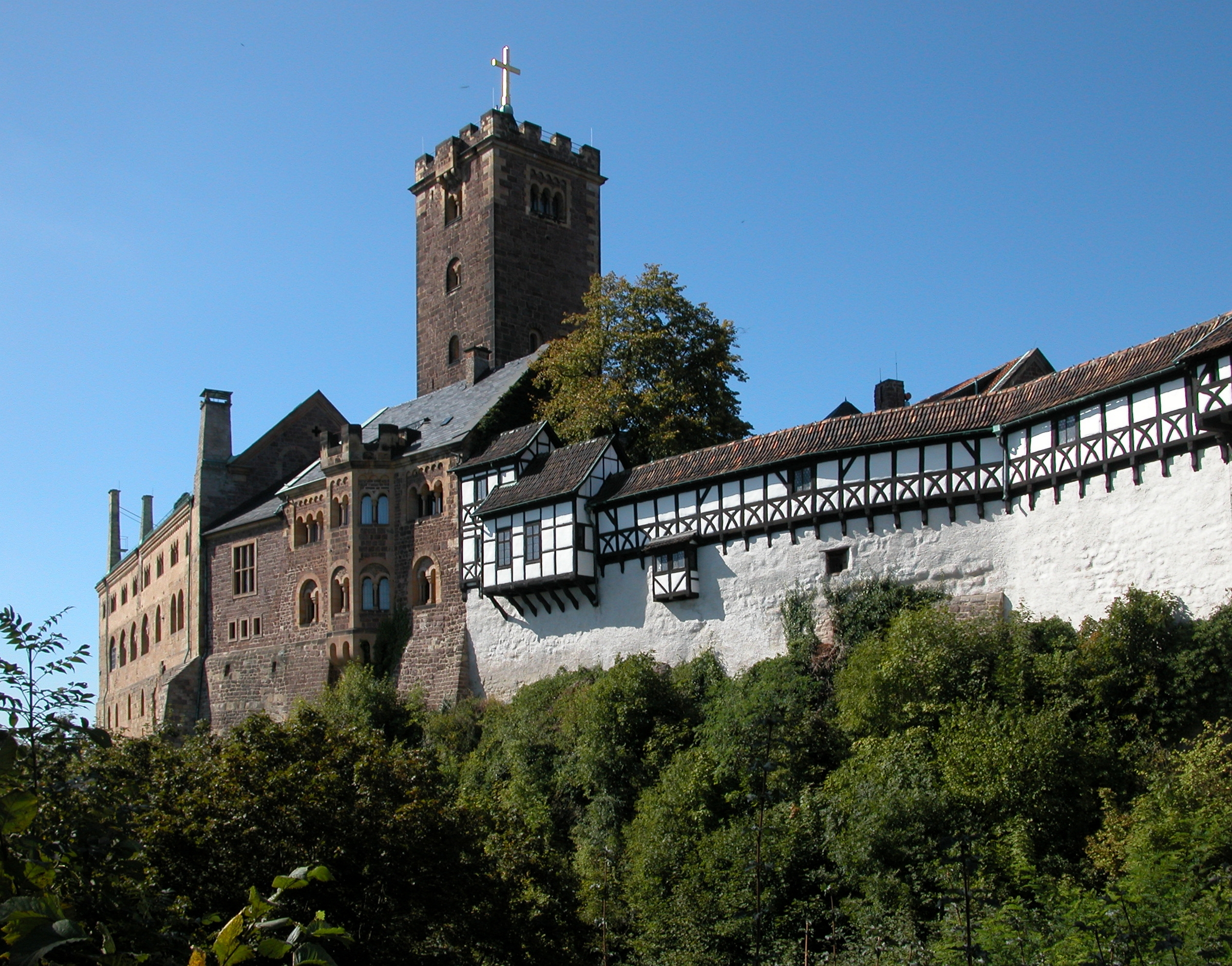
Wartburg Castle,  by Robert Scarth                          .
Yes, the same where Luther was given protection, the house of St. Elizabeth, and the place of competition of Minnensangers, and featured in Wagner's opera Tannhauser. Click on the picture to see high resolution.
Here he felt free , and in a state of rapture collected flowers. It was a kind of religious ecstasy. He decided to confess all his sexual debauchery, and ask Got for forgiveness. However, every priest who heard his confession was too shocked and didn't want to grant him absolution, telling that God will never, ever forgive such sins. Tannhauser even went to Rome in despair, confessed to the pope Urban IV himself, and asked for  forgiveness again. All this made the stern pope very upset: he said that first his pontifical staff  "will rather grow green, and bloom than God will forgive such lust." Depressed Tannhauser departed, decided to go back to the Venusberg, as there was no place for him on earth, he went back to the goddess and her realm of carnal pleasures. But after three days the pastoral staff of the pope greened with lush leaves, and flowered profusely. The pontiff send his  messengers after the desperate knight, but they couldn't find him anymore. The people in the village close to the  Venusberg told them he passed by, with somber face.He was never found again.

Picture on the left  is Tannhauser himself, from page of Codex Manese where some of his poetry are compiled, among them also a repentance song. The Codex is an anthology of medieval German poetry. The legend of Tannhauser made to German literature during XIX c. when literati  started to be interested in folklore and medieval world. But the strongest increase of popularity came after Richard Wagner's opera, named after the poet and retelling the Venus  legend, and the story about   competition at the Wartburg Castle, combined with Wagner's own creative liberties.

The Venusberg story is very interesting for three reasons: first it talks about real-life poet and maybe a real-life poetic competition, fits the history of a  personality, and his creative output into a legend. Second, it is an old legend Christianized, similar as the grail story was Christianized,it is a hybrid. It shows dynamism of a society which was in transition from culture of paganism to conforming into a new religion, and still quite new fedaul reality. The third reason: it gives a moral lesson about forgiveness, which it is not granted freely, and forces the protagonist to go back to the old ways.It shows that people are not forgiving, but the divine forgives. A lot of moralising here: about the goddess Venus and her court, personality of the  poet knight, but also about the hard hearts of the clergy.No one is spared, and in this story the divine gives a lesson that forgiveness should be granted freely and quickly, and this is a true loving way. The story is of course about carnal and spiritual love, and about serving a lady, but it is so multi layered. This were also times when Europe clarified its own ideas of romantic love.

Regarding an old legend combined with Christianity; Sabine Baring-Gould mentioned this one  in his book Curious Myths of the Middle Ages. He reported that the legend appears in its basic version in many countries in Europe, on which the local folklore built other layers. No confession and clerical invlovement is seen except Taanhauser story.Which I was not aware of. Basic version is that under-terrestrial beings want to contact human beings. A man comes in contact with them, has a very beautiful women as  a lover. He longs for earth, and escapes. However, he needs to return, as the earthly world is not receptive to him anymore. Baring-Gould gave examples of stories which have variations, but retain the basic roots. A very folklorist  view. Sometimes a pagan goddess, sometimes the goddess Venus herself  is present, and there is also a motive of ring and the marriage. There are also more mountains of Venus in Germany, also in Italy, there called Venus mountains, or mountains of Sybil. (I wonder if this has to do with Roman presence there). Baring-Gould also mentions that  the story of Tam Lin, tells stories from Catalonia, Farroe Islands, Sweden, Pomerania, Switzerland, etc. and mentions written versions by various ancient authors.Some are more related, some are more distant relatives.

 I also see now the connection between a legend from Poland, about a young knight who went through the waves into the heart of the lake to be married to some beautiful woman who held a court there. He was telling his loyal horse-or loyal friend who was a rider, depends on version- to go to and to tell his family he wedded a beautiful lady of the lake. The mother of the knight in the bottom of the lake knew the  he will never come back. Poland has of course many stories about aquatic world, courts and the cities, as there are so many lakes.

Tannhauser was present among supernatural beings, under the earth. Main ruler of the court here is chtonic type of the goddess, in spite of the goddes being Venus,a conflation. And the idea of under-terresatial folk itself reminds me of a huge bestseller, kind of  the Da Vinci Code of the turn of XIX c. It was a novel about Vril and subterrean super race living in  caves under the earth. The novel was an enormous financial success. Many people actually believed in reality of such race, and this belief was rumored to linger for long. Some of the Nazis supposedly believed it, it was believed in some occult circles, in Theosophy belief in Vril still exists to some extend. It was a novel, but seriously captured people's belief in reality. Vril, similar like the grail, is the idea about power granted, about  fulfillment of wishes. No wonder that both, the grail and the vril resonated so strongly with the audiences.  Recently we had The Secret phenomenon, which falls in the same category:  power of fulfilment of wishes, power of belief. Law of Attraction, another magical world for the frustrated. But I prefer the legends, I confess, Vril and the Secret don't attract me.  Are they an equivalent of today's court of Venus, where first after some time one sees the illusion?

As for the caves in Venusberg: local society hopes they will attract tourism, and the caves were explored. In them are diverse colonies of rare  bats, which hopefully will not suffer in case tourism increases one day. Iron bars at the entrance of some caves make a lot of sense, and here is a responsible way of protecting nature.
Sunday, April 22, 2012

Templar Legends in Poland, part 1

 
   The Knights Templars' history can induce flights of imagination, and no wonder: given the rise to power, their wealth and tragic dismiss of this chivalric order in France. From the legends someone can have an impression that not many Templars stayed alive after the imprisonment, torture, and killing of some of the knights in France.

 Templar chant Salve Regina

However, Templars were present in other countries of Europe, and when the order got dissolved; they joined the ranks of the other chivalric orders, as for ex. Johannites, or the Teutonic Knights. After the land ownership was transferred to others, some Templars still were allowed to stay. French king's power didn't reach to other parts of Europe. But the power of the Pope who was pressed by the king did. The puppet pope decided to dissolve the order, and told Templars to change alliances. His word was taken seriously. However, the Vinci Code-style Templar pogroms across all Europe just didn't happen.

When we look closer at some Polish legends, we find a story where a Templar commander was killed by the burghers of a specific town.  There is a stone cross on the place of the alleged murder. I didn’t see the cross, if it is stone it may be so called “penitent cross” put often on a place of crime. Why the people killed the Templar? Most likely abusive conduct of the Templar in question, nothing to do with the events in France. The Knight Templars were crusaders after all, and similar to other crusaders in Poland they not always were treating the locals gently.

 Description in Polish language of someone who is nasty and arrogant as  "haughty like a Templar" may point to not-so-mysterious and holly direction. The knights are the stuff of legends and mystery, but also they took parts in rides against the pagan population. The massacres of civilian populations were seen by the crusaders of any kind as normal behavior towards the non-Christians. Teutonic Knights, the other crusaders in situ, also complained that the pagans in the region were very rebellious and rotten: they didn't want to submit to "proper" power. There were of course uprisings by pagan populations and by the Christians alike. And Templars, like any other crusading orders, got also great latifundia donated to them by the Polish dukes, with local population included.

One legend, written down nicely by Mr. Gralinski, relates to Templars’ memory when they are seen as murderous crusaders. Not painting a pretty picture of the knights. This legend is alive in the village Dankow. Centuries ago Dankow was a city on its own right, but  fires reduced it to today’s simple village with two  beautiful lakes, ruins of the castle fortification,  and decaying remnants of a manor house. Archeologist are conducting digs right now, trying to find what is left from one of the most powerful castle in the Brandenburg March. Also archeologists are diving, looking for ev. remnants of the Medieval pagan fort (Slavic Wends?)  whom the legends also includes. So far there seem to be some parts of armors and weapons on the bottom of the lake.
The legend talks about a great battle between the Knights Templars and the pagans. The pagan warriors lost the battle and were all killed, no prisoners were taken. Only the women and children remained. In addition some material goods and cattle were in the fort, as spoils of war. The pope’s legate was there, among the victorious knights, and the Templar commander Friedrich von Alvensleben (commander in years 1302-1305). Von Alvensleben was initially proposing that the population which was still alive was to be treated relatively gently, in order not to cause hatred toward Christianity, which could lead to future additional uprisings.

 All invaders went to the fortress, and the daughter of the slain chief was now the ruler there. She met the victors, and a group of beautiful young women stood behind her, all festively dressed. The female new chief tried to negotiate with the invaders addressing Friedrich von Alvensleben: "Please, let after the times of tears be times of joy and peace, let be here a better future. As an act of forgiveness, and as a peace offering, let the music play, and come ye knights, and dance with those women." This peace offering was very upsetting to the papal legate. He slurred some nasty insults toward the women accusing them of pagan seduction tricks, and gave a hand signal toward the Templars, ordering them to kill off all women and children. The massacre started, and amidst the horrible screams of the victims the daughter of the pagan chieftain cursed the knights and the legate, and high water rose from the lake and swallowed all which was left from the fort, and all the women and children, and all cattle. Since then every year during the evening of the Summer Solstice  from the lake appears a group of young and beautiful women, dressed festively, and they sing  trying to lure any young men do dance.