Showing posts with label monastery. Show all posts

Sunday, September 9, 2012

Rock-hewn churches, cave monasteries, and stones: longing for travel

I come from a country with mostly flat terrain, some hills and mountains, but not much, lots of lakes and forests, and as you probably guess not many stone buildings. There are some, but most old buildings are made of bricks. Yes, brick Gothic is there too. Even the huge crusaders' fortress, Malbork Castle, is made of 35 millions bricks. Brick Gothic has its own fascinating features, and Gothic bricks themselves can be fascinating, but as you probably also guess I like stone buildings too. Actually I am really fascinated by them: huge cathedral or tiny shepherd chalet, I am hooked.

 So, the church of Notre Dame in Vals, Ariege in France (Pyrenees area) I find extremely interesting, this video lets you in.   Take a look at the humble Virgin statue, 1: 34. All it is element Earth in is glory, and very humble and simple at the same time.Gothic cathedrals have their beauty, but this one has own character, very Zen.


The Notre Dame church is Vals is Romanesque, partially build on the rock, (semi-cave church to be exact), has also very interesting frescoes, humble looking and with quite strong Byzantine influences, unusual in France, in addition to the only depiction of archangel Pantasaron, and depiction of scene after birth of Jesus.  Byzantine in appearance, as this is more often  found in Byzantine art, and also has strong Catalan influences, which is not so surprising given this is a neighbouring area to this region. The site was surveyed by archaeologists, and the conclusion is that there was human presence for thousands of years, even it must have been a cult site, at which point of the location  cannot be exactly said now, but the presence of ceramics used for religious purposes was there. But the site was at its peak during early Middle Ages, during the Merovingian times. I should write about the frescoes on another occasion, as they deserve attention on their own.

Landscape at Cote d' Azure, France, by Heidi Fuchs

Those stone churches like the one in Vals, the rugged and humble ones are very much in harmony with the environment. Those rock formations, this time at Cote d'Azure area, in spite of being regular, are in perfect harmony with anything which surrounds them. I couldn't help myself to post this picture. They are simply a silent part of the environment, awe-inspiring. But when I was really young I couldn't warm up to this type of aesthetics, the vegetation was kind of too dried-up for me, I liked lush green seen in the North during the Summer. Now I am enthusiastic about it. But also take  a look at the cave monastery in France,  Beaucaire, abbey Saint-Roman, photo taken by G. Freihalter, (via wiki commons) you can zoom in very closely.
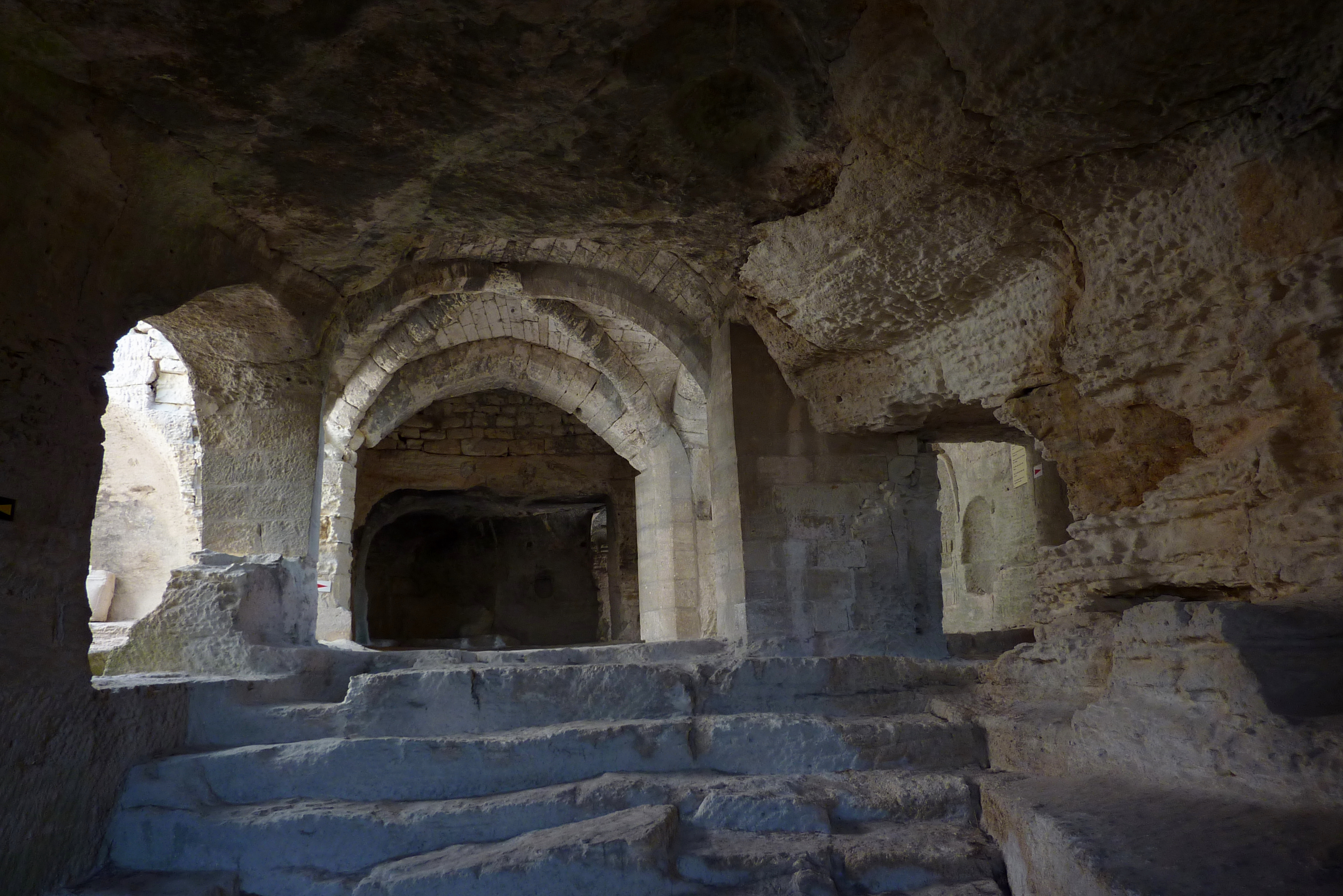

Cave churches or monasteries are rare, but there are still plenty for curious travelers.List of cave beauties on wikipedia

Quite a number of those is to be found in Bulgaria.And bellow is a picture from Bulgaria,  rock-hewn churches of Ivanovo, with Byzantine  frescoes.

Ivanovo rock-hewn monasteries, Bulgaria, by Denis Berthel, via wiki commons

And take a look at this photo of Todorka Mountain in Bulgaria. Makes me want to follow advice by my  Bulgarian expatriate friends and visit their home country. Sure, I would love to. Who can resist the lure of ancient art and architecture, and of such sundown  like this bellow on the magnificent mountain. But again, I need to postpone it again, even if at the momentI have what the Germans call Fernweh,  which means aching for the far away.
 The mountian bellow is Todorka Peak, in Bulgaria, by Evgeni Dinev, via. wiki common.
 Artlicle about this mountain mentions the legends too.

Todorka Peak, in Bulgaria, photo by Evgeni Dinev, via wiki commons

The author of the picture has more interesting photos of Bulgaria on Flickr, and his photo gallery there is great! Those pictures are my recent discovery on this media stream, and they make me think about maybe putting more links to Flickr albums by various photographers. Take a look at Evgeni Dinev's other awesome pictures.


Wednesday, September 5, 2012

Paradise on Earth-the legend

Legends were extremely important during the Middle Ages, sure. Some were the source of psychological strength, like the legend of the terrestial paradise, which gave people sense of hope and was interchangeable with the idea of heaven. First during the Renaissance this belief  faded away, but not completely, and when people stopped to believe in the paradise on Earth, their belief system became more gloomy, more fearful of devil and the punishing God. The disappearance of the belief  in terrestrial paradise is not the only factor that the times became very somber: more of natural catastrophes, more wars, including religious wars, legacy of black death,  increased activity of Inquisition, all combined with fire and brimstone preaching through XV-XVII c. gave way to a more depressive mood.paradise was no more to be found on the Earth full of suffering.

Medieval people were more optimistic: they believed that Paradise existed on Earth in their present times in some far away land, and trusted that some travelers indeed have seen it with their own eyes. Ancient manuscripts have maps, the Paradise was located somewhere in Armenia, China, India, later in Japan: in general it was very far  in the East. The Tree of Life was there, wonderful climate, of course vegetation was fabulous and abundant, with plenty of fruit to eat. There was not even a glimpse of darkness, day time always, never falling of a night,  and the Paradise was filled with light seven times brighter than the daylight on the rest of the planet.  The multitude of precious stones of many kinds was joy for the eyes. Abraham and Jesus was there too. This illuminated page from shows Christ on the lap of Abraham, with personifications of fours rivers in the circles of four corners of the mandorla. Those rivers are Euphrates, Gihon, Pison and Hiddekel were the four great rivers of the Paradise.


The Three of Life was in the center, also a Fountain of Life, which cured all imperfections a human  body could have. Sabine Baring-Gould wrote about this myth ( Curious Myths of the Middle Ages), mentioned maps pointing the location of the Paradise, but also writes about the manuscripts in which the legend is recorded as a  true fact, also he lists the various authors of the narration. For example he states that St Brendan took the journey to Paradise because one monk traveled there, and told about the wonder for this place, and St Brendan became very curious. St Brendan went to the East, very far, and reported on the Paradise he visited, and told about going further until he came to the place no one alive was allowed to cross.  According to Sabine-Baring a map in the Cambridge collection depicted the Paradise as a round island  located close to the mouth of Ganges. According to another legend  Alexander the Great was eager to see this land of delights, but hadn't possessed proper mind, as it was an inner Paradise, not the physical one. But the most detailed account was given in the Icelandic narration of Eirkes Saga Vidforla, form XIV c. mixing pagan and Christian beliefs. The following centuries the Paradise narrations didn't die completely out, the occurred as "learned  treatises."

What I was not aware of is the fact that the legend was also given strong  theological validity, and is found often in the books of sermons. Books of sermons in general are quite numerous, and give a good insight into medieval religiosity,  they also repeat legends. The master dissertation by Gavin S. Fort gives examples how this legend was functioning in religious life, specially interesting is the relation of this legend to medieval  monasticism. Monasteries were supposed to be images of Paradise on Earth, were people had the great opportunity to cleanse their souls ans enter the state of perfection, and have angelic habits. In monastic life celibacy was equated with the attempt to live like angels, than celibacy was a requirement in monastic life, later the argument for angelic life became a point in deciding that the celibacy should be extended to priests also. Later the belief  in a geographical location of the Paradise developed into the abstract meditative practice on the inner Paradise. Are you interested in additional reading? I recommend the Master degree thesis by Gavin S. Fort about Paradisal language in Medieval reform

  Take a look at this mysterious  diagram of a mystical Paradise  from the Rare Manuscripts Collection of Walters Museum of Art, by Conrad of Hirsau, XIII c.

I didn't find the remnants of this legend in today's Europe, not a full narrative but just some short mention about which I am not sure if this is  truly oral tradition as told,  but this fragment is similar what wrote Baring-Gould. According to this mention the Paradise was sealed by the walls of fire, and is guarded by an angel and no one could step in. The walls of fire are relating to some medieval reports about inaccessibility, (Baring-Gould), the angel with sword is of course the cherubim of the Genesis.


Friday, August 10, 2012

Reichenau: the Lost Glory and the Holy Blood Relic

Once Richenau was a monastic island, one big and famous monastery with over twenty chapels and churches, monks dormitories, gardens and scriptoria. Not much is left form its former glory, but still worth a trip. During my visit at the Lake of Constance several years ago in June, Reichenau Island was warm and full of nature's riches. Sweet cherries sold at the roads close to farms were sweet and warm form the sun, and gardens were greening with salads and other vegetarian delights. My photos don't do justice. The farms are small, island itself is small, and everything seems simply charmingly rustic. In the reeds I could hear birds. I went to what is  today UNESCO heritage site, Sankt Georg church, Oberzell, to see what is left from the former glory of Reichenau Abbbey. The monastic island once had 20 monasteries, 25 churches and chapels, and seven hundred monks were dedicated to cultural work. Today only three churches are left.

Columban (or Colomba in Latin)  the famous monk of Ireland came to the area in 610, but was not successufl in converting the Allemain pagans to new religion, went back to the Island Iona, today Scotland.Iona was a monastic island, well known today for the Book of Kells. Hundred years later, Pirin with whom is bound the simmilar legend like with St Patrick- expulsion of all snakes for the island-was the founder of the abbey  in 720,  just shortly after St Gallen was founded.

 Reichenau once was a monastic island, like Iona, had Benedictine Abbey, big and influential.It had the biggest library in the West. In its scriptorium many illuminated books were created, during the X and XI century it was a largest and most influential center of manuscripts creation, possessing huge library, very famous than, and school of painting. Renowned scholars of the day (among them Strabo) and men of great talent worked and lived there. The style of the manuscripts written and illuminated in the abbey is called Reichenau style. It is characterized by simplicity of design and soft, pastel-like colors.

 Click on the link to see an example of illuminated manuscript from Reichenau.
And another example, this time full codex, you can see every single page, in the collection of Walters Art Museum, Reichenau Gospel

And here is the splendid crozier from Reichenau, today at Victoria and Albert Museum in London.The first crown of German emperor was also made here.

And here is Sankt Georg church.  Often is seen on pictures surrounded by field of salad or sunflowers, I didn't have such luck.

Reichenau Abbey, Sankt Georg church,  Oberzell, Reichenau Island, Germany

Reichenau, Oberzell, St Georg basilica, Ottonian murals


The name Riechenau means in old German Rich Island, and it was really fitting. In addition precious relics were donated, important thing during those days, among them a crucifix containing blood of Christ, as was there, also the pitcher form wedding of Cana. Any blood relics were  very important. Still today in the treasury of St Mary and Marcus church,  there are some objects which are preserved, not as much of them as in the times of glory. Pitcher of Can is there, blood relic is in a preserved in the church of Mary, and it is presented in procession Monday after  Trinity Sunday ( don't know the day).


Reichenau, Sankt Georg church, interior with Ottonian murals, by Heidi Fuchs


Sankt Georg church, murals dating from the times of the Ottonian Renaissance. I apologize for the quality, but the light conditions are not favorable for photography. Could't use flash, by principle, and hate when people do, not good for the ancient paintings.


  Carolingian Renaissance was time of great learning, development of scholarship and arts. One of the renaissances predating Italian Renaissance, more famous and influential. What happened to this once famous abbey, center of learning spreading its culture wide? Bishops of Constance mismanaged it when he was in charge of it, starting during XVI c. also the fame of competing St Gallen not too far from the area was a downfall, in addition the forced secularization (XVIII c. finished beginning XIX c.) was a final blow: monks needed to leave, the library of precious manuscripts was send to museums. Over twenty churches and chapels were demolished with dynamite. And act of iconoclasm for sure, this time the secular one.

Here are some grave stones from the  St Georg church.


The glory of Reichenau abbey is lost, but what we have left is beautiful anyway!

 And in the garden of St Mary and Mrcus church is the plate which honors poet and scholar Walahfrid Strabo, (lived during the first half of the IX c.) mentioning that he wrote the first book about gardening in Germany describing 440 plants for healing and for cooking

And what about Ottonian renaissance? It was fueled by closer contact with Byzantium, where the traditions of Antiquity were still alive.And the schism between the Orthodox Christianity and the Latin one was not there, the church was still united. This came because emperor Otto had a Byzantine wife, Theophanu, learned and literate. (He himself was illiterate). Theophanu was an intelligent ruler who brought progressive Byzantine ideas, used diplomatic skills and learned in Byzantium strategies to make her place in history. There were also other learned and influential women of those days, princess Theophanu was the first one. From the family of the emperor there were also women who greatly supported art and learning.

Click here to go to UNESCO's description of Reichenau as the world heritage Site

There is another side in Reichenau: holy blood relic. About it tomorrow.