Showing posts with label Mary Magdalene. Show all posts

Monday, July 15, 2013

Imagery of Ascention of Mary Magdalene

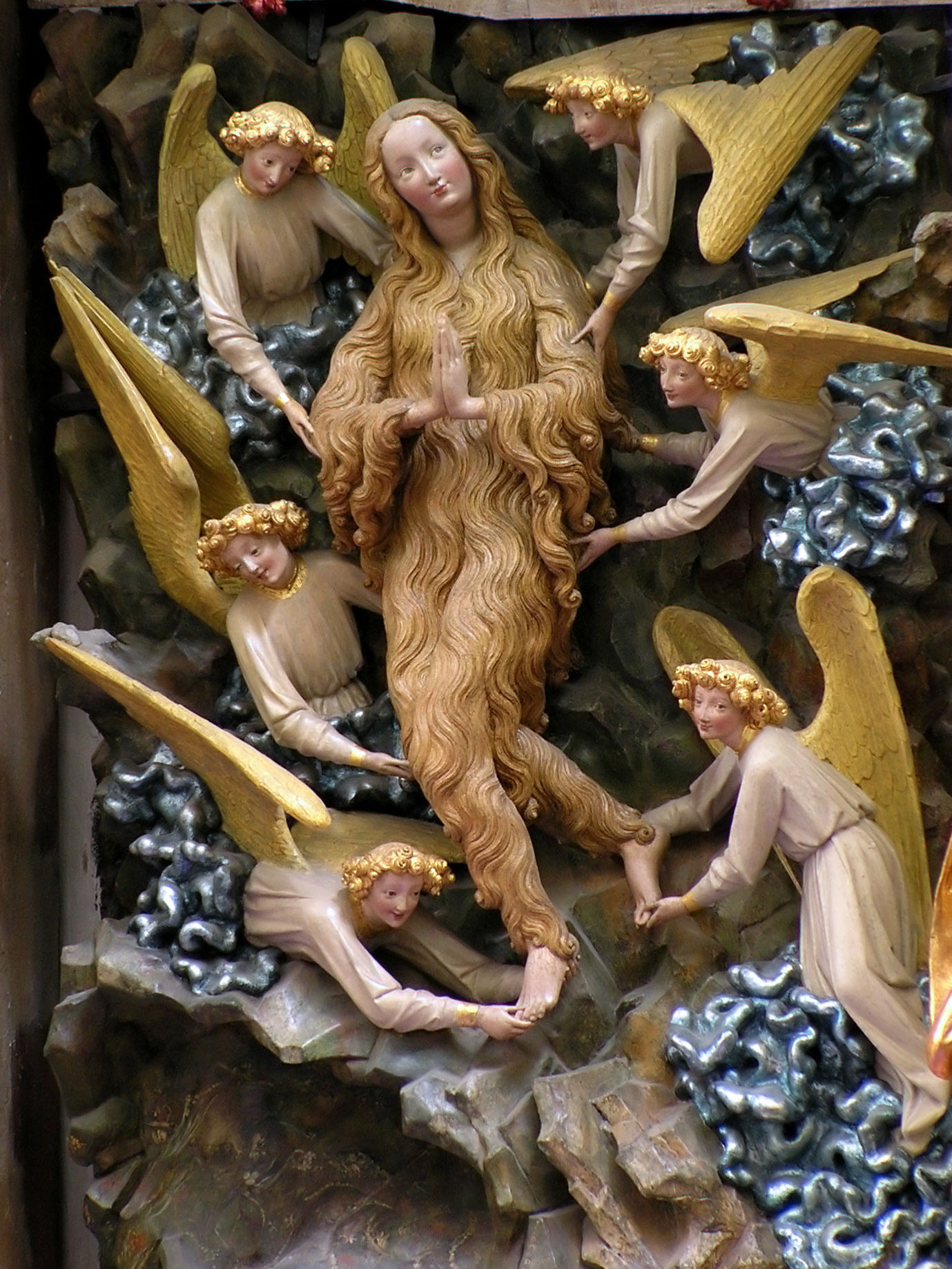
On this picture, originally from Gdansk today in National Museum in Warsaw National Museum, Warsaw we see ascension of Mary Magdalene. It is one type of many way of representing Mary Magdalene in art, here she is shown as a  saint who meditated so much that she was feed divine food by God himself, according to Medieval accounts. Latin church tradition says  happened seven times daily, angels took her before the throne of god where she was given nourishment.

Assention of Mary Magdalene, tempera on panel, 1430, 71x48in (182.5x122cm)
Very similar in form on canonical depictions of ascension of Virgin Mary. I was writing before that Mary Magdalene was the second most depicted woman in Catholic art, after Mary mother of Jesus. It comes at no surprise that the glorification images, painting or sculptures are often similar. Here we have Mary Magdalene crowned by Gods himself, held in sky by angels.  We know that this is Mary Magdalene because of hairy costume. But Mary Magdalene dressed in more ornate robes is represented also, see my other entries fro examples.

Another depiction of Mary Magdalene's ascension, also form my country, Poland, this time from St John's church in  Torun. I love the charm and joy of this one. And I am so glad that wiki commons has nice pictures, it is often a chore to take a good picture without flash. I never use flash while taking photos of art. As an artist I know that this is bad for the pigments.

Anonmymous artist, Ascension of Mary Magdalene, XIV c.
in Church of Saint John the Baptist and St. Evangelist
This graceful Mary Magdalene is shown as a hermit, but there is nothing austere in the scene. All is charming and lush, full of beatitude. About the austerities reminds her body covered with flowing hair, which is very beautiful, the rocks of the cave and flat belly. Those days a good muffin on the belly was a sign of female beauty, flat belly was indicating that someone hadn't enough to eat. What is beautiful today for us, for people living in times when Gothic art was created such flat belly wasn't beautiful, but it was signifying that the depicted saint wasn't eating much. Some fashion of medieval times is kind of strange for us today, and I think is worth a separate entry.


Illustration from Nurnberg Chronicle, 1491


Here we have a woodcut from Nurnber Chronicle ( via wikicommons, Schedel). Colorful wings of angels, very long robes with lots of draperies which formed angular folds, and round, protruding belly of the female figure was very typical for the art of the days, specially North of Alps.
Here, according to the artist,  we can say the divine nourishment was as filling as earthly food.

Here a few examples of Ascension of Mary Magdalene to browse
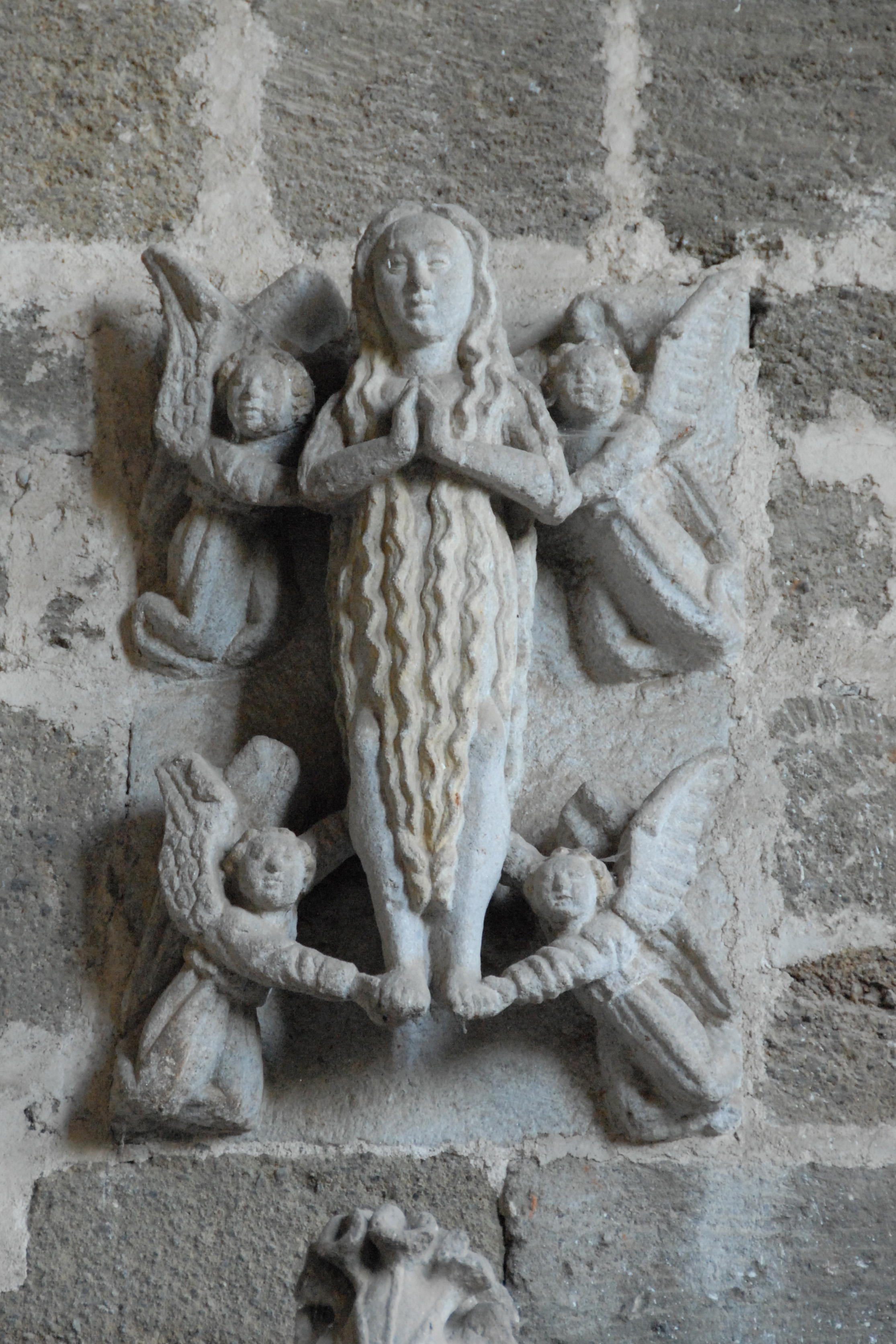
This Mary Magdalene sculpted in stone can be seen in Chanteuges Abbey. Wikipedia articles about this wonderful place are in German and French, so I don't include them here.
But those figures of Mary Magdalene and angles can be found in France, and not only there in various churches or abbeys.
They have their won charm and are of rugged beauty.
Photo by Jochen Jahnke.

Wednesday, July 10, 2013

Grail in Bezlawki part 2: Mary Magdalene patronage and pagans


The second part of the legend of grail in Bezlawki. How the grail was taken from Britain, by whom, in my previous entry about what happened after the battle of Hastings. 

This is a legend, we don't know how old it is, bu tit is very interesting as a story, and has historical events, as well people who lived in real life. A bit of historic  background of the story.

After Svidrigaila installed the grail and his army in today's Bezlawki, in a fortified tower which belonged to Teutonic Knights, military order crusading against the pagans of the East North, he lived like a prince. Historical records show food provided by Teutonic Knights, among them very costly morsels and spices imported from afar. Teutonic Knights promised him to become the grand duke of Lithuania, even though Svitrigaila didn't qualify, as Lithuania had the law of primogeniture, and he was the younger brother in line to the throne. His older brother, Jogailla was a pagan. They were also engaged in a bitter feud with their uncle, who also was keen of becoming the only ruler of Lithuania. It seemed that those three men had reasons to fear for their lives. The fortress in Bezlawki, in the middle of dense forest was a safe place for Svitrigaila.


 Here is video how Bezlawki tower was changing through centuries. For those of you who have trouble to watch the video's embedded in this blog, here is the to the youtube video.About  4 min on shows the change for Svidrigaila, making it more fit for princely residence.

One of the people who was on diplomatic missions dealing with Teutonic Knights, who were considered those days unstoppable, was young Polish queen Jadwiga. Or rather a young king who was a woman. Why? Because in Poland by law kings were ruling, so, if the sovereign wasn't male, she got the title of king, that meant she was a ruler on her own, not a queen consort.She was elected a king, and crowned as such at a tender age of 11, like some of the Merovingian child-king. But she was an extremely capable young genius.

Jadwiga of Poland was half Hungarian, half Bosnian, but from both parents she had genetic ties with native Polish Piast dynasty. She was also from Angevine dynasty, therefore the fleur-de-lys. Her mother, Elisabeth of Bosnia was ruling Poland, as the last king of Poland decided that his sons are no capable enough. Poland didn't have law of primogeniture. king or the nobles could decide who was the best candidate for the throne. But Elisabeth of Bosnia  wasn't  capable enough as a monarch to please the nobles and she  was replaced by her daughter, Jadwiga.

Jadwiga of Poland  by Antoni Piotrowski, at Jagiellonian University
Note the chalice on the right. Picture painted in 1901. 
Jadwiga of Poland grew up in Hungary in royal court of Buda, she was a polyglot speaking six languages, spent one year at royal court in Vienna, as it was common to send children of noble birth to be educated at other courts.She was supposed to be the future wife of William of Austria, one of the Habsburg dukes, was engaged to him as a little girl (sponsalia). The Habsburgs were expanding their influence by marrying heiresses, this engagement was an early attempt in such politics.

Jadwiga was a politician and patron of culture, in addition she was very religious: she revered four saints, specially Mary Magdalene and her sister Martha. Mary Magdalene was the patron saint of Angevin dynasty, after Charles II, Count of Provence and king of Naples discovered the body of Mary Magdalene in Provence, at  Saint-Maximin-la-Sainte-Baume.Mary Magdalene was immensely popular saint and enjoyed patronage of rulers, but the Angevins were the most important in spreading and strengthening her cult. Without them Saint Baume pilgrimage site wouldn't exist, her cult in France wouldn't be as strong.

Charles II discovered the body of Mary Magdalene in 1279, he was called Charles of Salerno at this time, he became Charles II later.  At this moment this popular saint became the dynastic patron, so, no wonder Jadwiga venerated dynastic saint who according to the legend converted pagans of Provence to Christianity A scholarly article to read about Angevins and Mary Magdalene as their patron saint, and Angevins role is spreading the cult of Mary Magdalene in Provence, Naples and so supporting also the legitimacy of their dynasty, of which they claimed, Mary Magdalene was a miraculous founder.
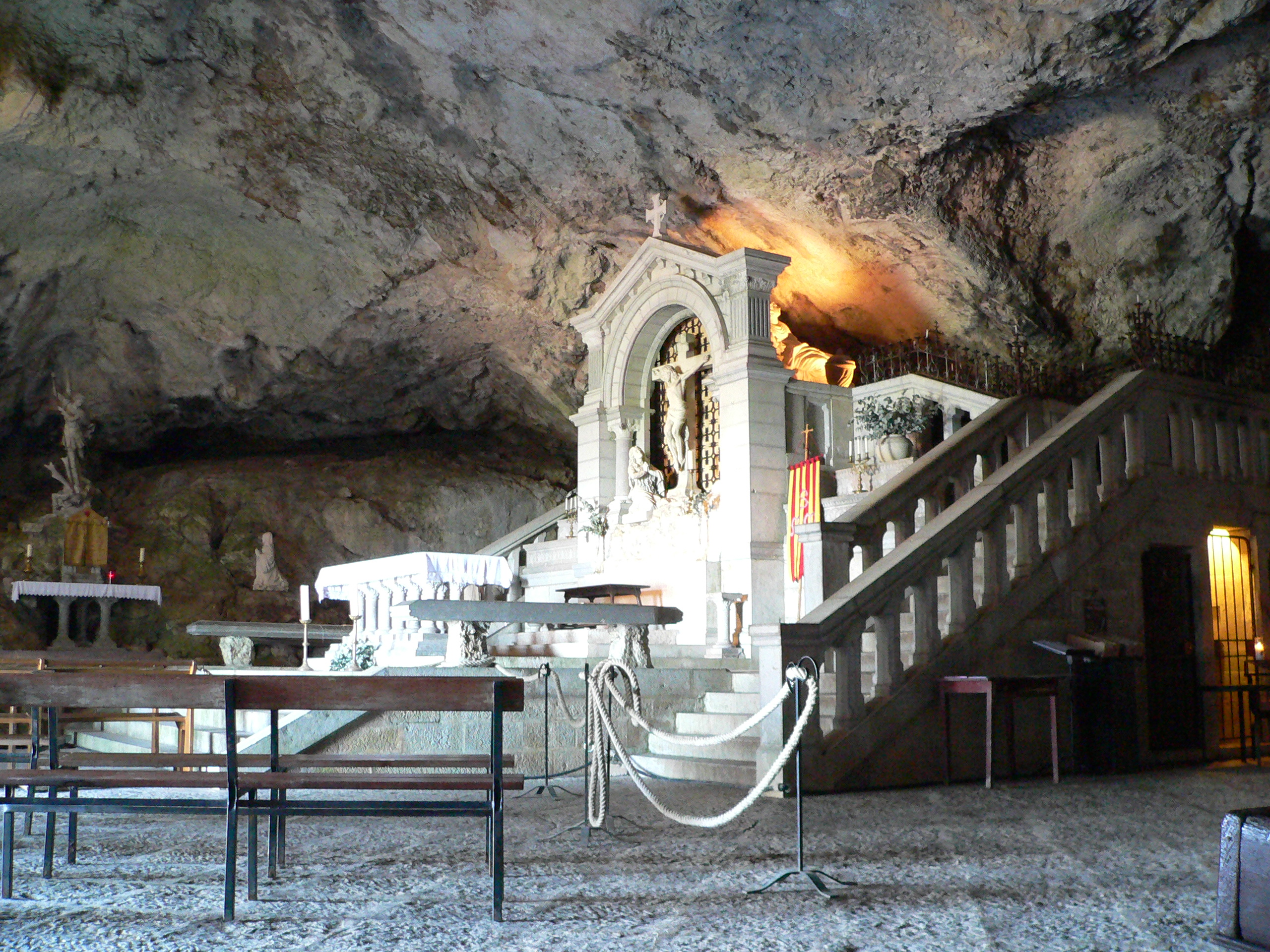
Grotto of Mary Magdalene in Sainte-Baume, by Disdero
http://www.escholarship.org/uc/item/7pz6w018
by Dr. Sarah Wilkins, professor of art history and design.

When Jadwiga was enthroned, however, several suitors appeared, hopeful for marriage and crown. William also appeared at the court in Krakow, as he was thinking now was the right time to got get married, after all Jadwiga was his fiancee. He was bitterly disappointed: the young sovereign declared the annulment of their contract, and the Habsburg duke went home.

Jadwiga got married three years later, she was 13 years old. Her king consort became duke Jogaila of Lithuania, who being a pagan needed to convert to Christianity. And through Jadwiga's influence the last pagan country of Europe was Christianized.She didn't need to preach to pagans: she just made the requirement that he husband to be needed to be Roman Catholic.

Svitrigaila  the owner of holy chalice (which one of two?)  lived with his hopes for Lithuanian throne in Bezlawki, in the area of crusader state of the Teutonic Knights, the military order which also targeted pagan Lithuania in their Northern Crusades. His alliance seemed easy, as the Teutonic Knights were believed to be invincible. Yet they were crushed, one day, and by no one else than his brother Jogaila with armies of allies.Life of Svidrigaila was marked by wars and dynastic struggles. He became grand duke of Lithuania for two years, noting more.

As Jogaila was baptised in Wawel Castle in Krakow, Christianization of Lithuania was official in 1386 The marriage couldn't happen without Jogaila's

 Svidrigialla also got baptized with his brother at the Wawel Castle. He converted from Greek Orthodox faith of his mother into Roman Catholicism.But in his case it was of no great political advantage. 

Because Jogaila became king of Poland, this didn't mean that Jadwiga was now a queen consort. She was the ruler, marriage didn't chip away her power, he was the king consort, but of course both were politically active. Jadwiga was known for her charity, good character and for her support of good causes. She was so much liked and revered by people that she was considered a saint, and legends of her miraculous powers spread. This was a queen of a true noble ideal of a virutous lady.She died young, only 26 years old, after complicated child birth. She and her daughter lived only one month. This was nothing unusual in those days, even among people who were very privileged, such deaths happened among ruling families too.

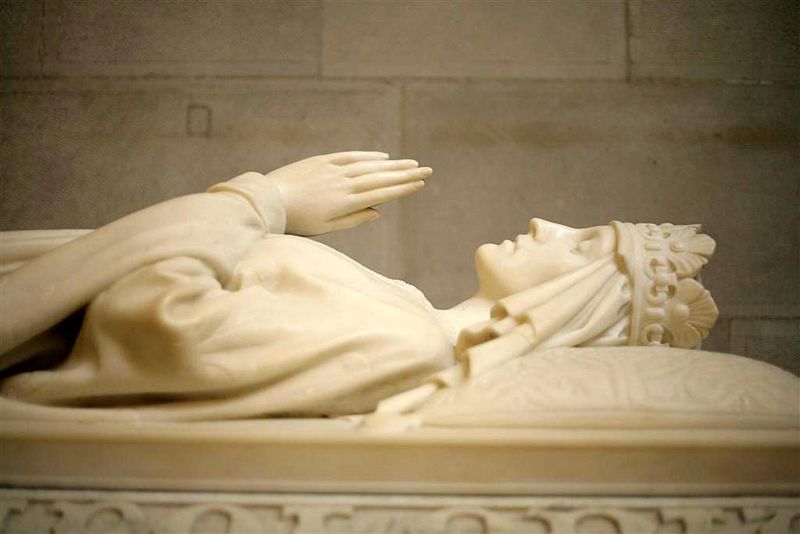
Sarcophagus of Jawdiga of Poland, Wawel Castle Cathedral
After Jadwiga died she was declared a saint by people, and her cult spread. Her relics are in the Wawel Cathedral under the crucifix at front of which she prayed. Even she was considered a saint and worshiped as such, her beatification happened as late as 1980, and she was officially declared a saint by Vatican in 1997, by the pope John Paul II as you may guess. He prayed at her sarcophagus. Pity I didn't take the picture, the sarcophagus sculpture includes a nice lap dog at Jadwiga's feet.Thank you Cezary Piwowarski for the picture. (Dog symbolized loyalty). Close to the sarcophagus her regal insignia are exhibited: the scepter and the globe. They are made of wood, painted gold. Maybe those were lighter for a child ruler to hold, but also she is remembered by her unusual generosity, she sold her jewels in order to support Krakow University (today Jagiellonian University) etc.

After Jadwiga's death it didn't mean that Jogaila as consort was now entitled to rule. There were several candidates, but he was considered the most suitable one, so, he became the king.

 As for pagans in Lithuania: they were left unmolested, their priests also. As officially Lithuania was a Christian country, crusades stopped after battle of Tannenberg in 1410.

Jadwiga's patronage of art and culture is continuation of  Angevin artistic patronage of the Neapolitan Angevin dynasty. She had good examples. In the article you will see also the image of funerary monument of Mary of Hungary, Queen of Naples, who was also patroness of arts, and like Jadwiga also connected to Hungarian Arpad dynasty. Mary's mother was a pagan of Cuman tribe who converted to Christianity in order to marry Stephen V, king of Hungary, and Dalmatia, Croatia, Rama, Bulgaria, Serbia, Galicia, Lodomeria and Cumania; Duke of Styria.

More about grail in Bezlawki, also historical background, soon, I hope, and I hope you enjoy it. Knowing the legend is one thing, but knowing the people in the legend can shed additional light, in my opinion. Again, we don't need to believe in the legend, that there are historical persons it doesn't make it automatically more credible. It is just a legend after all. Wasn't the legend  about Joseph of Arimathea who brought grail to Britain also a legend of Christianisation?


Monday, July 1, 2013

Saints who once were crooks, criminals and bad people in general

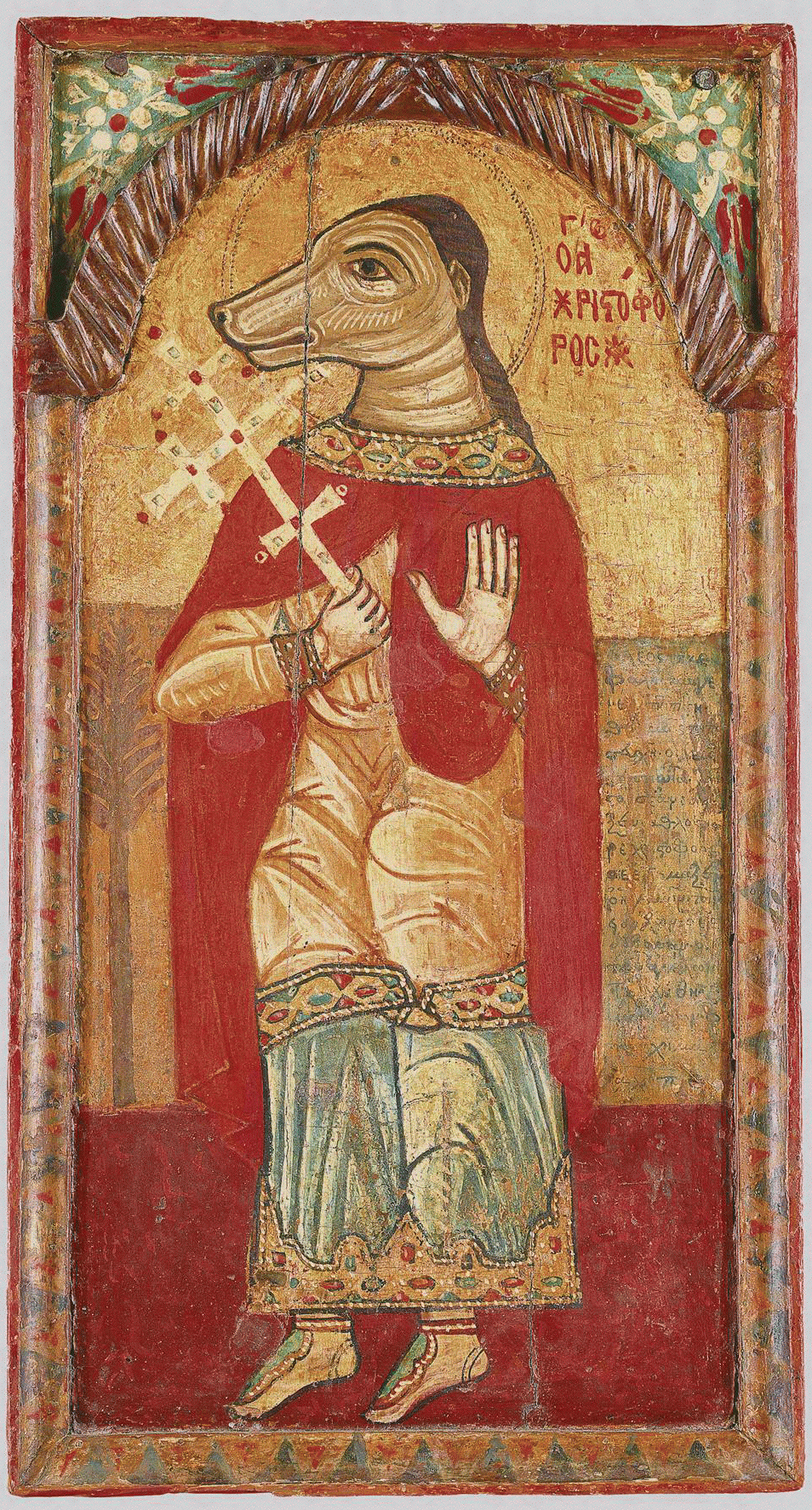
St Christopher, dog-headed saint,  icon
This entry will be not a light read partially, for it is about bad people who changed their ways and became saints, were reformed individuals.

 I was writing about Mary Magdalene and I see from my statistics that entries about her are quite popular. She was also an extremely popular saint, also in Catholicism which described her as a reformed prostitute for over a millennium.There is a disbelief, in general, regarding her alleged former profession and her super star status. It seems that branding someone as a prostitute would be a social death, and it was, normally. And here the logic of old days and logic of today clash: we talk today about erasing Mary Magdalene through smear campaign, all very upsetting. Logical point, not much to dispute from today's view point. After all we live in a society  in which  we can for example discredit a politician for marital infidelity. But she was a saint and she was worshiped by a society different than ours. She wasn't an average person: she was a saint.

We can't always apply our today logic to societies of days gone. Mary Magdalene was described as a  former prostitute, but also was called no less than Apostle to the Apostles. She was also the second most depicted saint: Virgin Mary was first. I know that modern day people struggle deeply with this paradox. Which is logical, of course. But keep in mind that societies of old were in some regards very, very different than ours, their beliefs, social mores, social system, in general their culture was different.

This maybe come as a surprise, but Mary Magdalene was not the only saint who "was a great sinner," as those saints were described relating to the phases in their lives before changing their ways. In her alleged status as a former sinner she wasn't even the worst one. There is over thirty saints who were very ungodly before they changed and after some time achieved saintly characters. (There were saints who had human lives on their conscience, for example). Hard to grasp? Maybe. If we don't know the cultural attitude toward transformation in earlier days, yes, those issues become incompatible, and it is surely  understandable that they are incompatible.

 Yet people during Medieval times,  Renaissance, and Baroque had different views. Actually as late as until Victorian times people were not shy about retelling the sins of the saints. Not at all. They told that St Olga had lots of blood on her hands, as she decided that revenge against murderers of her husband should be bloody and no ones life should be spared. St Paul, the one who authored parts of New Testament was forgiven prosecutor of Christians.  St Mary the Egyptian was a street prostitute. Margaret of Cortona was a sex addict. The first saint of all was the Good Thief:  he was one of the two criminals crucified with Jesus. St. Callixtus of Rome was convicted twice for felony, in addition embezzlement wasn't something he shied away from. St Moses the Egyptian was  boss of a violent gang, those men were killing people. St Camillus de Lellis was a con man, a mercenary, and card player for profit.And so on,this  list is not complete, and I don't see the reason to make it complete in this blog. You see the point anyway.

St Mary of Egypt, Russian icon, XVII c.
But Christianity isn't the only religion which has converted criminals as saints: Tibetan Buddhism has one such a person: Milarepa. He killed 35 people before he repented and became an example of goodness. Role of religious changes which emerged during  Axial Age was to tranform human ethics deeply on individual level.

So, not every saint was a paragon of virtue from early on. Some were examples of evil who later changed in the process of true alchemy of the soul. One of the last examples, from XX c. is a man who killed a policeman, and was the last person guillotined for his crime in France. He experienced conversion in prison and become unusually good and a shining example to others, his name was   Jaques Fesch. And here is the controversy for and against Jaques Fesch's case for sainthood as seen by the Catholics themselves.

Oscar Wild once said: "Evey saint has a past, every sinner has a future." For sure not every saint had "a past"  in sense of bad past, as there were some individuals who very immaculate from the beginning. But for sure path to sainthood wasn't excluding anyone. Mary Magdalene in her alleged profession was not paragon of virtue, but she was quite innocent in comparison to the others. So was another beloved saint,  Francis of Assisi, who according to  hagiography  was a bad boy who matured gradually to sainthood.Early on he wasn't a pacifist as he lived as a soldier, lead decadent life of revelry financed by his wealthy father. It was later when he changed his ways, and also married  "Lady Poverty." Word marriage symbolized his commitment to life in poverty.

Dog-Headed Cannibals, woodcut from Cartha Marina,  1530
What about the icon above, the saint with the head of a dog, adorning this post in a way so strange for us, the modern people? It is St Christopher, who was believed to belong to a cruel kind of people who were born with dog heads, and were extremely violent. In fact cannibals were depicted as dog-headed. Cane was Latin name for dog. St Christopher was such terrible man who after he met Jesus became a very good person, and one day he became saintly.

 Sainthood was and still is considered to be the life as most human and humane as it possibly can be. It was believed that every person without exception can become a saint, and the true miracles of transformation of a soul are possible. Miracle of changing water into wine was a miracle of transformation, and such transformation was considered possible for human soul with divine intervention and openness combined with willingness from the side of the sinner.

Today those things may appear difficult to grasp, but were quite simple for people of earlier days:  those saints were illustrations of great workings of divine grace. They were miracles in action and  embodiments of  hope given to every person, however imperfect a human being was, for sure there was hope. The hope was the promise that perfect transformation was possible because perfect forgiveness was possible, that God's love was all inclusive. If one abandoned for good the path of evil, the person could even become sanctified if the transformation was complete. The person was forgiven, and you didn't question divine forgiveness. To do so it would be to dwell on peoples' sins who were forgiven already, washed totally clean, no-existing. People went to confession and believed that their sins were forgiven also, that they were cleansed also.Accepting that this happened to others as well wasn't a big deal for them.It was the world in which confession and repentance was a sacrament of reconciliation, of giving freedom from sin.

Forgiveness as a concept and mystical experience is very prominent in Christianity. It makes transformation possible. Transformation into what? Into purity, life in sanctified grace.Mary Magdalene was considered completely transformed, and as someone who was pure she was also depicted as ascending to heaven. Those things need to be understood in relation to saints, specially those of them who had difficult past, who were not from the beginning like Mother Theresa. They had bad past but grew so far beyond it,that  they were not soiled by it anymore. Bad past was the memory of a  battle won, not something which was supposed to be held against them, as it showed the severe spiritual obstacles they overcame. You couldn't slander a saint, as the sins forgiven were considered erased forever, sins of any person, and not an object of discussion or doubt after they were removed.

 Holding their past against them would be like not accepting God's verdict of forgiveness, to be unforgiving against God's will, and people were warned that those who are unforgiving can't expect much forgiveness themselves. It was much deeper matter than we think about it today from our perspective, "oh, this saint had bad past, therefore was discredited." They couldn't be discredited, as their sins were considered forgiven, what was forgiven wasn't existing anymore.

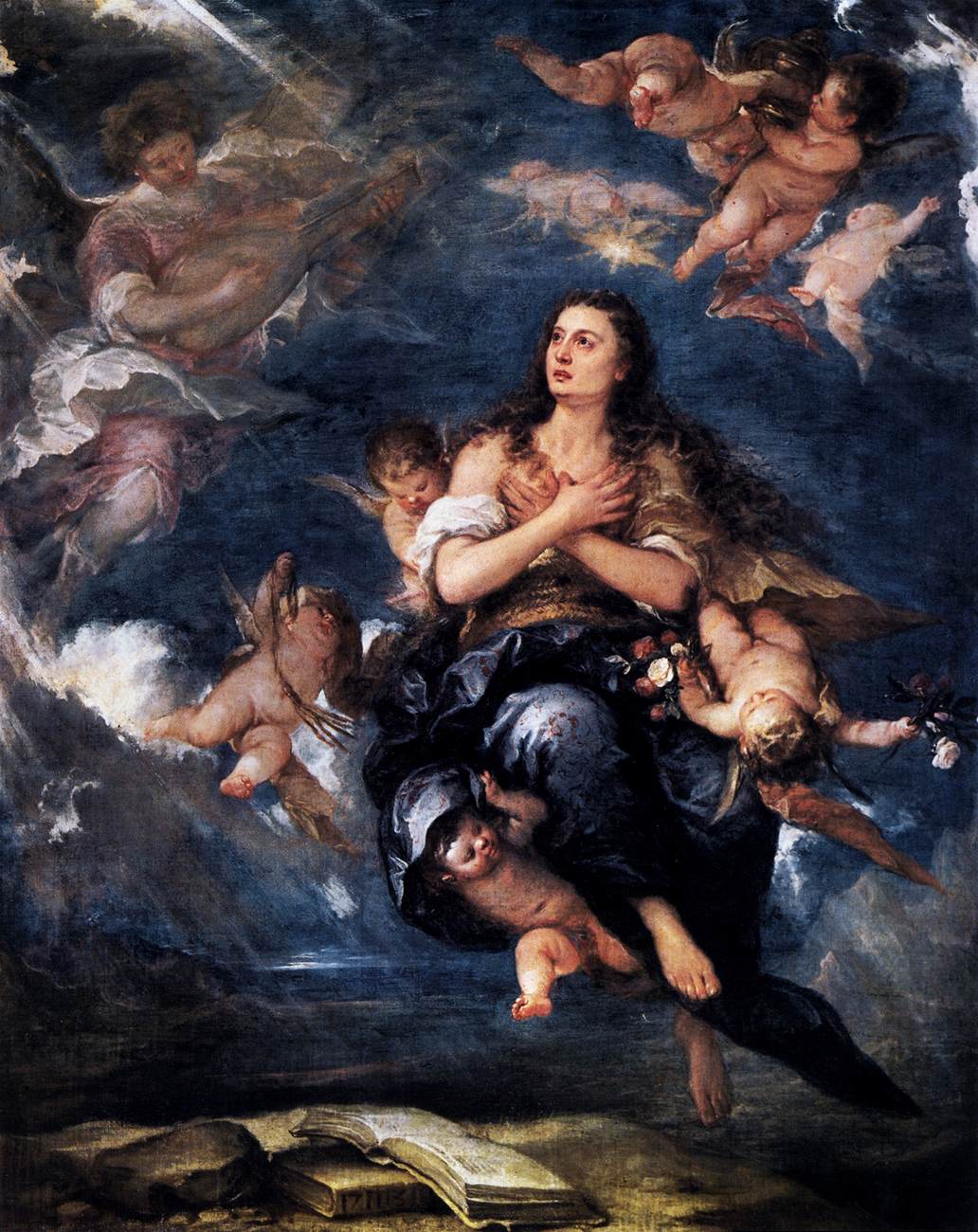
Assumption of Mary Magdalene by Jose Claudio Vicente Antolinez, XVII c.
Mary Magdalene has black hair here, not red. This is Spanish painting. Spanish artists depicted her with black hair, not as  a redhead.

As you see Mary Magdalene wasn't the only saint in Catholicism who had bad past, and who was sanctified in spite of it. Yes, early Christianity tried to figure out what to do with women, if they were allowed to be for example priests or not, etc. Misogyny was there. According to comparative religion scholar Karen Armstrong as long as Christianity was a secret and forbidden religion, when Christians met in catacombs or private homes, women were prominent. When Christianity became state religion, power was regarded as right  of men. And I say, no wonder, Mediterranean cultures were very misogynistic those days. People are very surprised when they read for example about position of women in Greece of Antiquity. And gender was not considered polarized, as we believe today. It was a different, kind of evolutionary concept which dealt with the belief what every thing was developing in nature. In this system which was linear and not polarized as today, man was the highest sentient being in the  hierarchy of life, woman was below him.She was the link between humans and animals. Yes, it was "really so bad." Religions as systems often adopt a lot of surrounding culture. Early Christianity maybe was socially very different at the beginning, but than normative  cultural prescriptions started to settle in. And for that no conspiracy was needed. People are not only products of their religions, but also of their cultures, and their times.


Tuesday, June 25, 2013

Perished Mary Magdalene's old collegiate church


Virgin Mary and Mary Magdalene are two women who are the most represented  in the history of Catholic church. Mary Magdalene is the second most shown woman, so we can safely say that as a saint she is the most represented after Virgin Mary. Both Marys are also shown in the type of images called assumption into heaven. Both were honored, and Mary Magdalene wasn't  marginalized as a saint, wasn't pushed into fringes of Catholic faith because the tradition was that she was a reformed prostitute. The marginalization theory is often repeated, and I think I understand where it comes from. Catholic church is most often pointed out as the main villain here, because she was labeled as former prostitute, but the fact gets overlooked that she was exceptionally honored also by the Catholics. I will give you an example of many, the collegiate church built in her honor.

This  was a collegiate church in Poznan, huge as a cathedral, which had a Mary Magdalene school adjacent to it. It was a high school, founded in 1303, the oldest secular school in Poland. The school must have been quite liberal for its days, as sometimes there were fights among the Catholics and the "heretics," when the students started to use fists in order to win arguments. Short tempers aside, but the fact that under the same roof were studying people who often represented very opposing views is nothing so common in old days. The picture above, by Alberti ( thank you Radomil) shows how big the building was even as  a ruin, in late XVIII c. It was built in the Middle Ages, once was one of the biggest Gothic churches in Poland, and the symbol of the city of Poznan. It was as big as St. Mary Basilica in Cracow, than the capital of Poland, but St. Mary Magdalene Collegiate church had even taller tower: 20 m (c.67') higher. The church was destroyed, the school survived until  today. Some trivia: among famous guests Chopin visited and gave concerts there, also the  school was awarded prestigious Order of Polonia Restituta Knights' Cross.

From Civitates ORbis Terrarum ( XVII c.) printed in Cologne
Why I am writing about a church which doesn't exist anymore? Specially because so many St. Mary Magdalene churches exists, or existed all over Europe. Fair point. But this one  has intersting history, which is very representative regarding two Marys, also how medieval art or architecture was treated during XIX c.

According to medieval chronicles, the  collegiate church was founded  in the middle of XIII  century. It had to do with urban planing: the city of Poznan was supposed to be moved to the other side of the Warta river, and people had idea to built a huge collegiate church.  One side had already St. Mary's Cathedral, so, it was decided that the new patroness should be St.Mary Magdalene. Very typical: Virgin Mary as the main super star, Mary Magdalen close to her in fame. Here Mary Magdalene with her church became something of a founding mother of the new city. Nice hommage. Also the church  was under patronage of the dukes of Greater Poland. Another trivia: those were the dukes who took Arthurian legends seriously, even styled themselves according the legends, also had crest of Lancelot. Maybe the dukes were the founders themselves, it is not clear. Other patronage later, when the ducal  lineage died out was taken by the king of Poland, from rather remote capital of Cracow.

The collegiate church of St. Mary Magdalene was different from a cathedral only in some aspects: it didn't have bishop's throne in it, ( the cathedrals have it), was not the sit of a bishop in the administrative sense, but it had body of clergy, canons,  member of a chapter in a similar manner to cathedral.Those members of clergy  who also have special honorary privileges were allowed to elect bishops. So, it was quite a prominent church. This church is one of the artistic examples of Mary Magdalene's prominence in the Catholic fait.

It took long to finish the construction work, very typical for those days too. Today what is left on this location  is only a plazza, one sculpture in a museum, the heart of a bell,  and an archeological dig.

 Once this church had 52 altars, 27 chapels, the tower was 114.8 m tall (376' ) high enough to be listed among tallest church towers. The tower was slightly shorter than the tower of Chartres Cathedral (115 m). The width of St. Mary Magdalene church was 42 m, had three naves  (Chartres has 32 m to 46 m width). St. Mary Magdalene's church was was 70 m long "only" as compared to Chartres, imposing 130 m length. In feet 233, and 433. This is addressed  to those who are familiar with Chartres. However, 70 m length of a church isn't little either, actually it is a lot. In comparison to the cathedral in Poznan (St. Mary's Cathedral) this church was only 2 m shorter in length, but wider 6 m (20') than 36 m wide St. Mary's Cathedral. If devotion can be measure in meters and feet, not bad at all for a saint who was considered a former prostitute. Mary Magdalene got a church which was actually bigger in square meters or square feet measurements, with a  taller tower than the local cathedral. Mary Magdalene wasn't much on the margins.

This model of the church is nice (thank you Poznaniak). I don't know how accurate it is, if during medieval times the roof tiles were so big in proportion to the rest of the church? But I am not an architecture historian. Today the size of the roof tiles would indicate average building in Europe, which this church was of course not. So, squint you eyes to get maybe better feel for the real proportions. This is artist talking in me.

The church suffered the last of devastating fires at the end of XVIII c. People tried to rebuild it, but lightning caused  the wall to fall , and in 1802 the consensus was that the church will not be rebuilt. Those were the times when medieval heritage wasn't as much appreciated as it is today. For example Prussian administration  (Poznan was occupied by Prussia at this time) ordered to destroy the medieval city walls. I didn't know if the people gave up, or the Prussians administration didn't give permission, as often happened, the church is lost forever. But not blaming the Prussian here: destroying parts of Medieval heritage wasn't so uncommon. Krakow, then under Austrian occupation, lost its medieval walls too. For example Paris doesn't have the Old Town anymore because it was destroyed in order to make way for modernisation of the city. Cloisters Museum in New York exist because the old monasteries were considered worthless in France, were in a state of ruin. An appreciative American bought it and shipped to US, cloisters were lovingly re-assembled. Good for us and future generations.

Some churches were demolished by purpose, explosives were used. Chartres again: it was planed to destroy the cathedral, as some were destroyed already, explosives were set, just someone, lucky for us today and the future generations, decided that the explosion will create too much of  unnecessary dust clouds. French Revolution: some churches, if survived the destructive zeal directed  at Medieval and religious art,  were supposed to be converted to the so called "temples of Reason." Sigh...

Today the archaeologists excavate what is left from the St. Mary Magdalene church. They found interesting objects, also conduct genetic research of the human remains found the collegiate church, as it was also the resting place of many prominent figures in local history. Archeology is very interdisciplinary today: DNA testing allows to know quite a lot about public health in earlier days, genetic illnesses shared by members of similar population, or families, etc. In  earlier days  big help for archaeologists was carbon dating, today they have also DNA testing to their disposal, scanning of the grounds or objects, aerial photography, impressive inventions. What comes next, I am curious.

Alberti ,Ruins of the church of St. Mary Magdalen in Poznan, via Radomil


Monday, August 6, 2012

Mary Magdalene: Blue Color of Her Robes and Art Historians

 Here we have Lamentation by Petrus Christus from Royal Museum of Art in Brussels. Can you recognize who is who among both Marys? Both have blue robes. Mary, the mother of Jesus is depicted as fainting, her body lifted up by two people. Common depiction, Mary fainting at the lamentation scenes. Is one of the people attending her the Mary Magdalene because she has red dress? Well... no. Color symbolism was common, but not set in stone, there was nothing very dogmatic about it. Please, click on "Mary Magdalene robes"  among the labels/links at the bottom of this post, you can read posts about the other colors.

Lamentation by Petrus Christus, via Wiki commons, click on the picture to view it larger


 But where is Mary Magdalene in this painting? You can recognize her by one of her attributes: the skull. She is the one turned toward the cross and the skull. Ointment jar is another attribute, not in this painting, the cup behind her is the cup for throwing dice, as dice are one of the symbols of Christ's passion. Both Marys are in blue, which was for sure costly, ultramarine was the most expensive of pigments. Both are made clear who they are, made recognizable: one by the pose, another one by her attribute. The viewers of those days knew how both were depicted, today those things are more confusing, as people have less familiarity with iconography.

This example of using so much blue is rather unusual for Petrus Christus himself. He most often used red for Virgin Mary's robes, as was common in the Northern painting. Blue was more common in France. This is of course rough division, the geography, but this is a  more factual explanation to clarify this red and blue vision, than color coding Virgin Mary and Magdalene rigidly.


Rather dogmatic is thinking in red and blue, which sometimes happens today, as art historians and art history buffs say. This means the idiosyncratic idea that Mary the mother of Jesus was depicted only in blue robes, and Mary Magdalene was depicted only in red robes. Luckily the Old Masters where not as limited, or as color blind.But some art historians complain that it is difficult for some people to understand this fact, and even those people will rather aggressively defend their pet idea, in spite the fact that their knowledge is limited.Why is it, and why some people are so fiercely attached to this specific color combination, is a mystery for me. As one art historian said, the subject of the robes of those two venerated quickly reveals how much someone knows, or rather how much someone doesn't knows about art history.

Art historians are not as ignorant as they often gladly represented as: most important, they see a lot of art; when I took history of art on the exam we had c. 600 slides,which were part of the test in the introductory course only, later things were more complicated. Art history classes were compulsory for my degree. I had strong interest in art history quite early, started when I was 13 year sold, so I didn't struggle, but for those people in general who learn art history as elective, mostly it it not an easy A class. It depends on university and who teaches the class, but in general challenges are there, if you want an A, better work hard, as it is not hobby level art history.  

Art historians are very involved in general: they travel if needed, study artists' historical contracts by the patrons and artists, write books, keep current with current research. So, why this need to tell art historians they are so wrong, and specially by people whose knowledge belongs to the limitations of a hobby? Mystery, mystery...


Monday, April 16, 2012

Mary Magdalene:Colors, Robes and Archetype History of Color # 8

I noticed in my blog's statistics that some of you came to my blog searching for info about the colors of Mary Magdalene's robes. I must have been a disappointment to see so little about it. I hope this entry will give you more of satisfying information.


Red was very common when she was depicted, but other colors were not rare either. I feel I need to move beyond the Middle Ages, as I was writing about vermilion robe of Mary Magdalene already. I am focusing in this post on Latin Christianity. Byzantine Christianity depicted her also in red robes, often with red egg in her hand. In this tradition she also she was considered extremely virtuous, one generation older than Jesus, died in Ephesus, her relics (body) were revered in Constantinople. Disappeared of course, maybe together with other relics after sack and looting of Constantinople they, tradition say were brought to Western Europe. But we don't know for sure what happened.

Mary Magdalene, Orthodox icon
 Red was often the color of choice by the later painters as well, but I would advise not to rely on red so much. Some people do, to some degree of annoyance of the well-educated art historians, when the non-art historians try to convince them, sometimes quite harshly,  they know it better because they read a few popular books. Thing can turn rather grotesque.About annoyances and my defence of art historians  later, in another entry, now I focus on colors and Mary Magdalene as a cultural phenomenon.

Magdalene was shown in red robes, quite often in a green dress. Green symbolized eternal life, color of paradise, hope and promise of eternal happiness in heaven. Green of the  paradise was shown already in the early Christian art. Shouldn’t be confused with non-religious matters, when green symbolized rebirth, Spring, fertility, hope in matters other than theological. It is important to know about such differences, not only for knowledge sake, but also for avoiding mistakes, for example reshaping Mary Magdalene into fertility goddess, as it sometimes happens in some books authored by some non-art historians. The context of the art matters, quite a lot.

 Red was common, yes, but not an exclusive color assigned to her only, nor she was shown in red only. This is a curious misconception, recently spreading. I would like to know about the sources of it. Assuming that she was shown only in red robes, isn't in relation with factual history of art, it is  huge over-simplification. Red in religious, not secular tradition  represented  love in sense of charity, (agape), martyrdom, sacrifice on the cross, redemption through crucifixion.

 But she was also depicted in lush and colorful robes, rich and beautifully embroidered, often golden. Look at this picture, which I got through twitter. One of many examples of colorful robes, from the collection in Kassel Museum, Germany. Cloak is elegant subtle shade of red.
Mary Magdalene and Jesus as Gardner

Or click to see life of Mary Magdalen at Chartres Cathedral stained glass window. Click on links to different images, and you will see range of colors, blue included.

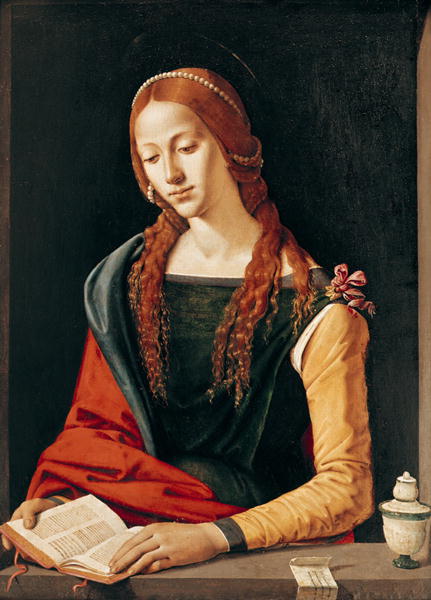
Form gold we go to yellow, which was in certain times the color assigned by law to the common prostitutes and courtesans. Red wasn't. There is another misconception that red was color of prostitutes, which is not true: yellow was. Red sometimes only. I wonder if this assumption comes from Scarlet Letter? Who knows. Mary Magdalene could be dressed in yellow, or only be a part of her garment, like for ex. the sleeves were yellow, the dress itself  is black and white, and no cloak. Etc.

Piero di Cosimo, Mary Magdalene, public domain, via Wikimedia Commons


Penitent Magdalene by Artemisia Gentileschi,via wikimedia commons


Colorful, rich robes were shown too, or in very subdued colors, when she was depicted as a meditating penitent. Or dressed in shiny silvery silk, XIX c. And I am glad she was not depicted in red only, and not in vermilion only. She captured the imagination of the people of Latin Christianity as a very colorful personality anyway, as someone who lived a whole spectrum of human emotion and full spectrum of ethics. Why she should be than depicted in one color only? It would be very limiting. She was considered the accessible saint, giver of hope to fallen humanity, and as a personality more a symphony than a simple melody. She was one of the Latin Christianity highly elevated persons who was somehow considered unclean at the beginning.

Mary Magdalene by Jan van Scorel, via wikimedia commons
To the masses of believers she was the embodiment of a phenomenon of transformation. From a women from whom seven demons were expelled, a prostitute by profession, who than became no less than "Apostle to the apostles," the title given her by the Catholics church, a base metal changed alchemically to gold. Transformation which Oscar Wilde one described as: "every saint had a past, every sinner has a future." Initially a bad girl, but with golden heart, also in accordance to some societal views about the harlot with a heart of gold. Europe loved such stories, Europeans were not Puritans. La Traviatta is one of those stories, for example. I don't think there is an equivalent in the US. Different cultures, different views, different archetypes.

And she was an embodiment of a loving, yet a very independent woman. Sometimes I am asked if I believe Mary Magdalene was the Grail. Depends what you understand as "grail". To me grail as an archetype can’t be confined to the ideas of biological reductionism. Grail of the legends itself is an archetype of a quest, and it is elusive, as quest is often about elusive goals. Many people are on quest, but don't know what the quest is about. And nothing wrong with it. Mary Magdalene: it is nothing wrong in being a parent, it is something very noble in parenthood. I respect that. But did she really need to be a mother, a cup bearing diving DNA in order to be more important to us?

Penitent Mary Magdalene, by Vaccaro, via wiki commons

We may find out that today we are less tolerant toward her than the people who didn’t believe that she was the mother of Jesus offspring. Those people loved her anyway, even when they believed she was a reformed fallen woman. It seems they were quite  forgiving. She was loved and venerated the way she was perceived, with all her imperfect humanity, the way she was seen. Imperfect saint? People didn’t mind. This is not about who she was historically, as stories were often confused. Mary the Egyptian for example, or dispute which body was the real Mary Magdalene, as at times there was more than one body claimed to be Mary Magdalene's. Holy relics were not such clear business, and there are also cases of spurious claims. Her story is not so much about her, but very much about us: how much were are willing to accept in a person, specially in a women, in order to consider someones contribution a worthy one.

 And how many prejudices we have. Her story is a very interesting case in social history, indeed. Interesting, unique perspective in a Guardian article by the novelist and  columnist who was herself a prostitute, Tracy Quan. She mentions her visit in Southern France to see the relics whom she considers to be her patron saint. Specially important, I think, is the quote engraved on the stone tablets along the steps leading to the cave said to be saint's meditation hermitage: "Blessed are those who have been persecuted." Quan noticed this quote as she climbed the stairs. To me Quan's article was a gentle reminder and a rebuke, to all, me including, calling to not forget those who are in need, no matter who they are, or how "lowly" they are. Over a millennium and half Latin Christianity's message regarding this saint was: stop marginalizing, be open to others. 

The founder of  the first church in Europe was Lydia. She was a business woman, dealing with luxury goods prohibitively expensive purple cloth. She was unusual for the place and times, when women were considered deficient human beings, with human rights comparable of that of children assigned to them. Why she is not talked about now, along with Mary Magdalene? Not sexy enough? Not enough of sensationalistic dramas? No way to focus on her genitals/womb, as it was done in Mary Magdalene's case, and still is today?

In general this turmoil about Mary Magdalene and women, being not given enough enough respect,  not given enough place for them in the church, as much as it is healthy and good has it own flaws: conveniently blaming the Catholics for everything evil seems to be a little bit displaced, when we take women as archetypes. In Orthodox Christianity there was no mention of her as prostitute, and there she also has churches devoted to her, and the legend saying that she traveled to Ephesus, stayed there and her grave is there. After the schism this is a competing legend, as the legend  of Mary Magdalene traveling to France is more well known, as Western Europe is more well known. To me the position of Mary Magdalene is more problematic in Protestantism. It seems to me that the Catholic sisters of Protestantism don't complain as much about women not given enough place in the church theology, except complaints that women can't be ordained. And other issues not relating to theology, which I omit know as they don't relate to the subject directly. Mary Magdalene was always a very popular saint, tin Catholicism, if not the most popular one after all.

Here is Mary Magdalene in brown robe of a penitent, those often were extremely crude, made of goat hair or crude wool (other races of those animal than today), or was she was supposed to be covered only by her long flowing hair.

Ascension of Mary Magdalene, Anonymous, via wiki commons
Mary Magdalene here taken to heaven is dressed in coarse penitent robe, or according to the legend, 
her naked body was covered by her very long hair.
Their (Catholics) equivalent of the Sacred Feminine, a term so often used now, is Virgin Mary, given the title of the co-saviour, as saving together with Jesus. Mary Magdalene is the  apostle to the apostles. And other women saints. They say those personages are just humans among the Protestants, who reject cult of Virgin Mary, etc. not divine enough. Should we reject their opinions as illogical? Given the number of the churches devoted to Virgin Mary and and Mary Magdalene in Catholic countries in general? Look at the picture above, is this disrespectful? The word "vilified" is often used in relation to Mary Magdalene. Is she as vilified as it is complained in popular opinion? I think we need to to look deeper, it is easy to repeat catchy phrases, which can be emotionally satisfying, but on the long run those phrases make things shallow. And the subject of Mary Magdalene is not shallow, not matter which tradition we analyse or which one we like.

Art history gives another picture. On the last example above she is rather glorified than vilified.And it was one of many kind of depictions of Mary Magdalene.


Tuesday, April 3, 2012

Red: Mary Magdalene's Case:Medieval Art, History of Color # 7

Mary Magdalene wasn't depicted only in red though history, as Virgin Mary wasn't depicted in blue only. But let take a look at the red, as both Marys were depicted in red garments. For example the red of the robes of Mary Magdalene had a different, double symbolism, than for example red of other persons' cloaks. Mary Magdalene's robes were painted in cinnabar red, (vermillion), having more hint of orange. Red in general can tend toward more to direction of yellow, or blue, and during the Middle Ages the quality of red was important, which red was symbolizing which idea. The other red symbolized regal values and charity.

 Here comes Crucifixion by Juan Rexach from Northon Simon Museum, Los Angeles. Due to poor lighting conditions the color of Mary Magdalene robes not very accurate on this photograph, in person is like on the photo bellow.

 Crucifixtion by Jaun Rexach, Norton Simon Museum Los Angeles


Here you can see desctiption and a better quality photo 
You can zoom into, and see very well the specific color of Mary Magdalene's garment.

Crucifixion by Masaccio, Museo di Capodimonte, Naples,public domain,  via Wikimedia Commons
 
 I am glad that Maria Rzepinska wisely comments is her book about color that red in Middle Ages was not just red, but it had two aspects. Red was one color in which case people paid attention to its shade, shades had codified meaning. Two types of red were differentiated: the noble one, considered sublimed, and the earthly one, viewed as "sinful". Several examples of this red can be seen close to my living place in California: Norton Simon Museum and  the Huntington Library art collection.But today Massacio, as more widely known.

In general, red stood for love in sense of charity, blood of martyrs, sacrifice on the cross, redemption through crucifixion. But as it could be a color of love in spiritual sense, redemption, also when in specific tone, could symbolize sin, or lust, or both: redemption form sin.This dichotomy is visible in portrayals of Virgin Mary as the sinless one who is represented in another red than Mary  Magdalene  ( dressed in "sinful" red). A medieval painted wouldn't confuse those two reds.


We need to remember that color in medieval art isn't always symbolic: sometimes just the need of decorative usage of color was important. In Latin Christianity (Byzantium was another case) the robes of such a person as Virgin Mary wouldn't have been painted in the same as red of Mary Magdalene's.

Above the crucifixion scene by Masaccio, Mary Magdalene in dramatic gesture of devotion and anguish dressed in red so typical for her. Although there are quite a number of representations of Mary Magdalene in this type of red, specially at crucifixion, this one is probably the most famous one. It is still very medieval. But there are hints of coming of the new era: the Renaissance in Italian art,there are more of human emotions shown. Gothic was very emotional in other countries, (for example showing suffering of Jesus),  but art in Italy was more reserved, making more usage of  Byzantine ideals.

 All  older medieval representations of crucifixion in Latin Christianity would show Jesus fully dressed, each foot nailed separately, and no signs of his suffering. With the passing of time Jesus became more humanized, specially in the art of Northern and Central Europe. The body was more and more exposed, agony and blood shown, feet nailed together. For example in German art Jesus was shown with great attention to expression. From Jesus as a symbol there was a shift  toward showing Jesus as a human being.

What about Masaccio himself? His name was Tommaso di Ser Giovanni di Simone. He died when he was only 27 years old, and he wasn't as famous as the other painters of his times. Even his name was a humorous take on his given name. Masaccio, as he is known even today, is a form from Tom, meaning "clumsy" Tom, as separated form his collaborator Masolino,  the "delicate " Tom.

Yet Masaccio influenced the other Italian artists. It was his example which caused a shift in art:  more and more toward realistic representations of the world around. Here we see a paintings which is still medieval: composition, golden background.  But carved into the golden background humans who were much more real, not idealized, captured in a moment of strong emotion. Figures are real, not ideal.

Other colors of Mary Magdalne's robes in another post, more colors.
And my post about Mary Magdalene depicted in blue click here

Byzantine Christianity depicted her also in red,  with an egg in her hand. In this tradition she was an extremely virtuous woman in similar age of Jesus's mother, and both women died in Ephesus. Mary Magdalene's body was was kept in Constantinople as a very venerated relic. This dissapeared still during the Middle Ages, but also later her relics started to be venerated in Western Europe, Latin Christianity. Relics were hot commodity then, and many stolen from the Churches in Constantinople in 1204 when crusaders sacked and looted this cultured city. Virgin Mary's house is believed still to be there, what was one part of the Byzantine Empire, among ancient ruins of Ephesus, today in Turkey, in a rather remote location but among the most wonderful ruins.