Showing posts with label history of color. Show all posts

Monday, July 8, 2013

Iconography of Anounciation of Merode Altarpiece by Robert Campin

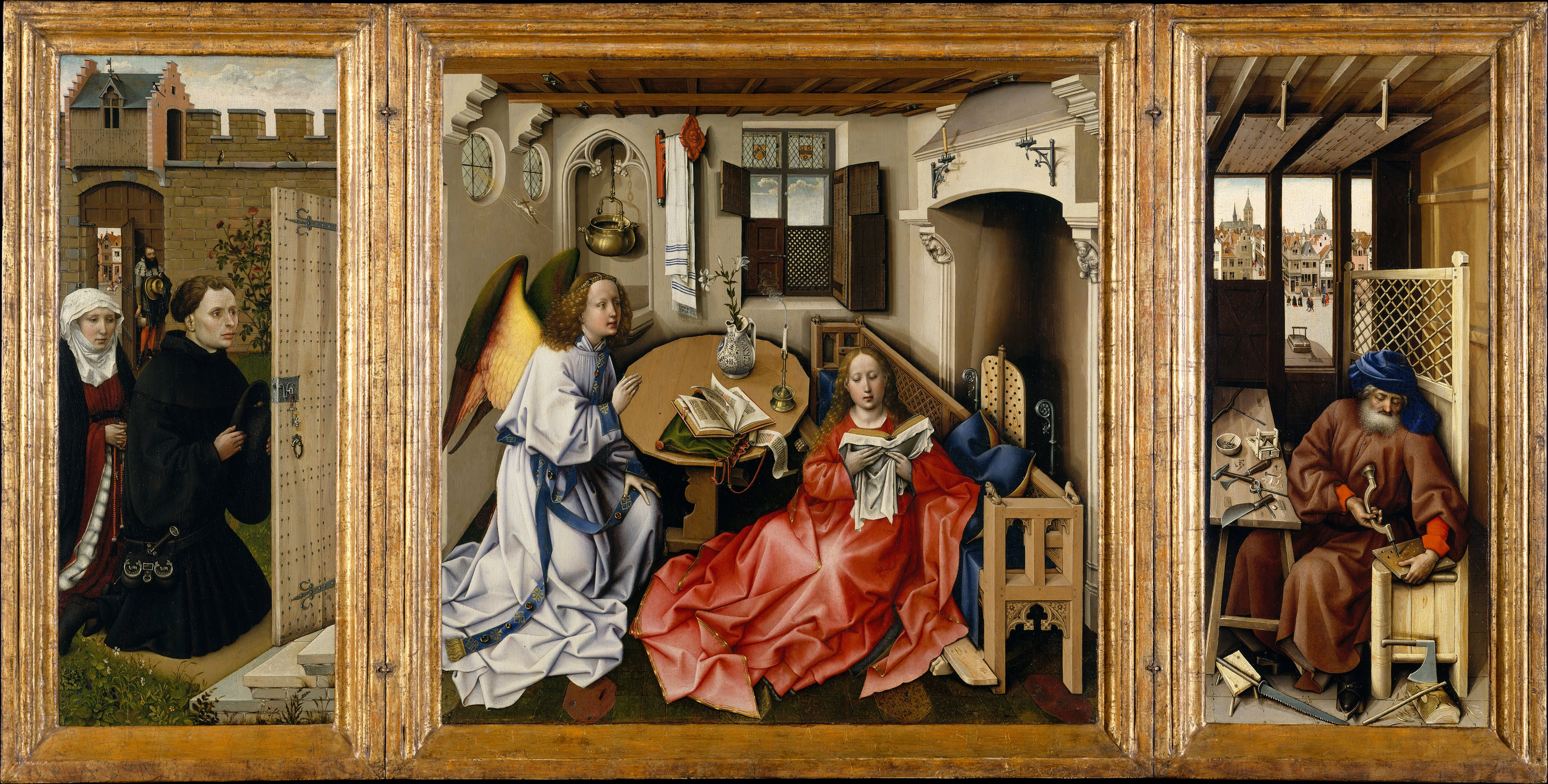
Robert Campin and apprentice, Annunciation triptych, Merode Altarpiece,  1427-1430 Cloisters, New York

This version of Annunciation is rich in symbolism which was easily understood by average person of the days this altarpiece was commissioned. Today anyone interested can see it at the Cloisters, branch of Metropolitan Museum of Art in New York, but in today's world an average person doesn't understand its symbolism. Usually someone notices what is going on and who is there, as we are trained to understand different type of symbols. This painting belongs to Northern Renaissance but has still many elements of Late Gothic. Click on the picture to see it bigger.

Who is there?  From right to left: Joseph, engaged in wood working in his workshop, secluded an din a different landscape as we see through the window. Virgin Mary, absorbed in reading a book and she is not noticing the Archangel Gabriel yet. Archangel just arrived, he looks as he is about to kneel.  Above him in the air  on the rays of light there is a tiny baby Jesus with the cross. Merode couple kneeling outside, open or semi-open door at front of them.Maybe they are watching the scene. And close to the wall in the background we see a messenger. As for those who dismiss Virgin Mary as Virgin Mary on artistic depictions anytime she is dressed in red: this is Virgin Mary indeed, and she was often depicted in this color, specially in Northern school to which the painting belongs, and no, she is not pregnant. The bump under heavy draped robe is just  her knee.

Joseph made two mouse traps. This relates to the sermon by St Augustine who described incarnation of Jesus as a bite for Satan, in some way as mice are trapped in mouse traps. There are two traps, if they represent Jesus and Mary as two participants in the process of incarnation, etc. I prefer to say I don't know instead of giving you my guesses. This can mean many things, and there is debate among scholars, so, as I am not someone specializing in this part of art history, I leave it at this point how it is, no point of adding my opinions to it.

The central panel has symbols of Mary's purity: white as color symbolizing purity, white vase and white lily (chastity), also the wash basin and towel: Mary was called a pure vessel.  Archangel Gabriel also dressed like a deacon, in white, underlines the idea of purity. I like the respect shown for books, they were considered precious objects and this painting shows it.

On the table the scroll represents  Testament, the book is the New Testament. Book represents law, here is the fulfillment of what was written in the book. Green of the cache for the book  is the color of hope, Paradise and resurrection. It is not symbolizing fertility in this case, as it is religious painting, not secular one, and green is tied to Paradise and resurrection. The incarnation of the divine here is not regular event relating to natural earthly fertility.

The candle which is extinguished symbolizes divine light extinguished in order to become human, in order to incarnate in human body. The divine light in eternal aspect is shown on the wings of Archangel: gold or yellow in its place was also symbolizing divine light. The window which now shows the sky and family crests was painted in gold earlier, before over-painting with what we see today. Seven rays on which baby Jesus is traveling stands for divine light, seven rays: seven is the sacred number. Bu the dark color on the wings stands for depth of divine mysteries, for which black stood. The tiny carved lions on the bench are symbols of the seat of Salomon.

 Red robe of the Virgin symbolizes her love: ( agape the unconditional love), charity, redemption by the sacrifice on the cross, but also is a fashionable robe of the days in a very expensive color. Campin showed a domestic setting, and fashion of the days, which was typical. Old paintings are also valuable resources for costume historians and costume designers, as there is so much historical information, specially in the case of the painters with great attention to details and skills in rendering them. What we see also is an interior of a typical home in a city. Usually Annunciation was shown in a church or palace, here we have an interior of a real home. Campin was a painter for the city people, not a painter for aristocrats or churches. This small altarpiece was not intended to be installed in a church, but was an object of private domestic devotion.

The courtyard where the three people who are real life persons of Campin's days are present (donor with his wife and the messenger) is alluding to garden, but is not the same as in depiction of Virgin Mary in gardens: here it is is more cloistered, not much vegetation. Those gardens were cloistered gardens, in which the Virgin was depicted but had more vegetation, here it is more sparse. Still it is enclosed garden, hortus conclusus, which symbolizes Mary's virginity. Here the vegetation relates less to Paradise, which was typical in those hortus conclusus types of paintings, but the flowers represent the virtues of the Virgin: rose stand for her charity, violet for her humility.

The scenes are like almost everyday situations, except angel showing up. In Gothic slowly the divide between sacred and real human life started to narrow. Here we see religious scene happening like in real life, the saintly people don't even have halos, it was unusual. Painting saints without halos happened one century later, in Renaissance Italy.

Perspective in this painting is partially correct. It is not a typical linear perspective, where mathematics rules.Here those rules are bend and we have some twisted angles, like for example the table is painted correctly to the rules, this is not realistic, but allowed the painter to show more details. Sometimes artists do such things in order to make greater visual impact. For example Pieta by Michelangelo, where Mary is so much bigger than Jesus, yet for viewers it looks very natural.

 Bellow we have another painting of Virgin, this time with baby, in an interior by Campin, for comparison. I think now you will be able to read with ease the symbols contained in this domestic scene.


Saturday, September 8, 2012

Green: Paradise and the color symbolism, history of color # 12

Green in Medieval times had rather varied symbolic meaning, depending if was used in the religious or secular context. In religious art it was a symbol of eternal happy existence, Paradise, and soul's hope for eternal bliss. Green robes symbolized eternal happiness through salvation, and often martyrs were dressed in red and green.

 As it was a happy color, specially the emerald was praised as the most beautiful jewel, in which all marvel of nature was incarnated and made imperishable. It was considered also an earthly representation of Paradise, and written about by monks. No wonder: emerald has strong color and is translucent, has light, and light and strong hues very important for the medieval aesthetics.

The painting on the left is by Hieronymus Bosch, who is often labeled as being  Northern Renaissance painter, but there is still so much of medieval elements in his paintings, also in this one. Bosch: a very mysterious painter, and lots was written about his speculated following of heresies. But this painting is quite conventional for Bosch's standards. It is the  left wing of the Last Judgement triptych, in the collection Gemaldesammlung der Akademie der Bildenden Kunste, in Vienna. It shows the fall of angels, and the story of creation of Adam and Eve, temptation and expulsion form Paradise. (Please click on the picture to view it bigger). It is about bliss, heavenly and earthly, and primordial sense of innocence, and about loss all of this. Also we see Jesus in Paradise. Why? Jesus was in medieval mystical writings and systems considered the Second Adam, the one who brings the Paradise back to the fallen human race.

But the hope of salvation was the expectation of something bigger, something which  could not be lost anymore, not a conditional existence in a Paradise in the story depicted in the Bosch's painting. It was about something above also the secular symbolism of green, which was found very limiting and temporary. In the secular world green was standing for Spring, new love, fertility. It was real hope for something beyond all  limitations, it was about the  life eternal, and the color of life was green, archetype of course,  but it got a new dimension: a heavenly one.

 And as such was totally elevated, wasn't anymore about life like in the Nature, where seasons  pass, or impermanent state of natural fertility which was bound with rebirth, suffering, aging and death. This life was about absolute perfection which never faded.

 And the hope, longing  for such existence was made one of the most important Christian virtues, (along with faith and unconditional love), and of course the color of it was green, because already showed symbolically what the all hope was about.

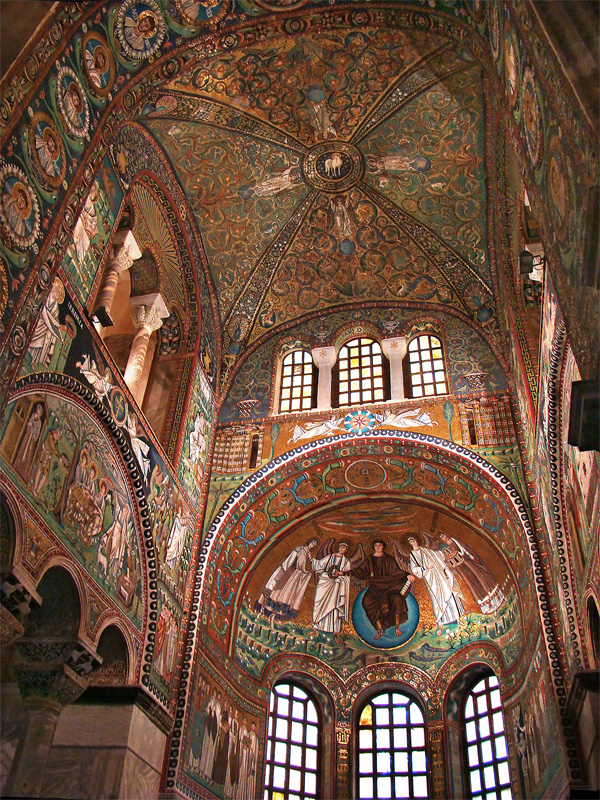
Mosaic of the apse int eh church of St Apolinare in Classe, Ravenna, Italy. Thank you Berthold Werner for releasing this picture into public domain.
 This happy symbolism of green came from the earlier Christian art- early frescoes and mosaics. In this post I follow the line form the youngest to the oldest art. Now a mosaic which is c. 900 years older than Bosch's painting. The picture above shows VI c. mosaic with St Apolinare in Paradise, adoring the cross, sheep around him, a very typical composition. Above, on the wall, Christ is giving his blessing, and we have the repetition of Paradise and the sheep. Click on the picture to see it bigger.

An earlier mosaic, this time from V c, is on the entrance wall of the mausoleum of Galla Palcidia, Also in Ravenna , Italy.

Jesus as the Good Shepherd, mosaic, V c. Galla Placidia Mausoleum, Ravenna, Italy
This type of mosaic is part of the iconographic tradition of  mosaics seen in the one with St Apolinar. The iconography is overlapping. But here we have Christs who is depicted as beardless youth was the typical figure in early Christian art. He is not the Pantacrator Jesus giving blessing, he is tender and pensive, and all sheep are looking is his direction.This was a common way of depicting Jesus: among his sheep, in Paradise, not hanging on the cross. He was shown as such even in earlier art, in a fresco, still in the catacombs, also as a good shepherd. One stream of the symbolism of the color green has a long lineage dating from early Christian art.


Saturday, September 1, 2012

Dark Ages? Not everywhere: Byzantine love for classics

In popular opinions Dark Ages were taking over Europe until the Renaissance came with revival of classic traditions. This is only partially true. Byzantine Empire continued the tradition of Greece and Rome, combined with Eastern influences. Medieval renaissances of Europe, to be exact Western and Central Europe were brought by closer contact with Byzantine Empire.

 Byzantium was the name of the city, which was renamed by the emperor Constantine Nova Roma, meaning the New Rome, as it became new capital, but it was also renamed  Constantinople . It became Europe's biggest city, it had half million inhabitants.The people who inhabited this empire called themselves Romans, the empire was called Romania. Greek was spoken, as the local language and the language of educated elites, nothing unusual, even in Rome educated people spoke Greek, as Romans were totally admiring Greek culture and copied a lot from it. The library of Constantinople was very prominent, Byzantine equivalent of the great library of Alexandria. Ancient writings were not only preserved here, but also studied and copied, to keep the knowledge from disappearing. There were also periods of additional stronger interests in classics, such as Macedonian Renaissance of the X c. from which time the page of the manuscript called the Psalter of David is dated. King David is depicted as a Byzantine emperor, but the other two figures are very classical. No wonder: as Rome had  monuments of the classical past, so did this area of Byzantine Empire.

Penitence of David, Paris Psalter,  X c.Biblioteque Nationale, Paris

We see David twice: sitting on his throne, and also bowing feeling remorse for all the bad deeds  he has done. Classical figures are here- the admonishing prophet, and the female figure which is the personification of penitence. She is dressed in green and red, the colors later seen often in robes of Mary Magdalene. Why we know that this is penitence? One thing is that personifications were common in the art of Antiquity, another prof is her name written above. It was common in Byzantine art to include captions about the figures to indicate who was who. (People in Byzantine Empire were quite literate, the culture was vibrant). Also above the prostrating David we have the caption which spells his name, that the viewers shouldn't be confused. The writing connected to the female figure there is the word "Metanoia," which term meant repentance in Greek. Meant changing one's mind, turning point. The flagellants of Latin Christianity gave it bad connotations. Penitence was about making amendments, changing mind, changing lifestyle.

But Byzantine Empire was of course more sophisticated than Latin West, were tribal warfare and other struggles went on through some longer periods of time, but still medieval times were not as dark as it is held in popular imagination. The movies may show this time as era of ignorance, superstition, dirt, illness and decline, as this imagery adds drama, but the times were more lively and enlightened. Rather during the Renaissance, or general during the XV-XVII c.Europe had even more dark turmoils: more of  illness, witch hunts, inquisition, wars,  fears of devil,belief that magic equals science, etc. Even medieval universities were not all about faith, as is often assumed: popular belief is that science believed the Earth was flat, or in medicine there was no dissection of corpses, the medical knowledge of Antiquity wasn't practiced, etc. Not true, we know thanks to explosion of knowledge about the Middle Ages during he XX c. So, why the term Dark Ages?

First putting down on the predecessors occurred during the Renaissance, in order to point out the new achievements. Gothic art was called Gothic in a derogative way, as Goths were considered barbarians. The Renaissance mind was so enamored in the nostalgia for antiquity, that they couldn't really appreciate the art and achievements of earlier generations. This lack of appreciation went thorough centuries, and the era of Enlightenment in order to contrast is own achievements needed the idea contrasting light and darkness, needed the term Dark Ages. In addition the term Age of Faith was used, in order to brand the times as irrational and dark. The Enlightenment prided itself not only for its light, but also for reason as opposite to faith. There were even attempts to create temples of reason in churches.

Byzantine manuscript, X c. Paris Psalter, King David Playing Harp, very much in the tradition of classical frescoes

During the XIX c. the scholars were talking still about Dark Ages as the time from which were not too many written records left, but there was also medieval fashion . (Pre-Rafaelites, Romanticism, Gothic Revival, etc). This intense interest in all things medieval was combined with the Romanticism's love for mystery, the  fantastic, emotional and the irrational. Hard reason of previous era wasn't the fashionable idea. During the XX c. however, the term Dark Ages started to be criticized, in light of the new scholarship, and the term was used in a more neutral way, and even the neutrality of the term was disputed. It was argued that the scholars may know that the usage isn't negative, but the general public will not interpret it such way. And the criticism was right on target.

And myself I used the term provocatively in the title of this post. Still, I think in popular culture Byzantine Empire doesn't get enough credit, and this was an empire of great sophistication and influence, and lasted of a millennium. Holy Roman Empire lasted almost a millennium, but there were empires which existed for much shorter time: The British Empire, Austrian Empire, Empire of Austria and Hungary, Bulgarian Empire, and others. So, maybe it is time to refresh the memory of this part of common history? But still, I think the movie industry, mainstream literature, computer games, TV, advertisements, press,some popular chanels historical documentary movies, and others are still in the dark about not-so Dark-Ages.

Quite often there is a misconception of great Rome which fall:yes, Rome was sacked, but before became very empoverished because of Byzantium. The idea of "fall of Roman Empire" first was again talked about during he Renaissance, by popes. It was an idea supporting propaganda: Pagan empire which "fall," quite clever idea, remember, there was the schism between Byzantium and Latin Christianity. It is not very historically accurate common misconception, but quite often still, in XXI c. has place in the classroom.


Thursday, August 30, 2012

Byzantine tradition: icons, garments and liturgy

Once strolling through the old streets close to Krakow's Old Town Market Square I heard amazing singing, Orthodox choir. I stood on the street and listen, assuming someone had a nice CD playing, the sound coming from one of the open windows. But listening more carefully I heard that the sound came  the courtyard. Knowing from experience that those centuries-old houses quite often have beautiful an intriguing yards surrounded by walls, I went, slowly. Somehow the music pulled me. Than I saw the sign, "Orthodox Church," and an arrow. I followed, after climbing some steps in one of the old buildings I entered a church which was housed among apartments, not a regular Orthodox church building I normally knew and view from afar, but never visited during liturgy. There I saw the choir: three women with white kerchiefs covering their heads, and with them was one man, all very focused and singing beautifully. The congregation was very small, but there were icons on the walls, with  lamps hanging before them, and the liturgy was celebrated. In my country Orthodox Christians have a reputation of being excellent singers, and here was the proof, there were just so good that I was thinking it was a CD!  After the liturgy people were kissing the icons. All was very touching, I was moved by the music, liturgy, and by the solemn atmosphere. Something like in the videos below, specially the second one, the link.

The icon here is Christ Pantecrator, XXI c. by anonymous maker for tourist industry in Bulgaria, but I love it anyway!

Religions don't bother me, (unless there is some kind of abuse going on), but in general I find a lot of beauty in this kind of human involvement. The word religion comes form the words re-ligare, which means reconnect. I like this interpretation of the word's origins.

I will be writing more about Byzantine traditions, as they are important. They are part of Europe's cultural heritage, and without Byzantium there wouldn't be Italian Renaissance as we know it, nor it would there be European heritage as we know it. There the traditions of  Greece and Rome lived while in Western Europe it was a strong break. Not that ancient  philosophies were not read in the West during the Middle Ages, after all Latin Europe had medieval renaissances, but those parts of Europe were culturally developing in their own direction, and were much poorer.

Byzantine art was a mixture of classical Greek and Roman  traditions influenced by Eastern mysticism and love for imagination. Icons represented Jesus, or Mary, saints and angels, but also in its highly stylized canon there was representation of aesthetics and fashions of the imperial court. So, Jesus and Mary are dressed in robes of imperial purple, or the saints and angels depicted as dressed like important people of the imperial court. Icons didn't change much. Of course there are various schools of icon painting, and there also some influences among those schools which are more Westernized, but in general the icons are preserving the past very well, now and here. The tradition is followed rather strictly, and we can see how people were dressed long time ago, still can today see the stripes of fabric called loros still part of the garments, or see the color which are in the range of hue variations of real purple of Tyre. We can see how some courtiers looked like at the court of Constantinople, which was than the city of amazing luxury.

What fascinates me that when you look at the traditional icons or frescoes in Byzantine style and you see the liturgical garments used today, you recognize that some garment are very similar to what we see on the icons.Byzantine fashion of a millennium ago. I hope you will enjoy the beauty of the chants, and the visual part, and see similarities of the garments worn by the clergy mirroring the garments of the saints on the frescoes. It is like being among the people of Constantinople of old.

And take a loo at the fresco at 8:45, the creature with one face and six red wings with some writing (reads Cherubim) is an archaic depiction of a cherubim, one of the highest angels in angelic hierarchy. Stained glass window at 12: 25 shows also a cherubim or a seraph, those were often interchangeable. This is a sequence of very interesting and beautiful  pictures, not a liturgy video. Enjoy!


And just  in case you want more, here is another video! http://www.youtube.com/watch?v=UsL61X5fOLU The piece sung here is Agni Parthene, a non-liturgical hymnopoem to Virgin Mary. Have blessed time!


Monday, August 20, 2012

Yellow: Triumph and Fall, history of color #11

Yellow is unusual in art history regarding the attitudes people had toward this hue: it was held in high esteem until did fall low.

First during medieval times yellow was replacing gold when it was too expensive for the project, like for example usage for the background in frescoes, large surfaces. Sometimes of course, gold was used on frescoes also, it depended on how much a community could spend. Yellow was a much cheaper alternative and still represented divine light. In an earlier post I wrote about symbolism of gold as representing divine light, as the color symbolism is theological). But yellow wasn't used symbolically only, also when needed to give some beautfil robe to a saint, for composition purposes, the color was used freely.

Chromatically yellow is also the lightest color from all chromatic ones. (White is non chromatic). Also it was used in illuminated manuscripts, as we see in this masterwork of medieval art: the book of Kells, from Iona, dating from the times when Irish monks spread their culture and knowledge in Europe. Columba was visiting Reichenau, as I told you before. This folio showing Christ enthroned makes use of yellow, which is fine of a color to even line the cross and painted as color of Jesus' hair. The birds are peacocks, about symbolism of this bird in this this article. The circles at the feet, surprise, surprise! Those are angels, called Thrones, often depicted as wheels, sometimes as wheels with eyes and wing, specially in medieval Byzantine art. Wanted to mention it, as they are not uncommon, and people wonder about what is it. But also can mean the heads of the nails of the cross. The book Christ is holding represents the divine law.


Christus Enthroned, Book of Kells, Ireland, library of Trinity College, Dublin, via wiki commons


 The figures are angels, one angel is a seraf as the posture of his wings indicates (lower corner on the right, will write more about angels another time). This part of a wonderful lecture later describes the peacocks too: as incorruptibility of Christ's flesh, with chalices and hosts.

Closer to Renaissance the elevation of yellow to color of light started to diminish, when art started to be more realistic, the golden backgrounds fell out of fashion. Now yellow started to be viewed as color of falshood and treason. It was used to brand those who were considered socially less acceptable: prostitutes, Jews, heretics. Jews were ordered by law to wear yellow badge. About yellow as color of prostitution I wrote already when I wrote about Mary Magdalene.

And as we see in this fresco by Giotto, yellow was assigned to bad people.Jesus has a loving peaceful face, he is dressed in red and blue, Judas in all-yellow garment.
Giotto, Kiss of Judas, Scrovegni Chapel, Padua, Italy, via wiki commons

Cathars after Albigensian Crusade were forced to wear yellow cross, as badge of shame. Of course they couldn't be Cathars by choice, they needed to provide prof of marriage and repent, than their live were saved. Repentant heretic was important, as too many heroic personalities burned on stake wasn't good advertisement for ideological side of religion. Some of  information about Cathar religion we know from writing of a Cathar convert to Catholicism. Those crosses called las debanadoras were to be worn always outside the house. It depended on the depth of involvement in Catharism judged by the Inquisition in a trial of , if a person needed to wear one cross or two (front and back). Those crosses were usually six inches wide and had height of eight inches. Unless one was of aristocratic birth, the badge of shame was to be worn for the rest of someones life. Many simply didn't comply, or were unrepentant. It was not a simple badge of shame:Cathars didn't like the cross as a symbol, this refusal of the symbol was written in their religious philosophy. It was much more cruel punishement than a known more widely and younger scarlet letter for adultery. Following link will bring you the wikipedia articles about Cathars and yellow cross http://en.wikipedia.org/wiki/Cathar_yellow_cross 

As for heresies: they were not considered a religious offenders only, but in Western Europe heresies were viewed also as treason against the state, and considered anarchy. This was also one of the  reasons why it was relatively easy to prosecute those who didn't conform. Rulers were offended by heresies, specially because almost every heresy also criticized materialism of the status quo, preached poverty or renunciation of material world, Catharism did it to.


Wednesday, August 15, 2012

Purple, the Imperial Color, History of Color #10

Byzantine Emperor Justinian, mosaic in St Vitale church, Ravenna, Italy

I wrote about red and blue as colors of power in my recent entry. But the ultimate color of power was purple, before red and blue rose to higher prominence. It was before the sack of Constantinople during the Fourth Crusade in 1204, which I mentioned in the entry about the holy blood relic in Reichenau and Bruges. Constantinople never recovered enough to produce purple dyed clothes again. This fact might give you some insight how expensive purple dye was.

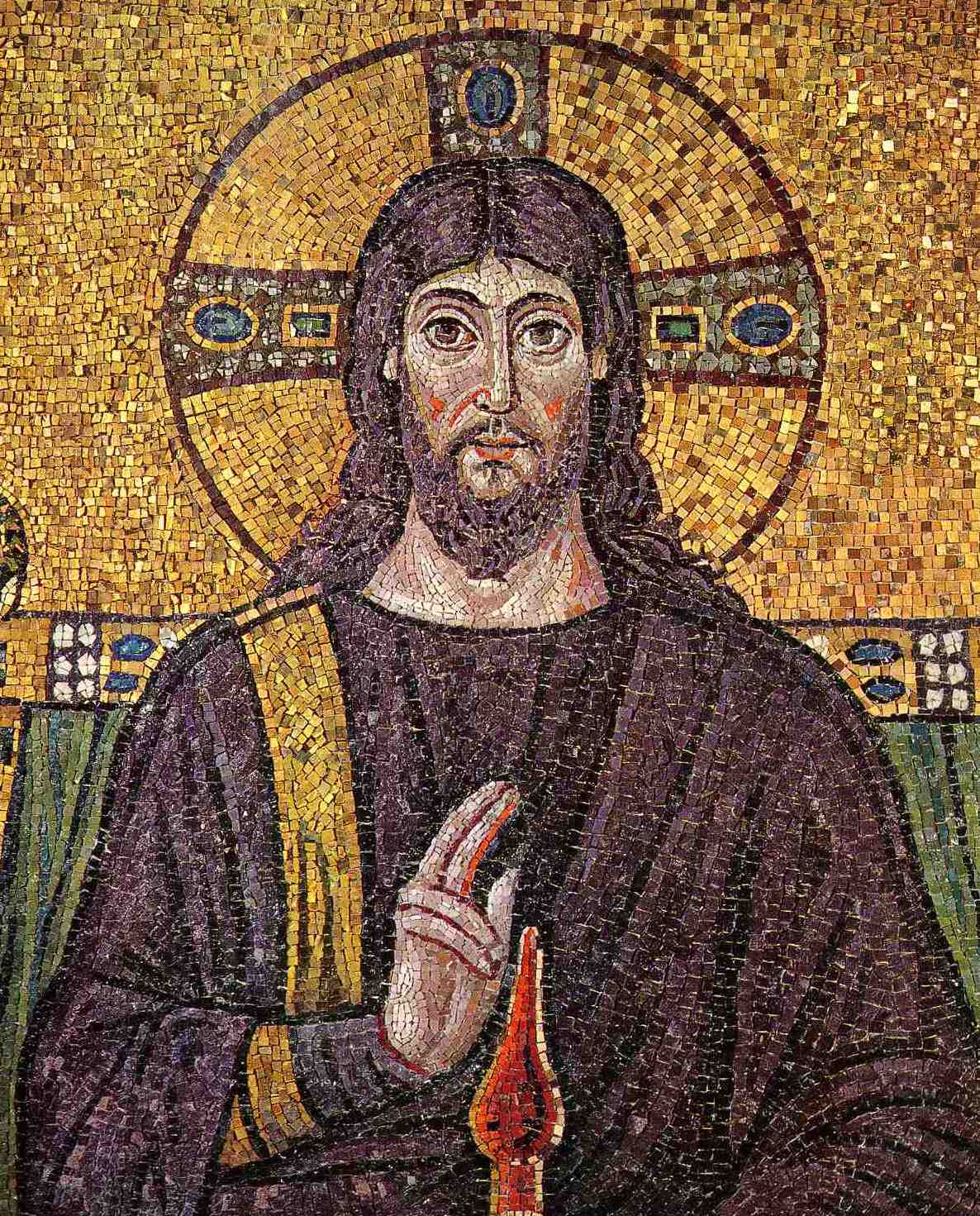
 The purple dye was so expensive that it was a subject of sumptuary laws, and mostly restricted for the imperial or royal families. It was produced from Murex sea snail, and tens of thousands were needed to dye one piece of garment. Color purple took the name from the dye, wasn't the description of color itself. The price of dye was equal of weight in gold.  The main center of the craft of dyeing in purple was Tyre, in Phoenicia. The name Purple of Tyre comes from it. This purple wasn't the hue we perceive today as such: it was more reddish brownish, a very muted but intense color. The emperors robe on the mosaic above looks more blueish than in person. The robe of Jesus looks more brownish, but it is difficult to take very accurate pictures of mosaics in the interior, where every detail will be of exact color. And the purple of Tyre doesn't get reproduced very well on the computer screens either. But you get the idea.
Mosaics at San Vitale church, Ravenna, Italy, via wiki commons, thanks to Tango


Not only rulers were depicted in purple, but also Jesus and Virgin Mary. Byzantine art showed them as rulers, full of dignity and somehow stern looking, as does the Christ dressed in purple on Byzantine mosaic from the church St Apolinare Nouvo, Ravenna, Italy (via wiki commons) The style is Early Byzantine.


And here is shroud of Charlemagne, early IXc. manufactured in Constantinople, today in Paris, Musée National du Moyen Âge. (via wiki commons). Purple on silk created wonderful effects that enchanted the eye: depending on light looked more blueish or reddish, had luster fro which was prized too. Not many fabric are left from Byzantine times, mostly fragments, and like this one found in the graves of the rulers of the time.

Shroud of emperor Charlemagne, purple dyed silk
 The purple was known already in Antiquity, and was mythologically credited to be discovered by the dog of Hercules. Plato mentioned this color in his Symposium as the greatest hue of all. It was used in Egypt, and became the color of Roman emperors. Sometimes the law was not harsh and women were allowed to wear purple, but other times anyone else than emperor wearing a purple robe would be killed. The first church in Europe was founded because of religious devotion and courtesy of a woman, Lydia, who was a business woman, a merchant in purple dyed fabrics. She must have only rich clients.

One of the Roman emperors forbid his wife to buy additional purples robes, as he considered too expensive.

Today, to all my knowledge there is only one pigment manufacturer mill, Kremmer Pigmente from Germany, which sells  this kind of  purple for art conservation purposes. One ounce would be 153,120 $, of course on the website for the art conservators this dye is sold in fractions of  1gram (1 once has 30 grams, to remind you), so , it is sold sold here in fractions of grams
According to Kremmer Pigmente, it takes 10,000 snails to make 1 gram of purple, which would be 300, 000 to make one ounce.

Later instead of purple silks were dyed with kermes, which was red dye made of the bodies of dried insects. I am for sure glad we use different process in fabric dyeing today, not involving killing masses of mollusc, or insects. (But still,  today fashion industry is terribly unfriendly toward the environment, one of the main polluters). Lucky for me, a fine artist, I can pick and chose which pigments I want. Honestly, I couldn't bear to buy paints or dyes containing colors made out of living creatures. I don't wear silk either for this reason.

This red coronation mantle of Roger II, silk and gold thread, pearls and precious jewels was done in royal workshops  from Palermo, Sicily. Now in Vienna treasury.We see the new fashion coming, replacing purple with red, which resulted in pictures of royals, nobles and Virgin Mary dressed in red mantles.

Roger's II coronation mantle, via wiki commons, by Gryfindor

Sunday, August 12, 2012

Colors of Power: red and blue- History of Color in Middle Ages # 9


Red and blue, most prominent color duo of the Middle Ages. People just loved them so much, that even when writing about rainbow  they wrote often only blue and red! Also the existence of separated guilds of dyesrs dedicated for each color may be a testimony for high esteem and priceses of those particular colors.

 We see here in the video the colorful splendor of the Middle Ages, about illuminated manuscripts about British royals. Lots of color, but most prominently the duo of red and blue. Fresh colors, most of the time.Video window may not come up in an instant.
Interesting movie by BBC about royal illuminated manuscripts.

Here Charlemagne is  being crowned.

Emperor's Charlemagne Coronation, Illuminated mansucript, via wiki commons

Red and blue were colors of power in the secular world, why?  Red and blue dyes were expensive, not common, and people loved those hues, of course. Red was used after the purple of Tyre, very expensive and reserved only for the rulers, became less and less available. Red in a more dark, dignified edition was replacing purple,which had a brownish tinge, not what we commonly classify as purple today, until appeared in its pure form, lighter and brighter. As we see bellow, on the Annunciation picture.The same with blue, it was considered a very noble color, and as the blue dye became to symbolize affluence and also royals were using it. (Royal blue).


Announciation by Petrus Christus, via wiki commons


Here on this Anounciation by Petrus Christus we see Virgin Mary dresses in a red mantle. We see the typical elements of Announciation, as the lilies signifying Mary's purity, the vase a pure vesel, open book also is traditional. Always opened on the same page on all paintings, Isaiah 7:14, or psalter pages in earlier book. Other written words is the passage from Announciation of the New Testament, the words spoken by the archangel ("Ave Maria,  gracia, plena"etc) was directly written in the picture. Mary is here depicted as a fine lady, dresses in a rich garment, expensive mantle.  Click here to read more about Announciation symbolism.
This painting is considered early Northern Renaissance, but still has elements of Gothic art. For example the folds of the robes of the angels are still very hard and geometric, the angel's posture is typical for Medieval art, also his wings, strong color, not white. But we see already linear perspective on the tiles of the floor, increased realism of depiction in painting, eye for detail.


Court scene from November,  Book of Hours of the Duke de Berry, Via Wiki commons


What a rich blue wears this duke! Probably he is the Duc de Berry himself, it is a miniature by Limbourg brothers, form the Tres Riches Heurs di Duc de Berry, form the magnificent manuscripts collection of the Musee Condee.
                                              
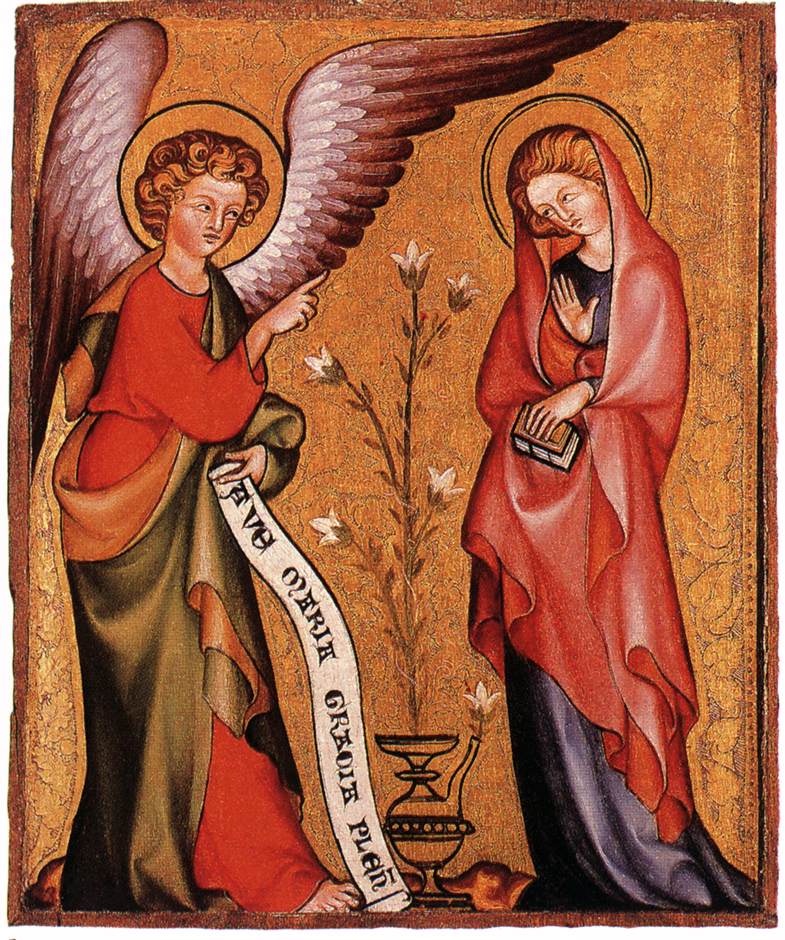
Announciation, unknown German Master, via wiki commons


The Announcaition again, this time we see all elements traditionally depicted in announciations, but this time the book is  not opened, but text is written on the banner held by the archangel.("Hail Mary, full of grace"). this banner as a speech bubble appears often.Wallraf Richttarzt Museum Cologne. Mary with a book again, it has significance, depends if closed or open, etc. Soon about Mary and book symbolism, an elaboration on this  important element of  iconography.

Altdorfer, Virgin Mary with Child, XIV.c via wiki commoms
Virgin Mary as queen, with infant Jesus in her arms, by Altdorfer, (German), museum in Budapest.Infant Jesus has a necklace symbolzsing his future Passion and death on the cross (coral ) which in secular symbolism and superstition of the days: it  was supposed to avert evil. The apple is relating to original sin, held by Jesus is a symbol of redemption, eradication of sin.
Death of the Virgin, by Konrad von Soest, Mary on her death bed attended by humans of saintly and common stature, and by angels themselves. We see richly embroidered blue mantle and blue angels, as the symbols of heavenly realm.Also prominent is red/blue color duo, gold background. Closed books also present, symbol of the Virgin. What is written on the open scroll, which is read by bearded man dressed in red, with his head covered as sign of respect and humility? The paleographers would tell. The saint whose hand holding quill  is almost touching Virgin's hand is, has "Saint John the Apostle" written on his hallo.

Death of Mary by Konrad von Soest, via wiki coomons


Monday, August 6, 2012

Mary Magdalene: Blue Color of Her Robes and Art Historians

 Here we have Lamentation by Petrus Christus from Royal Museum of Art in Brussels. Can you recognize who is who among both Marys? Both have blue robes. Mary, the mother of Jesus is depicted as fainting, her body lifted up by two people. Common depiction, Mary fainting at the lamentation scenes. Is one of the people attending her the Mary Magdalene because she has red dress? Well... no. Color symbolism was common, but not set in stone, there was nothing very dogmatic about it. Please, click on "Mary Magdalene robes"  among the labels/links at the bottom of this post, you can read posts about the other colors.

Lamentation by Petrus Christus, via Wiki commons, click on the picture to view it larger


 But where is Mary Magdalene in this painting? You can recognize her by one of her attributes: the skull. She is the one turned toward the cross and the skull. Ointment jar is another attribute, not in this painting, the cup behind her is the cup for throwing dice, as dice are one of the symbols of Christ's passion. Both Marys are in blue, which was for sure costly, ultramarine was the most expensive of pigments. Both are made clear who they are, made recognizable: one by the pose, another one by her attribute. The viewers of those days knew how both were depicted, today those things are more confusing, as people have less familiarity with iconography.

This example of using so much blue is rather unusual for Petrus Christus himself. He most often used red for Virgin Mary's robes, as was common in the Northern painting. Blue was more common in France. This is of course rough division, the geography, but this is a  more factual explanation to clarify this red and blue vision, than color coding Virgin Mary and Magdalene rigidly.


Rather dogmatic is thinking in red and blue, which sometimes happens today, as art historians and art history buffs say. This means the idiosyncratic idea that Mary the mother of Jesus was depicted only in blue robes, and Mary Magdalene was depicted only in red robes. Luckily the Old Masters where not as limited, or as color blind.But some art historians complain that it is difficult for some people to understand this fact, and even those people will rather aggressively defend their pet idea, in spite the fact that their knowledge is limited.Why is it, and why some people are so fiercely attached to this specific color combination, is a mystery for me. As one art historian said, the subject of the robes of those two venerated quickly reveals how much someone knows, or rather how much someone doesn't knows about art history.

Art historians are not as ignorant as they often gladly represented as: most important, they see a lot of art; when I took history of art on the exam we had c. 600 slides,which were part of the test in the introductory course only, later things were more complicated. Art history classes were compulsory for my degree. I had strong interest in art history quite early, started when I was 13 year sold, so I didn't struggle, but for those people in general who learn art history as elective, mostly it it not an easy A class. It depends on university and who teaches the class, but in general challenges are there, if you want an A, better work hard, as it is not hobby level art history.  

Art historians are very involved in general: they travel if needed, study artists' historical contracts by the patrons and artists, write books, keep current with current research. So, why this need to tell art historians they are so wrong, and specially by people whose knowledge belongs to the limitations of a hobby? Mystery, mystery...


Monday, April 16, 2012

Mary Magdalene:Colors, Robes and Archetype History of Color # 8

I noticed in my blog's statistics that some of you came to my blog searching for info about the colors of Mary Magdalene's robes. I must have been a disappointment to see so little about it. I hope this entry will give you more of satisfying information.


Red was very common when she was depicted, but other colors were not rare either. I feel I need to move beyond the Middle Ages, as I was writing about vermilion robe of Mary Magdalene already. I am focusing in this post on Latin Christianity. Byzantine Christianity depicted her also in red robes, often with red egg in her hand. In this tradition she also she was considered extremely virtuous, one generation older than Jesus, died in Ephesus, her relics (body) were revered in Constantinople. Disappeared of course, maybe together with other relics after sack and looting of Constantinople they, tradition say were brought to Western Europe. But we don't know for sure what happened.

Mary Magdalene, Orthodox icon
 Red was often the color of choice by the later painters as well, but I would advise not to rely on red so much. Some people do, to some degree of annoyance of the well-educated art historians, when the non-art historians try to convince them, sometimes quite harshly,  they know it better because they read a few popular books. Thing can turn rather grotesque.About annoyances and my defence of art historians  later, in another entry, now I focus on colors and Mary Magdalene as a cultural phenomenon.

Magdalene was shown in red robes, quite often in a green dress. Green symbolized eternal life, color of paradise, hope and promise of eternal happiness in heaven. Green of the  paradise was shown already in the early Christian art. Shouldn’t be confused with non-religious matters, when green symbolized rebirth, Spring, fertility, hope in matters other than theological. It is important to know about such differences, not only for knowledge sake, but also for avoiding mistakes, for example reshaping Mary Magdalene into fertility goddess, as it sometimes happens in some books authored by some non-art historians. The context of the art matters, quite a lot.

 Red was common, yes, but not an exclusive color assigned to her only, nor she was shown in red only. This is a curious misconception, recently spreading. I would like to know about the sources of it. Assuming that she was shown only in red robes, isn't in relation with factual history of art, it is  huge over-simplification. Red in religious, not secular tradition  represented  love in sense of charity, (agape), martyrdom, sacrifice on the cross, redemption through crucifixion.

 But she was also depicted in lush and colorful robes, rich and beautifully embroidered, often golden. Look at this picture, which I got through twitter. One of many examples of colorful robes, from the collection in Kassel Museum, Germany. Cloak is elegant subtle shade of red.
Mary Magdalene and Jesus as Gardner

Or click to see life of Mary Magdalen at Chartres Cathedral stained glass window. Click on links to different images, and you will see range of colors, blue included.

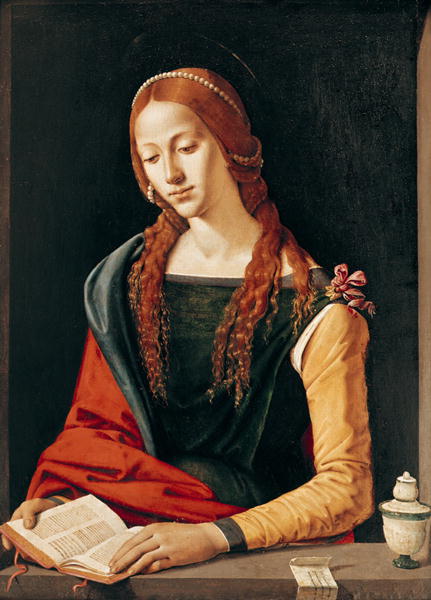
Form gold we go to yellow, which was in certain times the color assigned by law to the common prostitutes and courtesans. Red wasn't. There is another misconception that red was color of prostitutes, which is not true: yellow was. Red sometimes only. I wonder if this assumption comes from Scarlet Letter? Who knows. Mary Magdalene could be dressed in yellow, or only be a part of her garment, like for ex. the sleeves were yellow, the dress itself  is black and white, and no cloak. Etc.

Piero di Cosimo, Mary Magdalene, public domain, via Wikimedia Commons


Penitent Magdalene by Artemisia Gentileschi,via wikimedia commons


Colorful, rich robes were shown too, or in very subdued colors, when she was depicted as a meditating penitent. Or dressed in shiny silvery silk, XIX c. And I am glad she was not depicted in red only, and not in vermilion only. She captured the imagination of the people of Latin Christianity as a very colorful personality anyway, as someone who lived a whole spectrum of human emotion and full spectrum of ethics. Why she should be than depicted in one color only? It would be very limiting. She was considered the accessible saint, giver of hope to fallen humanity, and as a personality more a symphony than a simple melody. She was one of the Latin Christianity highly elevated persons who was somehow considered unclean at the beginning.

Mary Magdalene by Jan van Scorel, via wikimedia commons
To the masses of believers she was the embodiment of a phenomenon of transformation. From a women from whom seven demons were expelled, a prostitute by profession, who than became no less than "Apostle to the apostles," the title given her by the Catholics church, a base metal changed alchemically to gold. Transformation which Oscar Wilde one described as: "every saint had a past, every sinner has a future." Initially a bad girl, but with golden heart, also in accordance to some societal views about the harlot with a heart of gold. Europe loved such stories, Europeans were not Puritans. La Traviatta is one of those stories, for example. I don't think there is an equivalent in the US. Different cultures, different views, different archetypes.

And she was an embodiment of a loving, yet a very independent woman. Sometimes I am asked if I believe Mary Magdalene was the Grail. Depends what you understand as "grail". To me grail as an archetype can’t be confined to the ideas of biological reductionism. Grail of the legends itself is an archetype of a quest, and it is elusive, as quest is often about elusive goals. Many people are on quest, but don't know what the quest is about. And nothing wrong with it. Mary Magdalene: it is nothing wrong in being a parent, it is something very noble in parenthood. I respect that. But did she really need to be a mother, a cup bearing diving DNA in order to be more important to us?

Penitent Mary Magdalene, by Vaccaro, via wiki commons

We may find out that today we are less tolerant toward her than the people who didn’t believe that she was the mother of Jesus offspring. Those people loved her anyway, even when they believed she was a reformed fallen woman. It seems they were quite  forgiving. She was loved and venerated the way she was perceived, with all her imperfect humanity, the way she was seen. Imperfect saint? People didn’t mind. This is not about who she was historically, as stories were often confused. Mary the Egyptian for example, or dispute which body was the real Mary Magdalene, as at times there was more than one body claimed to be Mary Magdalene's. Holy relics were not such clear business, and there are also cases of spurious claims. Her story is not so much about her, but very much about us: how much were are willing to accept in a person, specially in a women, in order to consider someones contribution a worthy one.

 And how many prejudices we have. Her story is a very interesting case in social history, indeed. Interesting, unique perspective in a Guardian article by the novelist and  columnist who was herself a prostitute, Tracy Quan. She mentions her visit in Southern France to see the relics whom she considers to be her patron saint. Specially important, I think, is the quote engraved on the stone tablets along the steps leading to the cave said to be saint's meditation hermitage: "Blessed are those who have been persecuted." Quan noticed this quote as she climbed the stairs. To me Quan's article was a gentle reminder and a rebuke, to all, me including, calling to not forget those who are in need, no matter who they are, or how "lowly" they are. Over a millennium and half Latin Christianity's message regarding this saint was: stop marginalizing, be open to others. 

The founder of  the first church in Europe was Lydia. She was a business woman, dealing with luxury goods prohibitively expensive purple cloth. She was unusual for the place and times, when women were considered deficient human beings, with human rights comparable of that of children assigned to them. Why she is not talked about now, along with Mary Magdalene? Not sexy enough? Not enough of sensationalistic dramas? No way to focus on her genitals/womb, as it was done in Mary Magdalene's case, and still is today?

In general this turmoil about Mary Magdalene and women, being not given enough enough respect,  not given enough place for them in the church, as much as it is healthy and good has it own flaws: conveniently blaming the Catholics for everything evil seems to be a little bit displaced, when we take women as archetypes. In Orthodox Christianity there was no mention of her as prostitute, and there she also has churches devoted to her, and the legend saying that she traveled to Ephesus, stayed there and her grave is there. After the schism this is a competing legend, as the legend  of Mary Magdalene traveling to France is more well known, as Western Europe is more well known. To me the position of Mary Magdalene is more problematic in Protestantism. It seems to me that the Catholic sisters of Protestantism don't complain as much about women not given enough place in the church theology, except complaints that women can't be ordained. And other issues not relating to theology, which I omit know as they don't relate to the subject directly. Mary Magdalene was always a very popular saint, tin Catholicism, if not the most popular one after all.

Here is Mary Magdalene in brown robe of a penitent, those often were extremely crude, made of goat hair or crude wool (other races of those animal than today), or was she was supposed to be covered only by her long flowing hair.

Ascension of Mary Magdalene, Anonymous, via wiki commons
Mary Magdalene here taken to heaven is dressed in coarse penitent robe, or according to the legend, 
her naked body was covered by her very long hair.
Their (Catholics) equivalent of the Sacred Feminine, a term so often used now, is Virgin Mary, given the title of the co-saviour, as saving together with Jesus. Mary Magdalene is the  apostle to the apostles. And other women saints. They say those personages are just humans among the Protestants, who reject cult of Virgin Mary, etc. not divine enough. Should we reject their opinions as illogical? Given the number of the churches devoted to Virgin Mary and and Mary Magdalene in Catholic countries in general? Look at the picture above, is this disrespectful? The word "vilified" is often used in relation to Mary Magdalene. Is she as vilified as it is complained in popular opinion? I think we need to to look deeper, it is easy to repeat catchy phrases, which can be emotionally satisfying, but on the long run those phrases make things shallow. And the subject of Mary Magdalene is not shallow, not matter which tradition we analyse or which one we like.

Art history gives another picture. On the last example above she is rather glorified than vilified.And it was one of many kind of depictions of Mary Magdalene.


Tuesday, April 3, 2012

Red: Mary Magdalene's Case:Medieval Art, History of Color # 7

Mary Magdalene wasn't depicted only in red though history, as Virgin Mary wasn't depicted in blue only. But let take a look at the red, as both Marys were depicted in red garments. For example the red of the robes of Mary Magdalene had a different, double symbolism, than for example red of other persons' cloaks. Mary Magdalene's robes were painted in cinnabar red, (vermillion), having more hint of orange. Red in general can tend toward more to direction of yellow, or blue, and during the Middle Ages the quality of red was important, which red was symbolizing which idea. The other red symbolized regal values and charity.

 Here comes Crucifixion by Juan Rexach from Northon Simon Museum, Los Angeles. Due to poor lighting conditions the color of Mary Magdalene robes not very accurate on this photograph, in person is like on the photo bellow.

 Crucifixtion by Jaun Rexach, Norton Simon Museum Los Angeles


Here you can see desctiption and a better quality photo 
You can zoom into, and see very well the specific color of Mary Magdalene's garment.

Crucifixion by Masaccio, Museo di Capodimonte, Naples,public domain,  via Wikimedia Commons
 
 I am glad that Maria Rzepinska wisely comments is her book about color that red in Middle Ages was not just red, but it had two aspects. Red was one color in which case people paid attention to its shade, shades had codified meaning. Two types of red were differentiated: the noble one, considered sublimed, and the earthly one, viewed as "sinful". Several examples of this red can be seen close to my living place in California: Norton Simon Museum and  the Huntington Library art collection.But today Massacio, as more widely known.

In general, red stood for love in sense of charity, blood of martyrs, sacrifice on the cross, redemption through crucifixion. But as it could be a color of love in spiritual sense, redemption, also when in specific tone, could symbolize sin, or lust, or both: redemption form sin.This dichotomy is visible in portrayals of Virgin Mary as the sinless one who is represented in another red than Mary  Magdalene  ( dressed in "sinful" red). A medieval painted wouldn't confuse those two reds.


We need to remember that color in medieval art isn't always symbolic: sometimes just the need of decorative usage of color was important. In Latin Christianity (Byzantium was another case) the robes of such a person as Virgin Mary wouldn't have been painted in the same as red of Mary Magdalene's.

Above the crucifixion scene by Masaccio, Mary Magdalene in dramatic gesture of devotion and anguish dressed in red so typical for her. Although there are quite a number of representations of Mary Magdalene in this type of red, specially at crucifixion, this one is probably the most famous one. It is still very medieval. But there are hints of coming of the new era: the Renaissance in Italian art,there are more of human emotions shown. Gothic was very emotional in other countries, (for example showing suffering of Jesus),  but art in Italy was more reserved, making more usage of  Byzantine ideals.

 All  older medieval representations of crucifixion in Latin Christianity would show Jesus fully dressed, each foot nailed separately, and no signs of his suffering. With the passing of time Jesus became more humanized, specially in the art of Northern and Central Europe. The body was more and more exposed, agony and blood shown, feet nailed together. For example in German art Jesus was shown with great attention to expression. From Jesus as a symbol there was a shift  toward showing Jesus as a human being.

What about Masaccio himself? His name was Tommaso di Ser Giovanni di Simone. He died when he was only 27 years old, and he wasn't as famous as the other painters of his times. Even his name was a humorous take on his given name. Masaccio, as he is known even today, is a form from Tom, meaning "clumsy" Tom, as separated form his collaborator Masolino,  the "delicate " Tom.

Yet Masaccio influenced the other Italian artists. It was his example which caused a shift in art:  more and more toward realistic representations of the world around. Here we see a paintings which is still medieval: composition, golden background.  But carved into the golden background humans who were much more real, not idealized, captured in a moment of strong emotion. Figures are real, not ideal.

Other colors of Mary Magdalne's robes in another post, more colors.
And my post about Mary Magdalene depicted in blue click here

Byzantine Christianity depicted her also in red,  with an egg in her hand. In this tradition she was an extremely virtuous woman in similar age of Jesus's mother, and both women died in Ephesus. Mary Magdalene's body was was kept in Constantinople as a very venerated relic. This dissapeared still during the Middle Ages, but also later her relics started to be venerated in Western Europe, Latin Christianity. Relics were hot commodity then, and many stolen from the Churches in Constantinople in 1204 when crusaders sacked and looted this cultured city. Virgin Mary's house is believed still to be there, what was one part of the Byzantine Empire, among ancient ruins of Ephesus, today in Turkey, in a rather remote location but among the most wonderful ruins.

Monday, April 2, 2012

History of Science at Chartres Cathedral, and Zodiac

In the previous post there was Zodiac window form Chartres, today is the astronomical clock. Strange setting for such symbols?

No way. Zodiac then was nothing unusual in churches. So, why all the mystery so many tourists talk about? Actually there is nothing mysterious about it. Explanation follows.
Chartres Cathedral Choir, Astronomical Clock, via Wikimedia Commons, thanks to Harmonia Amanda
First, the clock comes form XVI c. but its ideological roots are medieval, and proto-scientific, not really esoteric. Astronomy, astrology, the synthesizing medieval minds didn't see the difference.

 It is a common misconception that the Middle Ages were not interested in science, only in religion, or there was no reading of Classical texts before the Renaissance. Actually the classics were read, not as widely as  during the Renaissance, of course, but were not unknown, rather kept in high esteem. Many Classical and Arabic texts of science were translated into Latin. Arabic texts about astronomy, mathematics, anatomy and chemistry, and medicine contributed a lot in development of Western medical sciences, we often forget about it. Or simply don't want to know. And there was no agreement about if the Sun was the center of Universe or moved around the Earth. The official decision   in favor of the Earth as the center of the Universe came later. Science was fine as long it didn't oppose any dogma. For example the theological idea of dignity of the human body was applied to the medical field, and this particular idea didn't allow dissecting human corpses for anatomical research. Dead animals were dissected instead, specially pigs. Sometimes, rarely, human bodies were dissected also.

Chartres itself had a cathedral school, as often was the case with such buildings: there were also centers of learning, not only part of religious live of communities as today. Chartres was one of such centers, and was among the famous ones. Neo-Platonism was flourishing there, sciences were treated as separated from theology. A number of so called than natural philosophers (philosophers interested in science) came from Chartres. School of Chartres became less influential when universities started to compete with cathedral schools, but this was a case with all cathedral schools.

So, if the clerics of Chartres were so scientifically minded, why such thing as Zodiac in the cathedral?

 Here we need to understand the mind of people who lived before us, and don't project our XXI c. world view on them. The clerics form Chartres were still products of their times, and during their times astrology was science, before the Catholic Church opposed it, and before it was mocked  by the scientists of the Enlightenment era as superstition, not a scinece. Medicine was part of curriculum at Chartres school, and astrology was officially part of medicine also. Here is the illumination dealing with the human body as related to Zodiac.

Anatomical Zodiac Man, Limburg Brothers, Book of Hours of Duke de Berry, illuminated manuscript tempera on vellum, public domain, via Wikimedia Commons, thanks to Petrus Berbygere


In addition to proto-scientific reasons, Zodiac was a very popular motive in depictions of passing time. One  was very common:  the labors of the months. Frequently months and Zodiac signs were tied together, and this is often found in medieval churches and religious  manuscripts. Labors of the months showed secular world. Zodiac window at Chartres belongs to this popular category. Here is incomplete list of  zodiacs and labours of months in churches.

 Another example, most famous of this type is the series of illuminations from the mentioned  Book of Hours of Duke de Berry, (the same book from which the illumination above comes from). It is not the only example of this kind, but among the most beautiful ones, if not the most skilfully rendered, so far. Here it is, via Wikipedia article and picture gallery.

The Book of Hours of Duke de Berry is  of the most beautiful examples of book illumination in International Gothic style, and contains a very good example of Gothic blue, specially loved and used in France.

 Art history itself is an interdisciplinary endeavor, and understanding history of science or cultural history can enhance knowledge of art. Art doesn't exist in historical vacuum. It is connected to the world around, it exists in historical contexts. Striping old art form its historical context can give us only partial insight, and lead to some  misunderstanding too, some of them can be quite funny.

Saturday, March 31, 2012

Lost Secrets of Chartres Blue? History of color, and why astrology in a church?

 A story instead of history? It happens.

Some people believe that making of blue color from the medieval stained glass windows of Chartres Cathedral was kept very secret, and the secret vanished. Since Middle Ages no one was able to re-create the famous Chartres-blue. Interesting story, very romantic, but simply not true. It is a part of cultural phenomenon involving romanticizing and sensationalizing art history. Specially the mystery of Chartre's blue was beloved during the era of Romanticism. Such sensationalizing happens most often in archeology, but art history isn't free from such exciting modern legends.

 In fact, there are enough of ancient "recipes" for making stained glass which survived until today. Problem with medieval recipes is that they often don't makes sense, because terminology is confusing, like for example the idea that sapphire was added  in making stained, glass, when this was also latinized name for  saffer, which was name of cobalt oxide. Often the color is also affected by patina, impurities, or the main compound: the sand. Subtle differences matter, for ex. if the was taken from the river or if was sea sand. We can't know exactly, we know which compounds were added, but in which form we don't know. Also the combination of blue with other colors on the installed window itself makes it look specific way, using the optical principle of color contrast.

But modern glass makers are fully capable of recreating the" mysterious" or "lost" Chartres-blue. It is sad to think so little about their skills and talents. Maria Rzepinska in her expertly researched book about history of color mentions those recipes, and even tells how color of the glass mass changed in relation of time involved in heating in the glass making kilns.Known phenomenon, nothing new,  just a reminder. Also some impurities, air bubbles, etc. which were the result of working in more crude conditions affect the color. Today's glass is extremely  pure.

But there is the  kernel of truth in this disappearance story: after the Age of Faith the Chartres-blue, or to be more exact, the presence of  strong colors diminished to almost disappear from stained glass windows, to reappear during XIX c. in their full glory.

So, what is the secret?

Stained glass window, with the Zodiac Sign of Pisces, Chartres Cathedral, via Wikimedia, photo taken by Dinkum
  It fact after the Middle Ages there was less interest in installing very colorful stained glass windows of the types as those seen in Chartres and the other Gothic cathedrals or churches. The reason was simple: colorful stained glass windows were prohibitively expensive. The cost of stained glass was closer to the price of precious stones than to the cost of the stained glass of today, as Maria Rzepinska says. (And she has also has a strong supportive bibliography which is a great resource for me). We also need to keep in mind that in addition to the already extremely high cost of its production, Gothic stained glass windows were very thick, which made the price even higher than those which are made of thin glass panels today. And thickness makes colors more intense too.Stained glass windows at Chartres Cathedral are for example c.1 inch thick. Due to progress of technologies, today's stained glass which is similar to the glass of XIX c. Gothic Revival has only a fraction of the thickness (c. 1/8 of inch) of the Gothic glass window panels. Gothic Revival brought colored window back into buildings but adjusted with new technologies. Religious buildings of the Middle Ages needed masses of expensive glass.
The tastes also changed, after jewel-like colors of the  Middle Ages white and grissaille glass became popular. With time people also became less religiously devoted than during the Age of Faith. Unstoppable religious enthusiasm which fueled building of the great cathedrals simply diminished with time.

 The window above is a curious case in popular imagination, as some other objects at Chartres. Many people think the Zodiac signs were too esoteric, and foreign to the doctrines of Christian religion, and as such couldn't find place in any church building.

One thing: Zodiac isn't anything unusual in Gothic churches. Actually it was a common subject. Astrology was intertwined with astronomy, as other proto-sciences of the day were.  Proto-science was called natural philosophy in those days. Zodiac itself represented to people God's role in creating order in Universe, and showed the idea that all things are inter-connected. Medieval people, even priests, didn't have problem with Zodiac. Zodiac wasn't esoteric in real sense, it was a perfect illustration of the idea of perfect order in the Universe.

The science of old was a mixture of experimentation, science, theology, metaphysics and superstition. The divide between science and theology, philosophy and metaphysics was drawn first during the XVIII c. Astrology was part of sciences and was legitimate than,  and was as legitimate as anatomy today is legitimate part of medicine.  During the Middle Ages astrology was part of medicine, and even clerics learned astrology. What the Church forbid in relation to astrology  was the belief in fatalism, and astrology was supposed to be something which didn't determine human fate completely, it was supposed  to give people some free will. Even Newton was still involved in a mixture of philosophy, theology, science and even alchemy. This of course relates to the history of science itself, but as you see art history involves partially history of science, not only in this particular case..

Zodiac window at Chartres cathedral from Sacred Destinations travel page

Here another one stained glass window, very jewel-like.
Stained glass window at Chartres cathedral, via Wikmedia, courtesy of Juan J.Rodriguez
 As the there was no clear division between the rational  and irrational in medieval sciences, as the division between science and religion didn't exist in the form  as we see it today, the same was with fine arts and crafts. Art and crafts were woven together in the same aesthetic system, and art often imitated craft. For example the stained glass window as above was reminding of jeweled and enameled objects crafted by jewelry makers.

 Mentioning Rzepinka again: she writes that people believed the only difference which existed between precious stones and stained glass was  that the natural jewels possessed magic powers, and glass was not effective. Even clerics were writing that the powers and colors of precious stones were virtues given to them by God. We need to take in account the differences in human knowledge and thinking when interpreting art done by humans from eras long gone, if we want to understand their art more fully.

Jewel-like aesthetics in stained glass windows was later replaced by imitative qualities of painting. Even during XIX c. particular paintings were recreated as stained glass version, a tribute to the value of the art of painting. Painting became "true" art," stained glass became craft. But as it was the case with theology, mysticism and proto-science, there was no divide between art and craft, no value judgement in this regard. Medieval mind was kind of holistic mind.

I have chosen those windows not only because stained glass is such a strong mark of Gothic art, but also because shows the duo of blue and red, a color contrast of the Middle Ages.
Tomorrow more about medieval zodiac and science, more about blue in illuminated manuscripts.


Sunday, March 25, 2012

Symbolism of Color, Medieval: Red, Blue, White and Gold History of Color # 4

During the Middle Ages the idea of splendor and light was extremely important in material creative expression. Very rich vocabulary was  used to describe light in art theory and in theology. Colors were seen as a part of symbolic expression, they were not supposed so much to imitate nature, as it happened later, during the Renaissance, but the goal of using colors was to express an ideal reality. Therefore was not much interest in showing shadow in art, but a lot of interest in showing the most possible clarity in colors. Paints were even mixed such way that they stayed as close as possible to the ideal hue of the best of pigments. And beauty was a representation of some kind of ideal reality, was it  luxury of secular art, or visionary and also luxurious  world of religious art. This ideal reality was thought to exist in colors, and colors had, in opinions of medieval people, their own inner light.

This thinking about the  ideal essences of things was the legacy of the Classics, of Plato and than of Plotinus. I hope not to make things too complicated, but symbolism, philosophy, iconography, mysticism, theology, and technicalities of making art were all  interconnected.

Medieval art put extreme emphasis on purity of colors. When digging deeper in art history we will see that there were some differences between Latin Christianity and the  Byzantine Christianity, but in general color ruled the art world.

Raw pigments, powdered metal. Yes, I prepare some of my paint from time to time, like in old days.

You see here the four most important colors of the Middle Ages. Yes, gold was considered a color, unlike today. Speaking of hues, we have almost primary colors, red, blue and yellow, as gold is close to yellow, and was replaced by cheaper yellow sometimes. Plus a neutral: white.

I start this part with two of those powders on the picture, (one raw pigment, one metal powder), which were relating to light: white and gold.

White: symbolized light, also  in theology which influenced art. White was a symbol of purity, innocence and renewal of spiritual life. During the early Middle Ages angles were shown as white, but later were colorful. It truly depends on time and place: later Middle Ages had colorful angels. Also the elders of Apocalypse, robes of Jesus, prophets, newly baptized people, considered innocent, the righteous people, Jesus in moment of transfiguration. But Jesus was not always shown in transfiguration in white robes only, Middle Ages had codified symbolism, but not rigid rules.

St Sever Apocalypse manuscript. Public domain, courtesy of French Wikipedia
 This example shows white as light (stars),  and as a symbol of innate purity as seen in  this white lamb from St. Sever Apocalypse manuscript.

Gold: as white was more representing physical light in the world, and also had symbolic meaning, the divine light was gold. The light reflecting properties were used freely, not only for decorative purposes but also to communicate theological truth, to show light out of this world. As the divine light was closely relating to the idea of absolute divine wisdom which it represented, the backgrounds of paintings and mosaics are golden. But not always, blue was used too. Gold symbolizing divine light represented spiritual illumination, and to indicate this state of blessedness, connection to the divine, or divinity itself. Halos were golden most of the time. But also there were halos painted blue.

 Here is the link to Hagia Sophia interior video. for those of you on whose search engines videos embedded in this blog do not show.Hagia Sophia means the Holy Wisdom in Greek, and it was the most magnificent church in the Constantinople,  the capital of the Byzantine Empire. Usage of gold is befitting the name of the church very well.

Red was color of love in sense of selfless love, like Christ's love fro humanity, agape which is the unconditional love, and blood of redemption and blood of martyrs. Blue was symbol of heaven,contemplation, things which are divine, life lived in accordance to the highest standards. More about those colors later.

 We need to keep in mind that system of  color symbol was not  rigid. There were canons in iconography, but it doesn't mean that the artists were slavishly following them. The philosophers and theologians were interpreting colors quite freely as well, a lot of abstract thinking went into writings about colors. Does it means we can't rely at all on color symbolism in Medieval art? Yes, we can. But we should approach it with open mind, and remember that there are no absolutes. Also the symbolic language of colors in religious art was adopted by secular art, but the meaning of one color in religious art many not be exact the same in secular art. For example white was worn by French queens as the color of mourning. Purple was color of mourning too, in addition of symbolizing royal, or imperial power.

A very informative article about color http://renaissanceclothing.blogspot.com/2011/02/meaning-of-renaissance-and-medieval.html in Renaissance and Medieval  clothing. Not only is the author very well informed, but also gives warning not to interpret things too rigidly.