Showing posts with label castle. Show all posts

Monday, August 27, 2012

Dragon of the Wawel Castle, Kracow, and some dragon examples

On the left is a snapshot from small part of the courtyard of  the Wawel Castle in Cracow. I revisited this city, I liked to go there since I was in my late teens. When I was a child, like every kid  I read the legend about the dragon, which is actually a founding myth of the city of Cracow. And the dragon's den is still there, the cave at the Wawel Castle Hill, open for the tourists to walk trough its dimly lit entrails, than coming out to the light at the other side, toward the Vistula River. It would be a perfect initiatory cave for pre-Christian pagan worship including symbolic death and rebirth. Only a part is open for tourists, the rest is the domain of the scientists, also the rare small animals living there.Would be also too difficult to pass through, even though the names such as "Coronation Hall" could be enticing.

In the founding legend the terrible dragon lived in this cave, and the voracious  beast terrorized the people who needed to give him lots of cattle as an offering every week. When the dragon wasn't satisfied, he used to devour humans also. The latest version, if I am right dating  from the XVI c. says that a clever shoemaker apprentice decided to slay the monster. No one really believed that he would come back alive, but he did. He filled a sheep skin with sulfur and gave to the hungry dragon. The beast devoured it in an instant, and felt very thirsty right away. The dragon went to the river and drunk, and drunk, but his thirst was not possible to quench. He drunk so much that his belly exploded, everyone was saved, and the courageous and the clever young man was elected the leader of the tribe. In the other version the savign hero, Krak, when he died after prosperous reign, thankful  people with their own hands and effort created a mount, still in Cracow, kurghan -type construction. But archeological excavation of the kurghan (usually a grave mount) didn't result in any finding of an ancient burial.

The older version of the legend, not much known, as was less flattering.This relation dates from the XII c. and was written down by Kadlubek, the early chronicler, and  involves two sons of the tribal leader Krak. The brothers killed the terrorizing beast the same way as the shoemaker's apprentice did, but one of the brothers killed the other, hungry for power. As he returned he told his father that the brother was killed by the dragon, and as a hero he became the new tribal leader. But in two years the fratricide was revealed, and he was expelled from the community. Wanda  the princes became the ruler instead, and she also lead army to battle against invading Germanic powers. The legendary Wanda and the versions of the legends about her was used as argument supporting the reign of some of the female monarchs in Poland, but sadly  also became a part of anti- German sentiments fueling XIX c. Polish nationalism.
Sebastian Münster, woodcut, Cosmographia Universalis, 1544
 Wawel Hill was inhabited already during the stone age, and pagan temple was close to the Vistula river.Cracow was  neighbouring the Moravenses terra Moravia, the short-lived Kingdom of Moravia. First mention about Cracow as a city comes form X c. and the city than was ruled by one of the Přemyslids, a cruel prince who was indeed charged with fratricide.He was the descendant of legendary princes Libuse, and here we come to another ancestor named Krak.  Krak, or Krok was also mentioned in Czech chronicles as father of three daughters, one of them, Libuse became the legendary founder of city of Prague. She was also the matriarch of the Přemyslid dynasty which ruled until XIV. c. and had a flaming she-eagle as their family crest. Prague is still the capital of the Czech Republic, Cracow was the capital of Poland until the end of XVI c. when Warsaw became a seat of Polish kings and place where they were elected.

In general in early history Cracow was thriving, until the ravages of the war with Sweden which was called the Deluge, as created as much destruction as WW II, and big parts of the Wawel Castle were burned and looted. Some parts of the buildings at the Wawel Hill were not  rebuilt anymore, but still the place has a lot to offer. It was a castle of proud monarch who wanted to show their glory. Wawel Castle was occupied by the Nazis, and in German  also can be described as Wawelburg, (Wawelthe name, Burg is castle, German combined words). But is not the same as the Wawelburg  the rumored place of the Holy Grail of also rumored Nazi mysticism. But Wawel Castle has visitors who are searching for the energy of the mystical stone, to the annoyance of the Wawel Castle personnel.

Dragon legends were common in Europe, (and not only there). The dragon of Wawel Castle is one of the main figures in the founding myth, and three is also the theory that Kadlubek just wrote his version of the legend about Alexander the Great battling a dragon, as this legend was very popular during the Middle Ages.Kadlubek was educated in Italy and France, where the legend was popular, known as The Romance about Alexander the Great, based on writing by pseudo-Callistenes. So, we don't know if this was truly a legend in local oral tradition, or Kadlubek's embellishment.

The old  architectural details of the Wawel castle show dragons, also two churches at the Wawel Hill  were dedicated to St George and St Michael, the known in Christian legends as dragon slayers.Churches were not rebuild anymore, just parts of the walls are still remaining. And at the entrance to the Wawel Cathedral, on the left,  are hanging  bones of a mammoth and a whale which were presented and believed through the ages as the true and real  bones of the dragon himself- until the development of more modern of sciences. The pictures of St George and St Margaret, both victorious over dragons, are also present. Dragon was a symbol of evil,  in iconography. But the Slavic dragons also have their peculiarities, and while for ex. the crest of Moscow has St George slaying dragon,  another Slavic capital, Ljubljana has a protective dragon in its crest.  Also quite a number of cities have dragons in their crests, not slayed, just being themselves, as they were also believed to be benevolent.
A heraldic dragon, but not a viwern
But also Arthurian legends were adapted in Poland, and wivern the green dragon of King Arthur becomes the heraldic animal of the Piast  princes of Czersk, visible on seals, crests of cities and towns, also appears on coins. This article is in Polish, but shows the crests with the green wivern. See wiverns in Poland.  Czersk line of Piasts died out in XVI c. Unusual phenomenon in heraldry, as the dragon as such was clearly a negative symbol then. Dragon appeared also as crest of the voivods of Transylvania during the XIV c.

 According to scholar from Maria Sklodowska-Curie University in Lublin, Wojciech Gorczak, Polish heraldic symbols are not well known in Europe, and a common misconception is that the wiverns  appear only in the heraldry of  British Isles, as connected to the Arthurian legends. Gorczak quotes sources where the King Arthur is called "the highest dragon," and of course the dragon is the symbol of the ruler himself. So, quite positive. But also dragon in the same form, but different color as King Arthur's is the symbol of the Mazovian Piasts of Czersk, and became also a territorial symbol.Gall the Anonymous, the chronicler used the word draco-dragon, describing the ruler of Czersk. In Europe only in the Arthurian legends the ruler is described as dragon in a positive manner (King Arthur as dragon) and the Piasts of Czersk. By the way, the Excalibur-like sword is included in the Polish verion too.

In addition Gorczak found that in the old chronicles form the XIII c. are quite number of similarities with the Arthurian legends, and the Grail story.  Presence of Holy Grail legend and place bound with it I mentioned only shortly before in another post. It seems that Poland had a phase of adaptation of Arthurian legends, and some real historical rulers were personifications of common ideas of the romance literature. If you are interested to know more, here is the article by above mentioned scholar, in Polish. Google translator makes funny mistakes, like for example making Industry from the name Przemysl, or Monet is instead of coins, but Polish is complicated. It is easy to understand what the article is about. Interesting how the stories were adapted. Interesting how the rulers were eager to present themselves, or the chroniclers were eager to present them as fitting the ideal of the Arthurian romance.

Thursday, August 23, 2012

Mountain of Venus: legend about Tannhauser

Recently I saw with my husband the movie Wagner's Dream. Totally fascinating documentary (and my husband told me it was very interesting to watch me watching the movie, my reactions, etc.) It was about the Ring of Nibelungen cycle, but this brings me to Tannhuaser, the other hero of Wagner's operatic world, and the legend about Mountain of Venus, a real mountain called Venusberg close to Horschelsberg. Located between Gotha and Eisenau in Thuringia, Germany. This area was explored by ethnographers of the XIX c., the Grimm Brothers included.Certain legends are as significant in German cultural heritage as the legends of King Arthur in Britain. This one is about Tannhauser, a knight and  a poet who supposedly took part in the literary competition at the Wartburg Castle, along with few of other historically known knight-poets.The real life Tannhauser (or Tannhauser, as his name was also written), as a poet wrote very erotic and easy-going pieces, not as refined as the courtly love poems by the other knight-troubadours (Minnesangers in German,  literally singers of love).

The Mountain of Venus itself is located somehow close to the  Wartburg castle. Here according to records (which may or may not be true) took place a competition between Minnensangers, who were German troubadours. Among others beside Tannhuaser very famous names come up: Walter von der Vogelweide, also Wolfram von Eschenbach, who is probably most known as the author of the Grail romance; Perzival.
You can see  them and their poetry in the Codex Manese manuscript

Here at  this mountain  with caves,  according to the legend, Tannhauser, their real life peer,  knight and poet,  met the goddess of love, Venus herself. She was surrounded with her court of beautiful women, and invited him to her subterrean world. He followed gladly, as he was a very sensual person, and through they entered  through the cave into the earth. The knight resided there for seven years. Some versions talk about one year. He enjoyed the easy fulfilment of all his carnal desires, and was very happy, unaware of passing time.  But finally he started to  feel empty, longing for earth, in spite of all delights, including pleasures given by Venus herself.

Venus Cave bellow, auhtor: Metilsteiner.
Venus Cave, Venusberg Mountain, Thuringia
Venus, however, didn't allow him to leave. When he was thinking of Virgin Mary, yearning for freedom, the Virgin appeared in an instant, and all charm of the under-terrestial world disappeared. At once Tannhauser found himself at the feet of the Wartburg Castle.

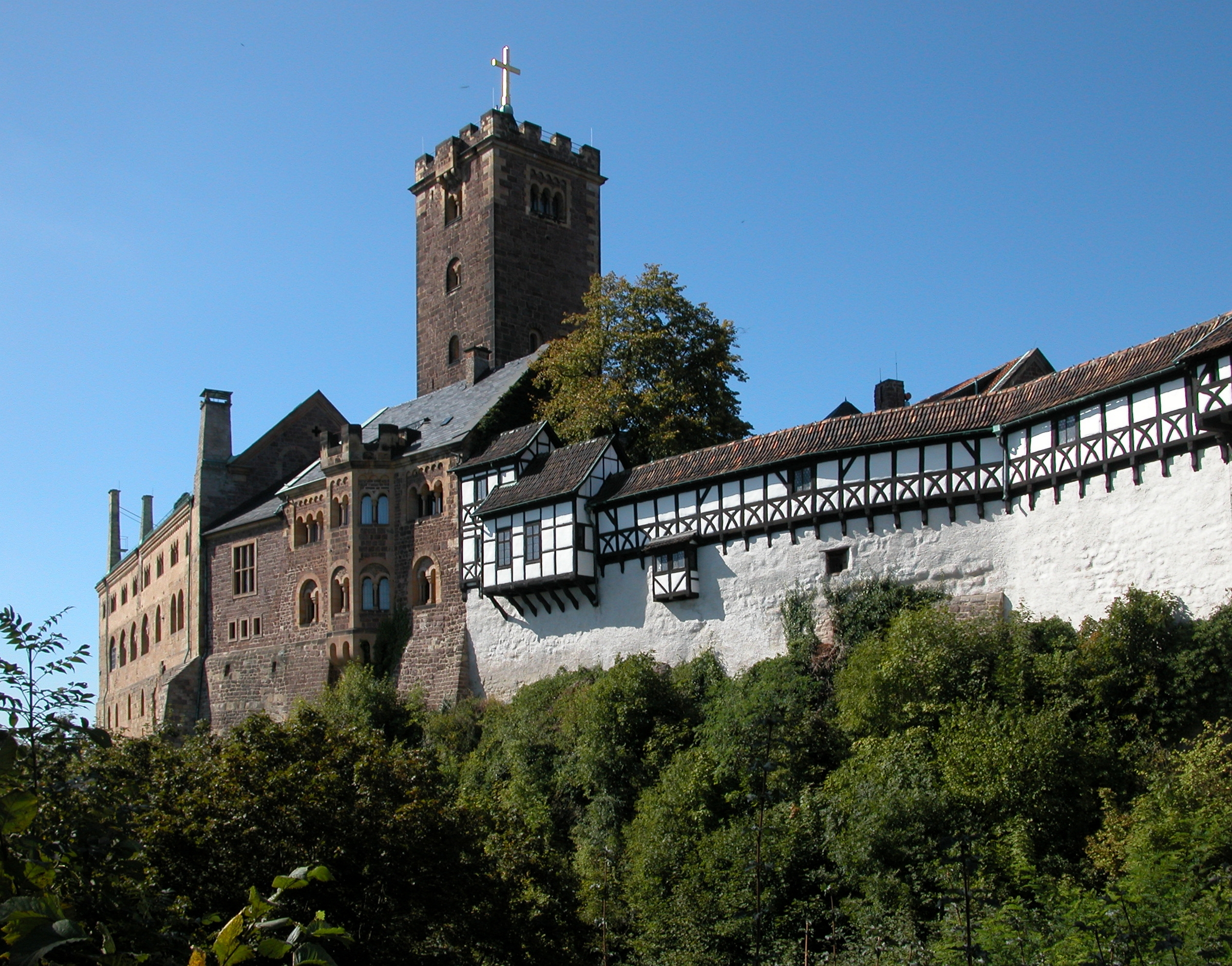
Wartburg Castle,  by Robert Scarth                          .
Yes, the same where Luther was given protection, the house of St. Elizabeth, and the place of competition of Minnensangers, and featured in Wagner's opera Tannhauser. Click on the picture to see high resolution.
Here he felt free , and in a state of rapture collected flowers. It was a kind of religious ecstasy. He decided to confess all his sexual debauchery, and ask Got for forgiveness. However, every priest who heard his confession was too shocked and didn't want to grant him absolution, telling that God will never, ever forgive such sins. Tannhauser even went to Rome in despair, confessed to the pope Urban IV himself, and asked for  forgiveness again. All this made the stern pope very upset: he said that first his pontifical staff  "will rather grow green, and bloom than God will forgive such lust." Depressed Tannhauser departed, decided to go back to the Venusberg, as there was no place for him on earth, he went back to the goddess and her realm of carnal pleasures. But after three days the pastoral staff of the pope greened with lush leaves, and flowered profusely. The pontiff send his  messengers after the desperate knight, but they couldn't find him anymore. The people in the village close to the  Venusberg told them he passed by, with somber face.He was never found again.

Picture on the left  is Tannhauser himself, from page of Codex Manese where some of his poetry are compiled, among them also a repentance song. The Codex is an anthology of medieval German poetry. The legend of Tannhauser made to German literature during XIX c. when literati  started to be interested in folklore and medieval world. But the strongest increase of popularity came after Richard Wagner's opera, named after the poet and retelling the Venus  legend, and the story about   competition at the Wartburg Castle, combined with Wagner's own creative liberties.

The Venusberg story is very interesting for three reasons: first it talks about real-life poet and maybe a real-life poetic competition, fits the history of a  personality, and his creative output into a legend. Second, it is an old legend Christianized, similar as the grail story was Christianized,it is a hybrid. It shows dynamism of a society which was in transition from culture of paganism to conforming into a new religion, and still quite new fedaul reality. The third reason: it gives a moral lesson about forgiveness, which it is not granted freely, and forces the protagonist to go back to the old ways.It shows that people are not forgiving, but the divine forgives. A lot of moralising here: about the goddess Venus and her court, personality of the  poet knight, but also about the hard hearts of the clergy.No one is spared, and in this story the divine gives a lesson that forgiveness should be granted freely and quickly, and this is a true loving way. The story is of course about carnal and spiritual love, and about serving a lady, but it is so multi layered. This were also times when Europe clarified its own ideas of romantic love.

Regarding an old legend combined with Christianity; Sabine Baring-Gould mentioned this one  in his book Curious Myths of the Middle Ages. He reported that the legend appears in its basic version in many countries in Europe, on which the local folklore built other layers. No confession and clerical invlovement is seen except Taanhauser story.Which I was not aware of. Basic version is that under-terrestrial beings want to contact human beings. A man comes in contact with them, has a very beautiful women as  a lover. He longs for earth, and escapes. However, he needs to return, as the earthly world is not receptive to him anymore. Baring-Gould gave examples of stories which have variations, but retain the basic roots. A very folklorist  view. Sometimes a pagan goddess, sometimes the goddess Venus herself  is present, and there is also a motive of ring and the marriage. There are also more mountains of Venus in Germany, also in Italy, there called Venus mountains, or mountains of Sybil. (I wonder if this has to do with Roman presence there). Baring-Gould also mentions that  the story of Tam Lin, tells stories from Catalonia, Farroe Islands, Sweden, Pomerania, Switzerland, etc. and mentions written versions by various ancient authors.Some are more related, some are more distant relatives.

 I also see now the connection between a legend from Poland, about a young knight who went through the waves into the heart of the lake to be married to some beautiful woman who held a court there. He was telling his loyal horse-or loyal friend who was a rider, depends on version- to go to and to tell his family he wedded a beautiful lady of the lake. The mother of the knight in the bottom of the lake knew the  he will never come back. Poland has of course many stories about aquatic world, courts and the cities, as there are so many lakes.

Tannhauser was present among supernatural beings, under the earth. Main ruler of the court here is chtonic type of the goddess, in spite of the goddes being Venus,a conflation. And the idea of under-terresatial folk itself reminds me of a huge bestseller, kind of  the Da Vinci Code of the turn of XIX c. It was a novel about Vril and subterrean super race living in  caves under the earth. The novel was an enormous financial success. Many people actually believed in reality of such race, and this belief was rumored to linger for long. Some of the Nazis supposedly believed it, it was believed in some occult circles, in Theosophy belief in Vril still exists to some extend. It was a novel, but seriously captured people's belief in reality. Vril, similar like the grail, is the idea about power granted, about  fulfillment of wishes. No wonder that both, the grail and the vril resonated so strongly with the audiences.  Recently we had The Secret phenomenon, which falls in the same category:  power of fulfilment of wishes, power of belief. Law of Attraction, another magical world for the frustrated. But I prefer the legends, I confess, Vril and the Secret don't attract me.  Are they an equivalent of today's court of Venus, where first after some time one sees the illusion?

As for the caves in Venusberg: local society hopes they will attract tourism, and the caves were explored. In them are diverse colonies of rare  bats, which hopefully will not suffer in case tourism increases one day. Iron bars at the entrance of some caves make a lot of sense, and here is a responsible way of protecting nature.