Showing posts with label art history. Show all posts

Wednesday, September 5, 2012

Paradise on Earth-the legend

Legends were extremely important during the Middle Ages, sure. Some were the source of psychological strength, like the legend of the terrestial paradise, which gave people sense of hope and was interchangeable with the idea of heaven. First during the Renaissance this belief  faded away, but not completely, and when people stopped to believe in the paradise on Earth, their belief system became more gloomy, more fearful of devil and the punishing God. The disappearance of the belief  in terrestrial paradise is not the only factor that the times became very somber: more of natural catastrophes, more wars, including religious wars, legacy of black death,  increased activity of Inquisition, all combined with fire and brimstone preaching through XV-XVII c. gave way to a more depressive mood.paradise was no more to be found on the Earth full of suffering.

Medieval people were more optimistic: they believed that Paradise existed on Earth in their present times in some far away land, and trusted that some travelers indeed have seen it with their own eyes. Ancient manuscripts have maps, the Paradise was located somewhere in Armenia, China, India, later in Japan: in general it was very far  in the East. The Tree of Life was there, wonderful climate, of course vegetation was fabulous and abundant, with plenty of fruit to eat. There was not even a glimpse of darkness, day time always, never falling of a night,  and the Paradise was filled with light seven times brighter than the daylight on the rest of the planet.  The multitude of precious stones of many kinds was joy for the eyes. Abraham and Jesus was there too. This illuminated page from shows Christ on the lap of Abraham, with personifications of fours rivers in the circles of four corners of the mandorla. Those rivers are Euphrates, Gihon, Pison and Hiddekel were the four great rivers of the Paradise.


The Three of Life was in the center, also a Fountain of Life, which cured all imperfections a human  body could have. Sabine Baring-Gould wrote about this myth ( Curious Myths of the Middle Ages), mentioned maps pointing the location of the Paradise, but also writes about the manuscripts in which the legend is recorded as a  true fact, also he lists the various authors of the narration. For example he states that St Brendan took the journey to Paradise because one monk traveled there, and told about the wonder for this place, and St Brendan became very curious. St Brendan went to the East, very far, and reported on the Paradise he visited, and told about going further until he came to the place no one alive was allowed to cross.  According to Sabine-Baring a map in the Cambridge collection depicted the Paradise as a round island  located close to the mouth of Ganges. According to another legend  Alexander the Great was eager to see this land of delights, but hadn't possessed proper mind, as it was an inner Paradise, not the physical one. But the most detailed account was given in the Icelandic narration of Eirkes Saga Vidforla, form XIV c. mixing pagan and Christian beliefs. The following centuries the Paradise narrations didn't die completely out, the occurred as "learned  treatises."

What I was not aware of is the fact that the legend was also given strong  theological validity, and is found often in the books of sermons. Books of sermons in general are quite numerous, and give a good insight into medieval religiosity,  they also repeat legends. The master dissertation by Gavin S. Fort gives examples how this legend was functioning in religious life, specially interesting is the relation of this legend to medieval  monasticism. Monasteries were supposed to be images of Paradise on Earth, were people had the great opportunity to cleanse their souls ans enter the state of perfection, and have angelic habits. In monastic life celibacy was equated with the attempt to live like angels, than celibacy was a requirement in monastic life, later the argument for angelic life became a point in deciding that the celibacy should be extended to priests also. Later the belief  in a geographical location of the Paradise developed into the abstract meditative practice on the inner Paradise. Are you interested in additional reading? I recommend the Master degree thesis by Gavin S. Fort about Paradisal language in Medieval reform

  Take a look at this mysterious  diagram of a mystical Paradise  from the Rare Manuscripts Collection of Walters Museum of Art, by Conrad of Hirsau, XIII c.

I didn't find the remnants of this legend in today's Europe, not a full narrative but just some short mention about which I am not sure if this is  truly oral tradition as told,  but this fragment is similar what wrote Baring-Gould. According to this mention the Paradise was sealed by the walls of fire, and is guarded by an angel and no one could step in. The walls of fire are relating to some medieval reports about inaccessibility, (Baring-Gould), the angel with sword is of course the cherubim of the Genesis.


Monday, August 20, 2012

Yellow: Triumph and Fall, history of color #11

Yellow is unusual in art history regarding the attitudes people had toward this hue: it was held in high esteem until did fall low.

First during medieval times yellow was replacing gold when it was too expensive for the project, like for example usage for the background in frescoes, large surfaces. Sometimes of course, gold was used on frescoes also, it depended on how much a community could spend. Yellow was a much cheaper alternative and still represented divine light. In an earlier post I wrote about symbolism of gold as representing divine light, as the color symbolism is theological). But yellow wasn't used symbolically only, also when needed to give some beautfil robe to a saint, for composition purposes, the color was used freely.

Chromatically yellow is also the lightest color from all chromatic ones. (White is non chromatic). Also it was used in illuminated manuscripts, as we see in this masterwork of medieval art: the book of Kells, from Iona, dating from the times when Irish monks spread their culture and knowledge in Europe. Columba was visiting Reichenau, as I told you before. This folio showing Christ enthroned makes use of yellow, which is fine of a color to even line the cross and painted as color of Jesus' hair. The birds are peacocks, about symbolism of this bird in this this article. The circles at the feet, surprise, surprise! Those are angels, called Thrones, often depicted as wheels, sometimes as wheels with eyes and wing, specially in medieval Byzantine art. Wanted to mention it, as they are not uncommon, and people wonder about what is it. But also can mean the heads of the nails of the cross. The book Christ is holding represents the divine law.


Christus Enthroned, Book of Kells, Ireland, library of Trinity College, Dublin, via wiki commons


 The figures are angels, one angel is a seraf as the posture of his wings indicates (lower corner on the right, will write more about angels another time). This part of a wonderful lecture later describes the peacocks too: as incorruptibility of Christ's flesh, with chalices and hosts.

Closer to Renaissance the elevation of yellow to color of light started to diminish, when art started to be more realistic, the golden backgrounds fell out of fashion. Now yellow started to be viewed as color of falshood and treason. It was used to brand those who were considered socially less acceptable: prostitutes, Jews, heretics. Jews were ordered by law to wear yellow badge. About yellow as color of prostitution I wrote already when I wrote about Mary Magdalene.

And as we see in this fresco by Giotto, yellow was assigned to bad people.Jesus has a loving peaceful face, he is dressed in red and blue, Judas in all-yellow garment.
Giotto, Kiss of Judas, Scrovegni Chapel, Padua, Italy, via wiki commons

Cathars after Albigensian Crusade were forced to wear yellow cross, as badge of shame. Of course they couldn't be Cathars by choice, they needed to provide prof of marriage and repent, than their live were saved. Repentant heretic was important, as too many heroic personalities burned on stake wasn't good advertisement for ideological side of religion. Some of  information about Cathar religion we know from writing of a Cathar convert to Catholicism. Those crosses called las debanadoras were to be worn always outside the house. It depended on the depth of involvement in Catharism judged by the Inquisition in a trial of , if a person needed to wear one cross or two (front and back). Those crosses were usually six inches wide and had height of eight inches. Unless one was of aristocratic birth, the badge of shame was to be worn for the rest of someones life. Many simply didn't comply, or were unrepentant. It was not a simple badge of shame:Cathars didn't like the cross as a symbol, this refusal of the symbol was written in their religious philosophy. It was much more cruel punishement than a known more widely and younger scarlet letter for adultery. Following link will bring you the wikipedia articles about Cathars and yellow cross http://en.wikipedia.org/wiki/Cathar_yellow_cross 

As for heresies: they were not considered a religious offenders only, but in Western Europe heresies were viewed also as treason against the state, and considered anarchy. This was also one of the  reasons why it was relatively easy to prosecute those who didn't conform. Rulers were offended by heresies, specially because almost every heresy also criticized materialism of the status quo, preached poverty or renunciation of material world, Catharism did it to.


Monday, August 6, 2012

Mary Magdalene: Blue Color of Her Robes and Art Historians

 Here we have Lamentation by Petrus Christus from Royal Museum of Art in Brussels. Can you recognize who is who among both Marys? Both have blue robes. Mary, the mother of Jesus is depicted as fainting, her body lifted up by two people. Common depiction, Mary fainting at the lamentation scenes. Is one of the people attending her the Mary Magdalene because she has red dress? Well... no. Color symbolism was common, but not set in stone, there was nothing very dogmatic about it. Please, click on "Mary Magdalene robes"  among the labels/links at the bottom of this post, you can read posts about the other colors.

Lamentation by Petrus Christus, via Wiki commons, click on the picture to view it larger


 But where is Mary Magdalene in this painting? You can recognize her by one of her attributes: the skull. She is the one turned toward the cross and the skull. Ointment jar is another attribute, not in this painting, the cup behind her is the cup for throwing dice, as dice are one of the symbols of Christ's passion. Both Marys are in blue, which was for sure costly, ultramarine was the most expensive of pigments. Both are made clear who they are, made recognizable: one by the pose, another one by her attribute. The viewers of those days knew how both were depicted, today those things are more confusing, as people have less familiarity with iconography.

This example of using so much blue is rather unusual for Petrus Christus himself. He most often used red for Virgin Mary's robes, as was common in the Northern painting. Blue was more common in France. This is of course rough division, the geography, but this is a  more factual explanation to clarify this red and blue vision, than color coding Virgin Mary and Magdalene rigidly.


Rather dogmatic is thinking in red and blue, which sometimes happens today, as art historians and art history buffs say. This means the idiosyncratic idea that Mary the mother of Jesus was depicted only in blue robes, and Mary Magdalene was depicted only in red robes. Luckily the Old Masters where not as limited, or as color blind.But some art historians complain that it is difficult for some people to understand this fact, and even those people will rather aggressively defend their pet idea, in spite the fact that their knowledge is limited.Why is it, and why some people are so fiercely attached to this specific color combination, is a mystery for me. As one art historian said, the subject of the robes of those two venerated quickly reveals how much someone knows, or rather how much someone doesn't knows about art history.

Art historians are not as ignorant as they often gladly represented as: most important, they see a lot of art; when I took history of art on the exam we had c. 600 slides,which were part of the test in the introductory course only, later things were more complicated. Art history classes were compulsory for my degree. I had strong interest in art history quite early, started when I was 13 year sold, so I didn't struggle, but for those people in general who learn art history as elective, mostly it it not an easy A class. It depends on university and who teaches the class, but in general challenges are there, if you want an A, better work hard, as it is not hobby level art history.  

Art historians are very involved in general: they travel if needed, study artists' historical contracts by the patrons and artists, write books, keep current with current research. So, why this need to tell art historians they are so wrong, and specially by people whose knowledge belongs to the limitations of a hobby? Mystery, mystery...


Friday, April 20, 2012

Gothic Art Outside France? Any Good? Central Europe, etc.?

French Gothic art is very renown, and for good reason. French cathedrals are magnificent, totally awe-inspiring.

Sadly, often it is only Gothic art known to travelers in Europe, and I understand that. Time and money can be a limiting factor. I consider myself lucky, growing and living where I could just take a walk and could step in a welcoming interior of a Gothic cathedral. Or a Gothic church, or a Baroque one, and other international styles. For sure this can nourish your aesthetic sensibilities. This is one reason I write this blog, to be able to share what I got for granted.

Sure, Reims, Chartres, Notre Dame, etc. are worth the journey, are iconic. So are Paris, Giverny, Carcassonne, and other beautiful places. So is Cologne with magnificent and finished cathedral towers.Stump-like towers of French cathedrals are unfinished, you know, those towers with flat tops? Those are unfinished ones, not just the intention of the builders.

Other German cathedrals or Gothic churches are also worth the visit. They look very much like the French ones, but the towers are usually much taller, truly the intention of Gothic, often with open work spires, lacy. Gothic was architecture which ambition was to grow as much in height as possible, the ideal was  to get the numbers of the ratio of walls and floor space as much different as possible (1:1 would be a bad ratio!) Cologne cathedral has 1:4 ratio of surface vs. height. French cathedrals get to 1:3 ratio. It was like a racing toward the sky, and often the attempts of getting the ratio to the extremes resulted in collapses of the cathedrals.Here is shown what you can see, and hear at the Cologne Cathedral.


And here are the magnificent bells an the exterior of Cologne Cathedral


  But there is of course beautiful lot of Gothic art in other countries too: England, Spain, Portugal, Czech Republic, Poland, Baltic States. Poland and Baltic States have examples of brick Gothic.
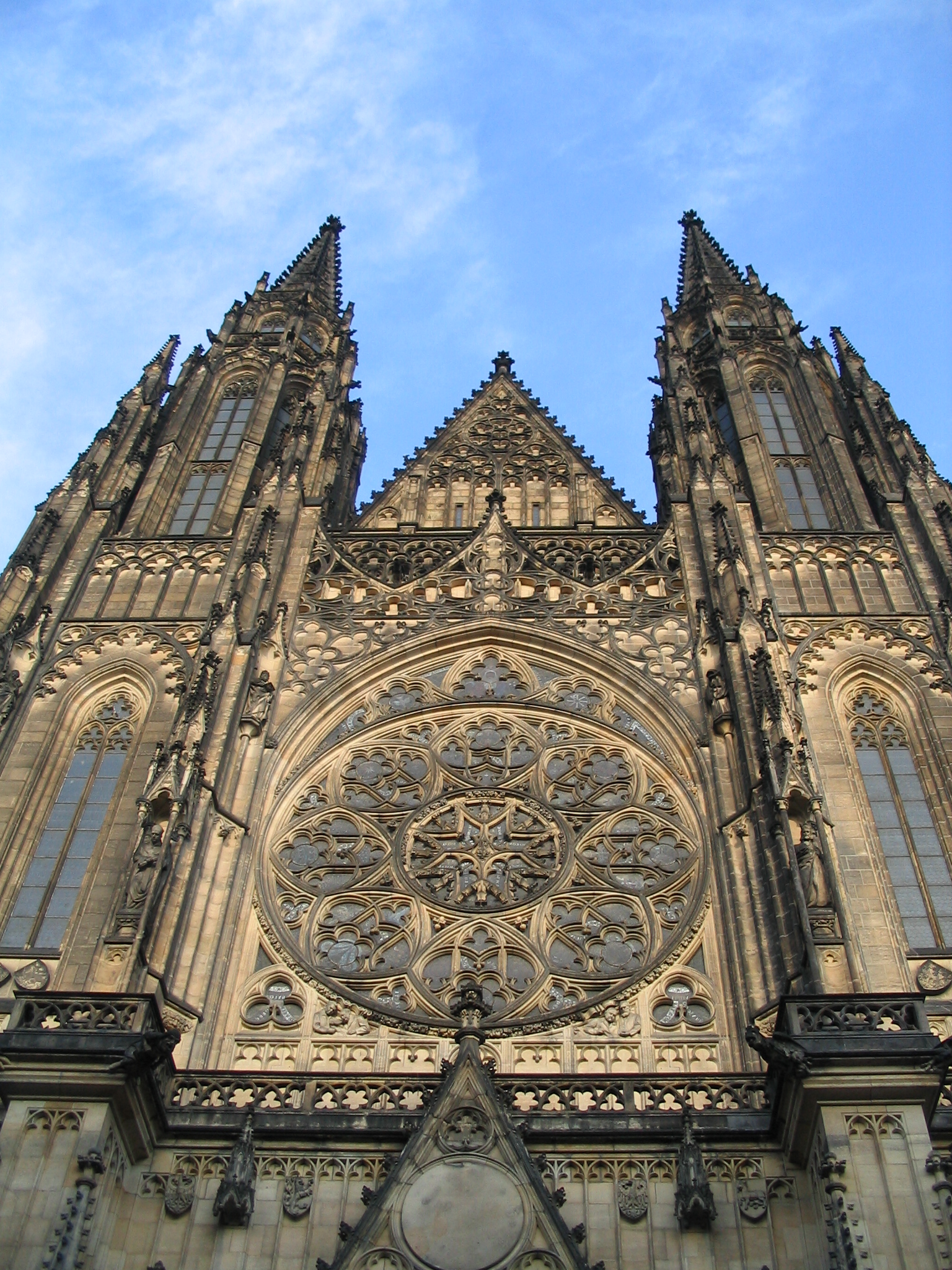
Portal of St. Vitus Cathedral wit rose window, stone masonry, Prague, via wiki commons courtesy of Vaylag

With mass tourism being such lively enterprise, many people are able to see a lot, but often this is knowledge given by the tour guides. Pity when among Gothic cathedrals only Chartres or Notre Dame rings the bell, but Amiens is a total mystery. I mean I don't argue to visit all possible sites, but to read. I wonder, maybe it is the fault of art historians, or popularizes, or people like me who can't make the subject interesting? For ex. authors who make Chartres a place of mystery reshaping its once famous cathedral school, (but one of many cathedral schools of the day) into some esoteric tradition school have the upper hand, as captivating story is given. Facts can be captivating? I think so, but then I am an art history geek.

There is also a curious situation regarding the Middle Ages: most popular knowledge deals with Western, parts of Central Europe, little with Eastern Europe. Byzantium is kind of a lost empire. Prague, luckily, developed into a tourist attraction. Krakow (Cracow) seems to be on its way now. I am Polish, and I am sometimes surprised when some people are surprised when they see that this country had Romanesque, Gothic, Renaissance, etc. It seems that it was such an empty hole in European history, regarding some countries, due to long slumber behind the iron curtain. Once I felt like someone coming totally out of empty space when I watched supposed to be educational video (US produced VHS), about Battle of Vienna. It made me laugh, as the video mentioned only prince Eugene of Savoy, as army commander. No mention about Polish army, even though it was a bi-national enterprise, and actually the Polish king, Johan III Sobieski was more in charge than Prince Eugene. Not that I care so much, and during times of Wikipedia such things are corrected, but it was really funny, how big of  a hole in knowledge can be created in one piece of material. One of the most decisive battles in European history, two big armies of two nations, and you totally forget one army plus the commander in chief? What a curious and amusing case of selective blindness! Cold War legacy? ;-)

Along the line of random info spreading, the Czechs had their own brand of Protestantism, c. one century before Luther (Jan Hus, Czech Brethren, etc.). Poland had religious tolerance guaranteed by law, including Statutes of Kalisz, about the protection of Jews. (Not as bad as in other countries, but it didn't mean it was a totally safe heaven). Religiously different people lived there, including the Cathars. The Kinghts Templars too. Or other crusaders who went for Northern Crusades, (often turned against Poles) . One blog writer from Czech Republic claims that every village in his country has some legend about the Knights Templars. Templar legends in general are not so very French-centered.

 Lots of mysterious, interesting stuff in other parts of Europe. For example devil in Polish art was treated as humorous nasty  figure and was often ridiculed, not a scary being like in the Western Europe. Devils form St. Mary Church in Cracow were painted in strong colors. In another Central European country, Germany, devil was feared, and stakes witches were burned. The conspiracy theory about witches came to Poland during the Renaissance, when the witch hunts intensified, but it was less common, and actually the Latin Church was not by law excluded form participation: only secular power did it. Strange? No. This is info is to point out the diversity of Europe during the Middle Ages and the Renaissance.

I don't have links about Gothic art in Slovenia, but Gothic went there via Prague, and Parler.I am mentioning Slovenia, as it it a very pictoresque country, (my hubby loved it), which enjoys, rightly so, many tourists visits. Very, very interesting landscapes, history, architecture, coasts in general.
A beautiful Corvin Castle in Romania you can see clicking on this sentence.

Here is a link to a site, in Polish; I apologize, but just for the sake of the pictures. There are iconic examples, such as Chartres, Nuamberg, Limbourg Brothers, Sluter, Crucifix of Geron, but also believed to be a miracle working crucifix from Cracow, and other examples, like the biggest Gothic altar in the St.Mary Church in Cracow, or probably the first authoportrait by Peter Parler in Prague, and wonderful St. Vitus Cathedral, Malbork Castle, and  "armor Madonnas" (Crusaders art, can be opened as cabinets!), and other exciting examples. The other is the link to St. Vitus Cathedral Wikipedia article. Enjoy!
http://www.historiasztuki.com.pl/001_KANON_GOT_2.html
http://en.wikipedia.org/wiki/St._Vitus_Cathedral 

Friday, April 6, 2012

Oral tradition. Folk Stories Geneis and Finding Sacred Art

 I wrote before that during middle Ages some ideas took lives on their own (proto- sciences). Today I will talk about folklore.

There is folk current in European Christianity, for example the  folk Catholicism. Secular or pagan  stories which were liked were appropriated, so, the Christian/religious current and the pagan/secular one created very interesting stream.

One  story is form Ukraine, and Belarus,( if I am right), and it is about a bird: the raven. It tells that "the raven’s plumage was very colorful as a rainbow, and even was radiating rays. Raven was a true bird of Paradise." When the paradise was no more, the land become barren, and the raven become black. But his plumage will be back in its full glory the moment the Paradise is back on Earth. Medieval art represented Paradise as radiant and colorful, cathedrals and basilicas were earthly representations of ideal of Paradise.

Other legends relate to concrete objects,  art which were found and installed in local churches and enjoyed special devotion. Typical motive: the sculpture, for ex. a Black Madonna, or an  icon was lost during turmoil, than was found in a miraculous way. Or even appeared in a miraculous way from the beginning, without being lost. The finders were the animals, such as cattle, or an owl, or a sheep. It appears to me that the animals are the most frequent finders of religious art, but I am not a folklorist, and those are just my original studies. My formal studies in this subject are limited, were part of my anthropology class, and dealt with the subject of art objects which were subject of veneration in Catholicism, and especially those relating to healing. I don't claim special knowledge here, (reading and listening stories passed as part of living oral tradition).

Sometimes instead of the animals young children are the finders.find the art taken then to the local church, or a blind woman. The story about the blind woman whose blindness was healed when she stood in the river and the crucifix was floating on the water, the Jesus on the crucifix talked to her and she was healed. It relates to one small village in Poznan region, Poland. This particular story has variants, including the treasure which was dug up by the oxen. The finders are somehow innocent, or under-priviledged. Those stories represent the idea that the divine is very accessible, and approachable through intuition, no special intellectual training is needed.

But lets go back to the story about the blind women. When the women was told by Jesus on the crucifix he wanted to stay at the local church (common motive, the holy one depicted decides on location where he/she wants to stay). The crucifix was pulled out of the river and put on a cart which was supposed to be pulled by oxen. But the load became so heavy, the oxen couldn't pull the cart even a a single step forward. They just were stepping in place. They tried and tried, but couldn't move, were just digging deeper and deeper into the soil. And this is how the oxen dug up the chest with golden treasure, from which the money was spend for renovation of the church. The chest is still exhibited in the church; the crucifix itself is in Gothic style, dated by art historians as created during early 15 c. The church itself became a local pilgrimage site. The crucifix was moved to other churches, richer and more impressive.The crucifix appeared in a miraculous way back in its humble church which was chosen at the beginning. This is also common: the artifact wants to stay in one and only place. But always I didn't visit this place, I didn't see the crucifix and the chest, but I listen to the story told by very old people. Maybe one day, I will visit this place too.

Tuesday, April 3, 2012

Red: Mary Magdalene's Case:Medieval Art, History of Color # 7

Mary Magdalene wasn't depicted only in red though history, as Virgin Mary wasn't depicted in blue only. But let take a look at the red, as both Marys were depicted in red garments. For example the red of the robes of Mary Magdalene had a different, double symbolism, than for example red of other persons' cloaks. Mary Magdalene's robes were painted in cinnabar red, (vermillion), having more hint of orange. Red in general can tend toward more to direction of yellow, or blue, and during the Middle Ages the quality of red was important, which red was symbolizing which idea. The other red symbolized regal values and charity.

 Here comes Crucifixion by Juan Rexach from Northon Simon Museum, Los Angeles. Due to poor lighting conditions the color of Mary Magdalene robes not very accurate on this photograph, in person is like on the photo bellow.

 Crucifixtion by Jaun Rexach, Norton Simon Museum Los Angeles


Here you can see desctiption and a better quality photo 
You can zoom into, and see very well the specific color of Mary Magdalene's garment.

Crucifixion by Masaccio, Museo di Capodimonte, Naples,public domain,  via Wikimedia Commons
 
 I am glad that Maria Rzepinska wisely comments is her book about color that red in Middle Ages was not just red, but it had two aspects. Red was one color in which case people paid attention to its shade, shades had codified meaning. Two types of red were differentiated: the noble one, considered sublimed, and the earthly one, viewed as "sinful". Several examples of this red can be seen close to my living place in California: Norton Simon Museum and  the Huntington Library art collection.But today Massacio, as more widely known.

In general, red stood for love in sense of charity, blood of martyrs, sacrifice on the cross, redemption through crucifixion. But as it could be a color of love in spiritual sense, redemption, also when in specific tone, could symbolize sin, or lust, or both: redemption form sin.This dichotomy is visible in portrayals of Virgin Mary as the sinless one who is represented in another red than Mary  Magdalene  ( dressed in "sinful" red). A medieval painted wouldn't confuse those two reds.


We need to remember that color in medieval art isn't always symbolic: sometimes just the need of decorative usage of color was important. In Latin Christianity (Byzantium was another case) the robes of such a person as Virgin Mary wouldn't have been painted in the same as red of Mary Magdalene's.

Above the crucifixion scene by Masaccio, Mary Magdalene in dramatic gesture of devotion and anguish dressed in red so typical for her. Although there are quite a number of representations of Mary Magdalene in this type of red, specially at crucifixion, this one is probably the most famous one. It is still very medieval. But there are hints of coming of the new era: the Renaissance in Italian art,there are more of human emotions shown. Gothic was very emotional in other countries, (for example showing suffering of Jesus),  but art in Italy was more reserved, making more usage of  Byzantine ideals.

 All  older medieval representations of crucifixion in Latin Christianity would show Jesus fully dressed, each foot nailed separately, and no signs of his suffering. With the passing of time Jesus became more humanized, specially in the art of Northern and Central Europe. The body was more and more exposed, agony and blood shown, feet nailed together. For example in German art Jesus was shown with great attention to expression. From Jesus as a symbol there was a shift  toward showing Jesus as a human being.

What about Masaccio himself? His name was Tommaso di Ser Giovanni di Simone. He died when he was only 27 years old, and he wasn't as famous as the other painters of his times. Even his name was a humorous take on his given name. Masaccio, as he is known even today, is a form from Tom, meaning "clumsy" Tom, as separated form his collaborator Masolino,  the "delicate " Tom.

Yet Masaccio influenced the other Italian artists. It was his example which caused a shift in art:  more and more toward realistic representations of the world around. Here we see a paintings which is still medieval: composition, golden background.  But carved into the golden background humans who were much more real, not idealized, captured in a moment of strong emotion. Figures are real, not ideal.

Other colors of Mary Magdalne's robes in another post, more colors.
And my post about Mary Magdalene depicted in blue click here

Byzantine Christianity depicted her also in red,  with an egg in her hand. In this tradition she was an extremely virtuous woman in similar age of Jesus's mother, and both women died in Ephesus. Mary Magdalene's body was was kept in Constantinople as a very venerated relic. This dissapeared still during the Middle Ages, but also later her relics started to be venerated in Western Europe, Latin Christianity. Relics were hot commodity then, and many stolen from the Churches in Constantinople in 1204 when crusaders sacked and looted this cultured city. Virgin Mary's house is believed still to be there, what was one part of the Byzantine Empire, among ancient ruins of Ephesus, today in Turkey, in a rather remote location but among the most wonderful ruins.

Monday, April 2, 2012

History of Science at Chartres Cathedral, and Zodiac

In the previous post there was Zodiac window form Chartres, today is the astronomical clock. Strange setting for such symbols?

No way. Zodiac then was nothing unusual in churches. So, why all the mystery so many tourists talk about? Actually there is nothing mysterious about it. Explanation follows.
Chartres Cathedral Choir, Astronomical Clock, via Wikimedia Commons, thanks to Harmonia Amanda
First, the clock comes form XVI c. but its ideological roots are medieval, and proto-scientific, not really esoteric. Astronomy, astrology, the synthesizing medieval minds didn't see the difference.

 It is a common misconception that the Middle Ages were not interested in science, only in religion, or there was no reading of Classical texts before the Renaissance. Actually the classics were read, not as widely as  during the Renaissance, of course, but were not unknown, rather kept in high esteem. Many Classical and Arabic texts of science were translated into Latin. Arabic texts about astronomy, mathematics, anatomy and chemistry, and medicine contributed a lot in development of Western medical sciences, we often forget about it. Or simply don't want to know. And there was no agreement about if the Sun was the center of Universe or moved around the Earth. The official decision   in favor of the Earth as the center of the Universe came later. Science was fine as long it didn't oppose any dogma. For example the theological idea of dignity of the human body was applied to the medical field, and this particular idea didn't allow dissecting human corpses for anatomical research. Dead animals were dissected instead, specially pigs. Sometimes, rarely, human bodies were dissected also.

Chartres itself had a cathedral school, as often was the case with such buildings: there were also centers of learning, not only part of religious live of communities as today. Chartres was one of such centers, and was among the famous ones. Neo-Platonism was flourishing there, sciences were treated as separated from theology. A number of so called than natural philosophers (philosophers interested in science) came from Chartres. School of Chartres became less influential when universities started to compete with cathedral schools, but this was a case with all cathedral schools.

So, if the clerics of Chartres were so scientifically minded, why such thing as Zodiac in the cathedral?

 Here we need to understand the mind of people who lived before us, and don't project our XXI c. world view on them. The clerics form Chartres were still products of their times, and during their times astrology was science, before the Catholic Church opposed it, and before it was mocked  by the scientists of the Enlightenment era as superstition, not a scinece. Medicine was part of curriculum at Chartres school, and astrology was officially part of medicine also. Here is the illumination dealing with the human body as related to Zodiac.

Anatomical Zodiac Man, Limburg Brothers, Book of Hours of Duke de Berry, illuminated manuscript tempera on vellum, public domain, via Wikimedia Commons, thanks to Petrus Berbygere


In addition to proto-scientific reasons, Zodiac was a very popular motive in depictions of passing time. One  was very common:  the labors of the months. Frequently months and Zodiac signs were tied together, and this is often found in medieval churches and religious  manuscripts. Labors of the months showed secular world. Zodiac window at Chartres belongs to this popular category. Here is incomplete list of  zodiacs and labours of months in churches.

 Another example, most famous of this type is the series of illuminations from the mentioned  Book of Hours of Duke de Berry, (the same book from which the illumination above comes from). It is not the only example of this kind, but among the most beautiful ones, if not the most skilfully rendered, so far. Here it is, via Wikipedia article and picture gallery.

The Book of Hours of Duke de Berry is  of the most beautiful examples of book illumination in International Gothic style, and contains a very good example of Gothic blue, specially loved and used in France.

 Art history itself is an interdisciplinary endeavor, and understanding history of science or cultural history can enhance knowledge of art. Art doesn't exist in historical vacuum. It is connected to the world around, it exists in historical contexts. Striping old art form its historical context can give us only partial insight, and lead to some  misunderstanding too, some of them can be quite funny.

Wednesday, March 28, 2012

The Famous Blue: History of Color # 5- the Middle Ages


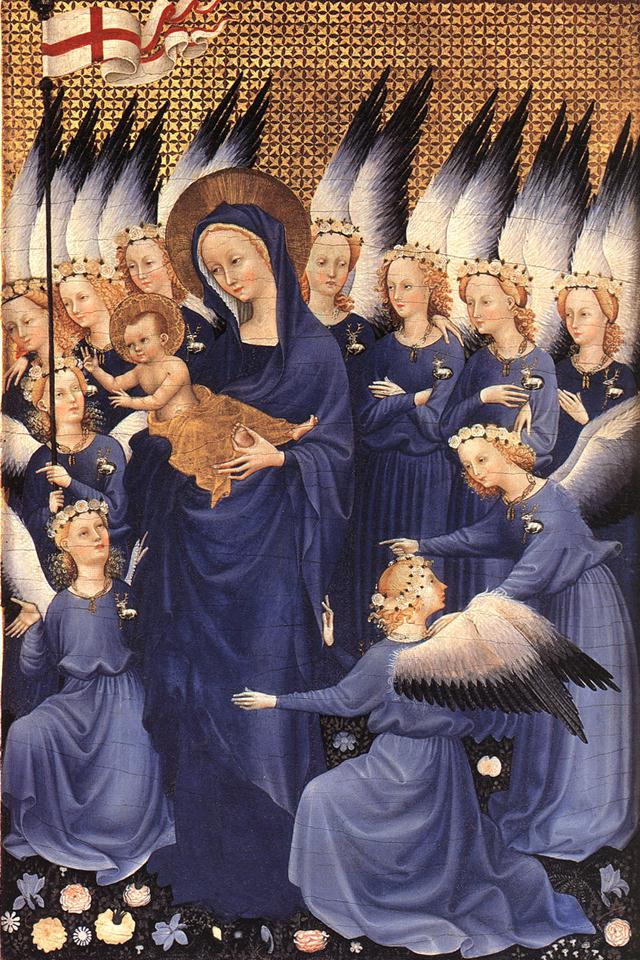
 Wilton Diptych: Virgin and Child with Angels, Unknown French Master, via Wikimedia Commons
Blue was famous during the Middle Ages. People valued the color of the sky, it reminded them of heaven, and its symbolism put it close to gold: it was also the color of divine wisdom, (but gold was used also as light), color of spirituality, calm, contemplation, and all things heavenly. It became also the color of power, but about this on another occasion. Today I will explain the dense code of visual symbolism of the picture above.

Still during 15th century Cennino Cennini, (artist, who was also a writer and theorist of painting techniques) wrote that blue was “illustrious, beautiful, and most perfect, beyond all other colors”.

People talked and wrote a lot about this color. It was considered extremely beautiful and working good on human psyche, it was praised a lot. Also blue pigment was extremely expensive, and for this reason people talked about it in a very different context: painting was a business like any other enterprise, and business talks and written contracts regarding  commissions in which using blue was necessary, specified how much blue should be used. Blue pigment was almost as expensive as gold, sometimes more than gold. It had a beautiful name: ultramarine. It was imported from a valley which is today Afghanistan, made from nothing less than high quality semi-precious lapis lazuli stone, also used in jewelry. The poetic name ultramarine means "from beyond the seas." The stone was extremely difficult to grind, which added to the high price of the pigment.

Artists wanted to make sure how much of ultramarine was to be used, on which parts of the painting. Because of the high price of the pigment, and together with red it was usually reserved for painting robes of the Madonna and Jesus. This example is saturated with blue. Blue was specially the color of French Gothic, especially Late Gothic. Many Madonnas in French art had blue robes, after times of purple and red. (Red for Madonnas’ robes was used more often in the North).

What is the symbolism included in this painting? You know already about gold as diving light and wisdom, blue as divine wisdom and contemplation, things heavenly. This picture is about joys of heavenly existence. First, we have the banner of victory, the banner of resurrection. The colors represent purity of the soul, the sins of humanity washed clean with blood of love ( the sacrifice on the cross) . Wreaths of white roses on the heads of angels symbolize purity and joy of heavenly life. The broaches of the stags represent Jesus: stag means purity and destruction of evil (stag tramples on evil and destroys it). Black on of angels wings stands for depth of the divine mystery. 

Flowers: white rose represents purity and is the flower of the Virgin. The iris was also her emblem, and daisies stand for baby Jesus, his purity and innocence. A lot about purity, right? The vegetation was also emblem of purity; the Virgin was often shown in a garden, which was her emblem, hortus conclusus, "enclosed garden," symbolizing her virginity. Garden had also other meaning starting from early on in Christian art: it was representation of heavenly paradise.

This painting was commissioned for King Richard II. Here the Virgin looks like a fine courtly lady surrounded by ladies in waiting. During Medieval times adoration of the Virgin and courtly love had often similar visual and linguistic vocabulary.

Saturday, March 24, 2012

History of Color # 3 Not Colorful Enough, or?

Medieval fresco with traces of paint,  monastery in Baden Baden, Germany.
 
 Dramatic scene. Expressive image, emotions shown in movement, clarity of composition. Fine work, but 600 or 700 years ago it would be considered just not colorful enough. Brown  was perceived as  a very ugly color, just way  too humble. Those contours were the first step in painting, preparatory drawing before filling in color. But we can appreciate it very  much. Similar situation of differences in perception of beauty through ages is the case of the sculptures and architecture of Antiquity, from Greece and Rome.White, unpainted marble  delighted and delights modern sensibilities, but for the Greeks and Romans was just way too plain.
So, lots of paint was put on it, often in garish colors. But the Medieval colors were not really garish, as I mentioned before,  they were jewel-like, as imitating colors of precious stones was so important then.

This is the stone vault of the bell tower of Freiburg Cathedral. This beautiful Gothic construction detail of the tower of the tower is beautiful for us today, but centuries ago  would be just much too grey. When it was newer, it was fresher, much lighter, but still  it was just a technical detail. Even though, it is touching to see the clover leaf adornment chiseled out of stone with such love for detail.


The tower itself is one tenth of the mile high. When I was there, I first visited the framer market at front of the cathedral. After all during the  medieval times markets were common at front of such visited sacred houses. I truly enjoyed this market with buckets of freshly cut flowers, organic food, fragrant hand made soaps, it was very sensual, music, colors, fragrances.  Than I entered the cathedral, looked around, contemplated the art, so typical for a visit on a trip. It was more elevated experience, meditative, sublime.

But this place also offered one  interesting option in addition: to climb the bell tower tower, to be able to see the bells and to admire the view of the old town. Of course I needed to do it. One tenth of the mile high climb: narrow, rather steep stairs, spiraling, twilight.  The climb seemed have no end to me. And than at the top this unusual feeling when you face all those bells which are tons heavy, this stone vault beyond which is the spire of lacy stone carving, becoming less and less material, the essence of Gothic architecture, sublimation of the material world into the heavenly one.  And the view of the blue sky. It was a very strange juxtaposition: stones and the sky.

We, the viewers of today, we like patina. Old artifacts are allowed to have patina, their market value can even diminish if the patina is removed. But for people of Middle Ages, this vault would have been too dirty.
Yes, there is accumulated dirt on the vault, but we don't mind it as much as people would do hundreds of  years ago. They disliked brown, grey, as those colors don't have enough chromatic intensity. Poor peoples' clothes were in neutral colors of raw fabric, made of flax, wool. Wool was often beige, or brown. The richer ones wore colors.

Those stones from the Reichenau Monastery, which was once of the greatest centers of learning, hosting a very large library, and busting with life, are charming to most of us, modern viewers.


But than, a thousand years ago when scribes of Reichenau produced delicately illustrated books, this combination of brown floor tiles and gray stones would be plain ugly. Medieval mind loved color. Bright, luminous color.  Neutral colors were not of much of use in art.

There were of course exceptions, like frescoes in Umbria, Italy, painted with lots of browns. But this is unusual. Other exception are Cistercian monasteries, with simple, unadorned interiors.Cistercian church is beautiful to us, in its simplicity, and probably was considered as such by the monastic community which valued the life of poverty. But the general idea of the times was that a church is supposed to represent to some degree a paradise on earth, or the heavenly Jerusalem, and needs to be adorned with pure colors.

From my experience when discussing Medieval tastes for things colorful, pure, shiny and glossy, sooner or later comes a comment: "but they were so terribly dirty!" (This comment comes when discussing Rococo also, understandable). However, the idea of Middle Ages as filthy ages is disputed by historians. Some lean toward  idea that indeed, dirt was common, and there is truth in it, but others point otherwise, and there is also truth in it. For example Byzantine Empire had system of waste removal, water flushed toilets, and high level of hygiene. Latin Middle Ages had the system of public baths, which were more like spas: hangouts were it was possible to take a bath, eat while soaking in the communal  bathtub, and  listen to life music, to gossip, and play games. Bathing was a social occasion, and baths were frequented, making the members of the bather gilt rich. Banya in Russia, sauna in Scandinavia, hot springs through Germany and Switzerland, and numerous public baths everywhere point to rather cleaner people than we are willing give them credit for.

 For example in Poland bathing was so common that even the beggars were entitled by law to get free bath every two weeks. Or some in Europe monasteries might have as a rule not to bathe, but others required cleanliness rule to follow. Even some of the old monasteries were build close to hot springs, and bathing was a symbolic action of washing away sins, after confession. Above mentioned monastery of Baden Baden was close to hot springs. The Church didn't oppose hygiene, and was advocating cleanliness for health reasons, but was against a habit of too much bathing, as it seemed to be addictive to some: every day several hours in bathing house. I know, i know,  I digress, but so many people have imprinted in their minds that Medieval times were ages of filth and darkness. I felt compelled to give additional information,as we talk about colors, splendor and light in Medieval art..

For more detailed information about Medieval hygiene, read this very interesting article.


Sunday, March 18, 2012

History of Color # 2: Color during Middle Ages

Yesterday I mentioned  the psychological impact the stained glass windows had on people during the Middle Ages, giving the viewers sense of awe. I have chosen to start with stained glass windows, as a window is very close to light by its function. And when glass is colorful it has strong similarity to a  precious stone. People during the so-called "Dark Ages" were obsessed with light and splendor. They loved bright hues, which reminded them of precious jewels. The comparison of color to precious stones was common among medieval writing which we still can read today.

People also loved gold, not only for its high material value, and being a metal  of bright color, but also for its light reflecting properties. Gold was, logically, the symbol of divinity, of spiritual illumination, and most of all, of divine light. Among the colors of  the rainbow the most  beloved color "trinity" during the Middle Ages was gold, blue and red. Yes, gold instead of yellow. Yellow was used as cheaper alternative to gold, but became also ambiguous, I will elaborate on this subject another time .

 Practical reasons also played a role in those choices: for example in a  dimly lit church, when you have bright colors and gold, everything looks more luminous, splendorous. And gold reflects light in the shadow, it gives a beautiful glow, as you see on the picture.


Interior of a church, can't recall which one, somewhere in the Black  Forest area, Germany.


As the medieval minds were so enamored with colors and light, it is understandable that a very complex metaphysics of light was developed by the scholars, theologians, and other  writers. When those people wrote about beauty, they often wrote  using therms describing light. This was not only comparison to the sunlight, but also to a fire. You can imagine the glow of gilded altar like on the photo above was fitting the aesthetic, religious and philosophical expectations of the viewers centuries ago. The Middle Ages used a very extensive vocabulary describing light.

To this  vocabulary of the aesthetics of light belongs the term "illuminated manuscripts,"  which refers to medieval books containing masterful calligraphy, richly painted in many colors and gilded with gold. Those books were adorned by ornate letters, and often had  lush illustrations.  The creation of illuminated manuscripts was a time consuming process, done by monks who were able and willing to spend their lives copping or illustrating books by hand . Take a look at this initial from an  illuminated manuscript. 

This Madonna with Child. is  a very typical example of Medieval painting.Golden background was such norm in religious art during the  Middle Ages, as it represented divine light and wisdom. Often the halos of the saints were painted blue, which represented spiritual virtues, contemplation and divinity, and  contrasted nicely with gold. Halos were painted in gold too, and the name "aureole" comes form the name of gold in Latin. Golden aureoles in religious art survived for long time.

Gold and precious stones, or color enamels was used on book covers and  reliquaries. Enamels were also used in jewelery. It was all about color. I have chosen to show you the beautiful chasse from the collection of Metropolitan Museum of Art in New York, and the golden reliquary of the magi shrine from Cologne cathedral. The form of  the chasses was common. Such clear are the colors of the Chasse with Crucifixion and Christ in Majesty . The  Magi Shrine  Reliquary looks very architectural, often reliquaries had this form, imitated architecture: they are like little golden buildings in miniature.

And this beautiful Bust of the Virgin still has lush traces of its original bright paint!

Take a look at this example: it is the portal of the cathedral in Freiburg, Germany. I apologize for the poor quality of this picture: when I took it,  there was a plastic net spanned during renovation work, and this created strange light reflexes. (Talking about light, ha!) But you can surely  guess the richness of colorful paint and gold when the portal was freshly made, and was carefully kept this way. The interiors of the Medieval cathedrals were colorful too. Not garish, but simply intense, jewel-like. If the budgets of the cities allowed for such splurge, the ceilings of the cathedrals were painted in blue and adorned with golden stars. Today this doesn't seem like a real splurge now,  but then blue pigments were expensive.


Portal of the cathedral in Freiburg, Germany.

I hope you like the links, as the pictures are of  high quality, (not like my take of the portal), and have perfect descriptions. If you have chance, you can see those examples in person at the Metropolitan Museum in New York. This museum has great collections. Freiburg is great to visit also, but the Cologne cathedral is very unusual in this regard that is the closest to the ideal of a Gothic cathedral as such. Not only the very slender proportions, but it is a truly a  finished cathedral. Some ideals were designed in theory, but never totally finished in real life. You see sometimes towers which were never finished, have flat tops without spires, like some of the  famous cathedrals in France.

Coming soon: the post about colors disliked by the medieval people, and after that a post about symbolic meaning of colors. Please, stay tuned.


Saturday, March 17, 2012

History of Color in Westen Art #1: Introduction

Physics can measure color: its energy and the length of waves are measurable. Color influences us on psychological level, and certain reactions to color can be measured. Physiological responses, like for example increase of blood pressure in reaction to red, or increased appetite in reaction to orange, and other reactions to other colors are measurable also. This belongs to the domain of psychologists and other researchers in the medical field.

There is of course the realm of emotional responses to color, which are individual, but quite often also culturally influenced. But what about art history? Do we can better understand art if we know more about color? Or  is color only a part of a given artist's aesthetic preferences, matter of subjective, personal taste?

Yes, we can understand more about art if we know more about color. Any color palette of a given epoch was also reflection not only of tastes, but also the philosophy and theology of the times, as  or example in Medieval art. But color choices also depended on very mundane matters, such as the accessibility or shortage of certain pigments.

Color as simply a matter of artistic tastes of creative individuals and nothing more? Yes, very often. But it was not always so. Freedom in using color as we see today was possible first in modern times, when chemists started to produce artists paints. Before  the industrial advances in paint making the artists had a much more limited palette, which fact to some extend dictated the expressive qualities of art they created.

Take simple  examples like Old Masters, or the colors of stained glass windows in Chartres (and other cathedrals). Old Masters had quite limited choice of pigments in comparison to modern times. Also very famous Chartres blue as a  phenomenon  is a mixture of technical skills and knowledge about chemistry which the makers of the stained glass windows possessed, but also accessibility of materials played strong part in it. We  need to add in this mix also the symbolism of color during the Middle Ages, optical qualities of glass, philosophy relating to architecture which the windows were supposed to enhance, etc. Stained glass windows served as heavenly vision, were supposed to create awe, to be like precious stones, no less. And the medieval minds didn't create too much difference between the real precious stones and stained glass. So, freedom of expression was tempered by the requirements of functionality.

Blue was of course the color of the sky, spirituality, contemplation and symbolized divine wisdom. The luminosity of the stained glass itself  represented  spiritual illumination. Please click on the link to see the Notre Dame