Showing posts with label Krakow. Show all posts

Wednesday, July 10, 2013

Grail in Bezlawki part 2: Mary Magdalene patronage and pagans


The second part of the legend of grail in Bezlawki. How the grail was taken from Britain, by whom, in my previous entry about what happened after the battle of Hastings. 

This is a legend, we don't know how old it is, bu tit is very interesting as a story, and has historical events, as well people who lived in real life. A bit of historic  background of the story.

After Svidrigaila installed the grail and his army in today's Bezlawki, in a fortified tower which belonged to Teutonic Knights, military order crusading against the pagans of the East North, he lived like a prince. Historical records show food provided by Teutonic Knights, among them very costly morsels and spices imported from afar. Teutonic Knights promised him to become the grand duke of Lithuania, even though Svitrigaila didn't qualify, as Lithuania had the law of primogeniture, and he was the younger brother in line to the throne. His older brother, Jogailla was a pagan. They were also engaged in a bitter feud with their uncle, who also was keen of becoming the only ruler of Lithuania. It seemed that those three men had reasons to fear for their lives. The fortress in Bezlawki, in the middle of dense forest was a safe place for Svitrigaila.


 Here is video how Bezlawki tower was changing through centuries. For those of you who have trouble to watch the video's embedded in this blog, here is the to the youtube video.About  4 min on shows the change for Svidrigaila, making it more fit for princely residence.

One of the people who was on diplomatic missions dealing with Teutonic Knights, who were considered those days unstoppable, was young Polish queen Jadwiga. Or rather a young king who was a woman. Why? Because in Poland by law kings were ruling, so, if the sovereign wasn't male, she got the title of king, that meant she was a ruler on her own, not a queen consort.She was elected a king, and crowned as such at a tender age of 11, like some of the Merovingian child-king. But she was an extremely capable young genius.

Jadwiga of Poland was half Hungarian, half Bosnian, but from both parents she had genetic ties with native Polish Piast dynasty. She was also from Angevine dynasty, therefore the fleur-de-lys. Her mother, Elisabeth of Bosnia was ruling Poland, as the last king of Poland decided that his sons are no capable enough. Poland didn't have law of primogeniture. king or the nobles could decide who was the best candidate for the throne. But Elisabeth of Bosnia  wasn't  capable enough as a monarch to please the nobles and she  was replaced by her daughter, Jadwiga.

Jadwiga of Poland  by Antoni Piotrowski, at Jagiellonian University
Note the chalice on the right. Picture painted in 1901. 
Jadwiga of Poland grew up in Hungary in royal court of Buda, she was a polyglot speaking six languages, spent one year at royal court in Vienna, as it was common to send children of noble birth to be educated at other courts.She was supposed to be the future wife of William of Austria, one of the Habsburg dukes, was engaged to him as a little girl (sponsalia). The Habsburgs were expanding their influence by marrying heiresses, this engagement was an early attempt in such politics.

Jadwiga was a politician and patron of culture, in addition she was very religious: she revered four saints, specially Mary Magdalene and her sister Martha. Mary Magdalene was the patron saint of Angevin dynasty, after Charles II, Count of Provence and king of Naples discovered the body of Mary Magdalene in Provence, at  Saint-Maximin-la-Sainte-Baume.Mary Magdalene was immensely popular saint and enjoyed patronage of rulers, but the Angevins were the most important in spreading and strengthening her cult. Without them Saint Baume pilgrimage site wouldn't exist, her cult in France wouldn't be as strong.

Charles II discovered the body of Mary Magdalene in 1279, he was called Charles of Salerno at this time, he became Charles II later.  At this moment this popular saint became the dynastic patron, so, no wonder Jadwiga venerated dynastic saint who according to the legend converted pagans of Provence to Christianity A scholarly article to read about Angevins and Mary Magdalene as their patron saint, and Angevins role is spreading the cult of Mary Magdalene in Provence, Naples and so supporting also the legitimacy of their dynasty, of which they claimed, Mary Magdalene was a miraculous founder.
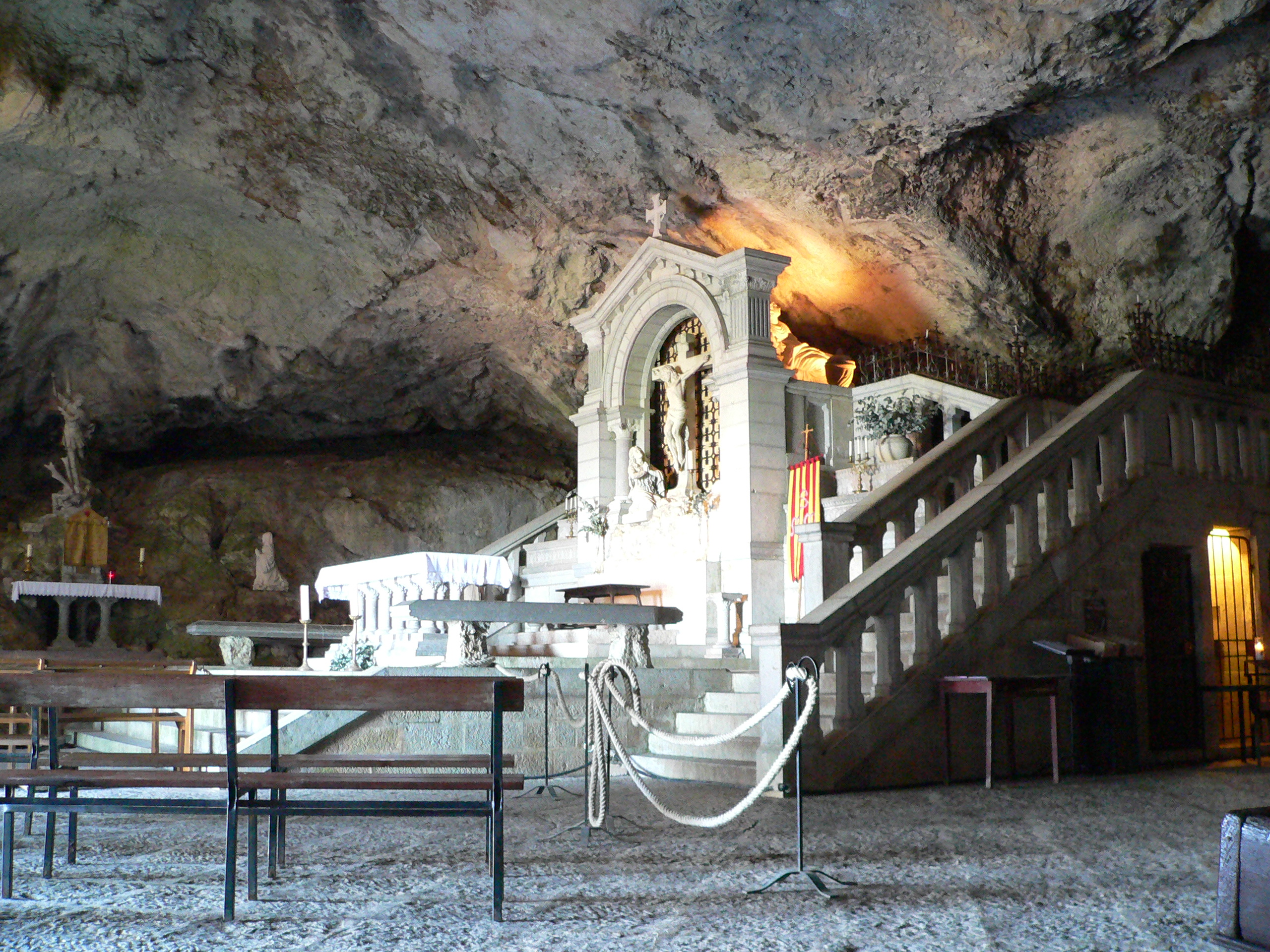
Grotto of Mary Magdalene in Sainte-Baume, by Disdero
http://www.escholarship.org/uc/item/7pz6w018
by Dr. Sarah Wilkins, professor of art history and design.

When Jadwiga was enthroned, however, several suitors appeared, hopeful for marriage and crown. William also appeared at the court in Krakow, as he was thinking now was the right time to got get married, after all Jadwiga was his fiancee. He was bitterly disappointed: the young sovereign declared the annulment of their contract, and the Habsburg duke went home.

Jadwiga got married three years later, she was 13 years old. Her king consort became duke Jogaila of Lithuania, who being a pagan needed to convert to Christianity. And through Jadwiga's influence the last pagan country of Europe was Christianized.She didn't need to preach to pagans: she just made the requirement that he husband to be needed to be Roman Catholic.

Svitrigaila  the owner of holy chalice (which one of two?)  lived with his hopes for Lithuanian throne in Bezlawki, in the area of crusader state of the Teutonic Knights, the military order which also targeted pagan Lithuania in their Northern Crusades. His alliance seemed easy, as the Teutonic Knights were believed to be invincible. Yet they were crushed, one day, and by no one else than his brother Jogaila with armies of allies.Life of Svidrigaila was marked by wars and dynastic struggles. He became grand duke of Lithuania for two years, noting more.

As Jogaila was baptised in Wawel Castle in Krakow, Christianization of Lithuania was official in 1386 The marriage couldn't happen without Jogaila's

 Svidrigialla also got baptized with his brother at the Wawel Castle. He converted from Greek Orthodox faith of his mother into Roman Catholicism.But in his case it was of no great political advantage. 

Because Jogaila became king of Poland, this didn't mean that Jadwiga was now a queen consort. She was the ruler, marriage didn't chip away her power, he was the king consort, but of course both were politically active. Jadwiga was known for her charity, good character and for her support of good causes. She was so much liked and revered by people that she was considered a saint, and legends of her miraculous powers spread. This was a queen of a true noble ideal of a virutous lady.She died young, only 26 years old, after complicated child birth. She and her daughter lived only one month. This was nothing unusual in those days, even among people who were very privileged, such deaths happened among ruling families too.
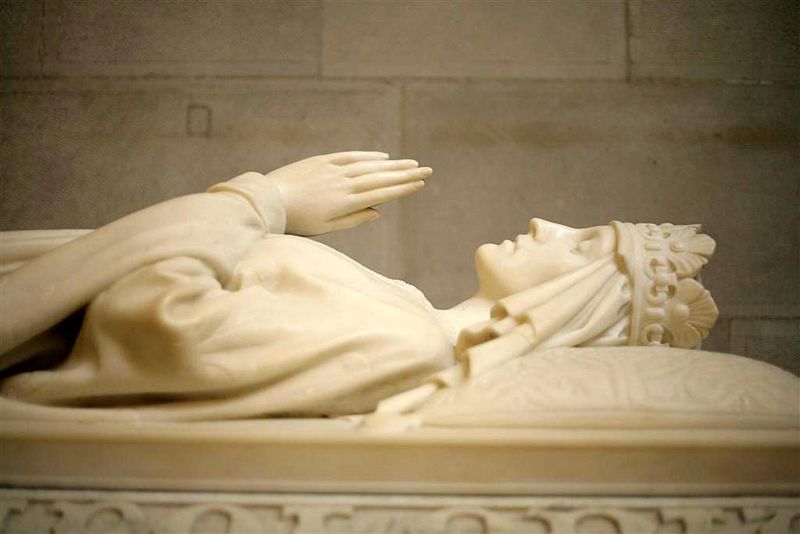
Sarcophagus of Jawdiga of Poland, Wawel Castle Cathedral
After Jadwiga died she was declared a saint by people, and her cult spread. Her relics are in the Wawel Cathedral under the crucifix at front of which she prayed. Even she was considered a saint and worshiped as such, her beatification happened as late as 1980, and she was officially declared a saint by Vatican in 1997, by the pope John Paul II as you may guess. He prayed at her sarcophagus. Pity I didn't take the picture, the sarcophagus sculpture includes a nice lap dog at Jadwiga's feet.Thank you Cezary Piwowarski for the picture. (Dog symbolized loyalty). Close to the sarcophagus her regal insignia are exhibited: the scepter and the globe. They are made of wood, painted gold. Maybe those were lighter for a child ruler to hold, but also she is remembered by her unusual generosity, she sold her jewels in order to support Krakow University (today Jagiellonian University) etc.

After Jadwiga's death it didn't mean that Jogaila as consort was now entitled to rule. There were several candidates, but he was considered the most suitable one, so, he became the king.

 As for pagans in Lithuania: they were left unmolested, their priests also. As officially Lithuania was a Christian country, crusades stopped after battle of Tannenberg in 1410.

Jadwiga's patronage of art and culture is continuation of  Angevin artistic patronage of the Neapolitan Angevin dynasty. She had good examples. In the article you will see also the image of funerary monument of Mary of Hungary, Queen of Naples, who was also patroness of arts, and like Jadwiga also connected to Hungarian Arpad dynasty. Mary's mother was a pagan of Cuman tribe who converted to Christianity in order to marry Stephen V, king of Hungary, and Dalmatia, Croatia, Rama, Bulgaria, Serbia, Galicia, Lodomeria and Cumania; Duke of Styria.

More about grail in Bezlawki, also historical background, soon, I hope, and I hope you enjoy it. Knowing the legend is one thing, but knowing the people in the legend can shed additional light, in my opinion. Again, we don't need to believe in the legend, that there are historical persons it doesn't make it automatically more credible. It is just a legend after all. Wasn't the legend  about Joseph of Arimathea who brought grail to Britain also a legend of Christianisation?


Monday, August 27, 2012

Dragon of the Wawel Castle, Kracow, and some dragon examples

On the left is a snapshot from small part of the courtyard of  the Wawel Castle in Cracow. I revisited this city, I liked to go there since I was in my late teens. When I was a child, like every kid  I read the legend about the dragon, which is actually a founding myth of the city of Cracow. And the dragon's den is still there, the cave at the Wawel Castle Hill, open for the tourists to walk trough its dimly lit entrails, than coming out to the light at the other side, toward the Vistula River. It would be a perfect initiatory cave for pre-Christian pagan worship including symbolic death and rebirth. Only a part is open for tourists, the rest is the domain of the scientists, also the rare small animals living there.Would be also too difficult to pass through, even though the names such as "Coronation Hall" could be enticing.

In the founding legend the terrible dragon lived in this cave, and the voracious  beast terrorized the people who needed to give him lots of cattle as an offering every week. When the dragon wasn't satisfied, he used to devour humans also. The latest version, if I am right dating  from the XVI c. says that a clever shoemaker apprentice decided to slay the monster. No one really believed that he would come back alive, but he did. He filled a sheep skin with sulfur and gave to the hungry dragon. The beast devoured it in an instant, and felt very thirsty right away. The dragon went to the river and drunk, and drunk, but his thirst was not possible to quench. He drunk so much that his belly exploded, everyone was saved, and the courageous and the clever young man was elected the leader of the tribe. In the other version the savign hero, Krak, when he died after prosperous reign, thankful  people with their own hands and effort created a mount, still in Cracow, kurghan -type construction. But archeological excavation of the kurghan (usually a grave mount) didn't result in any finding of an ancient burial.

The older version of the legend, not much known, as was less flattering.This relation dates from the XII c. and was written down by Kadlubek, the early chronicler, and  involves two sons of the tribal leader Krak. The brothers killed the terrorizing beast the same way as the shoemaker's apprentice did, but one of the brothers killed the other, hungry for power. As he returned he told his father that the brother was killed by the dragon, and as a hero he became the new tribal leader. But in two years the fratricide was revealed, and he was expelled from the community. Wanda  the princes became the ruler instead, and she also lead army to battle against invading Germanic powers. The legendary Wanda and the versions of the legends about her was used as argument supporting the reign of some of the female monarchs in Poland, but sadly  also became a part of anti- German sentiments fueling XIX c. Polish nationalism.
Sebastian Münster, woodcut, Cosmographia Universalis, 1544
 Wawel Hill was inhabited already during the stone age, and pagan temple was close to the Vistula river.Cracow was  neighbouring the Moravenses terra Moravia, the short-lived Kingdom of Moravia. First mention about Cracow as a city comes form X c. and the city than was ruled by one of the Přemyslids, a cruel prince who was indeed charged with fratricide.He was the descendant of legendary princes Libuse, and here we come to another ancestor named Krak.  Krak, or Krok was also mentioned in Czech chronicles as father of three daughters, one of them, Libuse became the legendary founder of city of Prague. She was also the matriarch of the Přemyslid dynasty which ruled until XIV. c. and had a flaming she-eagle as their family crest. Prague is still the capital of the Czech Republic, Cracow was the capital of Poland until the end of XVI c. when Warsaw became a seat of Polish kings and place where they were elected.

In general in early history Cracow was thriving, until the ravages of the war with Sweden which was called the Deluge, as created as much destruction as WW II, and big parts of the Wawel Castle were burned and looted. Some parts of the buildings at the Wawel Hill were not  rebuilt anymore, but still the place has a lot to offer. It was a castle of proud monarch who wanted to show their glory. Wawel Castle was occupied by the Nazis, and in German  also can be described as Wawelburg, (Wawelthe name, Burg is castle, German combined words). But is not the same as the Wawelburg  the rumored place of the Holy Grail of also rumored Nazi mysticism. But Wawel Castle has visitors who are searching for the energy of the mystical stone, to the annoyance of the Wawel Castle personnel.

Dragon legends were common in Europe, (and not only there). The dragon of Wawel Castle is one of the main figures in the founding myth, and three is also the theory that Kadlubek just wrote his version of the legend about Alexander the Great battling a dragon, as this legend was very popular during the Middle Ages.Kadlubek was educated in Italy and France, where the legend was popular, known as The Romance about Alexander the Great, based on writing by pseudo-Callistenes. So, we don't know if this was truly a legend in local oral tradition, or Kadlubek's embellishment.

The old  architectural details of the Wawel castle show dragons, also two churches at the Wawel Hill  were dedicated to St George and St Michael, the known in Christian legends as dragon slayers.Churches were not rebuild anymore, just parts of the walls are still remaining. And at the entrance to the Wawel Cathedral, on the left,  are hanging  bones of a mammoth and a whale which were presented and believed through the ages as the true and real  bones of the dragon himself- until the development of more modern of sciences. The pictures of St George and St Margaret, both victorious over dragons, are also present. Dragon was a symbol of evil,  in iconography. But the Slavic dragons also have their peculiarities, and while for ex. the crest of Moscow has St George slaying dragon,  another Slavic capital, Ljubljana has a protective dragon in its crest.  Also quite a number of cities have dragons in their crests, not slayed, just being themselves, as they were also believed to be benevolent.
A heraldic dragon, but not a viwern
But also Arthurian legends were adapted in Poland, and wivern the green dragon of King Arthur becomes the heraldic animal of the Piast  princes of Czersk, visible on seals, crests of cities and towns, also appears on coins. This article is in Polish, but shows the crests with the green wivern. See wiverns in Poland.  Czersk line of Piasts died out in XVI c. Unusual phenomenon in heraldry, as the dragon as such was clearly a negative symbol then. Dragon appeared also as crest of the voivods of Transylvania during the XIV c.

 According to scholar from Maria Sklodowska-Curie University in Lublin, Wojciech Gorczak, Polish heraldic symbols are not well known in Europe, and a common misconception is that the wiverns  appear only in the heraldry of  British Isles, as connected to the Arthurian legends. Gorczak quotes sources where the King Arthur is called "the highest dragon," and of course the dragon is the symbol of the ruler himself. So, quite positive. But also dragon in the same form, but different color as King Arthur's is the symbol of the Mazovian Piasts of Czersk, and became also a territorial symbol.Gall the Anonymous, the chronicler used the word draco-dragon, describing the ruler of Czersk. In Europe only in the Arthurian legends the ruler is described as dragon in a positive manner (King Arthur as dragon) and the Piasts of Czersk. By the way, the Excalibur-like sword is included in the Polish verion too.

In addition Gorczak found that in the old chronicles form the XIII c. are quite number of similarities with the Arthurian legends, and the Grail story.  Presence of Holy Grail legend and place bound with it I mentioned only shortly before in another post. It seems that Poland had a phase of adaptation of Arthurian legends, and some real historical rulers were personifications of common ideas of the romance literature. If you are interested to know more, here is the article by above mentioned scholar, in Polish. Google translator makes funny mistakes, like for example making Industry from the name Przemysl, or Monet is instead of coins, but Polish is complicated. It is easy to understand what the article is about. Interesting how the stories were adapted. Interesting how the rulers were eager to present themselves, or the chroniclers were eager to present them as fitting the ideal of the Arthurian romance.