Showing posts with label Germany. Show all posts

Wednesday, July 3, 2013

Beuatiful Madonnas style in International Gothic and topoi of courtly love

Today i want to show some Madonnas in style which was a branch of International Gothic. Those depictions of Virgin Mary are called in Beautiful Madonnas. This iconographic type emerged in Bohemia (Czech Republic today), and spread to neighbouring states: Holy Roman Empire including Silesia, Poland, Teutonic Knights Crusader State, Burgundy, Austria and France. Not surprising that in the Teutonic Knights' state,   the domain of militant order with their strong devotion to Virgin Mary this style spread rapidly.

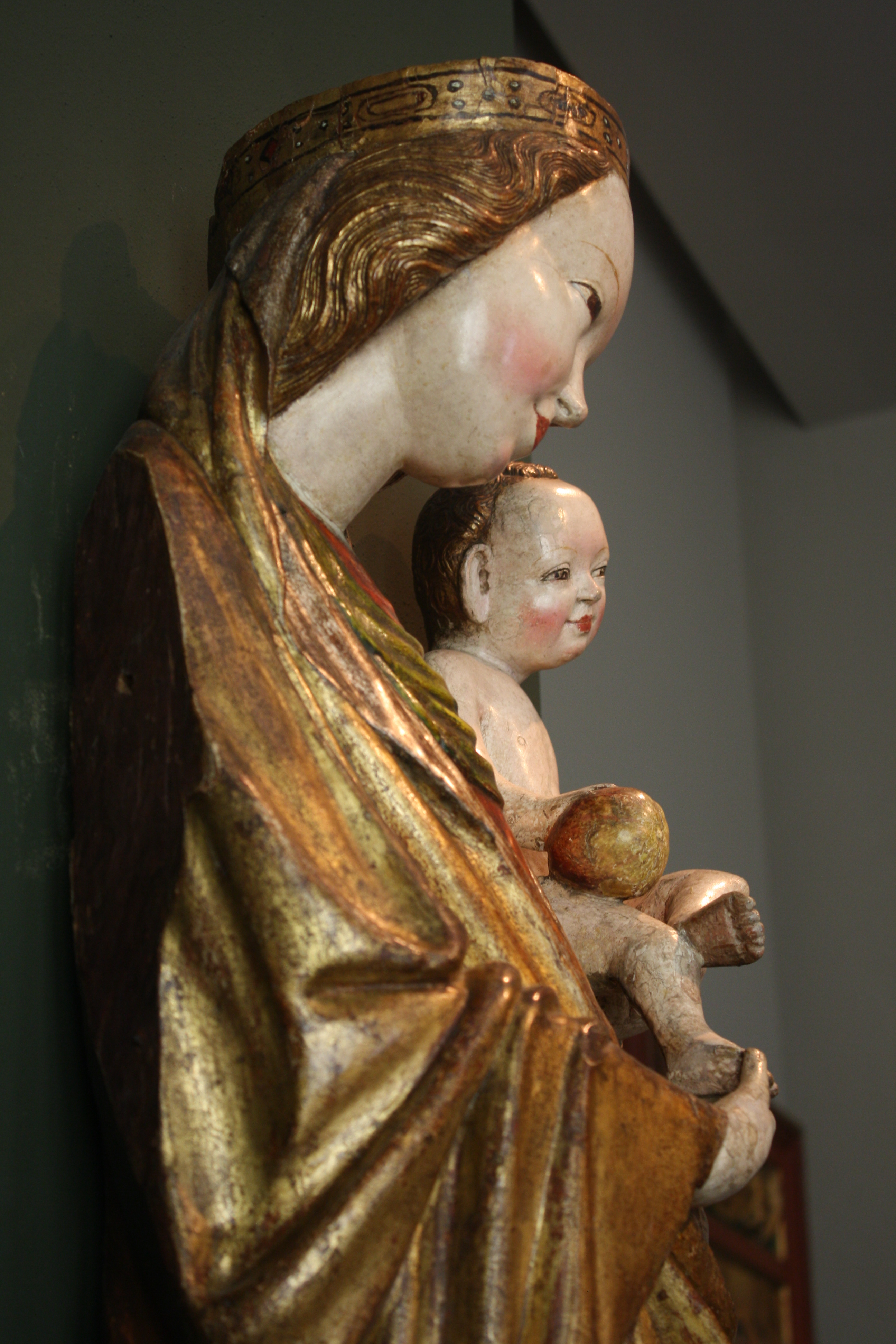
Madonna of Kruzlowa, by Ludwig Schneider/Wikimedia
Beautiful Madonnas were mostly stone sculptures, but sometimes were made wood, sometimes of terracotta fully three dimensional, no reliefs sculptures.

This type was a re-edition of images of Madonna with child, which started already in Byzantium, but this time Madonna was depicted as a very young woman, with delicate hands and small head, beautiful and lyrical. There is a lot of charm in Beautiful Madonnas, it is very sublime style with gentle gestures, cascades of fabrics, emotions showed realistically also the was strong attention to detail as the artists wanted to depict her very realistically, in a less stylized manner. It is all very refined in comparison to the previous styles of representation of her.

Characteristic pose of Madonnas is so called S pose, where the person stands slightly slouching, belly forward, the spine is bend, not straight. This was also a common pose in International Gothic, or High Gothic in general. It was considered very elegant those days.

The example on the left Madonna from Kruzlowa is obviously very young, she looks like an ideal lady of the court culture of her times. About an ideal of beauty in Gothic another time, in a separate entry. Yes, the baby looking as if he was going bald was one of the beauty ideals, also women had very high foreheads, which gave them balding looks. It was a fashion once.

Here the Madonna of Kruzlowa and her child are represented as New Adam and New Eve. This maybe confusing for today's audiences, but there was a lot of theological disputes in the Middle Ages about Mary's role in  redemption of humanity. Medieval allegories and symbols can be strange, but they also can be explained in a simple manner, I hope I can do it without making things complicated: Virgin Mary and her son are the new humanity, both were new people born without original sin. Adam and Eve were the people of old times, before the redemptive powers of the Messiah appeared in human form. Both Virgin and child are human, but also are divine, closer to perfection as born without original sin.  In Catholic doctrine Mary is the co-Savior, and Jesus is Savior of the world. Both take part in salvation of fallen  humanity. Here we see the apple in baby Jesus hand, it has double nature: it is an apple from Eden, but also an apple as globe, part of royal regalia, showing him as the ruler of humanity.

Beautiful Madonna of Wroclaw, Anonymous of Wroclaw or Prague, via wikicommons/ Burgher S

You can view a gallery of Beautiful Madonnas on wikipedia article (which i sin Polish only, but has quite nice visuals.) Those Madonnas represented ideal beauty, those ladies are equivalent of  models of today.  This type of representation was not a stylized Madonna anymore, but one that looked like a woman from real world, dressed like her, standing, gesturing like her, interacting with her child like a real mother from real world.

Also they would be cherished as court ladies, their about their virtues troubadours would sing. Just she wouldn't be so real, as the ladies who were the subject of courtly love were supposed to be extremely virtuous, extremely good.Knight would fall in love just by hearing of their virtues, before seeing them in person. Love of such lady was supposed to transform the lover who worshiped her.

 Even though in secular world the poetry of courtly love also included erotic elements, there was also an element of total sublimation, spread by the philosophy of Neo-platonism. Certain ideas overlapped, for example the idea of total devotion which echoes in mystical writings among others in those by Bernard of Clairveau who adored Virgin Mary, not a lady in earthly form. The lady is so adored, that she becomes unreal, she becomes totally divine. An ideal lady in secular world was of course a queen, and often the Virgin is wearing a royal crown.

Bust of a Virgin, terreacota, Bohemia, XIVc, wikimedia/ Mieow Mieow


The love of the Virgin is similar to courtly love, but of course is platonic, totally mystical, often has symbolic forms, like the Song of Songs was interpreted symbolically. Medieval mysticism, or Mariology in general, can be confusing. Social context and a little bit of social history is needed in order to make more sense of it.

Certain elements of devotion to Virgin Mary have common points in the idea of courtly love, it is strong selfless adoration of a chosen woman. With time an earthly court lady was replaced by Madonna, the Heavenly Lady. When the times of courtly love, fin'amor, (fine love), came to an end, and new era came:  XIII c was time of strong devotion to the Virgin Mary and mystical experience of sublimated love which broke any connections to sensuality.

For example Daude de Pradas who was also a troubadour, wrote that God was ultimate ":fine love and truth," and who loves God is loved back perfectly by him. He used the term fin'amor  referring to God, the term which was used usually in connection with courtly love. Lanfranc Cigala, another troubadour, also wrote about fine love in his religious poems. In his Gloriosa sainta Maria he wrote that he now is praising Virgin Mary as his lady in his songs, as the earthly love gave him only disappointment and pain.

Was this the search for ultimate virtue which gave new characteristics to Mariology? Probably. But also more troubadours than before were admonished not to sing sensual songs after the Albigensian Crusade. At once the culture of Southern France, home of prominent troubadours, became "worse than of the Saracens."  This  is a typical excuse of the colonisers, to talk with contempt about the culture they conquered. It happened later, in cases of XIX c. colonisation as well, putting down on India, Africa, Indochina, etc. But sometimes the conquerors adopted certain things for themselves, "to pity to destroy," as one of my art history teachers said. Troubadours were not only there, but Occitan culture was the culture of troubadours like for example Germany has culture of philosophy and good engineering.

But ardent songs of earthly love had topoi which were easily translated and adopted into mystical experience of platonic love. Song of Songs was symbolic also. Metaphors of religious love included love of parents for their children, love of spouses and also love of siblings. It seems that we humans need things earthly to express things the most abstract but very real at the same time. Mystical experiences belong to such realm of strong abstraction and reality.

The Madonnas included in this article here you can see  in order of appearance in two museums in Poland  Madonna of Kruzlowa is in Krakow,  Wroclaw Madonna is in Warsaw,  and in Bohemian Madonna in New York.Article about courtly love from wikipedia


Thursday, August 23, 2012

Mountain of Venus: legend about Tannhauser

Recently I saw with my husband the movie Wagner's Dream. Totally fascinating documentary (and my husband told me it was very interesting to watch me watching the movie, my reactions, etc.) It was about the Ring of Nibelungen cycle, but this brings me to Tannhuaser, the other hero of Wagner's operatic world, and the legend about Mountain of Venus, a real mountain called Venusberg close to Horschelsberg. Located between Gotha and Eisenau in Thuringia, Germany. This area was explored by ethnographers of the XIX c., the Grimm Brothers included.Certain legends are as significant in German cultural heritage as the legends of King Arthur in Britain. This one is about Tannhauser, a knight and  a poet who supposedly took part in the literary competition at the Wartburg Castle, along with few of other historically known knight-poets.The real life Tannhauser (or Tannhauser, as his name was also written), as a poet wrote very erotic and easy-going pieces, not as refined as the courtly love poems by the other knight-troubadours (Minnesangers in German,  literally singers of love).

The Mountain of Venus itself is located somehow close to the  Wartburg castle. Here according to records (which may or may not be true) took place a competition between Minnensangers, who were German troubadours. Among others beside Tannhuaser very famous names come up: Walter von der Vogelweide, also Wolfram von Eschenbach, who is probably most known as the author of the Grail romance; Perzival.
You can see  them and their poetry in the Codex Manese manuscript

Here at  this mountain  with caves,  according to the legend, Tannhauser, their real life peer,  knight and poet,  met the goddess of love, Venus herself. She was surrounded with her court of beautiful women, and invited him to her subterrean world. He followed gladly, as he was a very sensual person, and through they entered  through the cave into the earth. The knight resided there for seven years. Some versions talk about one year. He enjoyed the easy fulfilment of all his carnal desires, and was very happy, unaware of passing time.  But finally he started to  feel empty, longing for earth, in spite of all delights, including pleasures given by Venus herself.

Venus Cave bellow, auhtor: Metilsteiner.
Venus Cave, Venusberg Mountain, Thuringia
Venus, however, didn't allow him to leave. When he was thinking of Virgin Mary, yearning for freedom, the Virgin appeared in an instant, and all charm of the under-terrestial world disappeared. At once Tannhauser found himself at the feet of the Wartburg Castle.

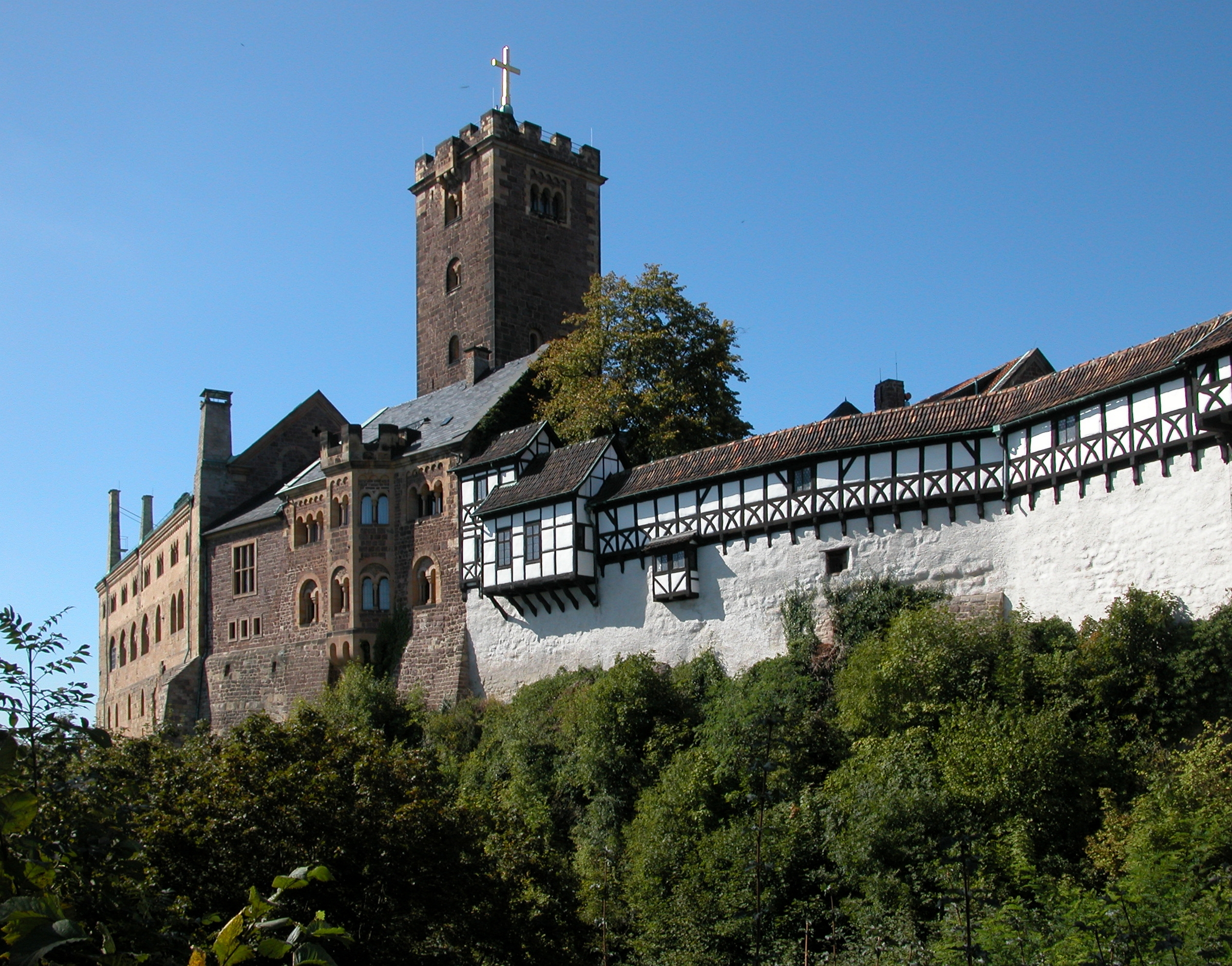
Wartburg Castle,  by Robert Scarth                          .
Yes, the same where Luther was given protection, the house of St. Elizabeth, and the place of competition of Minnensangers, and featured in Wagner's opera Tannhauser. Click on the picture to see high resolution.
Here he felt free , and in a state of rapture collected flowers. It was a kind of religious ecstasy. He decided to confess all his sexual debauchery, and ask Got for forgiveness. However, every priest who heard his confession was too shocked and didn't want to grant him absolution, telling that God will never, ever forgive such sins. Tannhauser even went to Rome in despair, confessed to the pope Urban IV himself, and asked for  forgiveness again. All this made the stern pope very upset: he said that first his pontifical staff  "will rather grow green, and bloom than God will forgive such lust." Depressed Tannhauser departed, decided to go back to the Venusberg, as there was no place for him on earth, he went back to the goddess and her realm of carnal pleasures. But after three days the pastoral staff of the pope greened with lush leaves, and flowered profusely. The pontiff send his  messengers after the desperate knight, but they couldn't find him anymore. The people in the village close to the  Venusberg told them he passed by, with somber face.He was never found again.

Picture on the left  is Tannhauser himself, from page of Codex Manese where some of his poetry are compiled, among them also a repentance song. The Codex is an anthology of medieval German poetry. The legend of Tannhauser made to German literature during XIX c. when literati  started to be interested in folklore and medieval world. But the strongest increase of popularity came after Richard Wagner's opera, named after the poet and retelling the Venus  legend, and the story about   competition at the Wartburg Castle, combined with Wagner's own creative liberties.

The Venusberg story is very interesting for three reasons: first it talks about real-life poet and maybe a real-life poetic competition, fits the history of a  personality, and his creative output into a legend. Second, it is an old legend Christianized, similar as the grail story was Christianized,it is a hybrid. It shows dynamism of a society which was in transition from culture of paganism to conforming into a new religion, and still quite new fedaul reality. The third reason: it gives a moral lesson about forgiveness, which it is not granted freely, and forces the protagonist to go back to the old ways.It shows that people are not forgiving, but the divine forgives. A lot of moralising here: about the goddess Venus and her court, personality of the  poet knight, but also about the hard hearts of the clergy.No one is spared, and in this story the divine gives a lesson that forgiveness should be granted freely and quickly, and this is a true loving way. The story is of course about carnal and spiritual love, and about serving a lady, but it is so multi layered. This were also times when Europe clarified its own ideas of romantic love.

Regarding an old legend combined with Christianity; Sabine Baring-Gould mentioned this one  in his book Curious Myths of the Middle Ages. He reported that the legend appears in its basic version in many countries in Europe, on which the local folklore built other layers. No confession and clerical invlovement is seen except Taanhauser story.Which I was not aware of. Basic version is that under-terrestrial beings want to contact human beings. A man comes in contact with them, has a very beautiful women as  a lover. He longs for earth, and escapes. However, he needs to return, as the earthly world is not receptive to him anymore. Baring-Gould gave examples of stories which have variations, but retain the basic roots. A very folklorist  view. Sometimes a pagan goddess, sometimes the goddess Venus herself  is present, and there is also a motive of ring and the marriage. There are also more mountains of Venus in Germany, also in Italy, there called Venus mountains, or mountains of Sybil. (I wonder if this has to do with Roman presence there). Baring-Gould also mentions that  the story of Tam Lin, tells stories from Catalonia, Farroe Islands, Sweden, Pomerania, Switzerland, etc. and mentions written versions by various ancient authors.Some are more related, some are more distant relatives.

 I also see now the connection between a legend from Poland, about a young knight who went through the waves into the heart of the lake to be married to some beautiful woman who held a court there. He was telling his loyal horse-or loyal friend who was a rider, depends on version- to go to and to tell his family he wedded a beautiful lady of the lake. The mother of the knight in the bottom of the lake knew the  he will never come back. Poland has of course many stories about aquatic world, courts and the cities, as there are so many lakes.

Tannhauser was present among supernatural beings, under the earth. Main ruler of the court here is chtonic type of the goddess, in spite of the goddes being Venus,a conflation. And the idea of under-terresatial folk itself reminds me of a huge bestseller, kind of  the Da Vinci Code of the turn of XIX c. It was a novel about Vril and subterrean super race living in  caves under the earth. The novel was an enormous financial success. Many people actually believed in reality of such race, and this belief was rumored to linger for long. Some of the Nazis supposedly believed it, it was believed in some occult circles, in Theosophy belief in Vril still exists to some extend. It was a novel, but seriously captured people's belief in reality. Vril, similar like the grail, is the idea about power granted, about  fulfillment of wishes. No wonder that both, the grail and the vril resonated so strongly with the audiences.  Recently we had The Secret phenomenon, which falls in the same category:  power of fulfilment of wishes, power of belief. Law of Attraction, another magical world for the frustrated. But I prefer the legends, I confess, Vril and the Secret don't attract me.  Are they an equivalent of today's court of Venus, where first after some time one sees the illusion?

As for the caves in Venusberg: local society hopes they will attract tourism, and the caves were explored. In them are diverse colonies of rare  bats, which hopefully will not suffer in case tourism increases one day. Iron bars at the entrance of some caves make a lot of sense, and here is a responsible way of protecting nature.

Friday, August 10, 2012

Reichenau: the Lost Glory and the Holy Blood Relic

Once Richenau was a monastic island, one big and famous monastery with over twenty chapels and churches, monks dormitories, gardens and scriptoria. Not much is left form its former glory, but still worth a trip. During my visit at the Lake of Constance several years ago in June, Reichenau Island was warm and full of nature's riches. Sweet cherries sold at the roads close to farms were sweet and warm form the sun, and gardens were greening with salads and other vegetarian delights. My photos don't do justice. The farms are small, island itself is small, and everything seems simply charmingly rustic. In the reeds I could hear birds. I went to what is  today UNESCO heritage site, Sankt Georg church, Oberzell, to see what is left from the former glory of Reichenau Abbbey. The monastic island once had 20 monasteries, 25 churches and chapels, and seven hundred monks were dedicated to cultural work. Today only three churches are left.

Columban (or Colomba in Latin)  the famous monk of Ireland came to the area in 610, but was not successufl in converting the Allemain pagans to new religion, went back to the Island Iona, today Scotland.Iona was a monastic island, well known today for the Book of Kells. Hundred years later, Pirin with whom is bound the simmilar legend like with St Patrick- expulsion of all snakes for the island-was the founder of the abbey  in 720,  just shortly after St Gallen was founded.

 Reichenau once was a monastic island, like Iona, had Benedictine Abbey, big and influential.It had the biggest library in the West. In its scriptorium many illuminated books were created, during the X and XI century it was a largest and most influential center of manuscripts creation, possessing huge library, very famous than, and school of painting. Renowned scholars of the day (among them Strabo) and men of great talent worked and lived there. The style of the manuscripts written and illuminated in the abbey is called Reichenau style. It is characterized by simplicity of design and soft, pastel-like colors.

 Click on the link to see an example of illuminated manuscript from Reichenau.
And another example, this time full codex, you can see every single page, in the collection of Walters Art Museum, Reichenau Gospel

And here is the splendid crozier from Reichenau, today at Victoria and Albert Museum in London.The first crown of German emperor was also made here.

And here is Sankt Georg church.  Often is seen on pictures surrounded by field of salad or sunflowers, I didn't have such luck.

Reichenau Abbey, Sankt Georg church,  Oberzell, Reichenau Island, Germany

Reichenau, Oberzell, St Georg basilica, Ottonian murals


The name Riechenau means in old German Rich Island, and it was really fitting. In addition precious relics were donated, important thing during those days, among them a crucifix containing blood of Christ, as was there, also the pitcher form wedding of Cana. Any blood relics were  very important. Still today in the treasury of St Mary and Marcus church,  there are some objects which are preserved, not as much of them as in the times of glory. Pitcher of Can is there, blood relic is in a preserved in the church of Mary, and it is presented in procession Monday after  Trinity Sunday ( don't know the day).


Reichenau, Sankt Georg church, interior with Ottonian murals, by Heidi Fuchs


Sankt Georg church, murals dating from the times of the Ottonian Renaissance. I apologize for the quality, but the light conditions are not favorable for photography. Could't use flash, by principle, and hate when people do, not good for the ancient paintings.


  Carolingian Renaissance was time of great learning, development of scholarship and arts. One of the renaissances predating Italian Renaissance, more famous and influential. What happened to this once famous abbey, center of learning spreading its culture wide? Bishops of Constance mismanaged it when he was in charge of it, starting during XVI c. also the fame of competing St Gallen not too far from the area was a downfall, in addition the forced secularization (XVIII c. finished beginning XIX c.) was a final blow: monks needed to leave, the library of precious manuscripts was send to museums. Over twenty churches and chapels were demolished with dynamite. And act of iconoclasm for sure, this time the secular one.

Here are some grave stones from the  St Georg church.


The glory of Reichenau abbey is lost, but what we have left is beautiful anyway!

 And in the garden of St Mary and Mrcus church is the plate which honors poet and scholar Walahfrid Strabo, (lived during the first half of the IX c.) mentioning that he wrote the first book about gardening in Germany describing 440 plants for healing and for cooking

And what about Ottonian renaissance? It was fueled by closer contact with Byzantium, where the traditions of Antiquity were still alive.And the schism between the Orthodox Christianity and the Latin one was not there, the church was still united. This came because emperor Otto had a Byzantine wife, Theophanu, learned and literate. (He himself was illiterate). Theophanu was an intelligent ruler who brought progressive Byzantine ideas, used diplomatic skills and learned in Byzantium strategies to make her place in history. There were also other learned and influential women of those days, princess Theophanu was the first one. From the family of the emperor there were also women who greatly supported art and learning.

Click here to go to UNESCO's description of Reichenau as the world heritage Site

There is another side in Reichenau: holy blood relic. About it tomorrow.


Thursday, August 9, 2012

Templar Treasure Legends in Poland, Templars-part 3

The believers of  the legends about the knights Templars escaping to Poland have one valid point: Poland was one of very few regions in Europe which practiced religious tolerance. Relatively, for those days. Later in the history several hundred different believers or atheists were killed. Poland wasn't "the country without burning stakes," as sometimes was called. This is a myth. However, the level of religious tolerance was higher than in other European countries, even later in comparison to for ex. tolerant Netherlands. For long no single religion dominated. However, the popular religious movements in Europe were also rebellions of the peasant and those of  urban poor as they spoke against the excesses of the religious leaders and aristocracy. Such rebellions were gladly helped by the feudal lords, who saw those as not only rebellions against religion, but also against their "God given" privileges. The Templars were of the privileged class.

One of the Templars forum member in Poland wrote once jokingly in his post that he will reveal where the Templar treasure is located, and this revelation will cause obsessions, mental illness etc. for those who will search for it. Poland, sadly, has its own brand of treasure hunters, who illegally dig and damage historical sites which could be properly excavated by archaeologists, and properly secured by them in order to prevent further damage. There is something of a touch of madness in such enterprises too by individuals armed with metal detectors, shovels, flash lights and night visors. Directed by greed and in search for becoming another Indiana Jones.Some inhabitants of the places associated with treasures fear them, (damage not only historical sites), and chase them away. In Rennes le Chateau associated with story about Templar treasure illegal digs was also a huge problem.

There are legends associated with Templar treasure in Poland, and in an old German folk song, telling about the Templars, their castle and their treasure in Poland. In Poland the  treasure legends are relatively numerous in comparison to the legend of the location of the Holly Grail, which is bound with one location only.

 I mentioned the legend of Templar fleet which was sailing from Marseilles to the Baltic Sea down the river Vistula already. It was supposed to carry Templar treasure from France, away from the greedy hands of the king Phillipe the Bel.

Some legends mention him by name, and there are other names of people involved, their kinship, if applicable, nationality, etc.One particular legend, which according to another oral tradition, resulted in treasure hunt by the Swedish, who during the Deluge (war with Sweden) were taking apart the walls of the castle of the local lord whose predecessor allegedly took the treasure for himself. This legend is strangely detailed, with the names of all people  involved, all details mentioned above, rank in the  Templar order, events such as hunting,  injuries on parts of their bodies, emotional and family relations etc.Long and very detailed story. With lots of details, which can of course make someones head spin. This is the story how a Polish local lord together with his relatives attempted robbery, knowing about the treasure, when the plan of the robbery didn't bring any desired results-as robbery happened,but  treasure wasn't there- they spied on the treasurer who hid it. (He was form Western Europe). Than they stole the treasure, and were in fight with the treasurer, with swords, when one of the robbers killed the treasurer with an arrow shot form the distance, a very un-knightly behaviour in addition to the robbery.

 I am omitting here the details of the story, which is long, and out of respect for the past troubles which this story excited. I was born and lived not too far from one of the locations of alleged Templar treasures, I respect oral traditions, but I found out that not everyone shares similar respect. Mentioned the treasure hunters already. Not like you and me, for  some people this stuff  simply creates confusion, oral tradition is only as interesting as can allegedly point to the location of the treasure. Sad but true.

The other legends about the Templar treasures are of course bound with the locations of former Templar commanderies, of villages owned by them with sometimes telling names as Templewo. Quite often they are very similar to the legends which were  teaching social mores, and were against the vice of greed. They are very similar to the legends about the treasure connected to the Summer Solstice hoard, just the treasure was Templars' and the access there was only during the Winter Solstice, during the Midnight mass, when the guardian spirits or the devils leaved the place leaving the doors open. The versions tell about one man who found the place, and was courageous enough not to be sacred of the spirits. Each year took some of the treasure, but one year he took too big of the sack, and busy to fill it with riches was captured there forever as the doors closed again when the mass was over. He was changed into one of the guarding spirits.

What about the legends which are not fantastic at all, like the legend above, which mentions just the events, without any supernatural involved? May they be true? Maybe yes, maybe not. People were gossiping during the Middle Ages and later, and were even paid for their gossip, when they told interesting story, as today. Their story might have been a sort of bestseller when they were journeying from village tot village, and from castle to castle, story telling was a profession. As today. Those stories than took life on their own when were retold. But sometimes the stories in oral traditions give pointers to the truth which is than confirmed by archaeologists, as the tale about Johannites, one of the military orders with which the Templars merged. The legend said that those knights were growing unloyal toward the Polish king, and also were minting counterfeit coins. The angry king took over their castle. Today's excavations in the castle lead by archaeologists unearthed minting presses and fake coins of various origins, among them fake coins of the Teutonic Knights, the other crusaders present in the country .

Sometimes I wish the rumors of the treasure will be combined with the treasure found in Poland, extremely valuable, hidden during XIV.c. found during the second half of the XX c. now is possession of museums.Why not to say this was the lost Templar treasure, and stop digging for it? Among the treasure's precious objects was also this beautiful royal crown. It is difficult to appraisals of  treasures, but this one was is worth today from 50 million to 100 million dollars. Fitting rich organization, like Templars.

Via Wikipedia Commons 
 And here is a rather creepy edited video with some castles in Poland, some of them associated with Templar treasure. I dislike the soundtrack, very much to be honest.


 Ruins of the Castle Ogrodzieniec is one of the alleged sites of the Templar treasure location. There is the well, recognized by the cross bars, from which according to another tale appears a huge black hound, very terrifying beast appears from time to time.  This  is the ghost of the one's of the owners who rebuilt the castle, and he was an immensely rich man. The castle itself was very rich. Actually competed in splendor with the royal castle in Cracow. But its owner was also a sadist, very protective of his treasures, and as the legend say, he was punished for his cruelties by becoming a hunting spirit in the the form of this huge black dog.
Treasure were always stuff of the legends, and excited human emotions as lotteries and Las Vegas slot machines are. Treasure stories are also archetypical belong to the quest category.

Friday, April 20, 2012

Gothic Art Outside France? Any Good? Central Europe, etc.?

French Gothic art is very renown, and for good reason. French cathedrals are magnificent, totally awe-inspiring.

Sadly, often it is only Gothic art known to travelers in Europe, and I understand that. Time and money can be a limiting factor. I consider myself lucky, growing and living where I could just take a walk and could step in a welcoming interior of a Gothic cathedral. Or a Gothic church, or a Baroque one, and other international styles. For sure this can nourish your aesthetic sensibilities. This is one reason I write this blog, to be able to share what I got for granted.

Sure, Reims, Chartres, Notre Dame, etc. are worth the journey, are iconic. So are Paris, Giverny, Carcassonne, and other beautiful places. So is Cologne with magnificent and finished cathedral towers.Stump-like towers of French cathedrals are unfinished, you know, those towers with flat tops? Those are unfinished ones, not just the intention of the builders.

Other German cathedrals or Gothic churches are also worth the visit. They look very much like the French ones, but the towers are usually much taller, truly the intention of Gothic, often with open work spires, lacy. Gothic was architecture which ambition was to grow as much in height as possible, the ideal was  to get the numbers of the ratio of walls and floor space as much different as possible (1:1 would be a bad ratio!) Cologne cathedral has 1:4 ratio of surface vs. height. French cathedrals get to 1:3 ratio. It was like a racing toward the sky, and often the attempts of getting the ratio to the extremes resulted in collapses of the cathedrals.Here is shown what you can see, and hear at the Cologne Cathedral.


And here are the magnificent bells an the exterior of Cologne Cathedral


  But there is of course beautiful lot of Gothic art in other countries too: England, Spain, Portugal, Czech Republic, Poland, Baltic States. Poland and Baltic States have examples of brick Gothic.
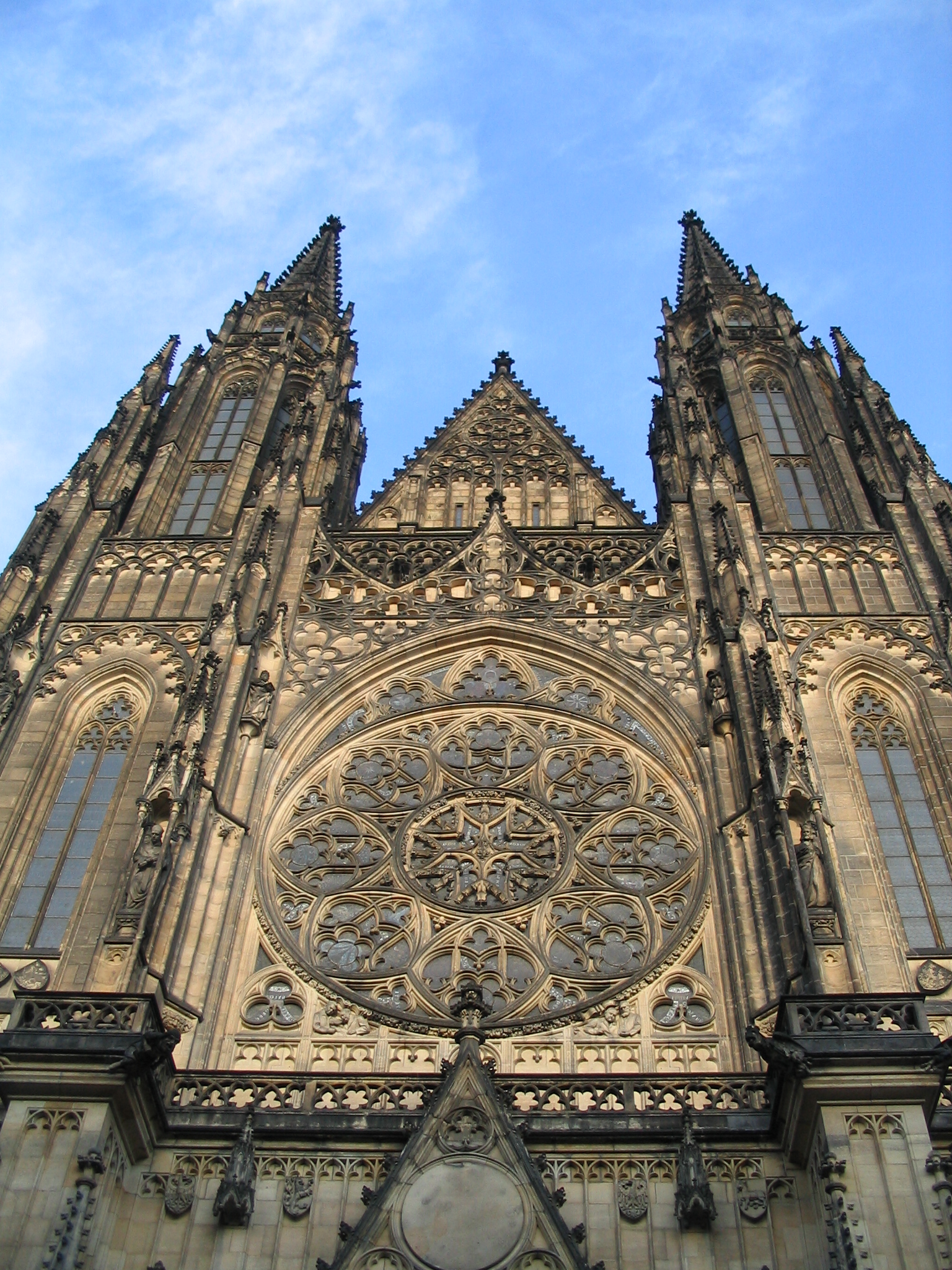
Portal of St. Vitus Cathedral wit rose window, stone masonry, Prague, via wiki commons courtesy of Vaylag

With mass tourism being such lively enterprise, many people are able to see a lot, but often this is knowledge given by the tour guides. Pity when among Gothic cathedrals only Chartres or Notre Dame rings the bell, but Amiens is a total mystery. I mean I don't argue to visit all possible sites, but to read. I wonder, maybe it is the fault of art historians, or popularizes, or people like me who can't make the subject interesting? For ex. authors who make Chartres a place of mystery reshaping its once famous cathedral school, (but one of many cathedral schools of the day) into some esoteric tradition school have the upper hand, as captivating story is given. Facts can be captivating? I think so, but then I am an art history geek.

There is also a curious situation regarding the Middle Ages: most popular knowledge deals with Western, parts of Central Europe, little with Eastern Europe. Byzantium is kind of a lost empire. Prague, luckily, developed into a tourist attraction. Krakow (Cracow) seems to be on its way now. I am Polish, and I am sometimes surprised when some people are surprised when they see that this country had Romanesque, Gothic, Renaissance, etc. It seems that it was such an empty hole in European history, regarding some countries, due to long slumber behind the iron curtain. Once I felt like someone coming totally out of empty space when I watched supposed to be educational video (US produced VHS), about Battle of Vienna. It made me laugh, as the video mentioned only prince Eugene of Savoy, as army commander. No mention about Polish army, even though it was a bi-national enterprise, and actually the Polish king, Johan III Sobieski was more in charge than Prince Eugene. Not that I care so much, and during times of Wikipedia such things are corrected, but it was really funny, how big of  a hole in knowledge can be created in one piece of material. One of the most decisive battles in European history, two big armies of two nations, and you totally forget one army plus the commander in chief? What a curious and amusing case of selective blindness! Cold War legacy? ;-)

Along the line of random info spreading, the Czechs had their own brand of Protestantism, c. one century before Luther (Jan Hus, Czech Brethren, etc.). Poland had religious tolerance guaranteed by law, including Statutes of Kalisz, about the protection of Jews. (Not as bad as in other countries, but it didn't mean it was a totally safe heaven). Religiously different people lived there, including the Cathars. The Kinghts Templars too. Or other crusaders who went for Northern Crusades, (often turned against Poles) . One blog writer from Czech Republic claims that every village in his country has some legend about the Knights Templars. Templar legends in general are not so very French-centered.

 Lots of mysterious, interesting stuff in other parts of Europe. For example devil in Polish art was treated as humorous nasty  figure and was often ridiculed, not a scary being like in the Western Europe. Devils form St. Mary Church in Cracow were painted in strong colors. In another Central European country, Germany, devil was feared, and stakes witches were burned. The conspiracy theory about witches came to Poland during the Renaissance, when the witch hunts intensified, but it was less common, and actually the Latin Church was not by law excluded form participation: only secular power did it. Strange? No. This is info is to point out the diversity of Europe during the Middle Ages and the Renaissance.

I don't have links about Gothic art in Slovenia, but Gothic went there via Prague, and Parler.I am mentioning Slovenia, as it it a very pictoresque country, (my hubby loved it), which enjoys, rightly so, many tourists visits. Very, very interesting landscapes, history, architecture, coasts in general.
A beautiful Corvin Castle in Romania you can see clicking on this sentence.

Here is a link to a site, in Polish; I apologize, but just for the sake of the pictures. There are iconic examples, such as Chartres, Nuamberg, Limbourg Brothers, Sluter, Crucifix of Geron, but also believed to be a miracle working crucifix from Cracow, and other examples, like the biggest Gothic altar in the St.Mary Church in Cracow, or probably the first authoportrait by Peter Parler in Prague, and wonderful St. Vitus Cathedral, Malbork Castle, and  "armor Madonnas" (Crusaders art, can be opened as cabinets!), and other exciting examples. The other is the link to St. Vitus Cathedral Wikipedia article. Enjoy!
http://www.historiasztuki.com.pl/001_KANON_GOT_2.html
http://en.wikipedia.org/wiki/St._Vitus_Cathedral