Showing posts with label symbolism. Show all posts

Monday, July 8, 2013

Iconography of Anounciation of Merode Altarpiece by Robert Campin

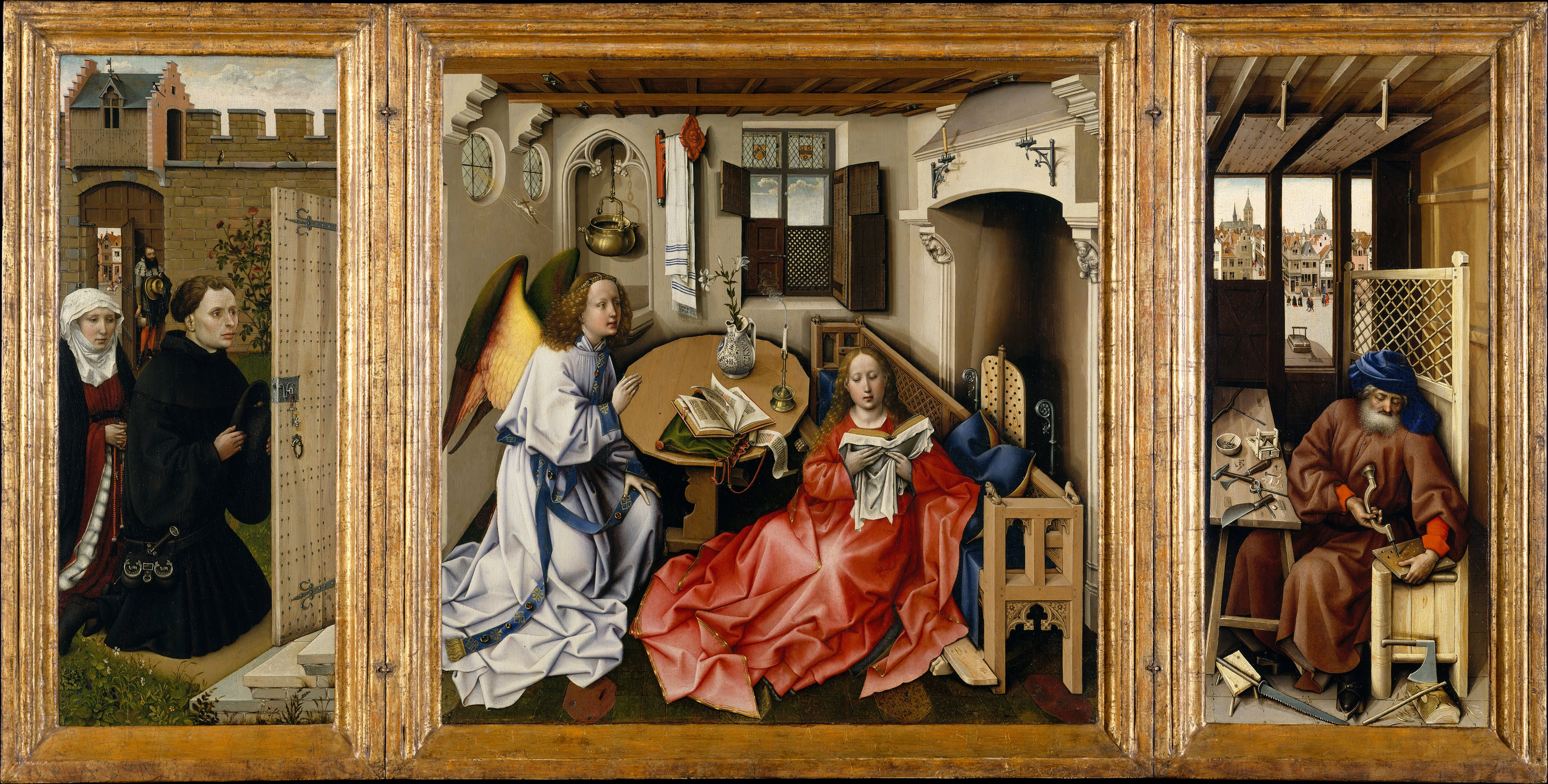
Robert Campin and apprentice, Annunciation triptych, Merode Altarpiece,  1427-1430 Cloisters, New York

This version of Annunciation is rich in symbolism which was easily understood by average person of the days this altarpiece was commissioned. Today anyone interested can see it at the Cloisters, branch of Metropolitan Museum of Art in New York, but in today's world an average person doesn't understand its symbolism. Usually someone notices what is going on and who is there, as we are trained to understand different type of symbols. This painting belongs to Northern Renaissance but has still many elements of Late Gothic. Click on the picture to see it bigger.

Who is there?  From right to left: Joseph, engaged in wood working in his workshop, secluded an din a different landscape as we see through the window. Virgin Mary, absorbed in reading a book and she is not noticing the Archangel Gabriel yet. Archangel just arrived, he looks as he is about to kneel.  Above him in the air  on the rays of light there is a tiny baby Jesus with the cross. Merode couple kneeling outside, open or semi-open door at front of them.Maybe they are watching the scene. And close to the wall in the background we see a messenger. As for those who dismiss Virgin Mary as Virgin Mary on artistic depictions anytime she is dressed in red: this is Virgin Mary indeed, and she was often depicted in this color, specially in Northern school to which the painting belongs, and no, she is not pregnant. The bump under heavy draped robe is just  her knee.

Joseph made two mouse traps. This relates to the sermon by St Augustine who described incarnation of Jesus as a bite for Satan, in some way as mice are trapped in mouse traps. There are two traps, if they represent Jesus and Mary as two participants in the process of incarnation, etc. I prefer to say I don't know instead of giving you my guesses. This can mean many things, and there is debate among scholars, so, as I am not someone specializing in this part of art history, I leave it at this point how it is, no point of adding my opinions to it.

The central panel has symbols of Mary's purity: white as color symbolizing purity, white vase and white lily (chastity), also the wash basin and towel: Mary was called a pure vessel.  Archangel Gabriel also dressed like a deacon, in white, underlines the idea of purity. I like the respect shown for books, they were considered precious objects and this painting shows it.

On the table the scroll represents  Testament, the book is the New Testament. Book represents law, here is the fulfillment of what was written in the book. Green of the cache for the book  is the color of hope, Paradise and resurrection. It is not symbolizing fertility in this case, as it is religious painting, not secular one, and green is tied to Paradise and resurrection. The incarnation of the divine here is not regular event relating to natural earthly fertility.

The candle which is extinguished symbolizes divine light extinguished in order to become human, in order to incarnate in human body. The divine light in eternal aspect is shown on the wings of Archangel: gold or yellow in its place was also symbolizing divine light. The window which now shows the sky and family crests was painted in gold earlier, before over-painting with what we see today. Seven rays on which baby Jesus is traveling stands for divine light, seven rays: seven is the sacred number. Bu the dark color on the wings stands for depth of divine mysteries, for which black stood. The tiny carved lions on the bench are symbols of the seat of Salomon.

 Red robe of the Virgin symbolizes her love: ( agape the unconditional love), charity, redemption by the sacrifice on the cross, but also is a fashionable robe of the days in a very expensive color. Campin showed a domestic setting, and fashion of the days, which was typical. Old paintings are also valuable resources for costume historians and costume designers, as there is so much historical information, specially in the case of the painters with great attention to details and skills in rendering them. What we see also is an interior of a typical home in a city. Usually Annunciation was shown in a church or palace, here we have an interior of a real home. Campin was a painter for the city people, not a painter for aristocrats or churches. This small altarpiece was not intended to be installed in a church, but was an object of private domestic devotion.

The courtyard where the three people who are real life persons of Campin's days are present (donor with his wife and the messenger) is alluding to garden, but is not the same as in depiction of Virgin Mary in gardens: here it is is more cloistered, not much vegetation. Those gardens were cloistered gardens, in which the Virgin was depicted but had more vegetation, here it is more sparse. Still it is enclosed garden, hortus conclusus, which symbolizes Mary's virginity. Here the vegetation relates less to Paradise, which was typical in those hortus conclusus types of paintings, but the flowers represent the virtues of the Virgin: rose stand for her charity, violet for her humility.

The scenes are like almost everyday situations, except angel showing up. In Gothic slowly the divide between sacred and real human life started to narrow. Here we see religious scene happening like in real life, the saintly people don't even have halos, it was unusual. Painting saints without halos happened one century later, in Renaissance Italy.

Perspective in this painting is partially correct. It is not a typical linear perspective, where mathematics rules.Here those rules are bend and we have some twisted angles, like for example the table is painted correctly to the rules, this is not realistic, but allowed the painter to show more details. Sometimes artists do such things in order to make greater visual impact. For example Pieta by Michelangelo, where Mary is so much bigger than Jesus, yet for viewers it looks very natural.

 Bellow we have another painting of Virgin, this time with baby, in an interior by Campin, for comparison. I think now you will be able to read with ease the symbols contained in this domestic scene.


Monday, August 20, 2012

Yellow: Triumph and Fall, history of color #11

Yellow is unusual in art history regarding the attitudes people had toward this hue: it was held in high esteem until did fall low.

First during medieval times yellow was replacing gold when it was too expensive for the project, like for example usage for the background in frescoes, large surfaces. Sometimes of course, gold was used on frescoes also, it depended on how much a community could spend. Yellow was a much cheaper alternative and still represented divine light. In an earlier post I wrote about symbolism of gold as representing divine light, as the color symbolism is theological). But yellow wasn't used symbolically only, also when needed to give some beautfil robe to a saint, for composition purposes, the color was used freely.

Chromatically yellow is also the lightest color from all chromatic ones. (White is non chromatic). Also it was used in illuminated manuscripts, as we see in this masterwork of medieval art: the book of Kells, from Iona, dating from the times when Irish monks spread their culture and knowledge in Europe. Columba was visiting Reichenau, as I told you before. This folio showing Christ enthroned makes use of yellow, which is fine of a color to even line the cross and painted as color of Jesus' hair. The birds are peacocks, about symbolism of this bird in this this article. The circles at the feet, surprise, surprise! Those are angels, called Thrones, often depicted as wheels, sometimes as wheels with eyes and wing, specially in medieval Byzantine art. Wanted to mention it, as they are not uncommon, and people wonder about what is it. But also can mean the heads of the nails of the cross. The book Christ is holding represents the divine law.


Christus Enthroned, Book of Kells, Ireland, library of Trinity College, Dublin, via wiki commons


 The figures are angels, one angel is a seraf as the posture of his wings indicates (lower corner on the right, will write more about angels another time). This part of a wonderful lecture later describes the peacocks too: as incorruptibility of Christ's flesh, with chalices and hosts.

Closer to Renaissance the elevation of yellow to color of light started to diminish, when art started to be more realistic, the golden backgrounds fell out of fashion. Now yellow started to be viewed as color of falshood and treason. It was used to brand those who were considered socially less acceptable: prostitutes, Jews, heretics. Jews were ordered by law to wear yellow badge. About yellow as color of prostitution I wrote already when I wrote about Mary Magdalene.

And as we see in this fresco by Giotto, yellow was assigned to bad people.Jesus has a loving peaceful face, he is dressed in red and blue, Judas in all-yellow garment.
Giotto, Kiss of Judas, Scrovegni Chapel, Padua, Italy, via wiki commons

Cathars after Albigensian Crusade were forced to wear yellow cross, as badge of shame. Of course they couldn't be Cathars by choice, they needed to provide prof of marriage and repent, than their live were saved. Repentant heretic was important, as too many heroic personalities burned on stake wasn't good advertisement for ideological side of religion. Some of  information about Cathar religion we know from writing of a Cathar convert to Catholicism. Those crosses called las debanadoras were to be worn always outside the house. It depended on the depth of involvement in Catharism judged by the Inquisition in a trial of , if a person needed to wear one cross or two (front and back). Those crosses were usually six inches wide and had height of eight inches. Unless one was of aristocratic birth, the badge of shame was to be worn for the rest of someones life. Many simply didn't comply, or were unrepentant. It was not a simple badge of shame:Cathars didn't like the cross as a symbol, this refusal of the symbol was written in their religious philosophy. It was much more cruel punishement than a known more widely and younger scarlet letter for adultery. Following link will bring you the wikipedia articles about Cathars and yellow cross http://en.wikipedia.org/wiki/Cathar_yellow_cross 

As for heresies: they were not considered a religious offenders only, but in Western Europe heresies were viewed also as treason against the state, and considered anarchy. This was also one of the  reasons why it was relatively easy to prosecute those who didn't conform. Rulers were offended by heresies, specially because almost every heresy also criticized materialism of the status quo, preached poverty or renunciation of material world, Catharism did it to.


Monday, April 16, 2012

Mary Magdalene:Colors, Robes and Archetype History of Color # 8

I noticed in my blog's statistics that some of you came to my blog searching for info about the colors of Mary Magdalene's robes. I must have been a disappointment to see so little about it. I hope this entry will give you more of satisfying information.


Red was very common when she was depicted, but other colors were not rare either. I feel I need to move beyond the Middle Ages, as I was writing about vermilion robe of Mary Magdalene already. I am focusing in this post on Latin Christianity. Byzantine Christianity depicted her also in red robes, often with red egg in her hand. In this tradition she also she was considered extremely virtuous, one generation older than Jesus, died in Ephesus, her relics (body) were revered in Constantinople. Disappeared of course, maybe together with other relics after sack and looting of Constantinople they, tradition say were brought to Western Europe. But we don't know for sure what happened.

Mary Magdalene, Orthodox icon
 Red was often the color of choice by the later painters as well, but I would advise not to rely on red so much. Some people do, to some degree of annoyance of the well-educated art historians, when the non-art historians try to convince them, sometimes quite harshly,  they know it better because they read a few popular books. Thing can turn rather grotesque.About annoyances and my defence of art historians  later, in another entry, now I focus on colors and Mary Magdalene as a cultural phenomenon.

Magdalene was shown in red robes, quite often in a green dress. Green symbolized eternal life, color of paradise, hope and promise of eternal happiness in heaven. Green of the  paradise was shown already in the early Christian art. Shouldn’t be confused with non-religious matters, when green symbolized rebirth, Spring, fertility, hope in matters other than theological. It is important to know about such differences, not only for knowledge sake, but also for avoiding mistakes, for example reshaping Mary Magdalene into fertility goddess, as it sometimes happens in some books authored by some non-art historians. The context of the art matters, quite a lot.

 Red was common, yes, but not an exclusive color assigned to her only, nor she was shown in red only. This is a curious misconception, recently spreading. I would like to know about the sources of it. Assuming that she was shown only in red robes, isn't in relation with factual history of art, it is  huge over-simplification. Red in religious, not secular tradition  represented  love in sense of charity, (agape), martyrdom, sacrifice on the cross, redemption through crucifixion.

 But she was also depicted in lush and colorful robes, rich and beautifully embroidered, often golden. Look at this picture, which I got through twitter. One of many examples of colorful robes, from the collection in Kassel Museum, Germany. Cloak is elegant subtle shade of red.
Mary Magdalene and Jesus as Gardner

Or click to see life of Mary Magdalen at Chartres Cathedral stained glass window. Click on links to different images, and you will see range of colors, blue included.

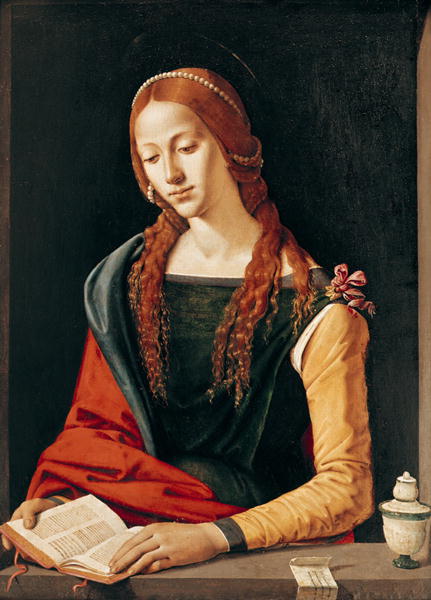
Form gold we go to yellow, which was in certain times the color assigned by law to the common prostitutes and courtesans. Red wasn't. There is another misconception that red was color of prostitutes, which is not true: yellow was. Red sometimes only. I wonder if this assumption comes from Scarlet Letter? Who knows. Mary Magdalene could be dressed in yellow, or only be a part of her garment, like for ex. the sleeves were yellow, the dress itself  is black and white, and no cloak. Etc.

Piero di Cosimo, Mary Magdalene, public domain, via Wikimedia Commons


Penitent Magdalene by Artemisia Gentileschi,via wikimedia commons


Colorful, rich robes were shown too, or in very subdued colors, when she was depicted as a meditating penitent. Or dressed in shiny silvery silk, XIX c. And I am glad she was not depicted in red only, and not in vermilion only. She captured the imagination of the people of Latin Christianity as a very colorful personality anyway, as someone who lived a whole spectrum of human emotion and full spectrum of ethics. Why she should be than depicted in one color only? It would be very limiting. She was considered the accessible saint, giver of hope to fallen humanity, and as a personality more a symphony than a simple melody. She was one of the Latin Christianity highly elevated persons who was somehow considered unclean at the beginning.

Mary Magdalene by Jan van Scorel, via wikimedia commons
To the masses of believers she was the embodiment of a phenomenon of transformation. From a women from whom seven demons were expelled, a prostitute by profession, who than became no less than "Apostle to the apostles," the title given her by the Catholics church, a base metal changed alchemically to gold. Transformation which Oscar Wilde one described as: "every saint had a past, every sinner has a future." Initially a bad girl, but with golden heart, also in accordance to some societal views about the harlot with a heart of gold. Europe loved such stories, Europeans were not Puritans. La Traviatta is one of those stories, for example. I don't think there is an equivalent in the US. Different cultures, different views, different archetypes.

And she was an embodiment of a loving, yet a very independent woman. Sometimes I am asked if I believe Mary Magdalene was the Grail. Depends what you understand as "grail". To me grail as an archetype can’t be confined to the ideas of biological reductionism. Grail of the legends itself is an archetype of a quest, and it is elusive, as quest is often about elusive goals. Many people are on quest, but don't know what the quest is about. And nothing wrong with it. Mary Magdalene: it is nothing wrong in being a parent, it is something very noble in parenthood. I respect that. But did she really need to be a mother, a cup bearing diving DNA in order to be more important to us?

Penitent Mary Magdalene, by Vaccaro, via wiki commons

We may find out that today we are less tolerant toward her than the people who didn’t believe that she was the mother of Jesus offspring. Those people loved her anyway, even when they believed she was a reformed fallen woman. It seems they were quite  forgiving. She was loved and venerated the way she was perceived, with all her imperfect humanity, the way she was seen. Imperfect saint? People didn’t mind. This is not about who she was historically, as stories were often confused. Mary the Egyptian for example, or dispute which body was the real Mary Magdalene, as at times there was more than one body claimed to be Mary Magdalene's. Holy relics were not such clear business, and there are also cases of spurious claims. Her story is not so much about her, but very much about us: how much were are willing to accept in a person, specially in a women, in order to consider someones contribution a worthy one.

 And how many prejudices we have. Her story is a very interesting case in social history, indeed. Interesting, unique perspective in a Guardian article by the novelist and  columnist who was herself a prostitute, Tracy Quan. She mentions her visit in Southern France to see the relics whom she considers to be her patron saint. Specially important, I think, is the quote engraved on the stone tablets along the steps leading to the cave said to be saint's meditation hermitage: "Blessed are those who have been persecuted." Quan noticed this quote as she climbed the stairs. To me Quan's article was a gentle reminder and a rebuke, to all, me including, calling to not forget those who are in need, no matter who they are, or how "lowly" they are. Over a millennium and half Latin Christianity's message regarding this saint was: stop marginalizing, be open to others. 

The founder of  the first church in Europe was Lydia. She was a business woman, dealing with luxury goods prohibitively expensive purple cloth. She was unusual for the place and times, when women were considered deficient human beings, with human rights comparable of that of children assigned to them. Why she is not talked about now, along with Mary Magdalene? Not sexy enough? Not enough of sensationalistic dramas? No way to focus on her genitals/womb, as it was done in Mary Magdalene's case, and still is today?

In general this turmoil about Mary Magdalene and women, being not given enough enough respect,  not given enough place for them in the church, as much as it is healthy and good has it own flaws: conveniently blaming the Catholics for everything evil seems to be a little bit displaced, when we take women as archetypes. In Orthodox Christianity there was no mention of her as prostitute, and there she also has churches devoted to her, and the legend saying that she traveled to Ephesus, stayed there and her grave is there. After the schism this is a competing legend, as the legend  of Mary Magdalene traveling to France is more well known, as Western Europe is more well known. To me the position of Mary Magdalene is more problematic in Protestantism. It seems to me that the Catholic sisters of Protestantism don't complain as much about women not given enough place in the church theology, except complaints that women can't be ordained. And other issues not relating to theology, which I omit know as they don't relate to the subject directly. Mary Magdalene was always a very popular saint, tin Catholicism, if not the most popular one after all.

Here is Mary Magdalene in brown robe of a penitent, those often were extremely crude, made of goat hair or crude wool (other races of those animal than today), or was she was supposed to be covered only by her long flowing hair.

Ascension of Mary Magdalene, Anonymous, via wiki commons
Mary Magdalene here taken to heaven is dressed in coarse penitent robe, or according to the legend, 
her naked body was covered by her very long hair.
Their (Catholics) equivalent of the Sacred Feminine, a term so often used now, is Virgin Mary, given the title of the co-saviour, as saving together with Jesus. Mary Magdalene is the  apostle to the apostles. And other women saints. They say those personages are just humans among the Protestants, who reject cult of Virgin Mary, etc. not divine enough. Should we reject their opinions as illogical? Given the number of the churches devoted to Virgin Mary and and Mary Magdalene in Catholic countries in general? Look at the picture above, is this disrespectful? The word "vilified" is often used in relation to Mary Magdalene. Is she as vilified as it is complained in popular opinion? I think we need to to look deeper, it is easy to repeat catchy phrases, which can be emotionally satisfying, but on the long run those phrases make things shallow. And the subject of Mary Magdalene is not shallow, not matter which tradition we analyse or which one we like.

Art history gives another picture. On the last example above she is rather glorified than vilified.And it was one of many kind of depictions of Mary Magdalene.


Saturday, March 31, 2012

Lost Secrets of Chartres Blue? History of color, and why astrology in a church?

 A story instead of history? It happens.

Some people believe that making of blue color from the medieval stained glass windows of Chartres Cathedral was kept very secret, and the secret vanished. Since Middle Ages no one was able to re-create the famous Chartres-blue. Interesting story, very romantic, but simply not true. It is a part of cultural phenomenon involving romanticizing and sensationalizing art history. Specially the mystery of Chartre's blue was beloved during the era of Romanticism. Such sensationalizing happens most often in archeology, but art history isn't free from such exciting modern legends.

 In fact, there are enough of ancient "recipes" for making stained glass which survived until today. Problem with medieval recipes is that they often don't makes sense, because terminology is confusing, like for example the idea that sapphire was added  in making stained, glass, when this was also latinized name for  saffer, which was name of cobalt oxide. Often the color is also affected by patina, impurities, or the main compound: the sand. Subtle differences matter, for ex. if the was taken from the river or if was sea sand. We can't know exactly, we know which compounds were added, but in which form we don't know. Also the combination of blue with other colors on the installed window itself makes it look specific way, using the optical principle of color contrast.

But modern glass makers are fully capable of recreating the" mysterious" or "lost" Chartres-blue. It is sad to think so little about their skills and talents. Maria Rzepinska in her expertly researched book about history of color mentions those recipes, and even tells how color of the glass mass changed in relation of time involved in heating in the glass making kilns.Known phenomenon, nothing new,  just a reminder. Also some impurities, air bubbles, etc. which were the result of working in more crude conditions affect the color. Today's glass is extremely  pure.

But there is the  kernel of truth in this disappearance story: after the Age of Faith the Chartres-blue, or to be more exact, the presence of  strong colors diminished to almost disappear from stained glass windows, to reappear during XIX c. in their full glory.

So, what is the secret?

Stained glass window, with the Zodiac Sign of Pisces, Chartres Cathedral, via Wikimedia, photo taken by Dinkum
  It fact after the Middle Ages there was less interest in installing very colorful stained glass windows of the types as those seen in Chartres and the other Gothic cathedrals or churches. The reason was simple: colorful stained glass windows were prohibitively expensive. The cost of stained glass was closer to the price of precious stones than to the cost of the stained glass of today, as Maria Rzepinska says. (And she has also has a strong supportive bibliography which is a great resource for me). We also need to keep in mind that in addition to the already extremely high cost of its production, Gothic stained glass windows were very thick, which made the price even higher than those which are made of thin glass panels today. And thickness makes colors more intense too.Stained glass windows at Chartres Cathedral are for example c.1 inch thick. Due to progress of technologies, today's stained glass which is similar to the glass of XIX c. Gothic Revival has only a fraction of the thickness (c. 1/8 of inch) of the Gothic glass window panels. Gothic Revival brought colored window back into buildings but adjusted with new technologies. Religious buildings of the Middle Ages needed masses of expensive glass.
The tastes also changed, after jewel-like colors of the  Middle Ages white and grissaille glass became popular. With time people also became less religiously devoted than during the Age of Faith. Unstoppable religious enthusiasm which fueled building of the great cathedrals simply diminished with time.

 The window above is a curious case in popular imagination, as some other objects at Chartres. Many people think the Zodiac signs were too esoteric, and foreign to the doctrines of Christian religion, and as such couldn't find place in any church building.

One thing: Zodiac isn't anything unusual in Gothic churches. Actually it was a common subject. Astrology was intertwined with astronomy, as other proto-sciences of the day were.  Proto-science was called natural philosophy in those days. Zodiac itself represented to people God's role in creating order in Universe, and showed the idea that all things are inter-connected. Medieval people, even priests, didn't have problem with Zodiac. Zodiac wasn't esoteric in real sense, it was a perfect illustration of the idea of perfect order in the Universe.

The science of old was a mixture of experimentation, science, theology, metaphysics and superstition. The divide between science and theology, philosophy and metaphysics was drawn first during the XVIII c. Astrology was part of sciences and was legitimate than,  and was as legitimate as anatomy today is legitimate part of medicine.  During the Middle Ages astrology was part of medicine, and even clerics learned astrology. What the Church forbid in relation to astrology  was the belief in fatalism, and astrology was supposed to be something which didn't determine human fate completely, it was supposed  to give people some free will. Even Newton was still involved in a mixture of philosophy, theology, science and even alchemy. This of course relates to the history of science itself, but as you see art history involves partially history of science, not only in this particular case..

Zodiac window at Chartres cathedral from Sacred Destinations travel page

Here another one stained glass window, very jewel-like.
Stained glass window at Chartres cathedral, via Wikmedia, courtesy of Juan J.Rodriguez
 As the there was no clear division between the rational  and irrational in medieval sciences, as the division between science and religion didn't exist in the form  as we see it today, the same was with fine arts and crafts. Art and crafts were woven together in the same aesthetic system, and art often imitated craft. For example the stained glass window as above was reminding of jeweled and enameled objects crafted by jewelry makers.

 Mentioning Rzepinka again: she writes that people believed the only difference which existed between precious stones and stained glass was  that the natural jewels possessed magic powers, and glass was not effective. Even clerics were writing that the powers and colors of precious stones were virtues given to them by God. We need to take in account the differences in human knowledge and thinking when interpreting art done by humans from eras long gone, if we want to understand their art more fully.

Jewel-like aesthetics in stained glass windows was later replaced by imitative qualities of painting. Even during XIX c. particular paintings were recreated as stained glass version, a tribute to the value of the art of painting. Painting became "true" art," stained glass became craft. But as it was the case with theology, mysticism and proto-science, there was no divide between art and craft, no value judgement in this regard. Medieval mind was kind of holistic mind.

I have chosen those windows not only because stained glass is such a strong mark of Gothic art, but also because shows the duo of blue and red, a color contrast of the Middle Ages.
Tomorrow more about medieval zodiac and science, more about blue in illuminated manuscripts.


Saturday, March 24, 2012

History of Color # 3 Not Colorful Enough, or?

Medieval fresco with traces of paint,  monastery in Baden Baden, Germany.
 
 Dramatic scene. Expressive image, emotions shown in movement, clarity of composition. Fine work, but 600 or 700 years ago it would be considered just not colorful enough. Brown  was perceived as  a very ugly color, just way  too humble. Those contours were the first step in painting, preparatory drawing before filling in color. But we can appreciate it very  much. Similar situation of differences in perception of beauty through ages is the case of the sculptures and architecture of Antiquity, from Greece and Rome.White, unpainted marble  delighted and delights modern sensibilities, but for the Greeks and Romans was just way too plain.
So, lots of paint was put on it, often in garish colors. But the Medieval colors were not really garish, as I mentioned before,  they were jewel-like, as imitating colors of precious stones was so important then.

This is the stone vault of the bell tower of Freiburg Cathedral. This beautiful Gothic construction detail of the tower of the tower is beautiful for us today, but centuries ago  would be just much too grey. When it was newer, it was fresher, much lighter, but still  it was just a technical detail. Even though, it is touching to see the clover leaf adornment chiseled out of stone with such love for detail.


The tower itself is one tenth of the mile high. When I was there, I first visited the framer market at front of the cathedral. After all during the  medieval times markets were common at front of such visited sacred houses. I truly enjoyed this market with buckets of freshly cut flowers, organic food, fragrant hand made soaps, it was very sensual, music, colors, fragrances.  Than I entered the cathedral, looked around, contemplated the art, so typical for a visit on a trip. It was more elevated experience, meditative, sublime.

But this place also offered one  interesting option in addition: to climb the bell tower tower, to be able to see the bells and to admire the view of the old town. Of course I needed to do it. One tenth of the mile high climb: narrow, rather steep stairs, spiraling, twilight.  The climb seemed have no end to me. And than at the top this unusual feeling when you face all those bells which are tons heavy, this stone vault beyond which is the spire of lacy stone carving, becoming less and less material, the essence of Gothic architecture, sublimation of the material world into the heavenly one.  And the view of the blue sky. It was a very strange juxtaposition: stones and the sky.

We, the viewers of today, we like patina. Old artifacts are allowed to have patina, their market value can even diminish if the patina is removed. But for people of Middle Ages, this vault would have been too dirty.
Yes, there is accumulated dirt on the vault, but we don't mind it as much as people would do hundreds of  years ago. They disliked brown, grey, as those colors don't have enough chromatic intensity. Poor peoples' clothes were in neutral colors of raw fabric, made of flax, wool. Wool was often beige, or brown. The richer ones wore colors.

Those stones from the Reichenau Monastery, which was once of the greatest centers of learning, hosting a very large library, and busting with life, are charming to most of us, modern viewers.


But than, a thousand years ago when scribes of Reichenau produced delicately illustrated books, this combination of brown floor tiles and gray stones would be plain ugly. Medieval mind loved color. Bright, luminous color.  Neutral colors were not of much of use in art.

There were of course exceptions, like frescoes in Umbria, Italy, painted with lots of browns. But this is unusual. Other exception are Cistercian monasteries, with simple, unadorned interiors.Cistercian church is beautiful to us, in its simplicity, and probably was considered as such by the monastic community which valued the life of poverty. But the general idea of the times was that a church is supposed to represent to some degree a paradise on earth, or the heavenly Jerusalem, and needs to be adorned with pure colors.

From my experience when discussing Medieval tastes for things colorful, pure, shiny and glossy, sooner or later comes a comment: "but they were so terribly dirty!" (This comment comes when discussing Rococo also, understandable). However, the idea of Middle Ages as filthy ages is disputed by historians. Some lean toward  idea that indeed, dirt was common, and there is truth in it, but others point otherwise, and there is also truth in it. For example Byzantine Empire had system of waste removal, water flushed toilets, and high level of hygiene. Latin Middle Ages had the system of public baths, which were more like spas: hangouts were it was possible to take a bath, eat while soaking in the communal  bathtub, and  listen to life music, to gossip, and play games. Bathing was a social occasion, and baths were frequented, making the members of the bather gilt rich. Banya in Russia, sauna in Scandinavia, hot springs through Germany and Switzerland, and numerous public baths everywhere point to rather cleaner people than we are willing give them credit for.

 For example in Poland bathing was so common that even the beggars were entitled by law to get free bath every two weeks. Or some in Europe monasteries might have as a rule not to bathe, but others required cleanliness rule to follow. Even some of the old monasteries were build close to hot springs, and bathing was a symbolic action of washing away sins, after confession. Above mentioned monastery of Baden Baden was close to hot springs. The Church didn't oppose hygiene, and was advocating cleanliness for health reasons, but was against a habit of too much bathing, as it seemed to be addictive to some: every day several hours in bathing house. I know, i know,  I digress, but so many people have imprinted in their minds that Medieval times were ages of filth and darkness. I felt compelled to give additional information,as we talk about colors, splendor and light in Medieval art..

For more detailed information about Medieval hygiene, read this very interesting article.