Showing posts with label Poland. Show all posts

Friday, July 5, 2013

The supposed "heresy" of "All men are born equal" part 1


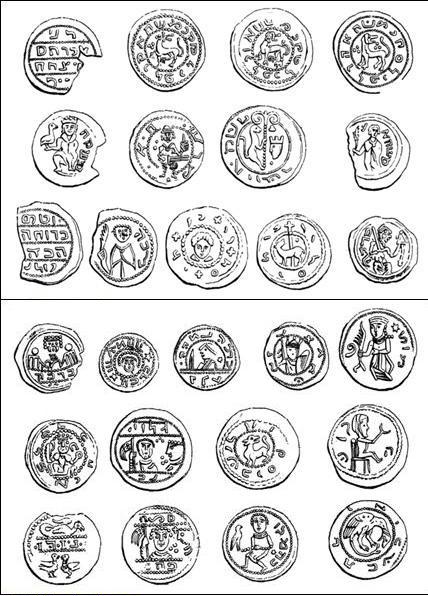
Polish Medieval coins with inscriptions in Hebrew
Yesterday was 4th of July celebrations in US. This time I am moving away from my chronological plan, and move in the next entry about this subject into 16th and 17th century Poland,  some "heretics" there dared to declare that "all men are born free." This included women too. Those people ideas influenced thinking in Europe, and then found it bloom in American Constitution. Do you know that Newton, Locke, Founding Fathers and other influential thinkers had their writings  in their libraries, or knew some of the thinkers in person?

The story of Socinians, Arians, or Polish Brethren as they were called, is the history of religious tolerance becoming persecuted fro freedom of conscience and pacifism. About them in the second part. Before I will write about them specifically, I need to explain a little bit more why I am doing it, about roots, and liberties  protected and abused.

This Summer I will write more about Poland, as there are interesting subjects you normally will not encounter easily. I hope I will not appear like Gus from My Big Fat Greek Wedding who promotes Greece such way that whatever is good it must be Greek. I will be writing about Poland, good and bad, also about roots of ideas, not only about Polish  Brethren who influenced Enlightenment in Europe and American Constitution, but also about Bogomils who influenced Cathars, Czech Brethren who were before Luther, and Arabs who influenced science and courtly love.

Poland once was a very unique country in Europe; had religious freedom guarantied by law.  There is a reason that there are Polish legends which talk about people escaping from other countries and finding safe haven in Poland. It was once called "a country without burning stakes." This is only partially true. And also the story of Polish Brethren, quite unique about whose ideas I was thinking yesterday in relation to American Constitution. Their story is story of intolerance in a country which was supposed to be tolerant,as declared to be so. Freedom can be very fragile, and needs to be protected. I will one time write more about burning stakes in Poland, but Polish Brethren were expelled form Poland. It was a tragedy because tolerance was guarantied by law.

Other people were not as fortunate to be "only" banished. Just some idea about it: Jews came to Poland because there were prosecuted in other countries. Many came from Spain. In Poland it was a unique situation Chapter of Jewish Liberties, known as Statute of Kalisz. It created a Jewish nation inside Polish nation. Please, take time to read this document, it is from 13th century, as it is very interesting, on English wikipedia are only some points out of original 36 , but still interesting.

Sounds good, right? For example the chapter forbade accusations of blood libel. Once world world's largest Jewish population lived in Poland, because they came there, escaped, looking for protection. Yet one Jew in Krakow was accused of desecration of the host, and he was burned on the stake. In Silesia 50 Jews were burned on the stake because they were accused of blood libel. Were such accusations forbidden by law?  Their freedom was supposed to be guaranteed by law, and I don't buy the argument " that it was unusually few casualties in comparison to the rest of Europe."  No, such comparison simply doesn't make it better, less tragic.  No need to ignore the problem, because the victims deserve better.  Even this one person in Krakow who was burned because he was accused of desecration, this is one human life too many.

There was also hysteria during epidemics, riots etc. No person should have been even harassed because of differences in creed, ethnicity etc. Those people came to Poland because they wanted protection. It is no need to be lured by numbers and compare it to other countries in Europe which were much worse. Comparing to even worse isn't ethically sound at all. In relation to  human lives and dignity. Even one victim is one too many, period. 

Wojciech Gerson, Reception of Jews by Casimir the Great, painting from 1874

History of Jews in Poland article can tell you more details, about riots, blaming Jews for black death and so on. It was not only freedom of religion and freedom profession on equal level with Christians. There were also abuses of freedom and human rights.

How strange is the contrast of Statutes of Kalisz in comparison to WWII. Non-Jewish victims in Poland were 3 millions, which was 20% of Polish population killed. Three million Polish Jews killed counted for 90% of Jewish population in Poland. We humans were we not supposed to be  "more civilized" during XX c?  After the era of Enlightenment people less enlightened than during Medieval times?  Antisemitism was than sponsored by the communist regime. Freedom need to be protected, always.

In comparison to those XXc. prosecutors, the king on the picture above was more enligthened. He not only reconfirmed the favorable laws of his predecessor who lived century earlier, but added additional protections. Freedom need to be protected, always.

Wednesday, July 3, 2013

Beuatiful Madonnas style in International Gothic and topoi of courtly love

Today i want to show some Madonnas in style which was a branch of International Gothic. Those depictions of Virgin Mary are called in Beautiful Madonnas. This iconographic type emerged in Bohemia (Czech Republic today), and spread to neighbouring states: Holy Roman Empire including Silesia, Poland, Teutonic Knights Crusader State, Burgundy, Austria and France. Not surprising that in the Teutonic Knights' state,   the domain of militant order with their strong devotion to Virgin Mary this style spread rapidly.

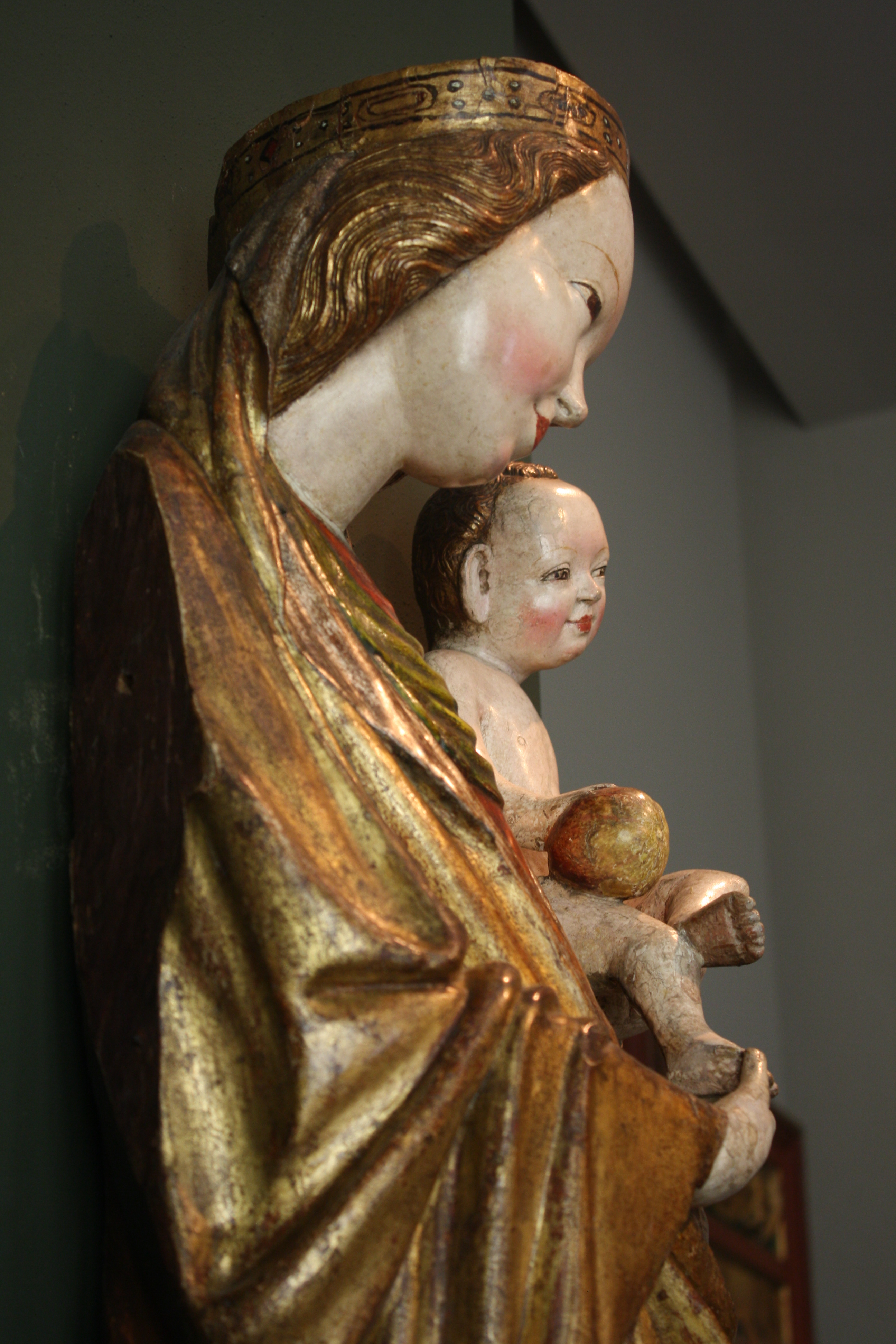
Madonna of Kruzlowa, by Ludwig Schneider/Wikimedia
Beautiful Madonnas were mostly stone sculptures, but sometimes were made wood, sometimes of terracotta fully three dimensional, no reliefs sculptures.

This type was a re-edition of images of Madonna with child, which started already in Byzantium, but this time Madonna was depicted as a very young woman, with delicate hands and small head, beautiful and lyrical. There is a lot of charm in Beautiful Madonnas, it is very sublime style with gentle gestures, cascades of fabrics, emotions showed realistically also the was strong attention to detail as the artists wanted to depict her very realistically, in a less stylized manner. It is all very refined in comparison to the previous styles of representation of her.

Characteristic pose of Madonnas is so called S pose, where the person stands slightly slouching, belly forward, the spine is bend, not straight. This was also a common pose in International Gothic, or High Gothic in general. It was considered very elegant those days.

The example on the left Madonna from Kruzlowa is obviously very young, she looks like an ideal lady of the court culture of her times. About an ideal of beauty in Gothic another time, in a separate entry. Yes, the baby looking as if he was going bald was one of the beauty ideals, also women had very high foreheads, which gave them balding looks. It was a fashion once.

Here the Madonna of Kruzlowa and her child are represented as New Adam and New Eve. This maybe confusing for today's audiences, but there was a lot of theological disputes in the Middle Ages about Mary's role in  redemption of humanity. Medieval allegories and symbols can be strange, but they also can be explained in a simple manner, I hope I can do it without making things complicated: Virgin Mary and her son are the new humanity, both were new people born without original sin. Adam and Eve were the people of old times, before the redemptive powers of the Messiah appeared in human form. Both Virgin and child are human, but also are divine, closer to perfection as born without original sin.  In Catholic doctrine Mary is the co-Savior, and Jesus is Savior of the world. Both take part in salvation of fallen  humanity. Here we see the apple in baby Jesus hand, it has double nature: it is an apple from Eden, but also an apple as globe, part of royal regalia, showing him as the ruler of humanity.

Beautiful Madonna of Wroclaw, Anonymous of Wroclaw or Prague, via wikicommons/ Burgher S

You can view a gallery of Beautiful Madonnas on wikipedia article (which i sin Polish only, but has quite nice visuals.) Those Madonnas represented ideal beauty, those ladies are equivalent of  models of today.  This type of representation was not a stylized Madonna anymore, but one that looked like a woman from real world, dressed like her, standing, gesturing like her, interacting with her child like a real mother from real world.

Also they would be cherished as court ladies, their about their virtues troubadours would sing. Just she wouldn't be so real, as the ladies who were the subject of courtly love were supposed to be extremely virtuous, extremely good.Knight would fall in love just by hearing of their virtues, before seeing them in person. Love of such lady was supposed to transform the lover who worshiped her.

 Even though in secular world the poetry of courtly love also included erotic elements, there was also an element of total sublimation, spread by the philosophy of Neo-platonism. Certain ideas overlapped, for example the idea of total devotion which echoes in mystical writings among others in those by Bernard of Clairveau who adored Virgin Mary, not a lady in earthly form. The lady is so adored, that she becomes unreal, she becomes totally divine. An ideal lady in secular world was of course a queen, and often the Virgin is wearing a royal crown.

Bust of a Virgin, terreacota, Bohemia, XIVc, wikimedia/ Mieow Mieow


The love of the Virgin is similar to courtly love, but of course is platonic, totally mystical, often has symbolic forms, like the Song of Songs was interpreted symbolically. Medieval mysticism, or Mariology in general, can be confusing. Social context and a little bit of social history is needed in order to make more sense of it.

Certain elements of devotion to Virgin Mary have common points in the idea of courtly love, it is strong selfless adoration of a chosen woman. With time an earthly court lady was replaced by Madonna, the Heavenly Lady. When the times of courtly love, fin'amor, (fine love), came to an end, and new era came:  XIII c was time of strong devotion to the Virgin Mary and mystical experience of sublimated love which broke any connections to sensuality.

For example Daude de Pradas who was also a troubadour, wrote that God was ultimate ":fine love and truth," and who loves God is loved back perfectly by him. He used the term fin'amor  referring to God, the term which was used usually in connection with courtly love. Lanfranc Cigala, another troubadour, also wrote about fine love in his religious poems. In his Gloriosa sainta Maria he wrote that he now is praising Virgin Mary as his lady in his songs, as the earthly love gave him only disappointment and pain.

Was this the search for ultimate virtue which gave new characteristics to Mariology? Probably. But also more troubadours than before were admonished not to sing sensual songs after the Albigensian Crusade. At once the culture of Southern France, home of prominent troubadours, became "worse than of the Saracens."  This  is a typical excuse of the colonisers, to talk with contempt about the culture they conquered. It happened later, in cases of XIX c. colonisation as well, putting down on India, Africa, Indochina, etc. But sometimes the conquerors adopted certain things for themselves, "to pity to destroy," as one of my art history teachers said. Troubadours were not only there, but Occitan culture was the culture of troubadours like for example Germany has culture of philosophy and good engineering.

But ardent songs of earthly love had topoi which were easily translated and adopted into mystical experience of platonic love. Song of Songs was symbolic also. Metaphors of religious love included love of parents for their children, love of spouses and also love of siblings. It seems that we humans need things earthly to express things the most abstract but very real at the same time. Mystical experiences belong to such realm of strong abstraction and reality.

The Madonnas included in this article here you can see  in order of appearance in two museums in Poland  Madonna of Kruzlowa is in Krakow,  Wroclaw Madonna is in Warsaw,  and in Bohemian Madonna in New York.Article about courtly love from wikipedia


Tuesday, June 25, 2013

Perished Mary Magdalene's old collegiate church


Virgin Mary and Mary Magdalene are two women who are the most represented  in the history of Catholic church. Mary Magdalene is the second most shown woman, so we can safely say that as a saint she is the most represented after Virgin Mary. Both Marys are also shown in the type of images called assumption into heaven. Both were honored, and Mary Magdalene wasn't  marginalized as a saint, wasn't pushed into fringes of Catholic faith because the tradition was that she was a reformed prostitute. The marginalization theory is often repeated, and I think I understand where it comes from. Catholic church is most often pointed out as the main villain here, because she was labeled as former prostitute, but the fact gets overlooked that she was exceptionally honored also by the Catholics. I will give you an example of many, the collegiate church built in her honor.

This  was a collegiate church in Poznan, huge as a cathedral, which had a Mary Magdalene school adjacent to it. It was a high school, founded in 1303, the oldest secular school in Poland. The school must have been quite liberal for its days, as sometimes there were fights among the Catholics and the "heretics," when the students started to use fists in order to win arguments. Short tempers aside, but the fact that under the same roof were studying people who often represented very opposing views is nothing so common in old days. The picture above, by Alberti ( thank you Radomil) shows how big the building was even as  a ruin, in late XVIII c. It was built in the Middle Ages, once was one of the biggest Gothic churches in Poland, and the symbol of the city of Poznan. It was as big as St. Mary Basilica in Cracow, than the capital of Poland, but St. Mary Magdalene Collegiate church had even taller tower: 20 m (c.67') higher. The church was destroyed, the school survived until  today. Some trivia: among famous guests Chopin visited and gave concerts there, also the  school was awarded prestigious Order of Polonia Restituta Knights' Cross.

From Civitates ORbis Terrarum ( XVII c.) printed in Cologne
Why I am writing about a church which doesn't exist anymore? Specially because so many St. Mary Magdalene churches exists, or existed all over Europe. Fair point. But this one  has intersting history, which is very representative regarding two Marys, also how medieval art or architecture was treated during XIX c.

According to medieval chronicles, the  collegiate church was founded  in the middle of XIII  century. It had to do with urban planing: the city of Poznan was supposed to be moved to the other side of the Warta river, and people had idea to built a huge collegiate church.  One side had already St. Mary's Cathedral, so, it was decided that the new patroness should be St.Mary Magdalene. Very typical: Virgin Mary as the main super star, Mary Magdalen close to her in fame. Here Mary Magdalene with her church became something of a founding mother of the new city. Nice hommage. Also the church  was under patronage of the dukes of Greater Poland. Another trivia: those were the dukes who took Arthurian legends seriously, even styled themselves according the legends, also had crest of Lancelot. Maybe the dukes were the founders themselves, it is not clear. Other patronage later, when the ducal  lineage died out was taken by the king of Poland, from rather remote capital of Cracow.

The collegiate church of St. Mary Magdalene was different from a cathedral only in some aspects: it didn't have bishop's throne in it, ( the cathedrals have it), was not the sit of a bishop in the administrative sense, but it had body of clergy, canons,  member of a chapter in a similar manner to cathedral.Those members of clergy  who also have special honorary privileges were allowed to elect bishops. So, it was quite a prominent church. This church is one of the artistic examples of Mary Magdalene's prominence in the Catholic fait.

It took long to finish the construction work, very typical for those days too. Today what is left on this location  is only a plazza, one sculpture in a museum, the heart of a bell,  and an archeological dig.

 Once this church had 52 altars, 27 chapels, the tower was 114.8 m tall (376' ) high enough to be listed among tallest church towers. The tower was slightly shorter than the tower of Chartres Cathedral (115 m). The width of St. Mary Magdalene church was 42 m, had three naves  (Chartres has 32 m to 46 m width). St. Mary Magdalene's church was was 70 m long "only" as compared to Chartres, imposing 130 m length. In feet 233, and 433. This is addressed  to those who are familiar with Chartres. However, 70 m length of a church isn't little either, actually it is a lot. In comparison to the cathedral in Poznan (St. Mary's Cathedral) this church was only 2 m shorter in length, but wider 6 m (20') than 36 m wide St. Mary's Cathedral. If devotion can be measure in meters and feet, not bad at all for a saint who was considered a former prostitute. Mary Magdalene got a church which was actually bigger in square meters or square feet measurements, with a  taller tower than the local cathedral. Mary Magdalene wasn't much on the margins.

This model of the church is nice (thank you Poznaniak). I don't know how accurate it is, if during medieval times the roof tiles were so big in proportion to the rest of the church? But I am not an architecture historian. Today the size of the roof tiles would indicate average building in Europe, which this church was of course not. So, squint you eyes to get maybe better feel for the real proportions. This is artist talking in me.

The church suffered the last of devastating fires at the end of XVIII c. People tried to rebuild it, but lightning caused  the wall to fall , and in 1802 the consensus was that the church will not be rebuilt. Those were the times when medieval heritage wasn't as much appreciated as it is today. For example Prussian administration  (Poznan was occupied by Prussia at this time) ordered to destroy the medieval city walls. I didn't know if the people gave up, or the Prussians administration didn't give permission, as often happened, the church is lost forever. But not blaming the Prussian here: destroying parts of Medieval heritage wasn't so uncommon. Krakow, then under Austrian occupation, lost its medieval walls too. For example Paris doesn't have the Old Town anymore because it was destroyed in order to make way for modernisation of the city. Cloisters Museum in New York exist because the old monasteries were considered worthless in France, were in a state of ruin. An appreciative American bought it and shipped to US, cloisters were lovingly re-assembled. Good for us and future generations.

Some churches were demolished by purpose, explosives were used. Chartres again: it was planed to destroy the cathedral, as some were destroyed already, explosives were set, just someone, lucky for us today and the future generations, decided that the explosion will create too much of  unnecessary dust clouds. French Revolution: some churches, if survived the destructive zeal directed  at Medieval and religious art,  were supposed to be converted to the so called "temples of Reason." Sigh...

Today the archaeologists excavate what is left from the St. Mary Magdalene church. They found interesting objects, also conduct genetic research of the human remains found the collegiate church, as it was also the resting place of many prominent figures in local history. Archeology is very interdisciplinary today: DNA testing allows to know quite a lot about public health in earlier days, genetic illnesses shared by members of similar population, or families, etc. In  earlier days  big help for archaeologists was carbon dating, today they have also DNA testing to their disposal, scanning of the grounds or objects, aerial photography, impressive inventions. What comes next, I am curious.

Alberti ,Ruins of the church of St. Mary Magdalen in Poznan, via Radomil


Sunday, June 23, 2013

Holy Grail in Bezlawki, part 1, Escape after Hastings


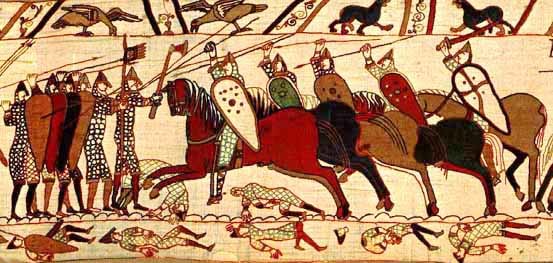
Bayeux tapestry, battle of Hastings. Via wiki commons, by Maxim

This blog has been neglected for long time. I planed and promised to write about the legend of the Holy Grail in Bezlawki, today's Poland. I mentioned before that it seems that Arthurian legends were very well received in Poland. But the legend of holy Grail in Bezalwki has some not very semi-historical events in it, and had people who are historical too. However, I am not saying here we need to believe the legend because of its historicity: it is just a legend based on real facts.

This is a story about a battle, escape, two chalices, two fighting brothers, the crusaders and a tower.
The battle in question was the battle of Hastings, when the last Anglo-Saxon king, the Harold II of England Harold II of England was killed. His children escaped to Denmark, as they were not safe anymore when  William the Conqueror became a new ruler. Short reminder: the mystical object of Medieval times, Holy Grail, was believed to be several things, one version was that it was the cup, or a chalice, into which Joseph of Arimathea collected blood of Jesus during the crucifixion. It became the ultimate  blood relic, which was brought by Joseph of Arimathea to the British Island. One version say that is connected to the Glastonbury Abbey.

 The tradition  also say that it was taken by escaping members of fallen dynasty more East, in order to save their lives, three people. They found refuge at the court of Danish king, their relative. They didn't escape empty handed, as you guess the story goes, they took  what they wanted, or rather what they thought was so precious they couldn't bear to leave behind. Among precious objects they considered worthy not to fall into the hands of William the Conqueror were two chalices, (from Britain and Greece). Finally  the grail was installed in this church, in Bezlawki, on the picture bellow. It stayed there for several centuries, still during the twenties of XX c. one travel book writer, Orlowicz, claimed he still saw one of the chalices in the church.

Church in Bezlawki today, empty, wiki commons, courtesy of Severus


Who were those three expatriate children of Harold II of England as real historical people? One of them was Gytha of Wessex Gytha of Wessex, who later became the wife of  Vladimir II Monomakh, the  ruler of  Byzantium influenced Kievan Rus. He is also known under name of Waldemar. Gytha's and Vladimir's son is mentioned in Norse sagas, there he is called Harald  his Slavic name was Mstislav. One of the brothers, Godwin, became the ruler of one of Lithuanian principalities, a duke. How it was possible? This was XI c. but Lithuania still was very similar to VI c. Britain: like at the court of king Arthur the knights took decisions during an assembly. Upward mobility was possible, still, during those days for a warrior who was considered worth of rule.

 Back to  Bezlawki: it was far away, actually when the chalices, (or chalice? ) first were installed there, the building which is the church today was not a church at all, but the fortified  tower of the crusaders. Not the Knights Templars, often they are associated in modern versions of the story with holy grail, but in this story we have Teutonic Knights, the worshipers of the Virgin Mary, with black crosses instead of red ones. They were  Order of Brothers of the German House of Saint Mary in Jerusalem. Knights form Europe joined them, not only from Germany. They were invited by pious Polish princes, Prussian Crusade was part of their military enterprise.


Church in Bezlawki, another view, wiki commons, courtesy of Jerzy Strzelecki

The Teutonic Knights came into the posession of the chalices later,but  it wasn't a war loot . It was a gift. From a rather pious ally.

Teutonic Knights, as a military order on a mission they  pressed East, however,  not South but  North, and who like those knights who went to the Holy Land got the blessing of  pope, they fought the  non-Christians, in this case the pagans, of today's Poland and Baltic states. They build a fortress which at the timescut the most east into the territories of the pagan Prussians, the Baltic people.  One  thing :  the English  version of article about Bezlawki mentions that the the fortress was a hunting lodge build by the Teutonic Knights. Not true, it was a fortified tower, a Wildhaus, as the knight called it, a house, a post in the wilderness. The forest was dense there, and I am sure there were hunters too, who hunted the wild  (it means game in German, also wilderness). However Jagd is hunting, hunting lodge is Jagdhaus. This was a fortress in which knights were stationed, not the hunters.

Two brothers, Lithuanian  dukes were in a bitter conflict. Jogaila, the older one,  who later became the king of Poland, was against the Teutonic Knights. His ascend to Polish throne happened after the Teutonic Knights were subdued and after Jogaila got baptized, it was the Christianisation of Lithuania. His younger brother,  Svitrigaila, sided with the Teutonic Knights, he also brought for them two mentioned chalices which were installed in the tower. Not too unusual, as the relics in the Medieval times were believed to help in difficult situations, and an outpost so far East probably was considered worth of help. Svitrigaila was invited to live in the tower together with his garrison. So, he didn't really give it away,  he moved with it. Svitrigaila still during XX c. was considered direct descendant of Harold II of England by Polish historians. Teutonic Knights promised him the crown of Lithuania.

More information follows soon.One Polish Medieval chronicle is somehow unusual,  it shows that Arthurian legend was taken seriously.Also two Lithuanian Grand Dukes were married to women who became divine: one was considered a goddess (she was a pagan), the other became a saint. Both were worshiped. Also the Nazis had it base very close: 30 buildings, 50 bunkers. It is today a tourist attraction, called Wolf's Lair.

As for the story, yes, it is kind of difficult to believe, it is a legend after all, we don't need to believe it. (I don't). Is it difficult to believe that such legend exists in Poland? Why? legends of escapes are not uncommon in Poland, it was a country to which refugees often went. And you can find this legend retold in polish on the net. Here are links to a website of a licenced tour guide (site in English) where the lady talks about  the legend, another is website of the town near Bezlawki. Not the only articles on net about this legend. This i part of tradition, really.

Blog entry by the tourist guide, she describes it well

Article in Polish, sorry, gmina Ketrzyn site, lots of hsitorical inforamtion


Monday, August 27, 2012

Dragon of the Wawel Castle, Kracow, and some dragon examples

On the left is a snapshot from small part of the courtyard of  the Wawel Castle in Cracow. I revisited this city, I liked to go there since I was in my late teens. When I was a child, like every kid  I read the legend about the dragon, which is actually a founding myth of the city of Cracow. And the dragon's den is still there, the cave at the Wawel Castle Hill, open for the tourists to walk trough its dimly lit entrails, than coming out to the light at the other side, toward the Vistula River. It would be a perfect initiatory cave for pre-Christian pagan worship including symbolic death and rebirth. Only a part is open for tourists, the rest is the domain of the scientists, also the rare small animals living there.Would be also too difficult to pass through, even though the names such as "Coronation Hall" could be enticing.

In the founding legend the terrible dragon lived in this cave, and the voracious  beast terrorized the people who needed to give him lots of cattle as an offering every week. When the dragon wasn't satisfied, he used to devour humans also. The latest version, if I am right dating  from the XVI c. says that a clever shoemaker apprentice decided to slay the monster. No one really believed that he would come back alive, but he did. He filled a sheep skin with sulfur and gave to the hungry dragon. The beast devoured it in an instant, and felt very thirsty right away. The dragon went to the river and drunk, and drunk, but his thirst was not possible to quench. He drunk so much that his belly exploded, everyone was saved, and the courageous and the clever young man was elected the leader of the tribe. In the other version the savign hero, Krak, when he died after prosperous reign, thankful  people with their own hands and effort created a mount, still in Cracow, kurghan -type construction. But archeological excavation of the kurghan (usually a grave mount) didn't result in any finding of an ancient burial.

The older version of the legend, not much known, as was less flattering.This relation dates from the XII c. and was written down by Kadlubek, the early chronicler, and  involves two sons of the tribal leader Krak. The brothers killed the terrorizing beast the same way as the shoemaker's apprentice did, but one of the brothers killed the other, hungry for power. As he returned he told his father that the brother was killed by the dragon, and as a hero he became the new tribal leader. But in two years the fratricide was revealed, and he was expelled from the community. Wanda  the princes became the ruler instead, and she also lead army to battle against invading Germanic powers. The legendary Wanda and the versions of the legends about her was used as argument supporting the reign of some of the female monarchs in Poland, but sadly  also became a part of anti- German sentiments fueling XIX c. Polish nationalism.
Sebastian Münster, woodcut, Cosmographia Universalis, 1544
 Wawel Hill was inhabited already during the stone age, and pagan temple was close to the Vistula river.Cracow was  neighbouring the Moravenses terra Moravia, the short-lived Kingdom of Moravia. First mention about Cracow as a city comes form X c. and the city than was ruled by one of the PÅ™emyslids, a cruel prince who was indeed charged with fratricide.He was the descendant of legendary princes Libuse, and here we come to another ancestor named Krak.  Krak, or Krok was also mentioned in Czech chronicles as father of three daughters, one of them, Libuse became the legendary founder of city of Prague. She was also the matriarch of the PÅ™emyslid dynasty which ruled until XIV. c. and had a flaming she-eagle as their family crest. Prague is still the capital of the Czech Republic, Cracow was the capital of Poland until the end of XVI c. when Warsaw became a seat of Polish kings and place where they were elected.

In general in early history Cracow was thriving, until the ravages of the war with Sweden which was called the Deluge, as created as much destruction as WW II, and big parts of the Wawel Castle were burned and looted. Some parts of the buildings at the Wawel Hill were not  rebuilt anymore, but still the place has a lot to offer. It was a castle of proud monarch who wanted to show their glory. Wawel Castle was occupied by the Nazis, and in German  also can be described as Wawelburg, (Wawelthe name, Burg is castle, German combined words). But is not the same as the Wawelburg  the rumored place of the Holy Grail of also rumored Nazi mysticism. But Wawel Castle has visitors who are searching for the energy of the mystical stone, to the annoyance of the Wawel Castle personnel.

Dragon legends were common in Europe, (and not only there). The dragon of Wawel Castle is one of the main figures in the founding myth, and three is also the theory that Kadlubek just wrote his version of the legend about Alexander the Great battling a dragon, as this legend was very popular during the Middle Ages.Kadlubek was educated in Italy and France, where the legend was popular, known as The Romance about Alexander the Great, based on writing by pseudo-Callistenes. So, we don't know if this was truly a legend in local oral tradition, or Kadlubek's embellishment.

The old  architectural details of the Wawel castle show dragons, also two churches at the Wawel Hill  were dedicated to St George and St Michael, the known in Christian legends as dragon slayers.Churches were not rebuild anymore, just parts of the walls are still remaining. And at the entrance to the Wawel Cathedral, on the left,  are hanging  bones of a mammoth and a whale which were presented and believed through the ages as the true and real  bones of the dragon himself- until the development of more modern of sciences. The pictures of St George and St Margaret, both victorious over dragons, are also present. Dragon was a symbol of evil,  in iconography. But the Slavic dragons also have their peculiarities, and while for ex. the crest of Moscow has St George slaying dragon,  another Slavic capital, Ljubljana has a protective dragon in its crest.  Also quite a number of cities have dragons in their crests, not slayed, just being themselves, as they were also believed to be benevolent.
A heraldic dragon, but not a viwern
But also Arthurian legends were adapted in Poland, and wivern the green dragon of King Arthur becomes the heraldic animal of the Piast  princes of Czersk, visible on seals, crests of cities and towns, also appears on coins. This article is in Polish, but shows the crests with the green wivern. See wiverns in Poland.  Czersk line of Piasts died out in XVI c. Unusual phenomenon in heraldry, as the dragon as such was clearly a negative symbol then. Dragon appeared also as crest of the voivods of Transylvania during the XIV c.

 According to scholar from Maria Sklodowska-Curie University in Lublin, Wojciech Gorczak, Polish heraldic symbols are not well known in Europe, and a common misconception is that the wiverns  appear only in the heraldry of  British Isles, as connected to the Arthurian legends. Gorczak quotes sources where the King Arthur is called "the highest dragon," and of course the dragon is the symbol of the ruler himself. So, quite positive. But also dragon in the same form, but different color as King Arthur's is the symbol of the Mazovian Piasts of Czersk, and became also a territorial symbol.Gall the Anonymous, the chronicler used the word draco-dragon, describing the ruler of Czersk. In Europe only in the Arthurian legends the ruler is described as dragon in a positive manner (King Arthur as dragon) and the Piasts of Czersk. By the way, the Excalibur-like sword is included in the Polish verion too.

In addition Gorczak found that in the old chronicles form the XIII c. are quite number of similarities with the Arthurian legends, and the Grail story.  Presence of Holy Grail legend and place bound with it I mentioned only shortly before in another post. It seems that Poland had a phase of adaptation of Arthurian legends, and some real historical rulers were personifications of common ideas of the romance literature. If you are interested to know more, here is the article by above mentioned scholar, in Polish. Google translator makes funny mistakes, like for example making Industry from the name Przemysl, or Monet is instead of coins, but Polish is complicated. It is easy to understand what the article is about. Interesting how the stories were adapted. Interesting how the rulers were eager to present themselves, or the chroniclers were eager to present them as fitting the ideal of the Arthurian romance.

Thursday, August 9, 2012

Templar Treasure Legends in Poland, Templars-part 3

The believers of  the legends about the knights Templars escaping to Poland have one valid point: Poland was one of very few regions in Europe which practiced religious tolerance. Relatively, for those days. Later in the history several hundred different believers or atheists were killed. Poland wasn't "the country without burning stakes," as sometimes was called. This is a myth. However, the level of religious tolerance was higher than in other European countries, even later in comparison to for ex. tolerant Netherlands. For long no single religion dominated. However, the popular religious movements in Europe were also rebellions of the peasant and those of  urban poor as they spoke against the excesses of the religious leaders and aristocracy. Such rebellions were gladly helped by the feudal lords, who saw those as not only rebellions against religion, but also against their "God given" privileges. The Templars were of the privileged class.

One of the Templars forum member in Poland wrote once jokingly in his post that he will reveal where the Templar treasure is located, and this revelation will cause obsessions, mental illness etc. for those who will search for it. Poland, sadly, has its own brand of treasure hunters, who illegally dig and damage historical sites which could be properly excavated by archaeologists, and properly secured by them in order to prevent further damage. There is something of a touch of madness in such enterprises too by individuals armed with metal detectors, shovels, flash lights and night visors. Directed by greed and in search for becoming another Indiana Jones.Some inhabitants of the places associated with treasures fear them, (damage not only historical sites), and chase them away. In Rennes le Chateau associated with story about Templar treasure illegal digs was also a huge problem.

There are legends associated with Templar treasure in Poland, and in an old German folk song, telling about the Templars, their castle and their treasure in Poland. In Poland the  treasure legends are relatively numerous in comparison to the legend of the location of the Holly Grail, which is bound with one location only.

 I mentioned the legend of Templar fleet which was sailing from Marseilles to the Baltic Sea down the river Vistula already. It was supposed to carry Templar treasure from France, away from the greedy hands of the king Phillipe the Bel.

Some legends mention him by name, and there are other names of people involved, their kinship, if applicable, nationality, etc.One particular legend, which according to another oral tradition, resulted in treasure hunt by the Swedish, who during the Deluge (war with Sweden) were taking apart the walls of the castle of the local lord whose predecessor allegedly took the treasure for himself. This legend is strangely detailed, with the names of all people  involved, all details mentioned above, rank in the  Templar order, events such as hunting,  injuries on parts of their bodies, emotional and family relations etc.Long and very detailed story. With lots of details, which can of course make someones head spin. This is the story how a Polish local lord together with his relatives attempted robbery, knowing about the treasure, when the plan of the robbery didn't bring any desired results-as robbery happened,but  treasure wasn't there- they spied on the treasurer who hid it. (He was form Western Europe). Than they stole the treasure, and were in fight with the treasurer, with swords, when one of the robbers killed the treasurer with an arrow shot form the distance, a very un-knightly behaviour in addition to the robbery.

 I am omitting here the details of the story, which is long, and out of respect for the past troubles which this story excited. I was born and lived not too far from one of the locations of alleged Templar treasures, I respect oral traditions, but I found out that not everyone shares similar respect. Mentioned the treasure hunters already. Not like you and me, for  some people this stuff  simply creates confusion, oral tradition is only as interesting as can allegedly point to the location of the treasure. Sad but true.

The other legends about the Templar treasures are of course bound with the locations of former Templar commanderies, of villages owned by them with sometimes telling names as Templewo. Quite often they are very similar to the legends which were  teaching social mores, and were against the vice of greed. They are very similar to the legends about the treasure connected to the Summer Solstice hoard, just the treasure was Templars' and the access there was only during the Winter Solstice, during the Midnight mass, when the guardian spirits or the devils leaved the place leaving the doors open. The versions tell about one man who found the place, and was courageous enough not to be sacred of the spirits. Each year took some of the treasure, but one year he took too big of the sack, and busy to fill it with riches was captured there forever as the doors closed again when the mass was over. He was changed into one of the guarding spirits.

What about the legends which are not fantastic at all, like the legend above, which mentions just the events, without any supernatural involved? May they be true? Maybe yes, maybe not. People were gossiping during the Middle Ages and later, and were even paid for their gossip, when they told interesting story, as today. Their story might have been a sort of bestseller when they were journeying from village tot village, and from castle to castle, story telling was a profession. As today. Those stories than took life on their own when were retold. But sometimes the stories in oral traditions give pointers to the truth which is than confirmed by archaeologists, as the tale about Johannites, one of the military orders with which the Templars merged. The legend said that those knights were growing unloyal toward the Polish king, and also were minting counterfeit coins. The angry king took over their castle. Today's excavations in the castle lead by archaeologists unearthed minting presses and fake coins of various origins, among them fake coins of the Teutonic Knights, the other crusaders present in the country .

Sometimes I wish the rumors of the treasure will be combined with the treasure found in Poland, extremely valuable, hidden during XIV.c. found during the second half of the XX c. now is possession of museums.Why not to say this was the lost Templar treasure, and stop digging for it? Among the treasure's precious objects was also this beautiful royal crown. It is difficult to appraisals of  treasures, but this one was is worth today from 50 million to 100 million dollars. Fitting rich organization, like Templars.

Via Wikipedia Commons 
 And here is a rather creepy edited video with some castles in Poland, some of them associated with Templar treasure. I dislike the soundtrack, very much to be honest.


 Ruins of the Castle Ogrodzieniec is one of the alleged sites of the Templar treasure location. There is the well, recognized by the cross bars, from which according to another tale appears a huge black hound, very terrifying beast appears from time to time.  This  is the ghost of the one's of the owners who rebuilt the castle, and he was an immensely rich man. The castle itself was very rich. Actually competed in splendor with the royal castle in Cracow. But its owner was also a sadist, very protective of his treasures, and as the legend say, he was punished for his cruelties by becoming a hunting spirit in the the form of this huge black dog.
Treasure were always stuff of the legends, and excited human emotions as lotteries and Las Vegas slot machines are. Treasure stories are also archetypical belong to the quest category.

Wednesday, April 25, 2012

Templar Legends in Poland, part 2

Today about Templars who are remembered as good or neutral, not as crusaders only.

One type of legend talks about a wounded Templar. As an example: the tale  about a Knight Templar who was wounded, and not able to take part in a crusade to the Holy Land. Hi restored his own health after some time, as he was very knowledgeable about medicinal herbs. He lived as a hermit on an island on the lake, with only a white raven and a white dove as his companions. He worked as a healer, helping greatly the local population, giving them potions and herbs. When he was walking in search of medicinal plants, the white raven and the withe dove where always with him. They even where his  helpers, did their part whispering into his ear to diagnosed illnesses. This legend fits very much the category of legends about hermit Christian healers, with some supernatural mixed in. Maybe there was really a Templar who was very skilled at healing living a secluded life, and the collective memory about this particular person got clustered with the Hermit-type of legend, or the Wounded-Healer- type of legend.


Chant of Templars Pacem Domine

Another story is about a Templar as a victim. After a battle a wounded Templar was lying on the battle field, suffering terribly, his death was approaching slowly. One man came,  looked at the suffering Templar, and didn't help him at all, as what he set his greedy eyes on Templar's armor. The man was just so tempted to get the armor that he was staying close, waiting for the Templar to die. After the knight died, and his body wasn't even cold, the man took the armor and tried it on. It fitted! He was so happy! His happiness was not of the long living kind, and he wasn't living long either. After a while, when Templar's corpse was still warm, the armor started to burn and squeeze his body, and he tried to take it off quickly but he couldn't. He died in the stolen armor. Often among the hills there appear the ghost of the Templar and the ghost of the man who stole the armor, and they fight.

This legend is a moral tale for the purpose of teaching about the social mores, about the virtue of being a good Samaritan. But mostly it served in the reinforcing the taboo against the desecration of dead bodies. All dead people were supposed to get a decent burial; it was expected from Christians to fulfill such last duty. Taking something from a dead person very personal belongings was part of desecrating the corpse. In folk mentality if someone trespassed taboo, this person died.

Another story about the Knights Templars is that a fleet of Templar's ships came from the Baltic Sea, at the times of the Templars' troubles in France. Those ships were entering the Vistula River and were going upward the stream, and lowered their anchors at a specific town. There is also French legend about the fleet of Templar ships, carrying the Templar treasure, leaving the port of Marseilles when the king who was heavily in debt with them started to persecute them. There are of course also Polish legends about the treasure. Some are also very detailed, mentioning names of people and places, starting with: "When the king of Franks, le Bel heard that Templars escaped with their treasure to the town such-and-such, he did send some of his spies and knights to get it.” And so on, and so on. Actually the name of Phillip IV, who persecuted Templars, was in French Phillip le Bel. Are the accurate historical names inserted it the legends the proof of the veracity of the legend itself? Not necessarily. The treasure's story next time.

Sunday, April 22, 2012

Templar Legends in Poland, part 1

 
   The Knights Templars' history can induce flights of imagination, and no wonder: given the rise to power, their wealth and tragic dismiss of this chivalric order in France. From the legends someone can have an impression that not many Templars stayed alive after the imprisonment, torture, and killing of some of the knights in France.

 Templar chant Salve Regina

However, Templars were present in other countries of Europe, and when the order got dissolved; they joined the ranks of the other chivalric orders, as for ex. Johannites, or the Teutonic Knights. After the land ownership was transferred to others, some Templars still were allowed to stay. French king's power didn't reach to other parts of Europe. But the power of the Pope who was pressed by the king did. The puppet pope decided to dissolve the order, and told Templars to change alliances. His word was taken seriously. However, the Vinci Code-style Templar pogroms across all Europe just didn't happen.

When we look closer at some Polish legends, we find a story where a Templar commander was killed by the burghers of a specific town.  There is a stone cross on the place of the alleged murder. I didn’t see the cross, if it is stone it may be so called “penitent cross” put often on a place of crime. Why the people killed the Templar? Most likely abusive conduct of the Templar in question, nothing to do with the events in France. The Knight Templars were crusaders after all, and similar to other crusaders in Poland they not always were treating the locals gently.

 Description in Polish language of someone who is nasty and arrogant as  "haughty like a Templar" may point to not-so-mysterious and holly direction. The knights are the stuff of legends and mystery, but also they took parts in rides against the pagan population. The massacres of civilian populations were seen by the crusaders of any kind as normal behavior towards the non-Christians. Teutonic Knights, the other crusaders in situ, also complained that the pagans in the region were very rebellious and rotten: they didn't want to submit to "proper" power. There were of course uprisings by pagan populations and by the Christians alike. And Templars, like any other crusading orders, got also great latifundia donated to them by the Polish dukes, with local population included.

One legend, written down nicely by Mr. Gralinski, relates to Templars’ memory when they are seen as murderous crusaders. Not painting a pretty picture of the knights. This legend is alive in the village Dankow. Centuries ago Dankow was a city on its own right, but  fires reduced it to today’s simple village with two  beautiful lakes, ruins of the castle fortification,  and decaying remnants of a manor house. Archeologist are conducting digs right now, trying to find what is left from one of the most powerful castle in the Brandenburg March. Also archeologists are diving, looking for ev. remnants of the Medieval pagan fort (Slavic Wends?)  whom the legends also includes. So far there seem to be some parts of armors and weapons on the bottom of the lake.
The legend talks about a great battle between the Knights Templars and the pagans. The pagan warriors lost the battle and were all killed, no prisoners were taken. Only the women and children remained. In addition some material goods and cattle were in the fort, as spoils of war. The pope’s legate was there, among the victorious knights, and the Templar commander Friedrich von Alvensleben (commander in years 1302-1305). Von Alvensleben was initially proposing that the population which was still alive was to be treated relatively gently, in order not to cause hatred toward Christianity, which could lead to future additional uprisings.

 All invaders went to the fortress, and the daughter of the slain chief was now the ruler there. She met the victors, and a group of beautiful young women stood behind her, all festively dressed. The female new chief tried to negotiate with the invaders addressing Friedrich von Alvensleben: "Please, let after the times of tears be times of joy and peace, let be here a better future. As an act of forgiveness, and as a peace offering, let the music play, and come ye knights, and dance with those women." This peace offering was very upsetting to the papal legate. He slurred some nasty insults toward the women accusing them of pagan seduction tricks, and gave a hand signal toward the Templars, ordering them to kill off all women and children. The massacre started, and amidst the horrible screams of the victims the daughter of the pagan chieftain cursed the knights and the legate, and high water rose from the lake and swallowed all which was left from the fort, and all the women and children, and all cattle. Since then every year during the evening of the Summer Solstice  from the lake appears a group of young and beautiful women, dressed festively, and they sing  trying to lure any young men do dance.


Friday, April 20, 2012

Gothic Art Outside France? Any Good? Central Europe, etc.?

French Gothic art is very renown, and for good reason. French cathedrals are magnificent, totally awe-inspiring.

Sadly, often it is only Gothic art known to travelers in Europe, and I understand that. Time and money can be a limiting factor. I consider myself lucky, growing and living where I could just take a walk and could step in a welcoming interior of a Gothic cathedral. Or a Gothic church, or a Baroque one, and other international styles. For sure this can nourish your aesthetic sensibilities. This is one reason I write this blog, to be able to share what I got for granted.

Sure, Reims, Chartres, Notre Dame, etc. are worth the journey, are iconic. So are Paris, Giverny, Carcassonne, and other beautiful places. So is Cologne with magnificent and finished cathedral towers.Stump-like towers of French cathedrals are unfinished, you know, those towers with flat tops? Those are unfinished ones, not just the intention of the builders.

Other German cathedrals or Gothic churches are also worth the visit. They look very much like the French ones, but the towers are usually much taller, truly the intention of Gothic, often with open work spires, lacy. Gothic was architecture which ambition was to grow as much in height as possible, the ideal was  to get the numbers of the ratio of walls and floor space as much different as possible (1:1 would be a bad ratio!) Cologne cathedral has 1:4 ratio of surface vs. height. French cathedrals get to 1:3 ratio. It was like a racing toward the sky, and often the attempts of getting the ratio to the extremes resulted in collapses of the cathedrals.Here is shown what you can see, and hear at the Cologne Cathedral.


And here are the magnificent bells an the exterior of Cologne Cathedral


  But there is of course beautiful lot of Gothic art in other countries too: England, Spain, Portugal, Czech Republic, Poland, Baltic States. Poland and Baltic States have examples of brick Gothic.
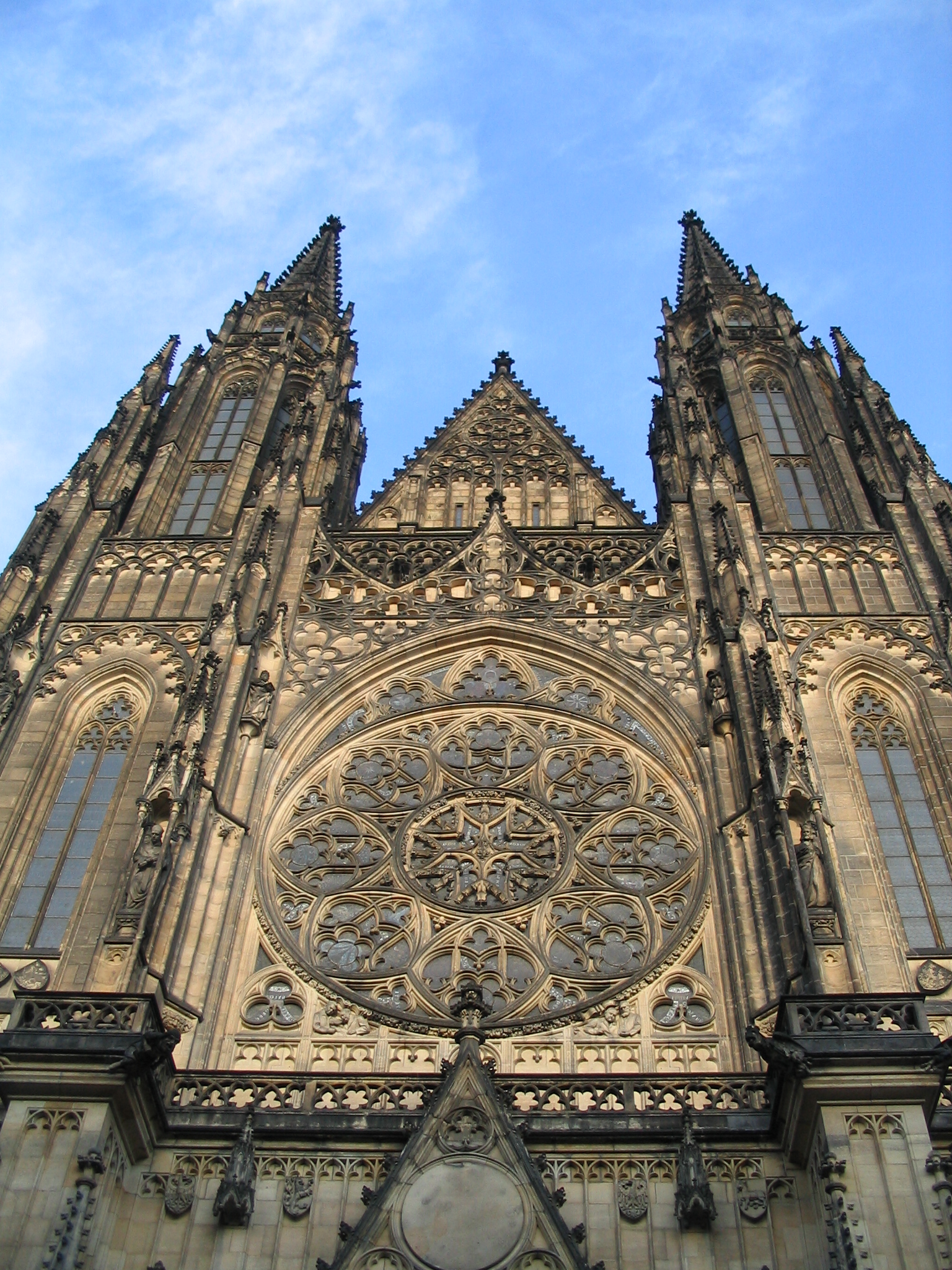
Portal of St. Vitus Cathedral wit rose window, stone masonry, Prague, via wiki commons courtesy of Vaylag

With mass tourism being such lively enterprise, many people are able to see a lot, but often this is knowledge given by the tour guides. Pity when among Gothic cathedrals only Chartres or Notre Dame rings the bell, but Amiens is a total mystery. I mean I don't argue to visit all possible sites, but to read. I wonder, maybe it is the fault of art historians, or popularizes, or people like me who can't make the subject interesting? For ex. authors who make Chartres a place of mystery reshaping its once famous cathedral school, (but one of many cathedral schools of the day) into some esoteric tradition school have the upper hand, as captivating story is given. Facts can be captivating? I think so, but then I am an art history geek.

There is also a curious situation regarding the Middle Ages: most popular knowledge deals with Western, parts of Central Europe, little with Eastern Europe. Byzantium is kind of a lost empire. Prague, luckily, developed into a tourist attraction. Krakow (Cracow) seems to be on its way now. I am Polish, and I am sometimes surprised when some people are surprised when they see that this country had Romanesque, Gothic, Renaissance, etc. It seems that it was such an empty hole in European history, regarding some countries, due to long slumber behind the iron curtain. Once I felt like someone coming totally out of empty space when I watched supposed to be educational video (US produced VHS), about Battle of Vienna. It made me laugh, as the video mentioned only prince Eugene of Savoy, as army commander. No mention about Polish army, even though it was a bi-national enterprise, and actually the Polish king, Johan III Sobieski was more in charge than Prince Eugene. Not that I care so much, and during times of Wikipedia such things are corrected, but it was really funny, how big of  a hole in knowledge can be created in one piece of material. One of the most decisive battles in European history, two big armies of two nations, and you totally forget one army plus the commander in chief? What a curious and amusing case of selective blindness! Cold War legacy? ;-)

Along the line of random info spreading, the Czechs had their own brand of Protestantism, c. one century before Luther (Jan Hus, Czech Brethren, etc.). Poland had religious tolerance guaranteed by law, including Statutes of Kalisz, about the protection of Jews. (Not as bad as in other countries, but it didn't mean it was a totally safe heaven). Religiously different people lived there, including the Cathars. The Kinghts Templars too. Or other crusaders who went for Northern Crusades, (often turned against Poles) . One blog writer from Czech Republic claims that every village in his country has some legend about the Knights Templars. Templar legends in general are not so very French-centered.

 Lots of mysterious, interesting stuff in other parts of Europe. For example devil in Polish art was treated as humorous nasty  figure and was often ridiculed, not a scary being like in the Western Europe. Devils form St. Mary Church in Cracow were painted in strong colors. In another Central European country, Germany, devil was feared, and stakes witches were burned. The conspiracy theory about witches came to Poland during the Renaissance, when the witch hunts intensified, but it was less common, and actually the Latin Church was not by law excluded form participation: only secular power did it. Strange? No. This is info is to point out the diversity of Europe during the Middle Ages and the Renaissance.

I don't have links about Gothic art in Slovenia, but Gothic went there via Prague, and Parler.I am mentioning Slovenia, as it it a very pictoresque country, (my hubby loved it), which enjoys, rightly so, many tourists visits. Very, very interesting landscapes, history, architecture, coasts in general.
A beautiful Corvin Castle in Romania you can see clicking on this sentence.

Here is a link to a site, in Polish; I apologize, but just for the sake of the pictures. There are iconic examples, such as Chartres, Nuamberg, Limbourg Brothers, Sluter, Crucifix of Geron, but also believed to be a miracle working crucifix from Cracow, and other examples, like the biggest Gothic altar in the St.Mary Church in Cracow, or probably the first authoportrait by Peter Parler in Prague, and wonderful St. Vitus Cathedral, Malbork Castle, and  "armor Madonnas" (Crusaders art, can be opened as cabinets!), and other exciting examples. The other is the link to St. Vitus Cathedral Wikipedia article. Enjoy!
http://www.historiasztuki.com.pl/001_KANON_GOT_2.html
http://en.wikipedia.org/wiki/St._Vitus_Cathedral