Showing posts with label white. Show all posts

Monday, July 8, 2013

Iconography of Anounciation of Merode Altarpiece by Robert Campin

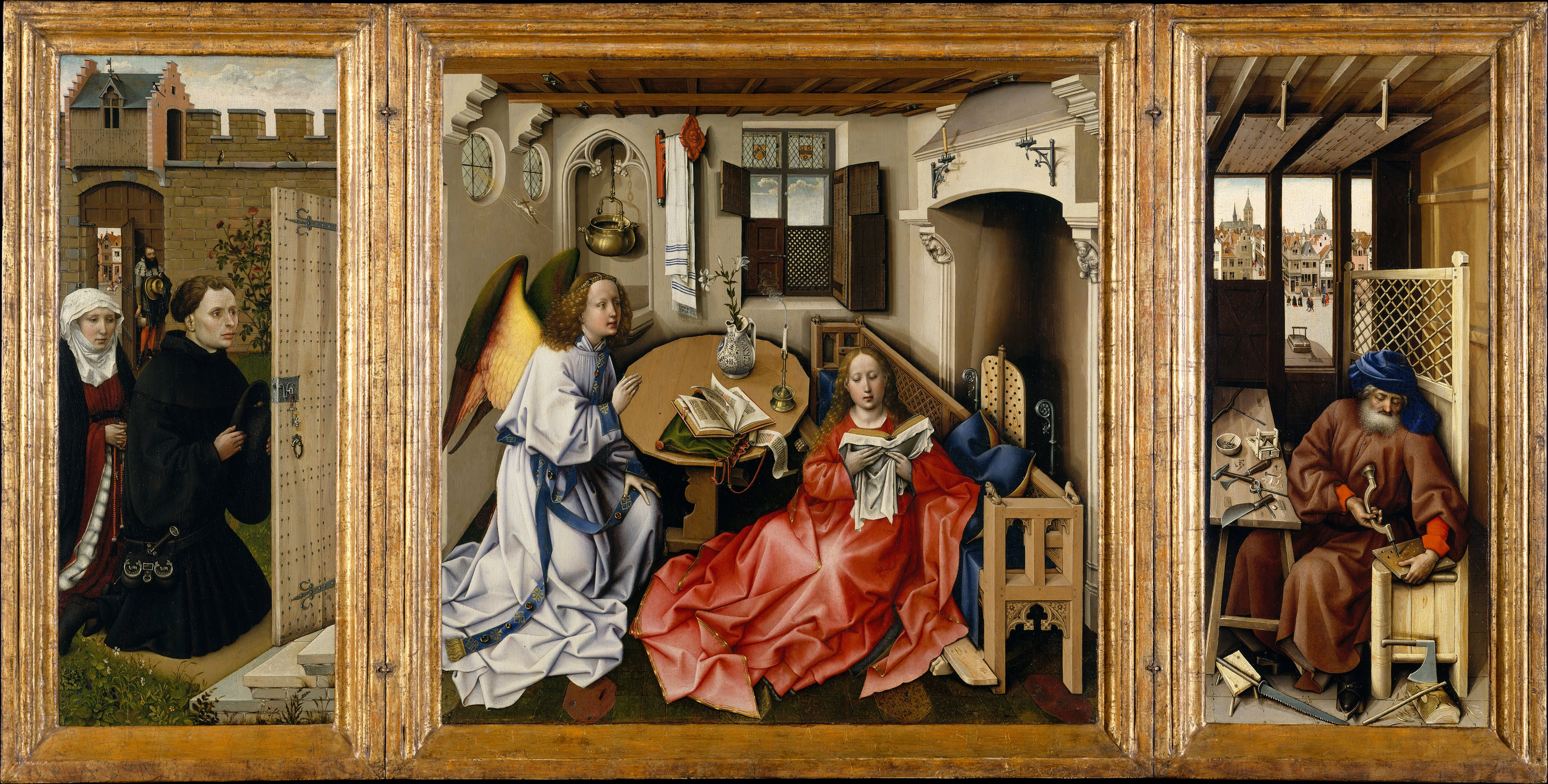
Robert Campin and apprentice, Annunciation triptych, Merode Altarpiece,  1427-1430 Cloisters, New York

This version of Annunciation is rich in symbolism which was easily understood by average person of the days this altarpiece was commissioned. Today anyone interested can see it at the Cloisters, branch of Metropolitan Museum of Art in New York, but in today's world an average person doesn't understand its symbolism. Usually someone notices what is going on and who is there, as we are trained to understand different type of symbols. This painting belongs to Northern Renaissance but has still many elements of Late Gothic. Click on the picture to see it bigger.

Who is there?  From right to left: Joseph, engaged in wood working in his workshop, secluded an din a different landscape as we see through the window. Virgin Mary, absorbed in reading a book and she is not noticing the Archangel Gabriel yet. Archangel just arrived, he looks as he is about to kneel.  Above him in the air  on the rays of light there is a tiny baby Jesus with the cross. Merode couple kneeling outside, open or semi-open door at front of them.Maybe they are watching the scene. And close to the wall in the background we see a messenger. As for those who dismiss Virgin Mary as Virgin Mary on artistic depictions anytime she is dressed in red: this is Virgin Mary indeed, and she was often depicted in this color, specially in Northern school to which the painting belongs, and no, she is not pregnant. The bump under heavy draped robe is just  her knee.

Joseph made two mouse traps. This relates to the sermon by St Augustine who described incarnation of Jesus as a bite for Satan, in some way as mice are trapped in mouse traps. There are two traps, if they represent Jesus and Mary as two participants in the process of incarnation, etc. I prefer to say I don't know instead of giving you my guesses. This can mean many things, and there is debate among scholars, so, as I am not someone specializing in this part of art history, I leave it at this point how it is, no point of adding my opinions to it.

The central panel has symbols of Mary's purity: white as color symbolizing purity, white vase and white lily (chastity), also the wash basin and towel: Mary was called a pure vessel.  Archangel Gabriel also dressed like a deacon, in white, underlines the idea of purity. I like the respect shown for books, they were considered precious objects and this painting shows it.

On the table the scroll represents  Testament, the book is the New Testament. Book represents law, here is the fulfillment of what was written in the book. Green of the cache for the book  is the color of hope, Paradise and resurrection. It is not symbolizing fertility in this case, as it is religious painting, not secular one, and green is tied to Paradise and resurrection. The incarnation of the divine here is not regular event relating to natural earthly fertility.

The candle which is extinguished symbolizes divine light extinguished in order to become human, in order to incarnate in human body. The divine light in eternal aspect is shown on the wings of Archangel: gold or yellow in its place was also symbolizing divine light. The window which now shows the sky and family crests was painted in gold earlier, before over-painting with what we see today. Seven rays on which baby Jesus is traveling stands for divine light, seven rays: seven is the sacred number. Bu the dark color on the wings stands for depth of divine mysteries, for which black stood. The tiny carved lions on the bench are symbols of the seat of Salomon.

 Red robe of the Virgin symbolizes her love: ( agape the unconditional love), charity, redemption by the sacrifice on the cross, but also is a fashionable robe of the days in a very expensive color. Campin showed a domestic setting, and fashion of the days, which was typical. Old paintings are also valuable resources for costume historians and costume designers, as there is so much historical information, specially in the case of the painters with great attention to details and skills in rendering them. What we see also is an interior of a typical home in a city. Usually Annunciation was shown in a church or palace, here we have an interior of a real home. Campin was a painter for the city people, not a painter for aristocrats or churches. This small altarpiece was not intended to be installed in a church, but was an object of private domestic devotion.

The courtyard where the three people who are real life persons of Campin's days are present (donor with his wife and the messenger) is alluding to garden, but is not the same as in depiction of Virgin Mary in gardens: here it is is more cloistered, not much vegetation. Those gardens were cloistered gardens, in which the Virgin was depicted but had more vegetation, here it is more sparse. Still it is enclosed garden, hortus conclusus, which symbolizes Mary's virginity. Here the vegetation relates less to Paradise, which was typical in those hortus conclusus types of paintings, but the flowers represent the virtues of the Virgin: rose stand for her charity, violet for her humility.

The scenes are like almost everyday situations, except angel showing up. In Gothic slowly the divide between sacred and real human life started to narrow. Here we see religious scene happening like in real life, the saintly people don't even have halos, it was unusual. Painting saints without halos happened one century later, in Renaissance Italy.

Perspective in this painting is partially correct. It is not a typical linear perspective, where mathematics rules.Here those rules are bend and we have some twisted angles, like for example the table is painted correctly to the rules, this is not realistic, but allowed the painter to show more details. Sometimes artists do such things in order to make greater visual impact. For example Pieta by Michelangelo, where Mary is so much bigger than Jesus, yet for viewers it looks very natural.

 Bellow we have another painting of Virgin, this time with baby, in an interior by Campin, for comparison. I think now you will be able to read with ease the symbols contained in this domestic scene.


Wednesday, March 28, 2012

The Famous Blue: History of Color # 5- the Middle Ages


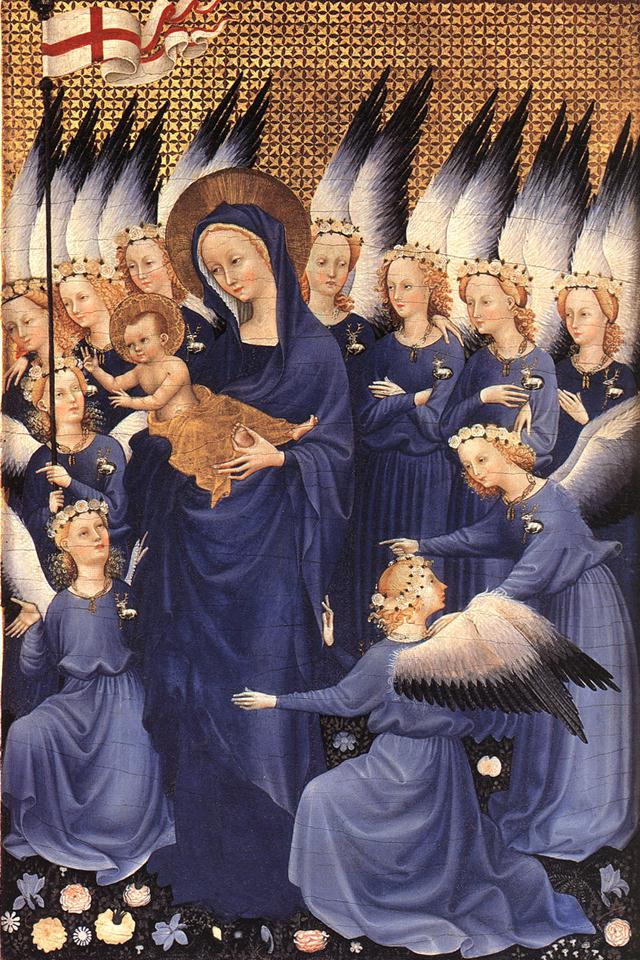
 Wilton Diptych: Virgin and Child with Angels, Unknown French Master, via Wikimedia Commons
Blue was famous during the Middle Ages. People valued the color of the sky, it reminded them of heaven, and its symbolism put it close to gold: it was also the color of divine wisdom, (but gold was used also as light), color of spirituality, calm, contemplation, and all things heavenly. It became also the color of power, but about this on another occasion. Today I will explain the dense code of visual symbolism of the picture above.

Still during 15th century Cennino Cennini, (artist, who was also a writer and theorist of painting techniques) wrote that blue was “illustrious, beautiful, and most perfect, beyond all other colors”.

People talked and wrote a lot about this color. It was considered extremely beautiful and working good on human psyche, it was praised a lot. Also blue pigment was extremely expensive, and for this reason people talked about it in a very different context: painting was a business like any other enterprise, and business talks and written contracts regarding  commissions in which using blue was necessary, specified how much blue should be used. Blue pigment was almost as expensive as gold, sometimes more than gold. It had a beautiful name: ultramarine. It was imported from a valley which is today Afghanistan, made from nothing less than high quality semi-precious lapis lazuli stone, also used in jewelry. The poetic name ultramarine means "from beyond the seas." The stone was extremely difficult to grind, which added to the high price of the pigment.

Artists wanted to make sure how much of ultramarine was to be used, on which parts of the painting. Because of the high price of the pigment, and together with red it was usually reserved for painting robes of the Madonna and Jesus. This example is saturated with blue. Blue was specially the color of French Gothic, especially Late Gothic. Many Madonnas in French art had blue robes, after times of purple and red. (Red for Madonnas’ robes was used more often in the North).

What is the symbolism included in this painting? You know already about gold as diving light and wisdom, blue as divine wisdom and contemplation, things heavenly. This picture is about joys of heavenly existence. First, we have the banner of victory, the banner of resurrection. The colors represent purity of the soul, the sins of humanity washed clean with blood of love ( the sacrifice on the cross) . Wreaths of white roses on the heads of angels symbolize purity and joy of heavenly life. The broaches of the stags represent Jesus: stag means purity and destruction of evil (stag tramples on evil and destroys it). Black on of angels wings stands for depth of the divine mystery. 

Flowers: white rose represents purity and is the flower of the Virgin. The iris was also her emblem, and daisies stand for baby Jesus, his purity and innocence. A lot about purity, right? The vegetation was also emblem of purity; the Virgin was often shown in a garden, which was her emblem, hortus conclusus, "enclosed garden," symbolizing her virginity. Garden had also other meaning starting from early on in Christian art: it was representation of heavenly paradise.

This painting was commissioned for King Richard II. Here the Virgin looks like a fine courtly lady surrounded by ladies in waiting. During Medieval times adoration of the Virgin and courtly love had often similar visual and linguistic vocabulary.

Sunday, March 25, 2012

Symbolism of Color, Medieval: Red, Blue, White and Gold History of Color # 4

During the Middle Ages the idea of splendor and light was extremely important in material creative expression. Very rich vocabulary was  used to describe light in art theory and in theology. Colors were seen as a part of symbolic expression, they were not supposed so much to imitate nature, as it happened later, during the Renaissance, but the goal of using colors was to express an ideal reality. Therefore was not much interest in showing shadow in art, but a lot of interest in showing the most possible clarity in colors. Paints were even mixed such way that they stayed as close as possible to the ideal hue of the best of pigments. And beauty was a representation of some kind of ideal reality, was it  luxury of secular art, or visionary and also luxurious  world of religious art. This ideal reality was thought to exist in colors, and colors had, in opinions of medieval people, their own inner light.

This thinking about the  ideal essences of things was the legacy of the Classics, of Plato and than of Plotinus. I hope not to make things too complicated, but symbolism, philosophy, iconography, mysticism, theology, and technicalities of making art were all  interconnected.

Medieval art put extreme emphasis on purity of colors. When digging deeper in art history we will see that there were some differences between Latin Christianity and the  Byzantine Christianity, but in general color ruled the art world.

Raw pigments, powdered metal. Yes, I prepare some of my paint from time to time, like in old days.

You see here the four most important colors of the Middle Ages. Yes, gold was considered a color, unlike today. Speaking of hues, we have almost primary colors, red, blue and yellow, as gold is close to yellow, and was replaced by cheaper yellow sometimes. Plus a neutral: white.

I start this part with two of those powders on the picture, (one raw pigment, one metal powder), which were relating to light: white and gold.

White: symbolized light, also  in theology which influenced art. White was a symbol of purity, innocence and renewal of spiritual life. During the early Middle Ages angles were shown as white, but later were colorful. It truly depends on time and place: later Middle Ages had colorful angels. Also the elders of Apocalypse, robes of Jesus, prophets, newly baptized people, considered innocent, the righteous people, Jesus in moment of transfiguration. But Jesus was not always shown in transfiguration in white robes only, Middle Ages had codified symbolism, but not rigid rules.

St Sever Apocalypse manuscript. Public domain, courtesy of French Wikipedia
 This example shows white as light (stars),  and as a symbol of innate purity as seen in  this white lamb from St. Sever Apocalypse manuscript.

Gold: as white was more representing physical light in the world, and also had symbolic meaning, the divine light was gold. The light reflecting properties were used freely, not only for decorative purposes but also to communicate theological truth, to show light out of this world. As the divine light was closely relating to the idea of absolute divine wisdom which it represented, the backgrounds of paintings and mosaics are golden. But not always, blue was used too. Gold symbolizing divine light represented spiritual illumination, and to indicate this state of blessedness, connection to the divine, or divinity itself. Halos were golden most of the time. But also there were halos painted blue.

 Here is the link to Hagia Sophia interior video. for those of you on whose search engines videos embedded in this blog do not show.Hagia Sophia means the Holy Wisdom in Greek, and it was the most magnificent church in the Constantinople,  the capital of the Byzantine Empire. Usage of gold is befitting the name of the church very well.

Red was color of love in sense of selfless love, like Christ's love fro humanity, agape which is the unconditional love, and blood of redemption and blood of martyrs. Blue was symbol of heaven,contemplation, things which are divine, life lived in accordance to the highest standards. More about those colors later.

 We need to keep in mind that system of  color symbol was not  rigid. There were canons in iconography, but it doesn't mean that the artists were slavishly following them. The philosophers and theologians were interpreting colors quite freely as well, a lot of abstract thinking went into writings about colors. Does it means we can't rely at all on color symbolism in Medieval art? Yes, we can. But we should approach it with open mind, and remember that there are no absolutes. Also the symbolic language of colors in religious art was adopted by secular art, but the meaning of one color in religious art many not be exact the same in secular art. For example white was worn by French queens as the color of mourning. Purple was color of mourning too, in addition of symbolizing royal, or imperial power.

A very informative article about color http://renaissanceclothing.blogspot.com/2011/02/meaning-of-renaissance-and-medieval.html in Renaissance and Medieval  clothing. Not only is the author very well informed, but also gives warning not to interpret things too rigidly.