Showing posts with label Virgin Mary. Show all posts

Tuesday, July 16, 2013

Divine Mothers, part 2: Miraculous Icons and icon kissing

For those of you on whose devices is empty space instead of link to you tube video, click here and you will get there
 
Chant in praise of Virgin,sung  by  Orthodox monks.
Written by St Nectarios of Egina, an Orthodox saint considered 
miracle worker himself here you have translation of words

Talk about divine mothers wouldn't be complete without mentioning Orthodox icons, specially those which were and are believed to be working miracles. So many of  icons represent Virgin Mary, called Theotokos,  with baby Jesus, that this fact amazes how much respect was, and is, given to the idea of motherhood set in most sublime concepts of faith. Theotokos is translated in a simplified way as Mother of God, but exact meaning is "the birth giver to god." 

Her cult first developed in Epheus, today Turkey, where according to Eastern tradition she lived with John the Evangelist and Mary Magdalene who retired there after life of preaching, and they were visited by Paul. My apology to those of you who are St Baume Mary Magdalene enthusiasts. St Baume is a wonderful place, but I need to mention Mary Magdalene in Ephesus, as this version  is so ancient, I will do no justice to it by silence. On the left is the picture of house known today as Mary's House, where it is believed that Theotokos lived. According to tradition she was preaching and teaching people about art of healing.There is also a sacred springs which water is supposed to have healing qualities: spring of love, health and happiness. Thanks Radomil for the picture. Ephesus was also the place of the council where the dogma of divine motherhood of Virgin Mary was pronounced. There is also oral tradition in a about Mary's presence there, held by Orthodox Christian village.

As for icons:  those are not considered ordinary images, they are windows to the divine. For Orthodox Christians are presence of the sacred in this world. So, if the icon represents a given saint, this saint presence it there. The icon is treated with respect, can be touched and is kissed in love and honor, and given votive offerings after a performed miracle.

Our lady Vladimirskaya, patron protector of Russia, Eleusa type icon. The star patterns on her moforion  symbolize her VirginityThis icon is damaged, but there is strong sense of radiance.
Kissing in Eastern tradition was a very important gesture, honorific kissing included, it meaning was quite broad, which kissing the icons also includes.Western culture is only intimate sign of affection, of friendliness when the French kiss the cheeks to say hello, kisses between parents and children, and of course between lovers.In earlier days there was a lot of kissing, including kissing women on hand as sign of honor.It is still practiced in Poland and Vienna, the yearly opera event. 

In Biblical times there were kisses between men, family members who were loved, abut also between friends, or people were kissed out of respect. For ex. kissing someones feet was a sign of very strong reverence an honor.. The same in Jesus times. Christian kiss of peace is one example. Also in Greek there were three words expressing love: eros, filos, agape. Eros is erotic love, filos is friendship as love, agape is often translated as charity, but mean unconditional love, the spiritual kind, love as the essence of the divine, love totally selfless. For example the part in New Testament, where Jesus ask Peter "do you love me more than those,"and here he was referring to his disciples. I was introduced to it by someone who studied Koine Greek,  what is translated in English is love, but in Greek there are two words in questions and answers used: filos and agape. As you probably guess, the Theotokos as a mother is also example of such divine, all surpassing unconditional love.

It is an important distinction between kinds of love, and  it got somehow lost, as the distinction between kisses got lost. In the New Testament at the supper in a house of a Pharisee Jesus defended the woman who washed and anointed and kissed his feet (in Orthodox tradition it wasn't Mary Magdalene) and said: "you gave me no kiss," and praised how she showered his feet with kisses and she will be remembered. This was expression of highest reverence, and the Orthodox Christians remember that. But see by yourself not in my words, why Orthodox Christians kiss icons.

But certain  icons are not to available for kissing. Those are the miracle working icons set higher in the altar. 
The icon above is Eluesa type of Madonna, (Our Lady Valdimirskaya, today in Tretakov Gallery). Those graceful depictions are called Virgin of Tender Mercy, of Virgin Showing Mercy, also found in the West. Virgin's and baby Jesus' cheeks touch, or almost touch. Those human gestures of affection are very charming, and here is a small list of miraculous icons in this Eluesa type .

One of miracle icons is the Black Madonna of Czestochowa, this one is not an Eeleusa, but Hedegetria, The Guide as iconograhic type.  Hedegetria, called also Madonna Showing the Way, as gestures with her hand toward  baby Jesus. This is the oldest and the most common stylistic type.
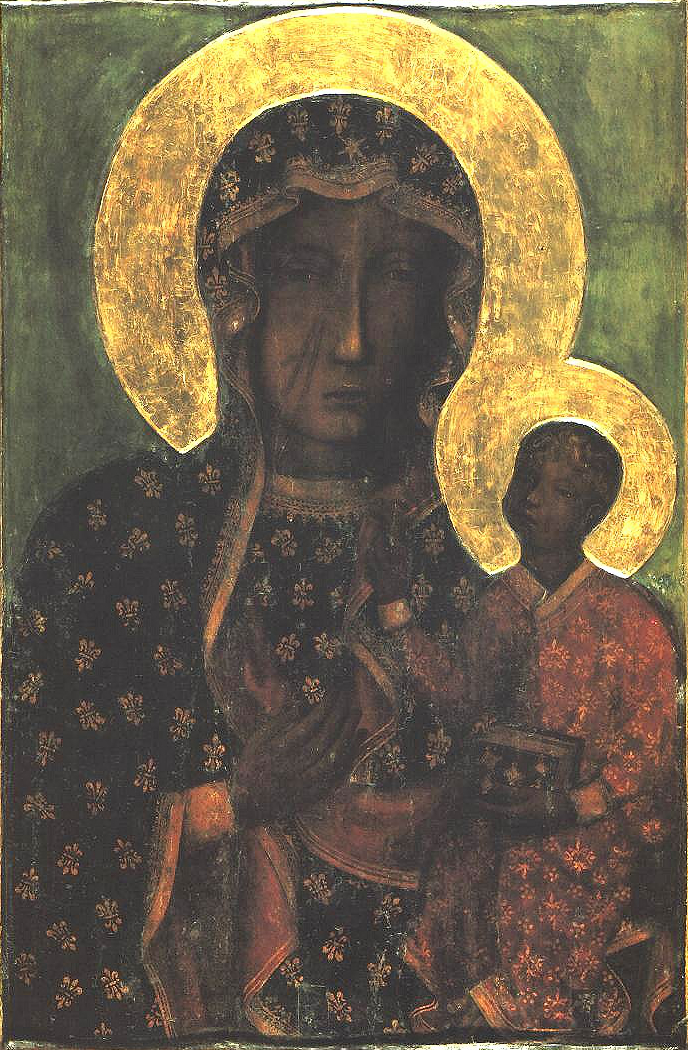
Black Madonna of Czestochowa, Byzantine origin icon of Hedegetria type

The Black Madonna of Czestochowa is the regal powerful mother, who is believed to heal you when you ask for it. Many of us remember from childhood when something hurt, like for example got a bruise from falling off kick scooter, the mother kissed the bruise and felt so much better. This is not to introduce banality in the reverence of miraculous icons, it is just for reminding that the veneration also includes tender feelings which relate to very basic human experiences. Basic, not base. 

She was crowned Queen of Poland. On the walls of the sanctuary there are votive offerings, as thanks from the donors for the miracles of healing: pieces of jewelery, pieces of silver in shapes of parts of human body, also you will see some real life crutches. 

The Black Madonna is viewed as powerful protectress. The icon is of Byzantine origin, showing Italianate influences. The legend says it was painted by St Luke himself on the table from the form  Virgin Mary's own household. It is one of several icons allegedly painted by St Luke. The pattern on Virgin's robes is fleur-de-lis.  There is over 130 iconographical types of depicting Virgin Mary on icons, this one is among the regal type images.

 Those Theotokos were shown like aristocrats of Byzantine imperial court. But the icon painting, or icon-type of style wasn't limited to the areas we today associate with icons: Italy had those too. Bellow  Hedegetria by Giotto. The stripes of fabric angels wear over their robes belong to a traditional fashion of imperial court in Constantinople. Even the Eleusa type has Byzantine moforion

A very imperial looking Theotokos by Giotto
Eastern Orthodox faith didn't develop Mariology as did the Latin Church, but the devotion to Theotokos was  given, even not much disputed in theological manner. The idea that Virgin Mary was elevated above any created being found its expersion  in showing her with as much dignity as depicting a powerful empress.

Sunday, July 14, 2013

Divine Mothers, part 1: breastfeeding Madonna


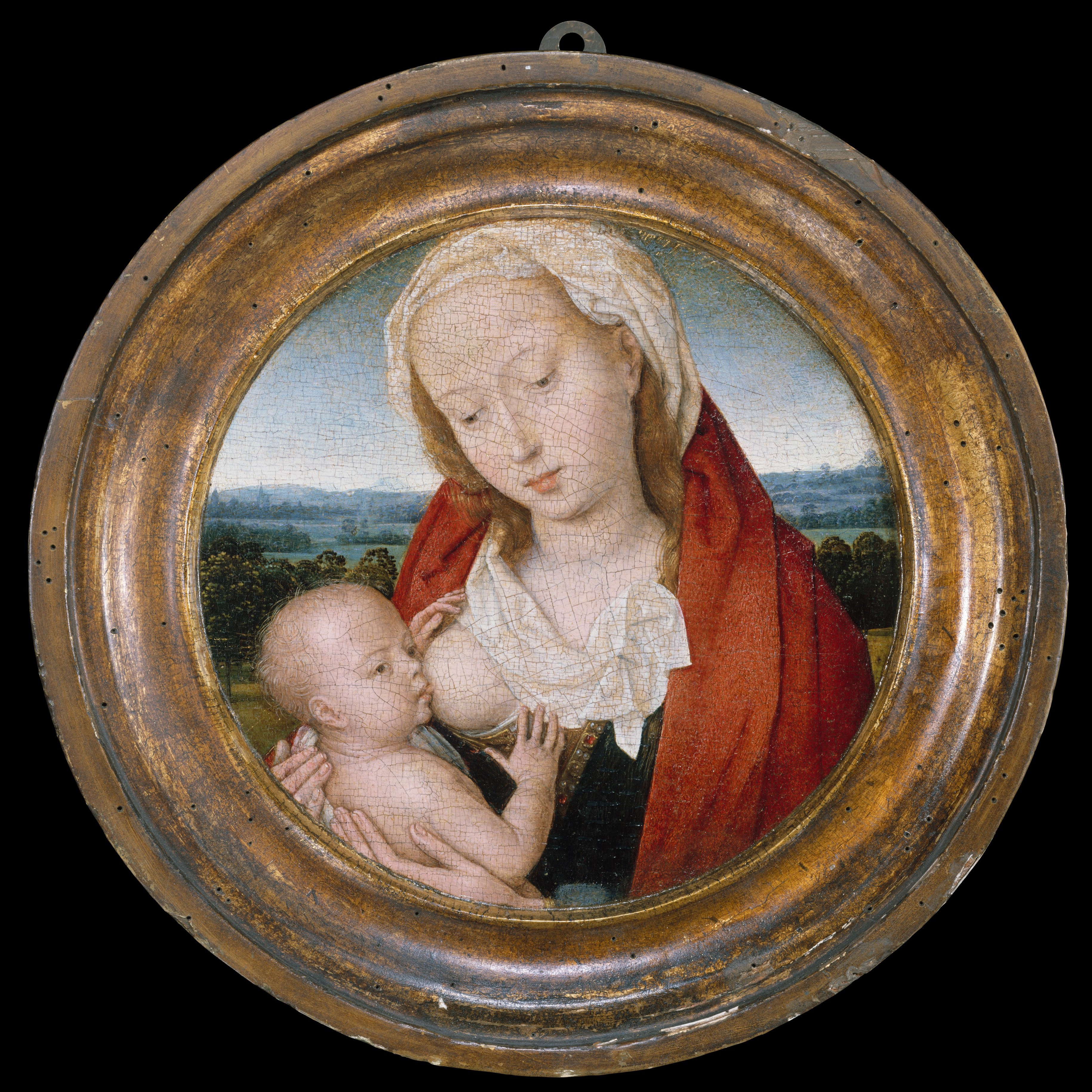
Hans Memling, Nursing Madonna

Today some people are kind of surprised that so many, specially women, like the idea of Mary Magdalene being the wife of Christ and the mother of his children, and talk about her being erased from history.

I am not surprised. In my earlier entry I wrote about how our ideas of Mary Magdalene represent something what is important in our society. Something what is maybe not so clear in our everyday awareness, but many know in some. Let me use that silly word for it: subconscious level.

First, in spite of the technological advances, the world in not becoming more cozy. Many of humans need things mytho-poetic when technology is invading their lives, even when it is to the advantage.We are humans, not cyborgs whose extensions of mind and body are machines. People turned to things mytho-poetic or considered less rational when huge technological advances were made, during the 19th c. and for example 20th century between wars. This trend now isn't new or surprising. It is a natural reaction when people feel that the pendulum went too far in one direction. So, there is a counter movement. It is evoking creative forces of the mind again.People don't want to be cheated out of this important part of human experience, mytho-poetic creativity is part of whole we call a human mind.

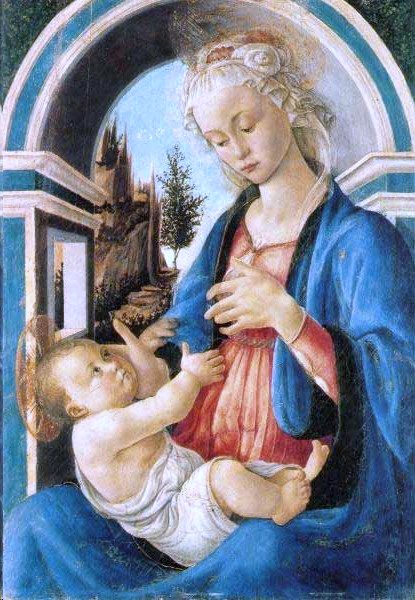
Sandro Botticelli, Madonna with Child, here Virgin Mary in a dress allowing easy nursing
As for Mary Magdalene being a mother and being pushed away: no wonder this idea is popular, lets take a look how we treat motherhood today, what our popular culture reveals, and how motherhood was treated earlier.  This is first entry on the subject of motherhood.First for his entry let consider breast feeding. Talking about things mytho-poetic:  Milky Way according to Greek mythology appeared because of  accidental squirt of Hera's milk while she was nursing Heracles, who as an infant was supposed to acquire god-like qualities by drinking from the breast of the goddess. The word galaxy comes from Greek word for milk.Nice story about milk of the goddess. Today's reality isn't poetic about breast feeding.

This link shows results of study about breast feeding mothers: prejudice. Also those mothers who breast-feed in public have personal stories to tell, how they were treated. Nothing encouraging. There is even a lawyer, a women, who tires to make breast feeding in public illegal. Because it is "disgusting." Not everyone finds it "disgusting," but it is enough for mothers to feel the hostility. Like not everyone is prejudiced against gay people, but enough to create hostile environment. Why so easily labels like "obscene, or"disgusting," "disturbing," are applied to something so positive, psychologically (bonding of mother and child) and what has proven health benefits for the baby?

Gerard David, Nursing Madonna
 Nursing Madonnas as images or part of Marian theology is a very interesting phenomenon. The imagery first appeared in Coptic church of Egypt, the iconography was borrowed from the depictions of Isis nursing Horus. Cultures borrow from each other, as languages borrow words.

Role of Virgin as divine mother was very elevated, she was a co-redeemer of humanity. Some old mystical pictures show her standing at the crucifixion, between her and crucified Jesus stands a chalice to which blood from Jesus' side flows and also milk form Virgin's exposed breast. This was analizsed by art history scholar Anna Boczkowska in her  book Triumph of Luna and Venus, about iconography of Paradise part of the Tryptych Garden of Earthly Delights by Heironymus Bosch.

It was elevation of milk to the same importance as blood of Eucharist, it symbolized grace. Of course this was only on symbolic level, as there was no mixing of milk with wine in ritual of Eucharist.

Milk was a symbol of wisdom, and not just an earthly wisdom. It was a supernatural wisdom of knowledge of things divine, and given as a gift of grace.

Milk was also believed to be transformed from blood, and as such to be part of Eucharist and it took its place in mystical writings. Today those writings maybe not easily understandable for our modern mindset, but people centuries ago understood all metaphors very well. Middle Ages were very poetic, made strong use of symbolic and abstract thinking. 

The type of iconographical depiction of Madonna as nursing mother was common during the Middle Ages, Renaissance and Baroque. Those images often depict  precious moments of human tenderness, but also they elevated motherhood to divine dimensions also. Probably the prototype of nursing Virgin Mary appeared first among Coptic Christians in Egypt, based on imagery of goddess Isis nursing baby Osiris. This doesn't mean that Iis was worshiped under a new name: it is like a new picture was put in an old frame.

 
 This icon of breast feeding Madonna is considered wonder-working in Easter Orthodox faith. It is Galaktotraufusa (Milk Giver) from Mount  Mount Athos Monastery, in Hilandar Monastery, part of Athos complex. It was put there in 13th century, brought here by  Saint Sava of Serbia and installed in iconostasis in an unusual place which was  reserved for icon of Jesus Christ and the Trinity. I have to admit I don't know what happened to this icon. The other icon brought by St Sava, Madonna of Three Hands is supposed to be there, 2004 was a terrible fire in the monastery.

I am not saying that elevating motherhood to such dimensions was all great and sure recipe for making all women happy: childless women suffered, and women conditions were not good in general. But at least mothers' contributions were not taken for granted, or there was an idea that they shouldn't be taken for granted. Motherhood was part of the totality of human experience, and it is, just not enough credit and respect is given to it now.Gender politics is visible in all art history, struggles related to gender continue today.


Francisco de Zurbaran, Holy Family


Ladies, those of you who are or will be mothers, I say: kudos to you for your patience, gentleness, pain, baby fat, hanging breasts, stretch marks. It is not a little thing to be a mother. Milk, pregnancy and labor pains were once revered in mystical writings about experience of the divine. About this another time.

Monday, July 8, 2013

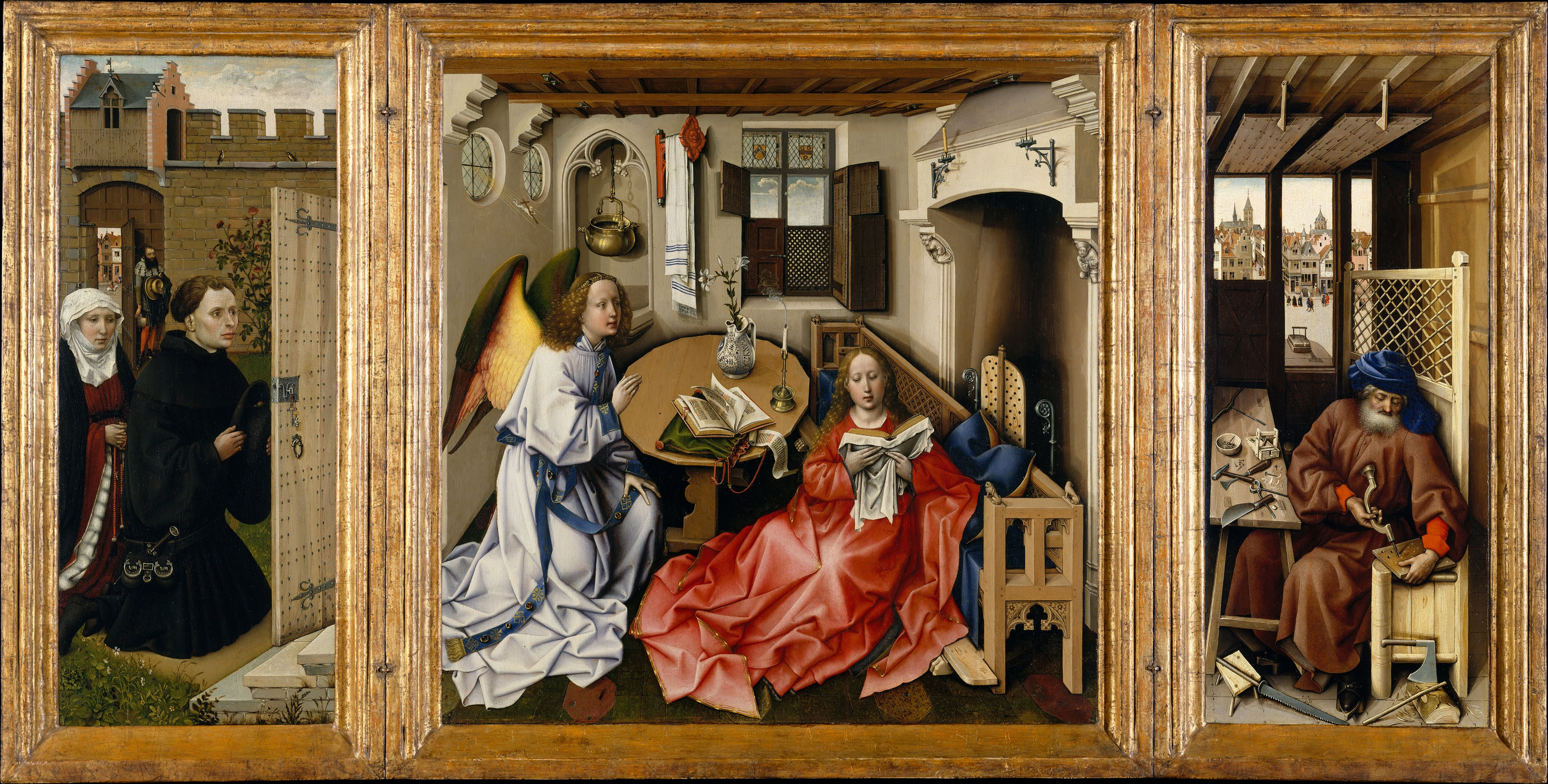
Iconography of Anounciation of Merode Altarpiece by Robert Campin

Robert Campin and apprentice, Annunciation triptych, Merode Altarpiece,  1427-1430 Cloisters, New York

This version of Annunciation is rich in symbolism which was easily understood by average person of the days this altarpiece was commissioned. Today anyone interested can see it at the Cloisters, branch of Metropolitan Museum of Art in New York, but in today's world an average person doesn't understand its symbolism. Usually someone notices what is going on and who is there, as we are trained to understand different type of symbols. This painting belongs to Northern Renaissance but has still many elements of Late Gothic. Click on the picture to see it bigger.

Who is there?  From right to left: Joseph, engaged in wood working in his workshop, secluded an din a different landscape as we see through the window. Virgin Mary, absorbed in reading a book and she is not noticing the Archangel Gabriel yet. Archangel just arrived, he looks as he is about to kneel.  Above him in the air  on the rays of light there is a tiny baby Jesus with the cross. Merode couple kneeling outside, open or semi-open door at front of them.Maybe they are watching the scene. And close to the wall in the background we see a messenger. As for those who dismiss Virgin Mary as Virgin Mary on artistic depictions anytime she is dressed in red: this is Virgin Mary indeed, and she was often depicted in this color, specially in Northern school to which the painting belongs, and no, she is not pregnant. The bump under heavy draped robe is just  her knee.

Joseph made two mouse traps. This relates to the sermon by St Augustine who described incarnation of Jesus as a bite for Satan, in some way as mice are trapped in mouse traps. There are two traps, if they represent Jesus and Mary as two participants in the process of incarnation, etc. I prefer to say I don't know instead of giving you my guesses. This can mean many things, and there is debate among scholars, so, as I am not someone specializing in this part of art history, I leave it at this point how it is, no point of adding my opinions to it.

The central panel has symbols of Mary's purity: white as color symbolizing purity, white vase and white lily (chastity), also the wash basin and towel: Mary was called a pure vessel.  Archangel Gabriel also dressed like a deacon, in white, underlines the idea of purity. I like the respect shown for books, they were considered precious objects and this painting shows it.

On the table the scroll represents  Testament, the book is the New Testament. Book represents law, here is the fulfillment of what was written in the book. Green of the cache for the book  is the color of hope, Paradise and resurrection. It is not symbolizing fertility in this case, as it is religious painting, not secular one, and green is tied to Paradise and resurrection. The incarnation of the divine here is not regular event relating to natural earthly fertility.

The candle which is extinguished symbolizes divine light extinguished in order to become human, in order to incarnate in human body. The divine light in eternal aspect is shown on the wings of Archangel: gold or yellow in its place was also symbolizing divine light. The window which now shows the sky and family crests was painted in gold earlier, before over-painting with what we see today. Seven rays on which baby Jesus is traveling stands for divine light, seven rays: seven is the sacred number. Bu the dark color on the wings stands for depth of divine mysteries, for which black stood. The tiny carved lions on the bench are symbols of the seat of Salomon.

 Red robe of the Virgin symbolizes her love: ( agape the unconditional love), charity, redemption by the sacrifice on the cross, but also is a fashionable robe of the days in a very expensive color. Campin showed a domestic setting, and fashion of the days, which was typical. Old paintings are also valuable resources for costume historians and costume designers, as there is so much historical information, specially in the case of the painters with great attention to details and skills in rendering them. What we see also is an interior of a typical home in a city. Usually Annunciation was shown in a church or palace, here we have an interior of a real home. Campin was a painter for the city people, not a painter for aristocrats or churches. This small altarpiece was not intended to be installed in a church, but was an object of private domestic devotion.

The courtyard where the three people who are real life persons of Campin's days are present (donor with his wife and the messenger) is alluding to garden, but is not the same as in depiction of Virgin Mary in gardens: here it is is more cloistered, not much vegetation. Those gardens were cloistered gardens, in which the Virgin was depicted but had more vegetation, here it is more sparse. Still it is enclosed garden, hortus conclusus, which symbolizes Mary's virginity. Here the vegetation relates less to Paradise, which was typical in those hortus conclusus types of paintings, but the flowers represent the virtues of the Virgin: rose stand for her charity, violet for her humility.

The scenes are like almost everyday situations, except angel showing up. In Gothic slowly the divide between sacred and real human life started to narrow. Here we see religious scene happening like in real life, the saintly people don't even have halos, it was unusual. Painting saints without halos happened one century later, in Renaissance Italy.

Perspective in this painting is partially correct. It is not a typical linear perspective, where mathematics rules.Here those rules are bend and we have some twisted angles, like for example the table is painted correctly to the rules, this is not realistic, but allowed the painter to show more details. Sometimes artists do such things in order to make greater visual impact. For example Pieta by Michelangelo, where Mary is so much bigger than Jesus, yet for viewers it looks very natural.

 Bellow we have another painting of Virgin, this time with baby, in an interior by Campin, for comparison. I think now you will be able to read with ease the symbols contained in this domestic scene.


Wednesday, July 3, 2013

Beuatiful Madonnas style in International Gothic and topoi of courtly love

Today i want to show some Madonnas in style which was a branch of International Gothic. Those depictions of Virgin Mary are called in Beautiful Madonnas. This iconographic type emerged in Bohemia (Czech Republic today), and spread to neighbouring states: Holy Roman Empire including Silesia, Poland, Teutonic Knights Crusader State, Burgundy, Austria and France. Not surprising that in the Teutonic Knights' state,   the domain of militant order with their strong devotion to Virgin Mary this style spread rapidly.

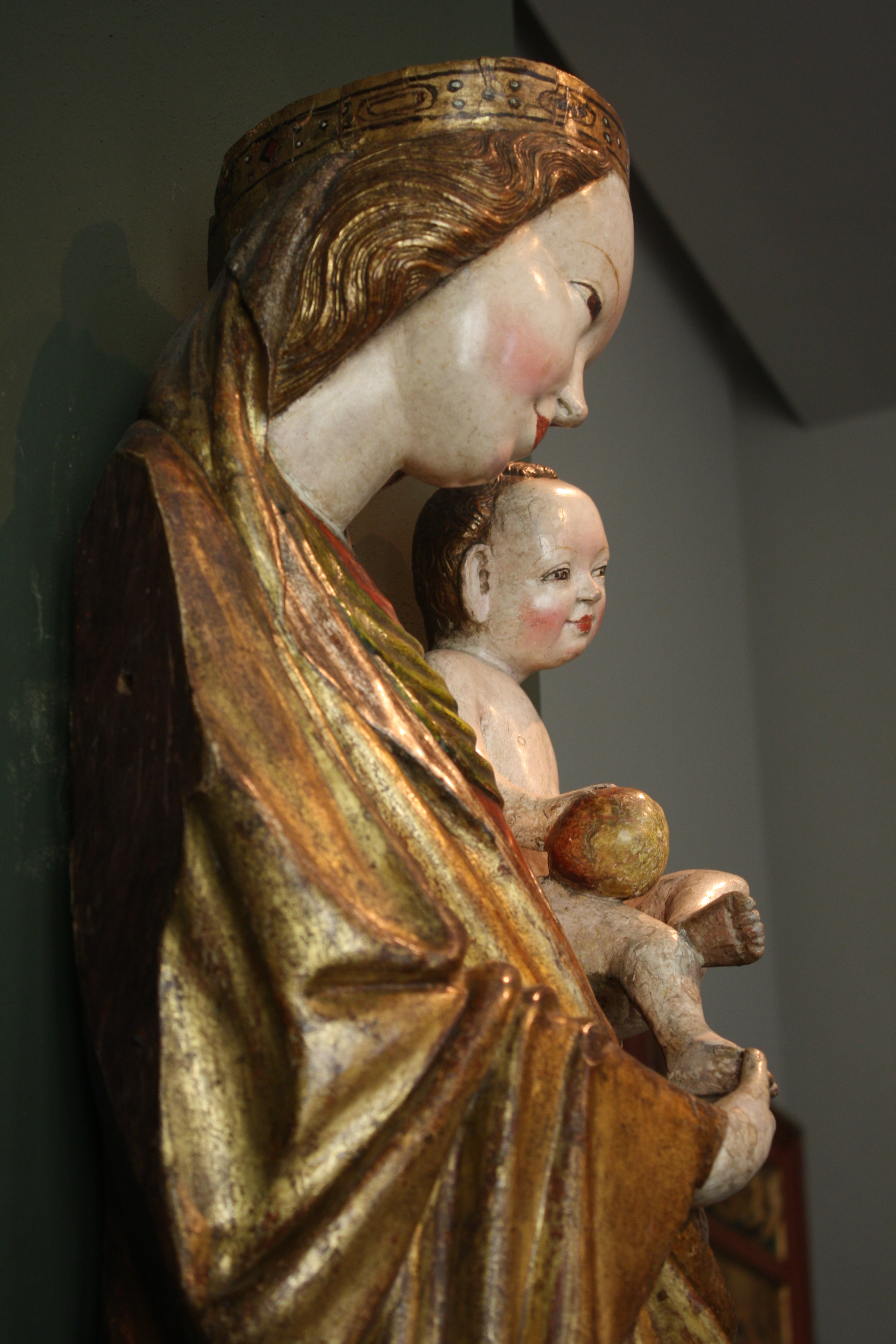
Madonna of Kruzlowa, by Ludwig Schneider/Wikimedia
Beautiful Madonnas were mostly stone sculptures, but sometimes were made wood, sometimes of terracotta fully three dimensional, no reliefs sculptures.

This type was a re-edition of images of Madonna with child, which started already in Byzantium, but this time Madonna was depicted as a very young woman, with delicate hands and small head, beautiful and lyrical. There is a lot of charm in Beautiful Madonnas, it is very sublime style with gentle gestures, cascades of fabrics, emotions showed realistically also the was strong attention to detail as the artists wanted to depict her very realistically, in a less stylized manner. It is all very refined in comparison to the previous styles of representation of her.

Characteristic pose of Madonnas is so called S pose, where the person stands slightly slouching, belly forward, the spine is bend, not straight. This was also a common pose in International Gothic, or High Gothic in general. It was considered very elegant those days.

The example on the left Madonna from Kruzlowa is obviously very young, she looks like an ideal lady of the court culture of her times. About an ideal of beauty in Gothic another time, in a separate entry. Yes, the baby looking as if he was going bald was one of the beauty ideals, also women had very high foreheads, which gave them balding looks. It was a fashion once.

Here the Madonna of Kruzlowa and her child are represented as New Adam and New Eve. This maybe confusing for today's audiences, but there was a lot of theological disputes in the Middle Ages about Mary's role in  redemption of humanity. Medieval allegories and symbols can be strange, but they also can be explained in a simple manner, I hope I can do it without making things complicated: Virgin Mary and her son are the new humanity, both were new people born without original sin. Adam and Eve were the people of old times, before the redemptive powers of the Messiah appeared in human form. Both Virgin and child are human, but also are divine, closer to perfection as born without original sin.  In Catholic doctrine Mary is the co-Savior, and Jesus is Savior of the world. Both take part in salvation of fallen  humanity. Here we see the apple in baby Jesus hand, it has double nature: it is an apple from Eden, but also an apple as globe, part of royal regalia, showing him as the ruler of humanity.

Beautiful Madonna of Wroclaw, Anonymous of Wroclaw or Prague, via wikicommons/ Burgher S

You can view a gallery of Beautiful Madonnas on wikipedia article (which i sin Polish only, but has quite nice visuals.) Those Madonnas represented ideal beauty, those ladies are equivalent of  models of today.  This type of representation was not a stylized Madonna anymore, but one that looked like a woman from real world, dressed like her, standing, gesturing like her, interacting with her child like a real mother from real world.

Also they would be cherished as court ladies, their about their virtues troubadours would sing. Just she wouldn't be so real, as the ladies who were the subject of courtly love were supposed to be extremely virtuous, extremely good.Knight would fall in love just by hearing of their virtues, before seeing them in person. Love of such lady was supposed to transform the lover who worshiped her.

 Even though in secular world the poetry of courtly love also included erotic elements, there was also an element of total sublimation, spread by the philosophy of Neo-platonism. Certain ideas overlapped, for example the idea of total devotion which echoes in mystical writings among others in those by Bernard of Clairveau who adored Virgin Mary, not a lady in earthly form. The lady is so adored, that she becomes unreal, she becomes totally divine. An ideal lady in secular world was of course a queen, and often the Virgin is wearing a royal crown.

Bust of a Virgin, terreacota, Bohemia, XIVc, wikimedia/ Mieow Mieow


The love of the Virgin is similar to courtly love, but of course is platonic, totally mystical, often has symbolic forms, like the Song of Songs was interpreted symbolically. Medieval mysticism, or Mariology in general, can be confusing. Social context and a little bit of social history is needed in order to make more sense of it.

Certain elements of devotion to Virgin Mary have common points in the idea of courtly love, it is strong selfless adoration of a chosen woman. With time an earthly court lady was replaced by Madonna, the Heavenly Lady. When the times of courtly love, fin'amor, (fine love), came to an end, and new era came:  XIII c was time of strong devotion to the Virgin Mary and mystical experience of sublimated love which broke any connections to sensuality.

For example Daude de Pradas who was also a troubadour, wrote that God was ultimate ":fine love and truth," and who loves God is loved back perfectly by him. He used the term fin'amor  referring to God, the term which was used usually in connection with courtly love. Lanfranc Cigala, another troubadour, also wrote about fine love in his religious poems. In his Gloriosa sainta Maria he wrote that he now is praising Virgin Mary as his lady in his songs, as the earthly love gave him only disappointment and pain.

Was this the search for ultimate virtue which gave new characteristics to Mariology? Probably. But also more troubadours than before were admonished not to sing sensual songs after the Albigensian Crusade. At once the culture of Southern France, home of prominent troubadours, became "worse than of the Saracens."  This  is a typical excuse of the colonisers, to talk with contempt about the culture they conquered. It happened later, in cases of XIX c. colonisation as well, putting down on India, Africa, Indochina, etc. But sometimes the conquerors adopted certain things for themselves, "to pity to destroy," as one of my art history teachers said. Troubadours were not only there, but Occitan culture was the culture of troubadours like for example Germany has culture of philosophy and good engineering.

But ardent songs of earthly love had topoi which were easily translated and adopted into mystical experience of platonic love. Song of Songs was symbolic also. Metaphors of religious love included love of parents for their children, love of spouses and also love of siblings. It seems that we humans need things earthly to express things the most abstract but very real at the same time. Mystical experiences belong to such realm of strong abstraction and reality.

The Madonnas included in this article here you can see  in order of appearance in two museums in Poland  Madonna of Kruzlowa is in Krakow,  Wroclaw Madonna is in Warsaw,  and in Bohemian Madonna in New York.Article about courtly love from wikipedia


Wednesday, August 15, 2012

Purple, the Imperial Color, History of Color #10

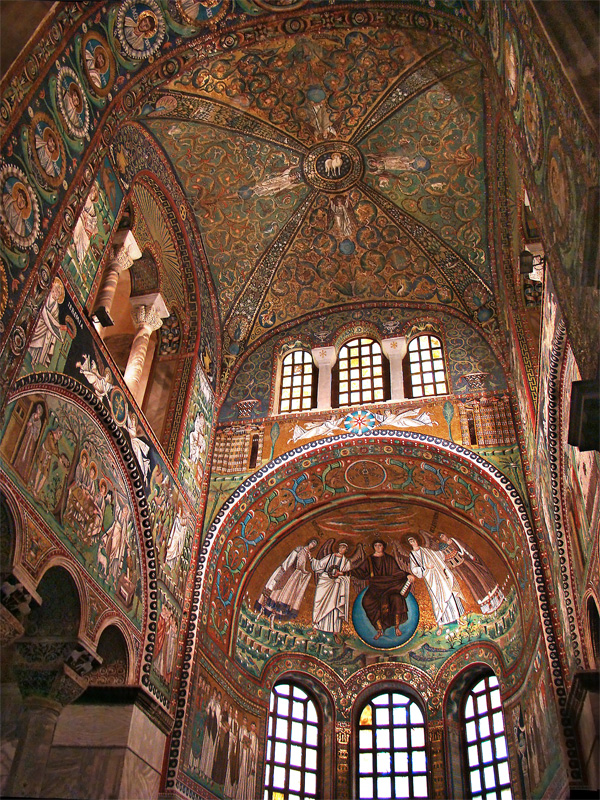
Byzantine Emperor Justinian, mosaic in St Vitale church, Ravenna, Italy

I wrote about red and blue as colors of power in my recent entry. But the ultimate color of power was purple, before red and blue rose to higher prominence. It was before the sack of Constantinople during the Fourth Crusade in 1204, which I mentioned in the entry about the holy blood relic in Reichenau and Bruges. Constantinople never recovered enough to produce purple dyed clothes again. This fact might give you some insight how expensive purple dye was.

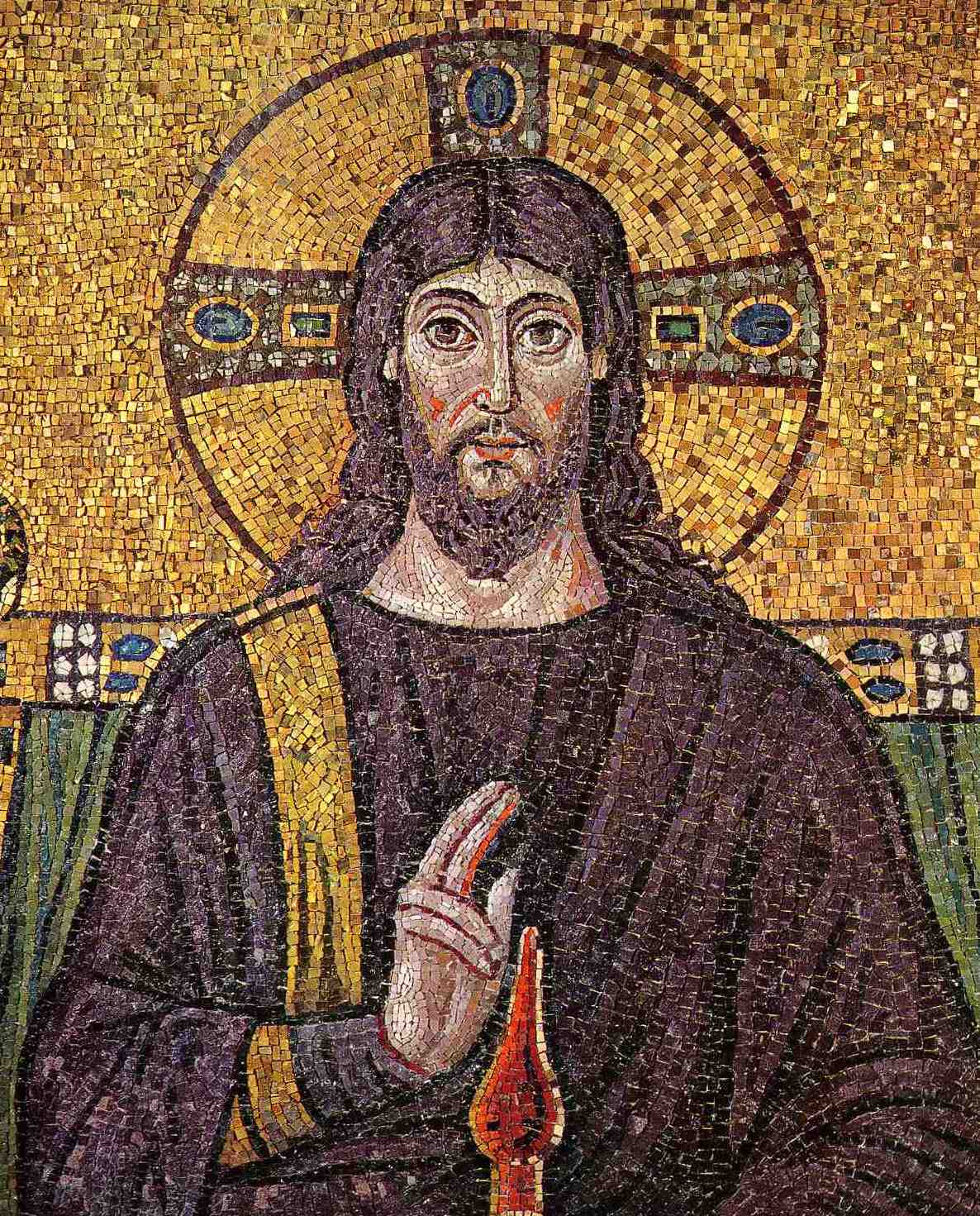
 The purple dye was so expensive that it was a subject of sumptuary laws, and mostly restricted for the imperial or royal families. It was produced from Murex sea snail, and tens of thousands were needed to dye one piece of garment. Color purple took the name from the dye, wasn't the description of color itself. The price of dye was equal of weight in gold.  The main center of the craft of dyeing in purple was Tyre, in Phoenicia. The name Purple of Tyre comes from it. This purple wasn't the hue we perceive today as such: it was more reddish brownish, a very muted but intense color. The emperors robe on the mosaic above looks more blueish than in person. The robe of Jesus looks more brownish, but it is difficult to take very accurate pictures of mosaics in the interior, where every detail will be of exact color. And the purple of Tyre doesn't get reproduced very well on the computer screens either. But you get the idea.
Mosaics at San Vitale church, Ravenna, Italy, via wiki commons, thanks to Tango


Not only rulers were depicted in purple, but also Jesus and Virgin Mary. Byzantine art showed them as rulers, full of dignity and somehow stern looking, as does the Christ dressed in purple on Byzantine mosaic from the church St Apolinare Nouvo, Ravenna, Italy (via wiki commons) The style is Early Byzantine.


And here is shroud of Charlemagne, early IXc. manufactured in Constantinople, today in Paris, Musée National du Moyen Âge. (via wiki commons). Purple on silk created wonderful effects that enchanted the eye: depending on light looked more blueish or reddish, had luster fro which was prized too. Not many fabric are left from Byzantine times, mostly fragments, and like this one found in the graves of the rulers of the time.

Shroud of emperor Charlemagne, purple dyed silk
 The purple was known already in Antiquity, and was mythologically credited to be discovered by the dog of Hercules. Plato mentioned this color in his Symposium as the greatest hue of all. It was used in Egypt, and became the color of Roman emperors. Sometimes the law was not harsh and women were allowed to wear purple, but other times anyone else than emperor wearing a purple robe would be killed. The first church in Europe was founded because of religious devotion and courtesy of a woman, Lydia, who was a business woman, a merchant in purple dyed fabrics. She must have only rich clients.

One of the Roman emperors forbid his wife to buy additional purples robes, as he considered too expensive.

Today, to all my knowledge there is only one pigment manufacturer mill, Kremmer Pigmente from Germany, which sells  this kind of  purple for art conservation purposes. One ounce would be 153,120 $, of course on the website for the art conservators this dye is sold in fractions of  1gram (1 once has 30 grams, to remind you), so , it is sold sold here in fractions of grams
According to Kremmer Pigmente, it takes 10,000 snails to make 1 gram of purple, which would be 300, 000 to make one ounce.

Later instead of purple silks were dyed with kermes, which was red dye made of the bodies of dried insects. I am for sure glad we use different process in fabric dyeing today, not involving killing masses of mollusc, or insects. (But still,  today fashion industry is terribly unfriendly toward the environment, one of the main polluters). Lucky for me, a fine artist, I can pick and chose which pigments I want. Honestly, I couldn't bear to buy paints or dyes containing colors made out of living creatures. I don't wear silk either for this reason.

This red coronation mantle of Roger II, silk and gold thread, pearls and precious jewels was done in royal workshops  from Palermo, Sicily. Now in Vienna treasury.We see the new fashion coming, replacing purple with red, which resulted in pictures of royals, nobles and Virgin Mary dressed in red mantles.

Roger's II coronation mantle, via wiki commons, by Gryfindor

Sunday, August 12, 2012

Colors of Power: red and blue- History of Color in Middle Ages # 9


Red and blue, most prominent color duo of the Middle Ages. People just loved them so much, that even when writing about rainbow  they wrote often only blue and red! Also the existence of separated guilds of dyesrs dedicated for each color may be a testimony for high esteem and priceses of those particular colors.

 We see here in the video the colorful splendor of the Middle Ages, about illuminated manuscripts about British royals. Lots of color, but most prominently the duo of red and blue. Fresh colors, most of the time.Video window may not come up in an instant.
Interesting movie by BBC about royal illuminated manuscripts.

Here Charlemagne is  being crowned.

Emperor's Charlemagne Coronation, Illuminated mansucript, via wiki commons

Red and blue were colors of power in the secular world, why?  Red and blue dyes were expensive, not common, and people loved those hues, of course. Red was used after the purple of Tyre, very expensive and reserved only for the rulers, became less and less available. Red in a more dark, dignified edition was replacing purple,which had a brownish tinge, not what we commonly classify as purple today, until appeared in its pure form, lighter and brighter. As we see bellow, on the Annunciation picture.The same with blue, it was considered a very noble color, and as the blue dye became to symbolize affluence and also royals were using it. (Royal blue).


Announciation by Petrus Christus, via wiki commons


Here on this Anounciation by Petrus Christus we see Virgin Mary dresses in a red mantle. We see the typical elements of Announciation, as the lilies signifying Mary's purity, the vase a pure vesel, open book also is traditional. Always opened on the same page on all paintings, Isaiah 7:14, or psalter pages in earlier book. Other written words is the passage from Announciation of the New Testament, the words spoken by the archangel ("Ave Maria,  gracia, plena"etc) was directly written in the picture. Mary is here depicted as a fine lady, dresses in a rich garment, expensive mantle.  Click here to read more about Announciation symbolism.
This painting is considered early Northern Renaissance, but still has elements of Gothic art. For example the folds of the robes of the angels are still very hard and geometric, the angel's posture is typical for Medieval art, also his wings, strong color, not white. But we see already linear perspective on the tiles of the floor, increased realism of depiction in painting, eye for detail.


Court scene from November,  Book of Hours of the Duke de Berry, Via Wiki commons


What a rich blue wears this duke! Probably he is the Duc de Berry himself, it is a miniature by Limbourg brothers, form the Tres Riches Heurs di Duc de Berry, form the magnificent manuscripts collection of the Musee Condee.
                                              
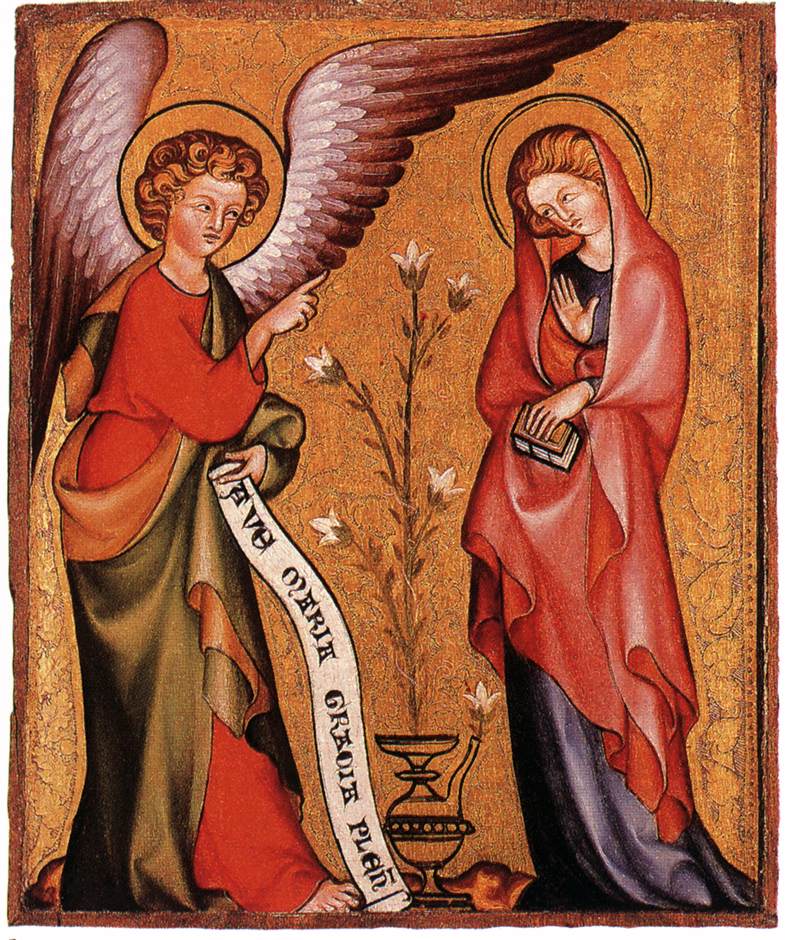
Announciation, unknown German Master, via wiki commons


The Announcaition again, this time we see all elements traditionally depicted in announciations, but this time the book is  not opened, but text is written on the banner held by the archangel.("Hail Mary, full of grace"). this banner as a speech bubble appears often.Wallraf Richttarzt Museum Cologne. Mary with a book again, it has significance, depends if closed or open, etc. Soon about Mary and book symbolism, an elaboration on this  important element of  iconography.

Altdorfer, Virgin Mary with Child, XIV.c via wiki commoms
Virgin Mary as queen, with infant Jesus in her arms, by Altdorfer, (German), museum in Budapest.Infant Jesus has a necklace symbolzsing his future Passion and death on the cross (coral ) which in secular symbolism and superstition of the days: it  was supposed to avert evil. The apple is relating to original sin, held by Jesus is a symbol of redemption, eradication of sin.
Death of the Virgin, by Konrad von Soest, Mary on her death bed attended by humans of saintly and common stature, and by angels themselves. We see richly embroidered blue mantle and blue angels, as the symbols of heavenly realm.Also prominent is red/blue color duo, gold background. Closed books also present, symbol of the Virgin. What is written on the open scroll, which is read by bearded man dressed in red, with his head covered as sign of respect and humility? The paleographers would tell. The saint whose hand holding quill  is almost touching Virgin's hand is, has "Saint John the Apostle" written on his hallo.

Death of Mary by Konrad von Soest, via wiki coomons


Monday, August 6, 2012

Mary Magdalene: Blue Color of Her Robes and Art Historians

 Here we have Lamentation by Petrus Christus from Royal Museum of Art in Brussels. Can you recognize who is who among both Marys? Both have blue robes. Mary, the mother of Jesus is depicted as fainting, her body lifted up by two people. Common depiction, Mary fainting at the lamentation scenes. Is one of the people attending her the Mary Magdalene because she has red dress? Well... no. Color symbolism was common, but not set in stone, there was nothing very dogmatic about it. Please, click on "Mary Magdalene robes"  among the labels/links at the bottom of this post, you can read posts about the other colors.

Lamentation by Petrus Christus, via Wiki commons, click on the picture to view it larger


 But where is Mary Magdalene in this painting? You can recognize her by one of her attributes: the skull. She is the one turned toward the cross and the skull. Ointment jar is another attribute, not in this painting, the cup behind her is the cup for throwing dice, as dice are one of the symbols of Christ's passion. Both Marys are in blue, which was for sure costly, ultramarine was the most expensive of pigments. Both are made clear who they are, made recognizable: one by the pose, another one by her attribute. The viewers of those days knew how both were depicted, today those things are more confusing, as people have less familiarity with iconography.

This example of using so much blue is rather unusual for Petrus Christus himself. He most often used red for Virgin Mary's robes, as was common in the Northern painting. Blue was more common in France. This is of course rough division, the geography, but this is a  more factual explanation to clarify this red and blue vision, than color coding Virgin Mary and Magdalene rigidly.


Rather dogmatic is thinking in red and blue, which sometimes happens today, as art historians and art history buffs say. This means the idiosyncratic idea that Mary the mother of Jesus was depicted only in blue robes, and Mary Magdalene was depicted only in red robes. Luckily the Old Masters where not as limited, or as color blind.But some art historians complain that it is difficult for some people to understand this fact, and even those people will rather aggressively defend their pet idea, in spite the fact that their knowledge is limited.Why is it, and why some people are so fiercely attached to this specific color combination, is a mystery for me. As one art historian said, the subject of the robes of those two venerated quickly reveals how much someone knows, or rather how much someone doesn't knows about art history.

Art historians are not as ignorant as they often gladly represented as: most important, they see a lot of art; when I took history of art on the exam we had c. 600 slides,which were part of the test in the introductory course only, later things were more complicated. Art history classes were compulsory for my degree. I had strong interest in art history quite early, started when I was 13 year sold, so I didn't struggle, but for those people in general who learn art history as elective, mostly it it not an easy A class. It depends on university and who teaches the class, but in general challenges are there, if you want an A, better work hard, as it is not hobby level art history.  

Art historians are very involved in general: they travel if needed, study artists' historical contracts by the patrons and artists, write books, keep current with current research. So, why this need to tell art historians they are so wrong, and specially by people whose knowledge belongs to the limitations of a hobby? Mystery, mystery...


Tuesday, April 3, 2012

Red: Mary Magdalene's Case:Medieval Art, History of Color # 7

Mary Magdalene wasn't depicted only in red though history, as Virgin Mary wasn't depicted in blue only. But let take a look at the red, as both Marys were depicted in red garments. For example the red of the robes of Mary Magdalene had a different, double symbolism, than for example red of other persons' cloaks. Mary Magdalene's robes were painted in cinnabar red, (vermillion), having more hint of orange. Red in general can tend toward more to direction of yellow, or blue, and during the Middle Ages the quality of red was important, which red was symbolizing which idea. The other red symbolized regal values and charity.

 Here comes Crucifixion by Juan Rexach from Northon Simon Museum, Los Angeles. Due to poor lighting conditions the color of Mary Magdalene robes not very accurate on this photograph, in person is like on the photo bellow.

 Crucifixtion by Jaun Rexach, Norton Simon Museum Los Angeles


Here you can see desctiption and a better quality photo 
You can zoom into, and see very well the specific color of Mary Magdalene's garment.

Crucifixion by Masaccio, Museo di Capodimonte, Naples,public domain,  via Wikimedia Commons
 
 I am glad that Maria Rzepinska wisely comments is her book about color that red in Middle Ages was not just red, but it had two aspects. Red was one color in which case people paid attention to its shade, shades had codified meaning. Two types of red were differentiated: the noble one, considered sublimed, and the earthly one, viewed as "sinful". Several examples of this red can be seen close to my living place in California: Norton Simon Museum and  the Huntington Library art collection.But today Massacio, as more widely known.

In general, red stood for love in sense of charity, blood of martyrs, sacrifice on the cross, redemption through crucifixion. But as it could be a color of love in spiritual sense, redemption, also when in specific tone, could symbolize sin, or lust, or both: redemption form sin.This dichotomy is visible in portrayals of Virgin Mary as the sinless one who is represented in another red than Mary  Magdalene  ( dressed in "sinful" red). A medieval painted wouldn't confuse those two reds.


We need to remember that color in medieval art isn't always symbolic: sometimes just the need of decorative usage of color was important. In Latin Christianity (Byzantium was another case) the robes of such a person as Virgin Mary wouldn't have been painted in the same as red of Mary Magdalene's.

Above the crucifixion scene by Masaccio, Mary Magdalene in dramatic gesture of devotion and anguish dressed in red so typical for her. Although there are quite a number of representations of Mary Magdalene in this type of red, specially at crucifixion, this one is probably the most famous one. It is still very medieval. But there are hints of coming of the new era: the Renaissance in Italian art,there are more of human emotions shown. Gothic was very emotional in other countries, (for example showing suffering of Jesus),  but art in Italy was more reserved, making more usage of  Byzantine ideals.

 All  older medieval representations of crucifixion in Latin Christianity would show Jesus fully dressed, each foot nailed separately, and no signs of his suffering. With the passing of time Jesus became more humanized, specially in the art of Northern and Central Europe. The body was more and more exposed, agony and blood shown, feet nailed together. For example in German art Jesus was shown with great attention to expression. From Jesus as a symbol there was a shift  toward showing Jesus as a human being.

What about Masaccio himself? His name was Tommaso di Ser Giovanni di Simone. He died when he was only 27 years old, and he wasn't as famous as the other painters of his times. Even his name was a humorous take on his given name. Masaccio, as he is known even today, is a form from Tom, meaning "clumsy" Tom, as separated form his collaborator Masolino,  the "delicate " Tom.

Yet Masaccio influenced the other Italian artists. It was his example which caused a shift in art:  more and more toward realistic representations of the world around. Here we see a paintings which is still medieval: composition, golden background.  But carved into the golden background humans who were much more real, not idealized, captured in a moment of strong emotion. Figures are real, not ideal.

Other colors of Mary Magdalne's robes in another post, more colors.
And my post about Mary Magdalene depicted in blue click here

Byzantine Christianity depicted her also in red,  with an egg in her hand. In this tradition she was an extremely virtuous woman in similar age of Jesus's mother, and both women died in Ephesus. Mary Magdalene's body was was kept in Constantinople as a very venerated relic. This dissapeared still during the Middle Ages, but also later her relics started to be venerated in Western Europe, Latin Christianity. Relics were hot commodity then, and many stolen from the Churches in Constantinople in 1204 when crusaders sacked and looted this cultured city. Virgin Mary's house is believed still to be there, what was one part of the Byzantine Empire, among ancient ruins of Ephesus, today in Turkey, in a rather remote location but among the most wonderful ruins.