 |
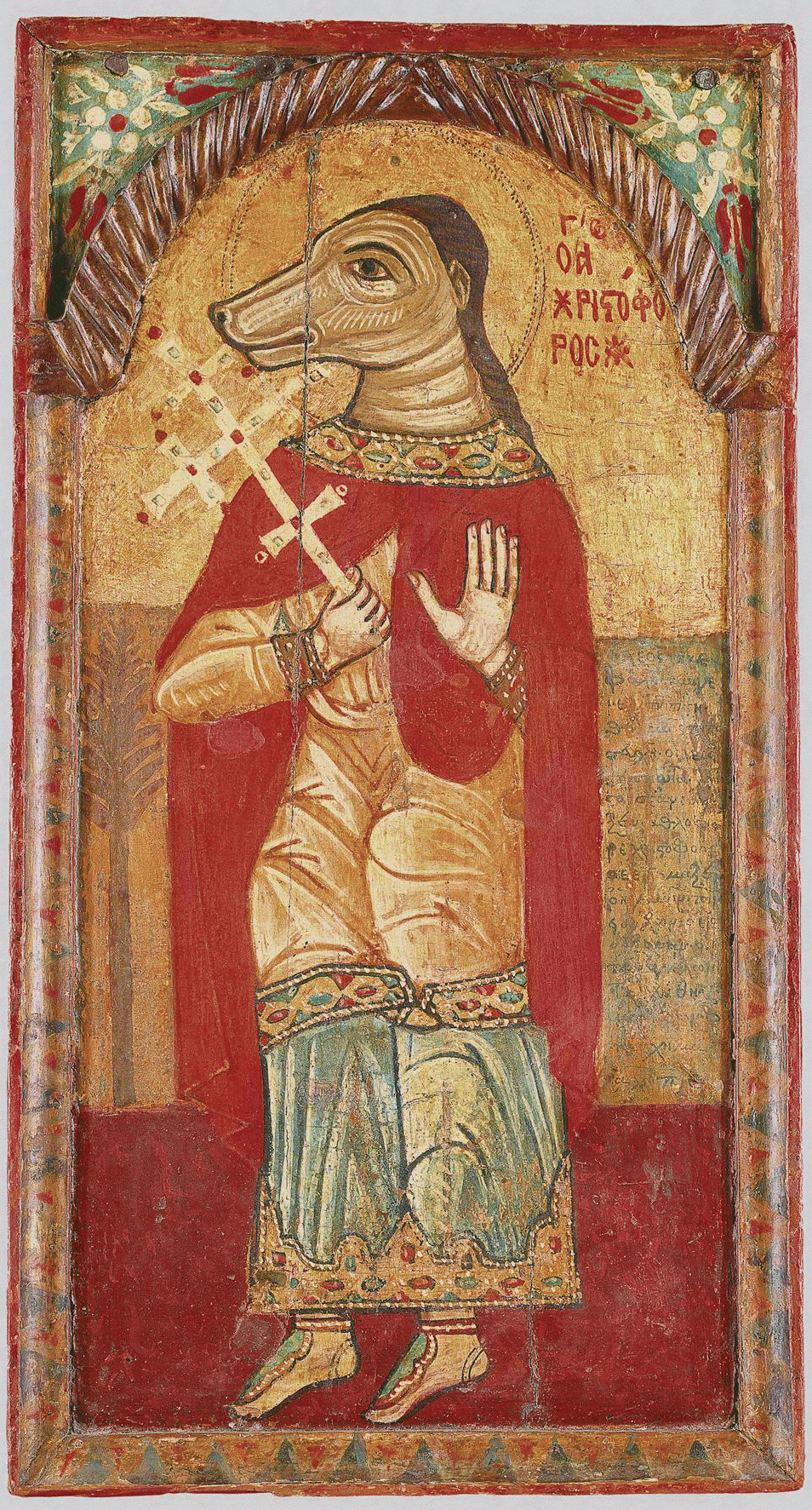
| St Christopher, dog-headed saint, icon |
I was writing about Mary Magdalene and I see from my statistics that entries about her are quite popular. She was also an extremely popular saint, also in Catholicism which described her as a reformed prostitute for over a millennium.There is a disbelief, in general, regarding her alleged former profession and her super star status. It seems that branding someone as a prostitute would be a social death, and it was, normally. And here the logic of old days and logic of today clash: we talk today about erasing Mary Magdalene through smear campaign, all very upsetting. Logical point, not much to dispute from today's view point. After all we live in a society in which we can for example discredit a politician for marital infidelity. But she was a saint and she was worshiped by a society different than ours. She wasn't an average person: she was a saint.
We can't always apply our today logic to societies of days gone. Mary Magdalene was described as a former prostitute, but also was called no less than Apostle to the Apostles. She was also the second most depicted saint: Virgin Mary was first. I know that modern day people struggle deeply with this paradox. Which is logical, of course. But keep in mind that societies of old were in some regards very, very different than ours, their beliefs, social mores, social system, in general their culture was different.
This maybe come as a surprise, but Mary Magdalene was not the only saint who "was a great sinner," as those saints were described relating to the phases in their lives before changing their ways. In her alleged status as a former sinner she wasn't even the worst one. There is over thirty saints who were very ungodly before they changed and after some time achieved saintly characters. (There were saints who had human lives on their conscience, for example). Hard to grasp? Maybe. If we don't know the cultural attitude toward transformation in earlier days, yes, those issues become incompatible, and it is surely understandable that they are incompatible.
Yet people during Medieval times, Renaissance, and Baroque had different views. Actually as late as until Victorian times people were not shy about retelling the sins of the saints. Not at all. They told that St Olga had lots of blood on her hands, as she decided that revenge against murderers of her husband should be bloody and no ones life should be spared. St Paul, the one who authored parts of New Testament was forgiven prosecutor of Christians. St Mary the Egyptian was a street prostitute. Margaret of Cortona was a sex addict. The first saint of all was the Good Thief: he was one of the two criminals crucified with Jesus. St. Callixtus of Rome was convicted twice for felony, in addition embezzlement wasn't something he shied away from. St Moses the Egyptian was boss of a violent gang, those men were killing people. St Camillus de Lellis was a con man, a mercenary, and card player for profit.And so on,this list is not complete, and I don't see the reason to make it complete in this blog. You see the point anyway.
 |
| St Mary of Egypt, Russian icon, XVII c. |
So, not every saint was a paragon of virtue from early on. Some were examples of evil who later changed in the process of true alchemy of the soul. One of the last examples, from XX c. is a man who killed a policeman, and was the last person guillotined for his crime in France. He experienced conversion in prison and become unusually good and a shining example to others, his name was Jaques Fesch. And here is the controversy for and against Jaques Fesch's case for sainthood as seen by the Catholics themselves.
Oscar Wild once said: "Evey saint has a past, every sinner has a future." For sure not every saint had "a past" in sense of bad past, as there were some individuals who very immaculate from the beginning. But for sure path to sainthood wasn't excluding anyone. Mary Magdalene in her alleged profession was not paragon of virtue, but she was quite innocent in comparison to the others. So was another beloved saint, Francis of Assisi, who according to hagiography was a bad boy who matured gradually to sainthood.Early on he wasn't a pacifist as he lived as a soldier, lead decadent life of revelry financed by his wealthy father. It was later when he changed his ways, and also married "Lady Poverty." Word marriage symbolized his commitment to life in poverty.
 |
| Dog-Headed Cannibals, woodcut from Cartha Marina, 1530 |
Sainthood was and still is considered to be the life as most human and humane as it possibly can be. It was believed that every person without exception can become a saint, and the true miracles of transformation of a soul are possible. Miracle of changing water into wine was a miracle of transformation, and such transformation was considered possible for human soul with divine intervention and openness combined with willingness from the side of the sinner.
Today those things may appear difficult to grasp, but were quite simple for people of earlier days: those saints were illustrations of great workings of divine grace. They were miracles in action and embodiments of hope given to every person, however imperfect a human being was, for sure there was hope. The hope was the promise that perfect transformation was possible because perfect forgiveness was possible, that God's love was all inclusive. If one abandoned for good the path of evil, the person could even become sanctified if the transformation was complete. The person was forgiven, and you didn't question divine forgiveness. To do so it would be to dwell on peoples' sins who were forgiven already, washed totally clean, no-existing. People went to confession and believed that their sins were forgiven also, that they were cleansed also.Accepting that this happened to others as well wasn't a big deal for them.It was the world in which confession and repentance was a sacrament of reconciliation, of giving freedom from sin.
Forgiveness as a concept and mystical experience is very prominent in Christianity. It makes transformation possible. Transformation into what? Into purity, life in sanctified grace.Mary Magdalene was considered completely transformed, and as someone who was pure she was also depicted as ascending to heaven. Those things need to be understood in relation to saints, specially those of them who had difficult past, who were not from the beginning like Mother Theresa. They had bad past but grew so far beyond it,that they were not soiled by it anymore. Bad past was the memory of a battle won, not something which was supposed to be held against them, as it showed the severe spiritual obstacles they overcame. You couldn't slander a saint, as the sins forgiven were considered erased forever, sins of any person, and not an object of discussion or doubt after they were removed.
Holding their past against them would be like not accepting God's verdict of forgiveness, to be unforgiving against God's will, and people were warned that those who are unforgiving can't expect much forgiveness themselves. It was much deeper matter than we think about it today from our perspective, "oh, this saint had bad past, therefore was discredited." They couldn't be discredited, as their sins were considered forgiven, what was forgiven wasn't existing anymore.
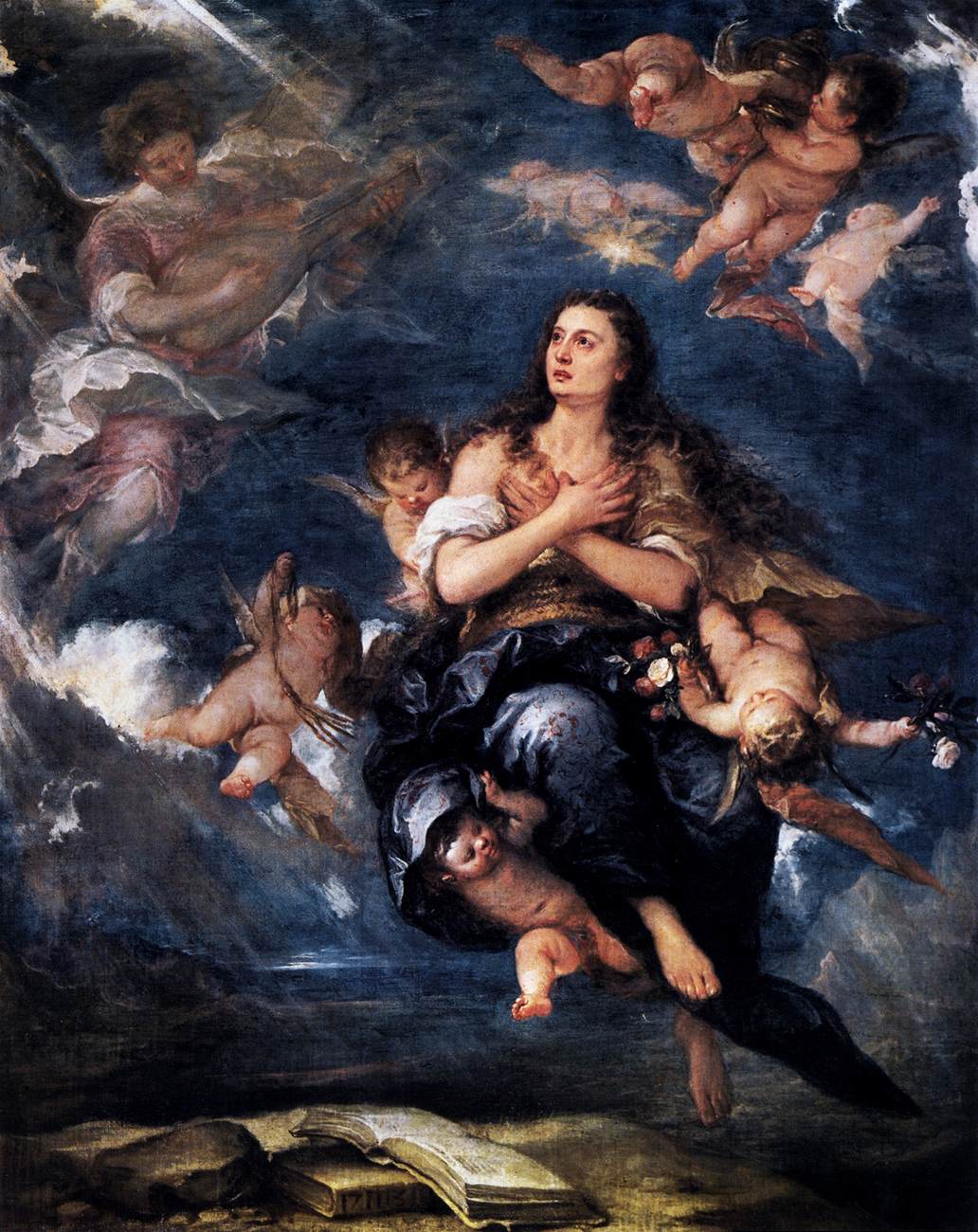 |
| Assumption of Mary Magdalene by Jose Claudio Vicente Antolinez, XVII c. |
As you see Mary Magdalene wasn't the only saint in Catholicism who had bad past, and who was sanctified in spite of it. Yes, early Christianity tried to figure out what to do with women, if they were allowed to be for example priests or not, etc. Misogyny was there. According to comparative religion scholar Karen Armstrong as long as Christianity was a secret and forbidden religion, when Christians met in catacombs or private homes, women were prominent. When Christianity became state religion, power was regarded as right of men. And I say, no wonder, Mediterranean cultures were very misogynistic those days. People are very surprised when they read for example about position of women in Greece of Antiquity. And gender was not considered polarized, as we believe today. It was a different, kind of evolutionary concept which dealt with the belief what every thing was developing in nature. In this system which was linear and not polarized as today, man was the highest sentient being in the hierarchy of life, woman was below him.She was the link between humans and animals. Yes, it was "really so bad." Religions as systems often adopt a lot of surrounding culture. Early Christianity maybe was socially very different at the beginning, but than normative cultural prescriptions started to settle in. And for that no conspiracy was needed. People are not only products of their religions, but also of their cultures, and their times.
