Showing posts with label Madonna. Show all posts

Tuesday, July 16, 2013

Divine Mothers, part 2: Miraculous Icons and icon kissing

For those of you on whose devices is empty space instead of link to you tube video, click here and you will get there
 
Chant in praise of Virgin,sung  by  Orthodox monks.
Written by St Nectarios of Egina, an Orthodox saint considered 
miracle worker himself here you have translation of words

Talk about divine mothers wouldn't be complete without mentioning Orthodox icons, specially those which were and are believed to be working miracles. So many of  icons represent Virgin Mary, called Theotokos,  with baby Jesus, that this fact amazes how much respect was, and is, given to the idea of motherhood set in most sublime concepts of faith. Theotokos is translated in a simplified way as Mother of God, but exact meaning is "the birth giver to god." 

Her cult first developed in Epheus, today Turkey, where according to Eastern tradition she lived with John the Evangelist and Mary Magdalene who retired there after life of preaching, and they were visited by Paul. My apology to those of you who are St Baume Mary Magdalene enthusiasts. St Baume is a wonderful place, but I need to mention Mary Magdalene in Ephesus, as this version  is so ancient, I will do no justice to it by silence. On the left is the picture of house known today as Mary's House, where it is believed that Theotokos lived. According to tradition she was preaching and teaching people about art of healing.There is also a sacred springs which water is supposed to have healing qualities: spring of love, health and happiness. Thanks Radomil for the picture. Ephesus was also the place of the council where the dogma of divine motherhood of Virgin Mary was pronounced. There is also oral tradition in a about Mary's presence there, held by Orthodox Christian village.

As for icons:  those are not considered ordinary images, they are windows to the divine. For Orthodox Christians are presence of the sacred in this world. So, if the icon represents a given saint, this saint presence it there. The icon is treated with respect, can be touched and is kissed in love and honor, and given votive offerings after a performed miracle.

Our lady Vladimirskaya, patron protector of Russia, Eleusa type icon. The star patterns on her moforion  symbolize her VirginityThis icon is damaged, but there is strong sense of radiance.
Kissing in Eastern tradition was a very important gesture, honorific kissing included, it meaning was quite broad, which kissing the icons also includes.Western culture is only intimate sign of affection, of friendliness when the French kiss the cheeks to say hello, kisses between parents and children, and of course between lovers.In earlier days there was a lot of kissing, including kissing women on hand as sign of honor.It is still practiced in Poland and Vienna, the yearly opera event. 

In Biblical times there were kisses between men, family members who were loved, abut also between friends, or people were kissed out of respect. For ex. kissing someones feet was a sign of very strong reverence an honor.. The same in Jesus times. Christian kiss of peace is one example. Also in Greek there were three words expressing love: eros, filos, agape. Eros is erotic love, filos is friendship as love, agape is often translated as charity, but mean unconditional love, the spiritual kind, love as the essence of the divine, love totally selfless. For example the part in New Testament, where Jesus ask Peter "do you love me more than those,"and here he was referring to his disciples. I was introduced to it by someone who studied Koine Greek,  what is translated in English is love, but in Greek there are two words in questions and answers used: filos and agape. As you probably guess, the Theotokos as a mother is also example of such divine, all surpassing unconditional love.

It is an important distinction between kinds of love, and  it got somehow lost, as the distinction between kisses got lost. In the New Testament at the supper in a house of a Pharisee Jesus defended the woman who washed and anointed and kissed his feet (in Orthodox tradition it wasn't Mary Magdalene) and said: "you gave me no kiss," and praised how she showered his feet with kisses and she will be remembered. This was expression of highest reverence, and the Orthodox Christians remember that. But see by yourself not in my words, why Orthodox Christians kiss icons.

But certain  icons are not to available for kissing. Those are the miracle working icons set higher in the altar. 
The icon above is Eluesa type of Madonna, (Our Lady Valdimirskaya, today in Tretakov Gallery). Those graceful depictions are called Virgin of Tender Mercy, of Virgin Showing Mercy, also found in the West. Virgin's and baby Jesus' cheeks touch, or almost touch. Those human gestures of affection are very charming, and here is a small list of miraculous icons in this Eluesa type .

One of miracle icons is the Black Madonna of Czestochowa, this one is not an Eeleusa, but Hedegetria, The Guide as iconograhic type.  Hedegetria, called also Madonna Showing the Way, as gestures with her hand toward  baby Jesus. This is the oldest and the most common stylistic type.
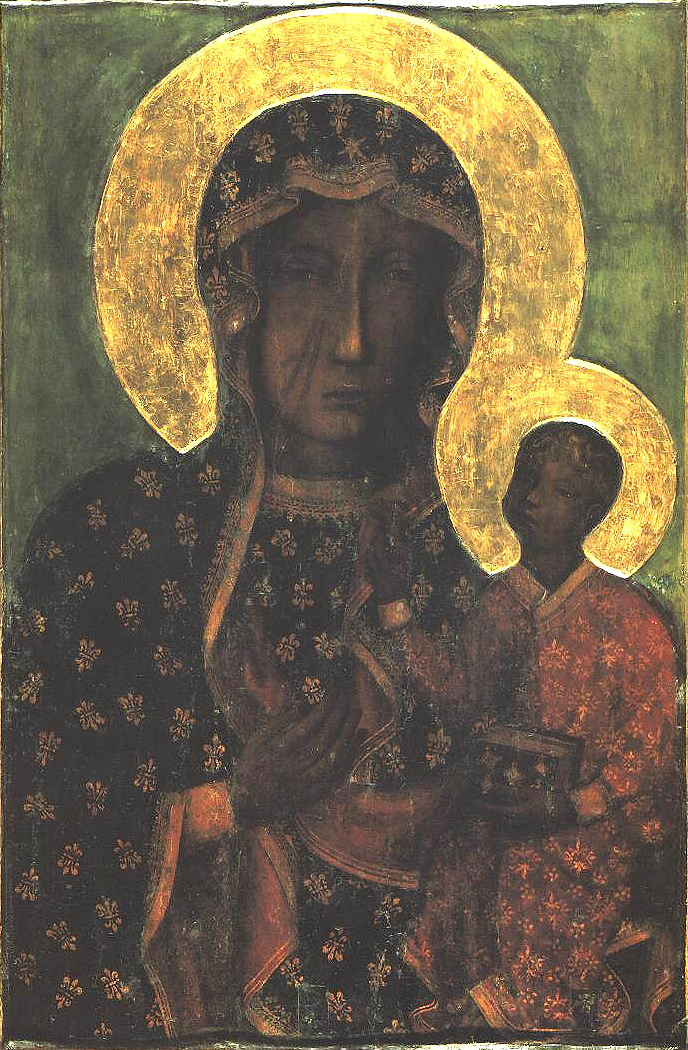
Black Madonna of Czestochowa, Byzantine origin icon of Hedegetria type

The Black Madonna of Czestochowa is the regal powerful mother, who is believed to heal you when you ask for it. Many of us remember from childhood when something hurt, like for example got a bruise from falling off kick scooter, the mother kissed the bruise and felt so much better. This is not to introduce banality in the reverence of miraculous icons, it is just for reminding that the veneration also includes tender feelings which relate to very basic human experiences. Basic, not base. 

She was crowned Queen of Poland. On the walls of the sanctuary there are votive offerings, as thanks from the donors for the miracles of healing: pieces of jewelery, pieces of silver in shapes of parts of human body, also you will see some real life crutches. 

The Black Madonna is viewed as powerful protectress. The icon is of Byzantine origin, showing Italianate influences. The legend says it was painted by St Luke himself on the table from the form  Virgin Mary's own household. It is one of several icons allegedly painted by St Luke. The pattern on Virgin's robes is fleur-de-lis.  There is over 130 iconographical types of depicting Virgin Mary on icons, this one is among the regal type images.

 Those Theotokos were shown like aristocrats of Byzantine imperial court. But the icon painting, or icon-type of style wasn't limited to the areas we today associate with icons: Italy had those too. Bellow  Hedegetria by Giotto. The stripes of fabric angels wear over their robes belong to a traditional fashion of imperial court in Constantinople. Even the Eleusa type has Byzantine moforion

A very imperial looking Theotokos by Giotto
Eastern Orthodox faith didn't develop Mariology as did the Latin Church, but the devotion to Theotokos was  given, even not much disputed in theological manner. The idea that Virgin Mary was elevated above any created being found its expersion  in showing her with as much dignity as depicting a powerful empress.

Sunday, July 14, 2013

Divine Mothers, part 1: breastfeeding Madonna


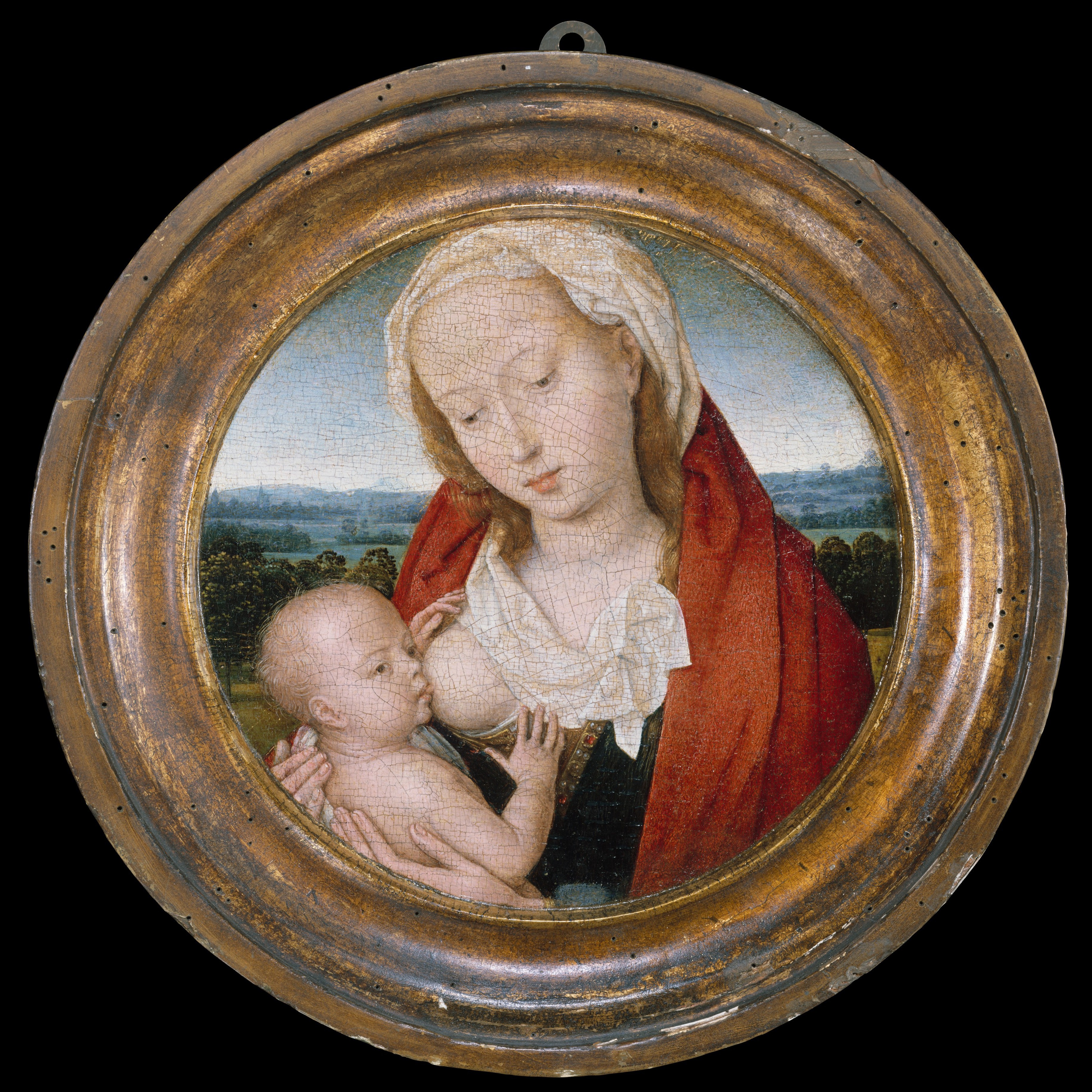
Hans Memling, Nursing Madonna

Today some people are kind of surprised that so many, specially women, like the idea of Mary Magdalene being the wife of Christ and the mother of his children, and talk about her being erased from history.

I am not surprised. In my earlier entry I wrote about how our ideas of Mary Magdalene represent something what is important in our society. Something what is maybe not so clear in our everyday awareness, but many know in some. Let me use that silly word for it: subconscious level.

First, in spite of the technological advances, the world in not becoming more cozy. Many of humans need things mytho-poetic when technology is invading their lives, even when it is to the advantage.We are humans, not cyborgs whose extensions of mind and body are machines. People turned to things mytho-poetic or considered less rational when huge technological advances were made, during the 19th c. and for example 20th century between wars. This trend now isn't new or surprising. It is a natural reaction when people feel that the pendulum went too far in one direction. So, there is a counter movement. It is evoking creative forces of the mind again.People don't want to be cheated out of this important part of human experience, mytho-poetic creativity is part of whole we call a human mind.

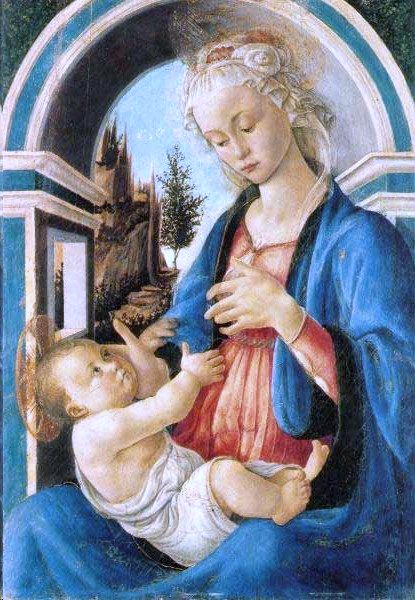
Sandro Botticelli, Madonna with Child, here Virgin Mary in a dress allowing easy nursing
As for Mary Magdalene being a mother and being pushed away: no wonder this idea is popular, lets take a look how we treat motherhood today, what our popular culture reveals, and how motherhood was treated earlier.  This is first entry on the subject of motherhood.First for his entry let consider breast feeding. Talking about things mytho-poetic:  Milky Way according to Greek mythology appeared because of  accidental squirt of Hera's milk while she was nursing Heracles, who as an infant was supposed to acquire god-like qualities by drinking from the breast of the goddess. The word galaxy comes from Greek word for milk.Nice story about milk of the goddess. Today's reality isn't poetic about breast feeding.

This link shows results of study about breast feeding mothers: prejudice. Also those mothers who breast-feed in public have personal stories to tell, how they were treated. Nothing encouraging. There is even a lawyer, a women, who tires to make breast feeding in public illegal. Because it is "disgusting." Not everyone finds it "disgusting," but it is enough for mothers to feel the hostility. Like not everyone is prejudiced against gay people, but enough to create hostile environment. Why so easily labels like "obscene, or"disgusting," "disturbing," are applied to something so positive, psychologically (bonding of mother and child) and what has proven health benefits for the baby?

Gerard David, Nursing Madonna
 Nursing Madonnas as images or part of Marian theology is a very interesting phenomenon. The imagery first appeared in Coptic church of Egypt, the iconography was borrowed from the depictions of Isis nursing Horus. Cultures borrow from each other, as languages borrow words.

Role of Virgin as divine mother was very elevated, she was a co-redeemer of humanity. Some old mystical pictures show her standing at the crucifixion, between her and crucified Jesus stands a chalice to which blood from Jesus' side flows and also milk form Virgin's exposed breast. This was analizsed by art history scholar Anna Boczkowska in her  book Triumph of Luna and Venus, about iconography of Paradise part of the Tryptych Garden of Earthly Delights by Heironymus Bosch.

It was elevation of milk to the same importance as blood of Eucharist, it symbolized grace. Of course this was only on symbolic level, as there was no mixing of milk with wine in ritual of Eucharist.

Milk was a symbol of wisdom, and not just an earthly wisdom. It was a supernatural wisdom of knowledge of things divine, and given as a gift of grace.

Milk was also believed to be transformed from blood, and as such to be part of Eucharist and it took its place in mystical writings. Today those writings maybe not easily understandable for our modern mindset, but people centuries ago understood all metaphors very well. Middle Ages were very poetic, made strong use of symbolic and abstract thinking. 

The type of iconographical depiction of Madonna as nursing mother was common during the Middle Ages, Renaissance and Baroque. Those images often depict  precious moments of human tenderness, but also they elevated motherhood to divine dimensions also. Probably the prototype of nursing Virgin Mary appeared first among Coptic Christians in Egypt, based on imagery of goddess Isis nursing baby Osiris. This doesn't mean that Iis was worshiped under a new name: it is like a new picture was put in an old frame.

 
 This icon of breast feeding Madonna is considered wonder-working in Easter Orthodox faith. It is Galaktotraufusa (Milk Giver) from Mount  Mount Athos Monastery, in Hilandar Monastery, part of Athos complex. It was put there in 13th century, brought here by  Saint Sava of Serbia and installed in iconostasis in an unusual place which was  reserved for icon of Jesus Christ and the Trinity. I have to admit I don't know what happened to this icon. The other icon brought by St Sava, Madonna of Three Hands is supposed to be there, 2004 was a terrible fire in the monastery.

I am not saying that elevating motherhood to such dimensions was all great and sure recipe for making all women happy: childless women suffered, and women conditions were not good in general. But at least mothers' contributions were not taken for granted, or there was an idea that they shouldn't be taken for granted. Motherhood was part of the totality of human experience, and it is, just not enough credit and respect is given to it now.Gender politics is visible in all art history, struggles related to gender continue today.


Francisco de Zurbaran, Holy Family


Ladies, those of you who are or will be mothers, I say: kudos to you for your patience, gentleness, pain, baby fat, hanging breasts, stretch marks. It is not a little thing to be a mother. Milk, pregnancy and labor pains were once revered in mystical writings about experience of the divine. About this another time.

Wednesday, July 3, 2013

Beuatiful Madonnas style in International Gothic and topoi of courtly love

Today i want to show some Madonnas in style which was a branch of International Gothic. Those depictions of Virgin Mary are called in Beautiful Madonnas. This iconographic type emerged in Bohemia (Czech Republic today), and spread to neighbouring states: Holy Roman Empire including Silesia, Poland, Teutonic Knights Crusader State, Burgundy, Austria and France. Not surprising that in the Teutonic Knights' state,   the domain of militant order with their strong devotion to Virgin Mary this style spread rapidly.

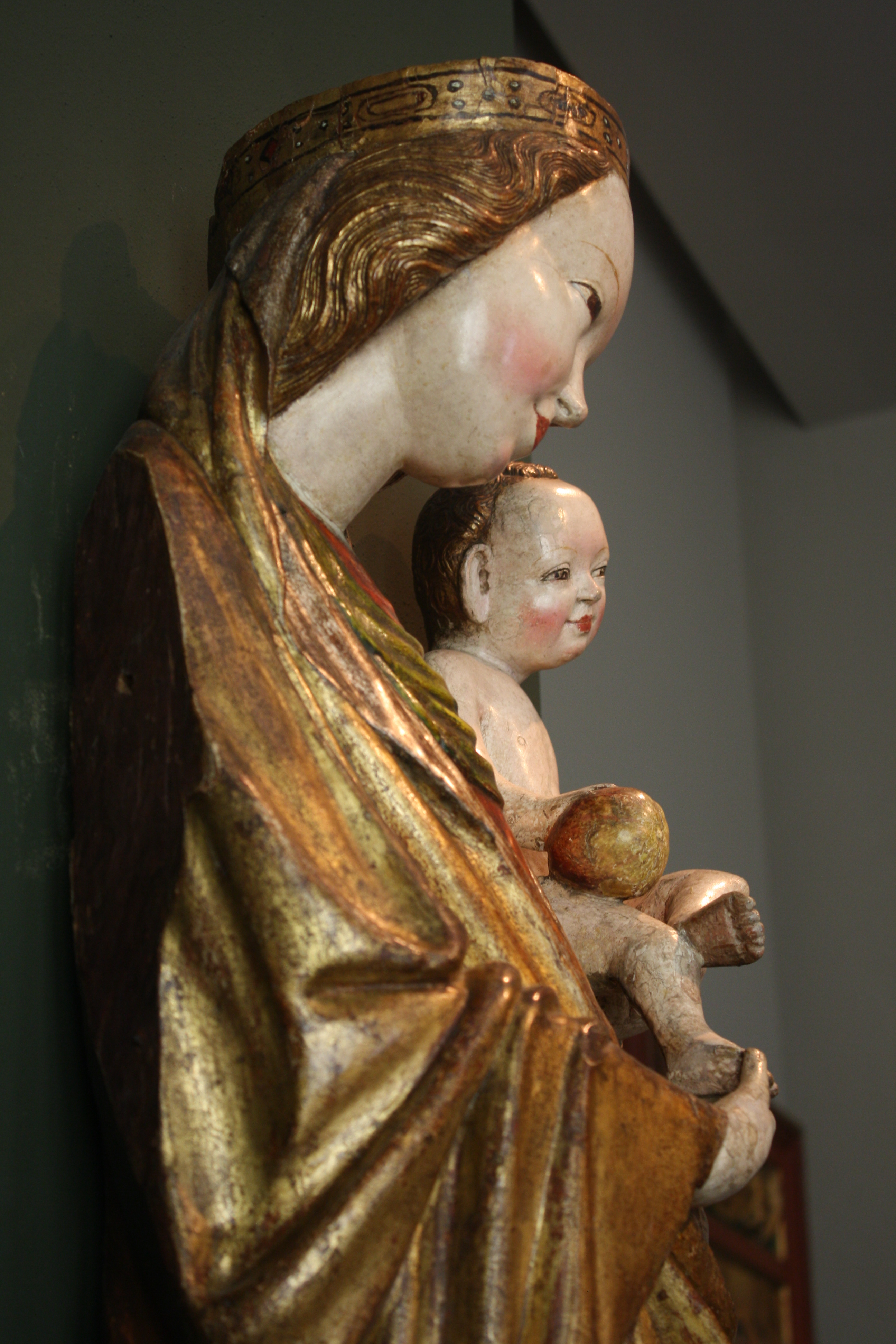
Madonna of Kruzlowa, by Ludwig Schneider/Wikimedia
Beautiful Madonnas were mostly stone sculptures, but sometimes were made wood, sometimes of terracotta fully three dimensional, no reliefs sculptures.

This type was a re-edition of images of Madonna with child, which started already in Byzantium, but this time Madonna was depicted as a very young woman, with delicate hands and small head, beautiful and lyrical. There is a lot of charm in Beautiful Madonnas, it is very sublime style with gentle gestures, cascades of fabrics, emotions showed realistically also the was strong attention to detail as the artists wanted to depict her very realistically, in a less stylized manner. It is all very refined in comparison to the previous styles of representation of her.

Characteristic pose of Madonnas is so called S pose, where the person stands slightly slouching, belly forward, the spine is bend, not straight. This was also a common pose in International Gothic, or High Gothic in general. It was considered very elegant those days.

The example on the left Madonna from Kruzlowa is obviously very young, she looks like an ideal lady of the court culture of her times. About an ideal of beauty in Gothic another time, in a separate entry. Yes, the baby looking as if he was going bald was one of the beauty ideals, also women had very high foreheads, which gave them balding looks. It was a fashion once.

Here the Madonna of Kruzlowa and her child are represented as New Adam and New Eve. This maybe confusing for today's audiences, but there was a lot of theological disputes in the Middle Ages about Mary's role in  redemption of humanity. Medieval allegories and symbols can be strange, but they also can be explained in a simple manner, I hope I can do it without making things complicated: Virgin Mary and her son are the new humanity, both were new people born without original sin. Adam and Eve were the people of old times, before the redemptive powers of the Messiah appeared in human form. Both Virgin and child are human, but also are divine, closer to perfection as born without original sin.  In Catholic doctrine Mary is the co-Savior, and Jesus is Savior of the world. Both take part in salvation of fallen  humanity. Here we see the apple in baby Jesus hand, it has double nature: it is an apple from Eden, but also an apple as globe, part of royal regalia, showing him as the ruler of humanity.

Beautiful Madonna of Wroclaw, Anonymous of Wroclaw or Prague, via wikicommons/ Burgher S

You can view a gallery of Beautiful Madonnas on wikipedia article (which i sin Polish only, but has quite nice visuals.) Those Madonnas represented ideal beauty, those ladies are equivalent of  models of today.  This type of representation was not a stylized Madonna anymore, but one that looked like a woman from real world, dressed like her, standing, gesturing like her, interacting with her child like a real mother from real world.

Also they would be cherished as court ladies, their about their virtues troubadours would sing. Just she wouldn't be so real, as the ladies who were the subject of courtly love were supposed to be extremely virtuous, extremely good.Knight would fall in love just by hearing of their virtues, before seeing them in person. Love of such lady was supposed to transform the lover who worshiped her.

 Even though in secular world the poetry of courtly love also included erotic elements, there was also an element of total sublimation, spread by the philosophy of Neo-platonism. Certain ideas overlapped, for example the idea of total devotion which echoes in mystical writings among others in those by Bernard of Clairveau who adored Virgin Mary, not a lady in earthly form. The lady is so adored, that she becomes unreal, she becomes totally divine. An ideal lady in secular world was of course a queen, and often the Virgin is wearing a royal crown.

Bust of a Virgin, terreacota, Bohemia, XIVc, wikimedia/ Mieow Mieow


The love of the Virgin is similar to courtly love, but of course is platonic, totally mystical, often has symbolic forms, like the Song of Songs was interpreted symbolically. Medieval mysticism, or Mariology in general, can be confusing. Social context and a little bit of social history is needed in order to make more sense of it.

Certain elements of devotion to Virgin Mary have common points in the idea of courtly love, it is strong selfless adoration of a chosen woman. With time an earthly court lady was replaced by Madonna, the Heavenly Lady. When the times of courtly love, fin'amor, (fine love), came to an end, and new era came:  XIII c was time of strong devotion to the Virgin Mary and mystical experience of sublimated love which broke any connections to sensuality.

For example Daude de Pradas who was also a troubadour, wrote that God was ultimate ":fine love and truth," and who loves God is loved back perfectly by him. He used the term fin'amor  referring to God, the term which was used usually in connection with courtly love. Lanfranc Cigala, another troubadour, also wrote about fine love in his religious poems. In his Gloriosa sainta Maria he wrote that he now is praising Virgin Mary as his lady in his songs, as the earthly love gave him only disappointment and pain.

Was this the search for ultimate virtue which gave new characteristics to Mariology? Probably. But also more troubadours than before were admonished not to sing sensual songs after the Albigensian Crusade. At once the culture of Southern France, home of prominent troubadours, became "worse than of the Saracens."  This  is a typical excuse of the colonisers, to talk with contempt about the culture they conquered. It happened later, in cases of XIX c. colonisation as well, putting down on India, Africa, Indochina, etc. But sometimes the conquerors adopted certain things for themselves, "to pity to destroy," as one of my art history teachers said. Troubadours were not only there, but Occitan culture was the culture of troubadours like for example Germany has culture of philosophy and good engineering.

But ardent songs of earthly love had topoi which were easily translated and adopted into mystical experience of platonic love. Song of Songs was symbolic also. Metaphors of religious love included love of parents for their children, love of spouses and also love of siblings. It seems that we humans need things earthly to express things the most abstract but very real at the same time. Mystical experiences belong to such realm of strong abstraction and reality.

The Madonnas included in this article here you can see  in order of appearance in two museums in Poland  Madonna of Kruzlowa is in Krakow,  Wroclaw Madonna is in Warsaw,  and in Bohemian Madonna in New York.Article about courtly love from wikipedia