Showing posts with label Northern Renaissance. Show all posts

Sunday, July 14, 2013

Divine Mothers, part 1: breastfeeding Madonna


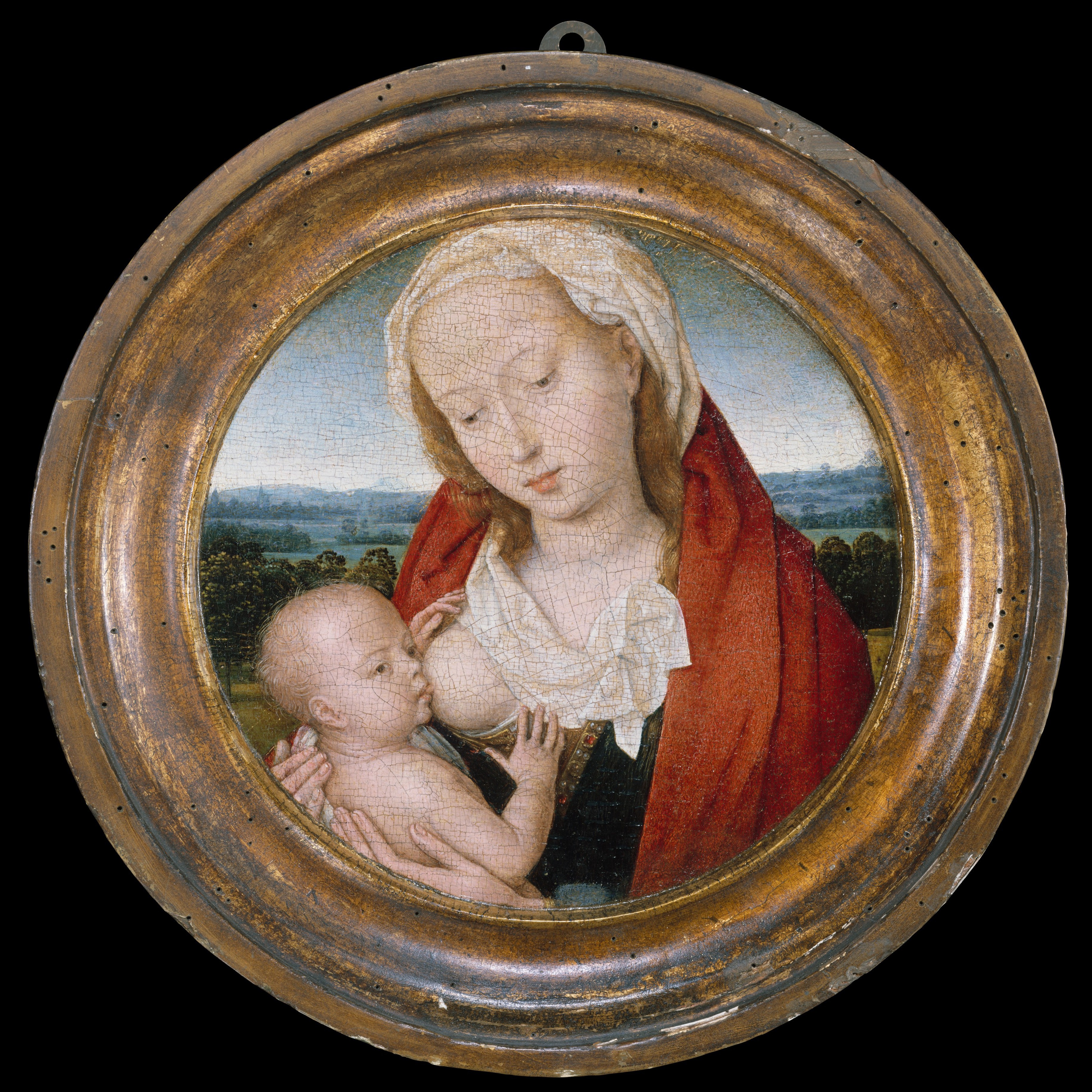
Hans Memling, Nursing Madonna

Today some people are kind of surprised that so many, specially women, like the idea of Mary Magdalene being the wife of Christ and the mother of his children, and talk about her being erased from history.

I am not surprised. In my earlier entry I wrote about how our ideas of Mary Magdalene represent something what is important in our society. Something what is maybe not so clear in our everyday awareness, but many know in some. Let me use that silly word for it: subconscious level.

First, in spite of the technological advances, the world in not becoming more cozy. Many of humans need things mytho-poetic when technology is invading their lives, even when it is to the advantage.We are humans, not cyborgs whose extensions of mind and body are machines. People turned to things mytho-poetic or considered less rational when huge technological advances were made, during the 19th c. and for example 20th century between wars. This trend now isn't new or surprising. It is a natural reaction when people feel that the pendulum went too far in one direction. So, there is a counter movement. It is evoking creative forces of the mind again.People don't want to be cheated out of this important part of human experience, mytho-poetic creativity is part of whole we call a human mind.
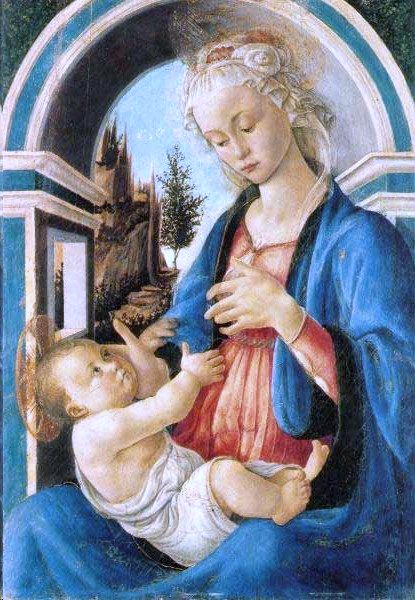
Sandro Botticelli, Madonna with Child, here Virgin Mary in a dress allowing easy nursing
As for Mary Magdalene being a mother and being pushed away: no wonder this idea is popular, lets take a look how we treat motherhood today, what our popular culture reveals, and how motherhood was treated earlier.  This is first entry on the subject of motherhood.First for his entry let consider breast feeding. Talking about things mytho-poetic:  Milky Way according to Greek mythology appeared because of  accidental squirt of Hera's milk while she was nursing Heracles, who as an infant was supposed to acquire god-like qualities by drinking from the breast of the goddess. The word galaxy comes from Greek word for milk.Nice story about milk of the goddess. Today's reality isn't poetic about breast feeding.

This link shows results of study about breast feeding mothers: prejudice. Also those mothers who breast-feed in public have personal stories to tell, how they were treated. Nothing encouraging. There is even a lawyer, a women, who tires to make breast feeding in public illegal. Because it is "disgusting." Not everyone finds it "disgusting," but it is enough for mothers to feel the hostility. Like not everyone is prejudiced against gay people, but enough to create hostile environment. Why so easily labels like "obscene, or"disgusting," "disturbing," are applied to something so positive, psychologically (bonding of mother and child) and what has proven health benefits for the baby?

Gerard David, Nursing Madonna
 Nursing Madonnas as images or part of Marian theology is a very interesting phenomenon. The imagery first appeared in Coptic church of Egypt, the iconography was borrowed from the depictions of Isis nursing Horus. Cultures borrow from each other, as languages borrow words.

Role of Virgin as divine mother was very elevated, she was a co-redeemer of humanity. Some old mystical pictures show her standing at the crucifixion, between her and crucified Jesus stands a chalice to which blood from Jesus' side flows and also milk form Virgin's exposed breast. This was analizsed by art history scholar Anna Boczkowska in her  book Triumph of Luna and Venus, about iconography of Paradise part of the Tryptych Garden of Earthly Delights by Heironymus Bosch.

It was elevation of milk to the same importance as blood of Eucharist, it symbolized grace. Of course this was only on symbolic level, as there was no mixing of milk with wine in ritual of Eucharist.

Milk was a symbol of wisdom, and not just an earthly wisdom. It was a supernatural wisdom of knowledge of things divine, and given as a gift of grace.

Milk was also believed to be transformed from blood, and as such to be part of Eucharist and it took its place in mystical writings. Today those writings maybe not easily understandable for our modern mindset, but people centuries ago understood all metaphors very well. Middle Ages were very poetic, made strong use of symbolic and abstract thinking. 

The type of iconographical depiction of Madonna as nursing mother was common during the Middle Ages, Renaissance and Baroque. Those images often depict  precious moments of human tenderness, but also they elevated motherhood to divine dimensions also. Probably the prototype of nursing Virgin Mary appeared first among Coptic Christians in Egypt, based on imagery of goddess Isis nursing baby Osiris. This doesn't mean that Iis was worshiped under a new name: it is like a new picture was put in an old frame.

 
 This icon of breast feeding Madonna is considered wonder-working in Easter Orthodox faith. It is Galaktotraufusa (Milk Giver) from Mount  Mount Athos Monastery, in Hilandar Monastery, part of Athos complex. It was put there in 13th century, brought here by  Saint Sava of Serbia and installed in iconostasis in an unusual place which was  reserved for icon of Jesus Christ and the Trinity. I have to admit I don't know what happened to this icon. The other icon brought by St Sava, Madonna of Three Hands is supposed to be there, 2004 was a terrible fire in the monastery.

I am not saying that elevating motherhood to such dimensions was all great and sure recipe for making all women happy: childless women suffered, and women conditions were not good in general. But at least mothers' contributions were not taken for granted, or there was an idea that they shouldn't be taken for granted. Motherhood was part of the totality of human experience, and it is, just not enough credit and respect is given to it now.Gender politics is visible in all art history, struggles related to gender continue today.


Francisco de Zurbaran, Holy Family


Ladies, those of you who are or will be mothers, I say: kudos to you for your patience, gentleness, pain, baby fat, hanging breasts, stretch marks. It is not a little thing to be a mother. Milk, pregnancy and labor pains were once revered in mystical writings about experience of the divine. About this another time.

Monday, July 8, 2013

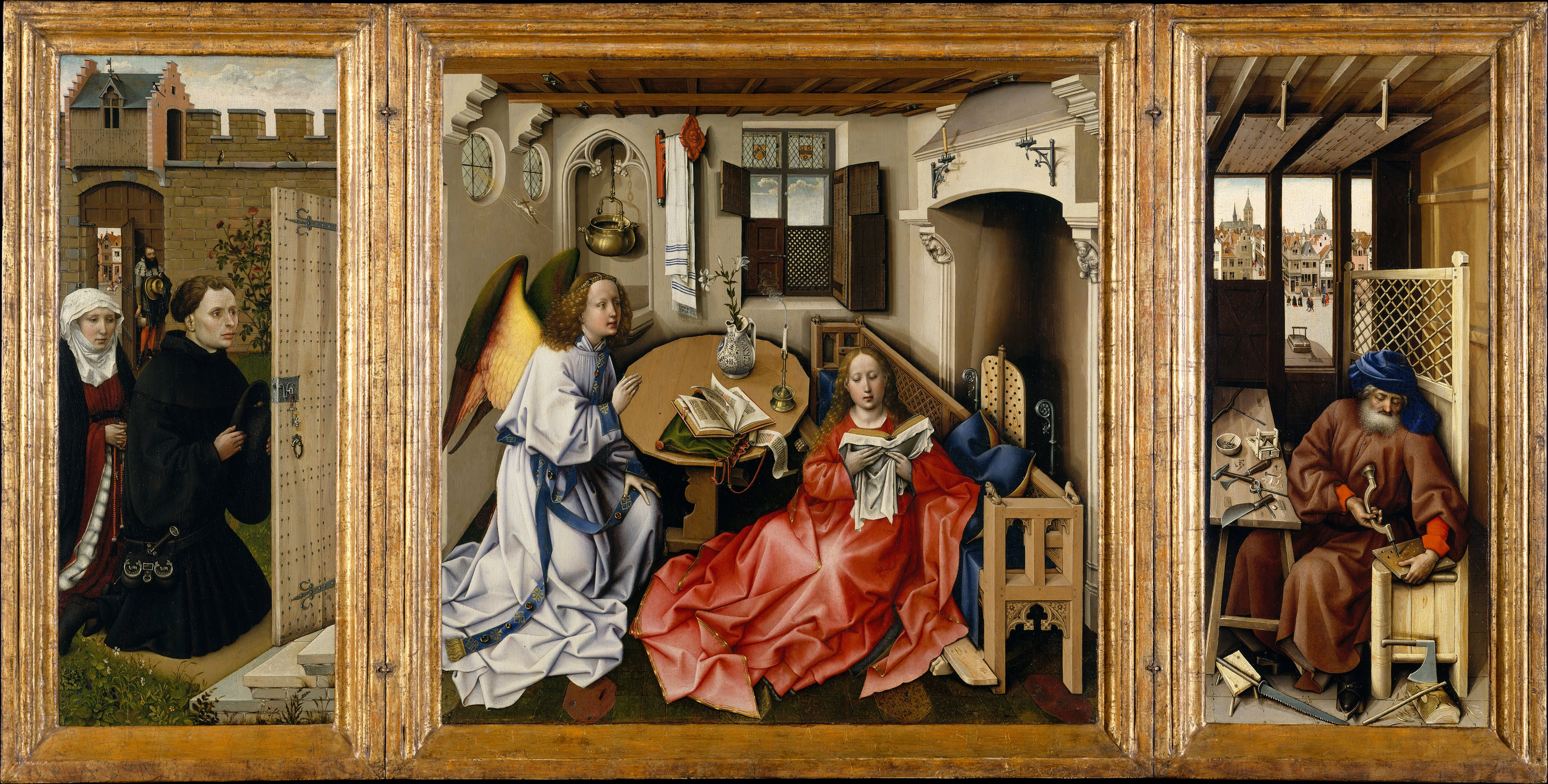
Iconography of Anounciation of Merode Altarpiece by Robert Campin

Robert Campin and apprentice, Annunciation triptych, Merode Altarpiece,  1427-1430 Cloisters, New York

This version of Annunciation is rich in symbolism which was easily understood by average person of the days this altarpiece was commissioned. Today anyone interested can see it at the Cloisters, branch of Metropolitan Museum of Art in New York, but in today's world an average person doesn't understand its symbolism. Usually someone notices what is going on and who is there, as we are trained to understand different type of symbols. This painting belongs to Northern Renaissance but has still many elements of Late Gothic. Click on the picture to see it bigger.

Who is there?  From right to left: Joseph, engaged in wood working in his workshop, secluded an din a different landscape as we see through the window. Virgin Mary, absorbed in reading a book and she is not noticing the Archangel Gabriel yet. Archangel just arrived, he looks as he is about to kneel.  Above him in the air  on the rays of light there is a tiny baby Jesus with the cross. Merode couple kneeling outside, open or semi-open door at front of them.Maybe they are watching the scene. And close to the wall in the background we see a messenger. As for those who dismiss Virgin Mary as Virgin Mary on artistic depictions anytime she is dressed in red: this is Virgin Mary indeed, and she was often depicted in this color, specially in Northern school to which the painting belongs, and no, she is not pregnant. The bump under heavy draped robe is just  her knee.

Joseph made two mouse traps. This relates to the sermon by St Augustine who described incarnation of Jesus as a bite for Satan, in some way as mice are trapped in mouse traps. There are two traps, if they represent Jesus and Mary as two participants in the process of incarnation, etc. I prefer to say I don't know instead of giving you my guesses. This can mean many things, and there is debate among scholars, so, as I am not someone specializing in this part of art history, I leave it at this point how it is, no point of adding my opinions to it.

The central panel has symbols of Mary's purity: white as color symbolizing purity, white vase and white lily (chastity), also the wash basin and towel: Mary was called a pure vessel.  Archangel Gabriel also dressed like a deacon, in white, underlines the idea of purity. I like the respect shown for books, they were considered precious objects and this painting shows it.

On the table the scroll represents  Testament, the book is the New Testament. Book represents law, here is the fulfillment of what was written in the book. Green of the cache for the book  is the color of hope, Paradise and resurrection. It is not symbolizing fertility in this case, as it is religious painting, not secular one, and green is tied to Paradise and resurrection. The incarnation of the divine here is not regular event relating to natural earthly fertility.

The candle which is extinguished symbolizes divine light extinguished in order to become human, in order to incarnate in human body. The divine light in eternal aspect is shown on the wings of Archangel: gold or yellow in its place was also symbolizing divine light. The window which now shows the sky and family crests was painted in gold earlier, before over-painting with what we see today. Seven rays on which baby Jesus is traveling stands for divine light, seven rays: seven is the sacred number. Bu the dark color on the wings stands for depth of divine mysteries, for which black stood. The tiny carved lions on the bench are symbols of the seat of Salomon.

 Red robe of the Virgin symbolizes her love: ( agape the unconditional love), charity, redemption by the sacrifice on the cross, but also is a fashionable robe of the days in a very expensive color. Campin showed a domestic setting, and fashion of the days, which was typical. Old paintings are also valuable resources for costume historians and costume designers, as there is so much historical information, specially in the case of the painters with great attention to details and skills in rendering them. What we see also is an interior of a typical home in a city. Usually Annunciation was shown in a church or palace, here we have an interior of a real home. Campin was a painter for the city people, not a painter for aristocrats or churches. This small altarpiece was not intended to be installed in a church, but was an object of private domestic devotion.

The courtyard where the three people who are real life persons of Campin's days are present (donor with his wife and the messenger) is alluding to garden, but is not the same as in depiction of Virgin Mary in gardens: here it is is more cloistered, not much vegetation. Those gardens were cloistered gardens, in which the Virgin was depicted but had more vegetation, here it is more sparse. Still it is enclosed garden, hortus conclusus, which symbolizes Mary's virginity. Here the vegetation relates less to Paradise, which was typical in those hortus conclusus types of paintings, but the flowers represent the virtues of the Virgin: rose stand for her charity, violet for her humility.

The scenes are like almost everyday situations, except angel showing up. In Gothic slowly the divide between sacred and real human life started to narrow. Here we see religious scene happening like in real life, the saintly people don't even have halos, it was unusual. Painting saints without halos happened one century later, in Renaissance Italy.

Perspective in this painting is partially correct. It is not a typical linear perspective, where mathematics rules.Here those rules are bend and we have some twisted angles, like for example the table is painted correctly to the rules, this is not realistic, but allowed the painter to show more details. Sometimes artists do such things in order to make greater visual impact. For example Pieta by Michelangelo, where Mary is so much bigger than Jesus, yet for viewers it looks very natural.

 Bellow we have another painting of Virgin, this time with baby, in an interior by Campin, for comparison. I think now you will be able to read with ease the symbols contained in this domestic scene.