Showing posts with label Czech Republic. Show all posts

Wednesday, July 3, 2013

Beuatiful Madonnas style in International Gothic and topoi of courtly love

Today i want to show some Madonnas in style which was a branch of International Gothic. Those depictions of Virgin Mary are called in Beautiful Madonnas. This iconographic type emerged in Bohemia (Czech Republic today), and spread to neighbouring states: Holy Roman Empire including Silesia, Poland, Teutonic Knights Crusader State, Burgundy, Austria and France. Not surprising that in the Teutonic Knights' state,   the domain of militant order with their strong devotion to Virgin Mary this style spread rapidly.

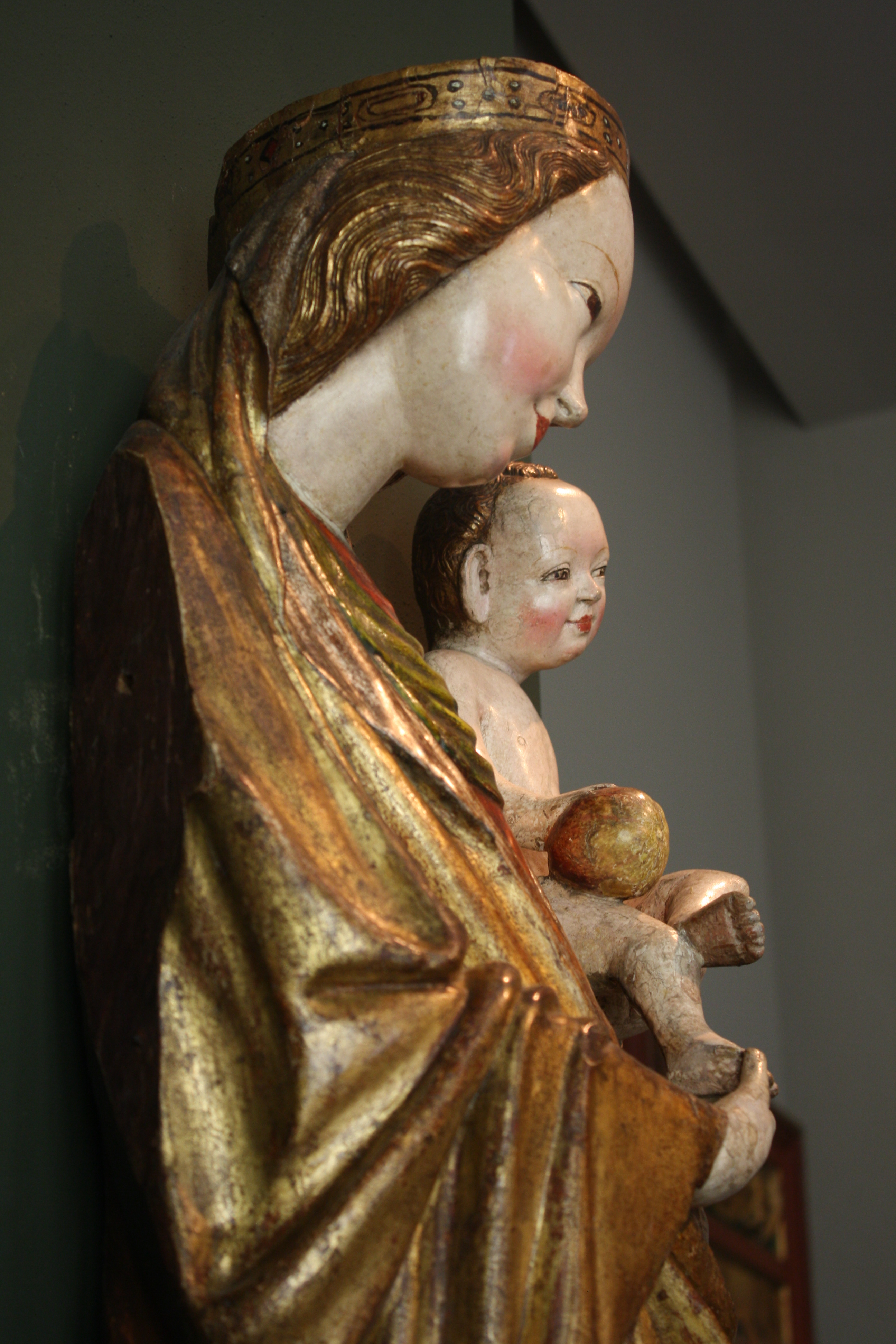
Madonna of Kruzlowa, by Ludwig Schneider/Wikimedia
Beautiful Madonnas were mostly stone sculptures, but sometimes were made wood, sometimes of terracotta fully three dimensional, no reliefs sculptures.

This type was a re-edition of images of Madonna with child, which started already in Byzantium, but this time Madonna was depicted as a very young woman, with delicate hands and small head, beautiful and lyrical. There is a lot of charm in Beautiful Madonnas, it is very sublime style with gentle gestures, cascades of fabrics, emotions showed realistically also the was strong attention to detail as the artists wanted to depict her very realistically, in a less stylized manner. It is all very refined in comparison to the previous styles of representation of her.

Characteristic pose of Madonnas is so called S pose, where the person stands slightly slouching, belly forward, the spine is bend, not straight. This was also a common pose in International Gothic, or High Gothic in general. It was considered very elegant those days.

The example on the left Madonna from Kruzlowa is obviously very young, she looks like an ideal lady of the court culture of her times. About an ideal of beauty in Gothic another time, in a separate entry. Yes, the baby looking as if he was going bald was one of the beauty ideals, also women had very high foreheads, which gave them balding looks. It was a fashion once.

Here the Madonna of Kruzlowa and her child are represented as New Adam and New Eve. This maybe confusing for today's audiences, but there was a lot of theological disputes in the Middle Ages about Mary's role in  redemption of humanity. Medieval allegories and symbols can be strange, but they also can be explained in a simple manner, I hope I can do it without making things complicated: Virgin Mary and her son are the new humanity, both were new people born without original sin. Adam and Eve were the people of old times, before the redemptive powers of the Messiah appeared in human form. Both Virgin and child are human, but also are divine, closer to perfection as born without original sin.  In Catholic doctrine Mary is the co-Savior, and Jesus is Savior of the world. Both take part in salvation of fallen  humanity. Here we see the apple in baby Jesus hand, it has double nature: it is an apple from Eden, but also an apple as globe, part of royal regalia, showing him as the ruler of humanity.

Beautiful Madonna of Wroclaw, Anonymous of Wroclaw or Prague, via wikicommons/ Burgher S

You can view a gallery of Beautiful Madonnas on wikipedia article (which i sin Polish only, but has quite nice visuals.) Those Madonnas represented ideal beauty, those ladies are equivalent of  models of today.  This type of representation was not a stylized Madonna anymore, but one that looked like a woman from real world, dressed like her, standing, gesturing like her, interacting with her child like a real mother from real world.

Also they would be cherished as court ladies, their about their virtues troubadours would sing. Just she wouldn't be so real, as the ladies who were the subject of courtly love were supposed to be extremely virtuous, extremely good.Knight would fall in love just by hearing of their virtues, before seeing them in person. Love of such lady was supposed to transform the lover who worshiped her.

 Even though in secular world the poetry of courtly love also included erotic elements, there was also an element of total sublimation, spread by the philosophy of Neo-platonism. Certain ideas overlapped, for example the idea of total devotion which echoes in mystical writings among others in those by Bernard of Clairveau who adored Virgin Mary, not a lady in earthly form. The lady is so adored, that she becomes unreal, she becomes totally divine. An ideal lady in secular world was of course a queen, and often the Virgin is wearing a royal crown.

Bust of a Virgin, terreacota, Bohemia, XIVc, wikimedia/ Mieow Mieow


The love of the Virgin is similar to courtly love, but of course is platonic, totally mystical, often has symbolic forms, like the Song of Songs was interpreted symbolically. Medieval mysticism, or Mariology in general, can be confusing. Social context and a little bit of social history is needed in order to make more sense of it.

Certain elements of devotion to Virgin Mary have common points in the idea of courtly love, it is strong selfless adoration of a chosen woman. With time an earthly court lady was replaced by Madonna, the Heavenly Lady. When the times of courtly love, fin'amor, (fine love), came to an end, and new era came:  XIII c was time of strong devotion to the Virgin Mary and mystical experience of sublimated love which broke any connections to sensuality.

For example Daude de Pradas who was also a troubadour, wrote that God was ultimate ":fine love and truth," and who loves God is loved back perfectly by him. He used the term fin'amor  referring to God, the term which was used usually in connection with courtly love. Lanfranc Cigala, another troubadour, also wrote about fine love in his religious poems. In his Gloriosa sainta Maria he wrote that he now is praising Virgin Mary as his lady in his songs, as the earthly love gave him only disappointment and pain.

Was this the search for ultimate virtue which gave new characteristics to Mariology? Probably. But also more troubadours than before were admonished not to sing sensual songs after the Albigensian Crusade. At once the culture of Southern France, home of prominent troubadours, became "worse than of the Saracens."  This  is a typical excuse of the colonisers, to talk with contempt about the culture they conquered. It happened later, in cases of XIX c. colonisation as well, putting down on India, Africa, Indochina, etc. But sometimes the conquerors adopted certain things for themselves, "to pity to destroy," as one of my art history teachers said. Troubadours were not only there, but Occitan culture was the culture of troubadours like for example Germany has culture of philosophy and good engineering.

But ardent songs of earthly love had topoi which were easily translated and adopted into mystical experience of platonic love. Song of Songs was symbolic also. Metaphors of religious love included love of parents for their children, love of spouses and also love of siblings. It seems that we humans need things earthly to express things the most abstract but very real at the same time. Mystical experiences belong to such realm of strong abstraction and reality.

The Madonnas included in this article here you can see  in order of appearance in two museums in Poland  Madonna of Kruzlowa is in Krakow,  Wroclaw Madonna is in Warsaw,  and in Bohemian Madonna in New York.Article about courtly love from wikipedia


Friday, April 20, 2012

Gothic Art Outside France? Any Good? Central Europe, etc.?

French Gothic art is very renown, and for good reason. French cathedrals are magnificent, totally awe-inspiring.

Sadly, often it is only Gothic art known to travelers in Europe, and I understand that. Time and money can be a limiting factor. I consider myself lucky, growing and living where I could just take a walk and could step in a welcoming interior of a Gothic cathedral. Or a Gothic church, or a Baroque one, and other international styles. For sure this can nourish your aesthetic sensibilities. This is one reason I write this blog, to be able to share what I got for granted.

Sure, Reims, Chartres, Notre Dame, etc. are worth the journey, are iconic. So are Paris, Giverny, Carcassonne, and other beautiful places. So is Cologne with magnificent and finished cathedral towers.Stump-like towers of French cathedrals are unfinished, you know, those towers with flat tops? Those are unfinished ones, not just the intention of the builders.

Other German cathedrals or Gothic churches are also worth the visit. They look very much like the French ones, but the towers are usually much taller, truly the intention of Gothic, often with open work spires, lacy. Gothic was architecture which ambition was to grow as much in height as possible, the ideal was  to get the numbers of the ratio of walls and floor space as much different as possible (1:1 would be a bad ratio!) Cologne cathedral has 1:4 ratio of surface vs. height. French cathedrals get to 1:3 ratio. It was like a racing toward the sky, and often the attempts of getting the ratio to the extremes resulted in collapses of the cathedrals.Here is shown what you can see, and hear at the Cologne Cathedral.


And here are the magnificent bells an the exterior of Cologne Cathedral


  But there is of course beautiful lot of Gothic art in other countries too: England, Spain, Portugal, Czech Republic, Poland, Baltic States. Poland and Baltic States have examples of brick Gothic.
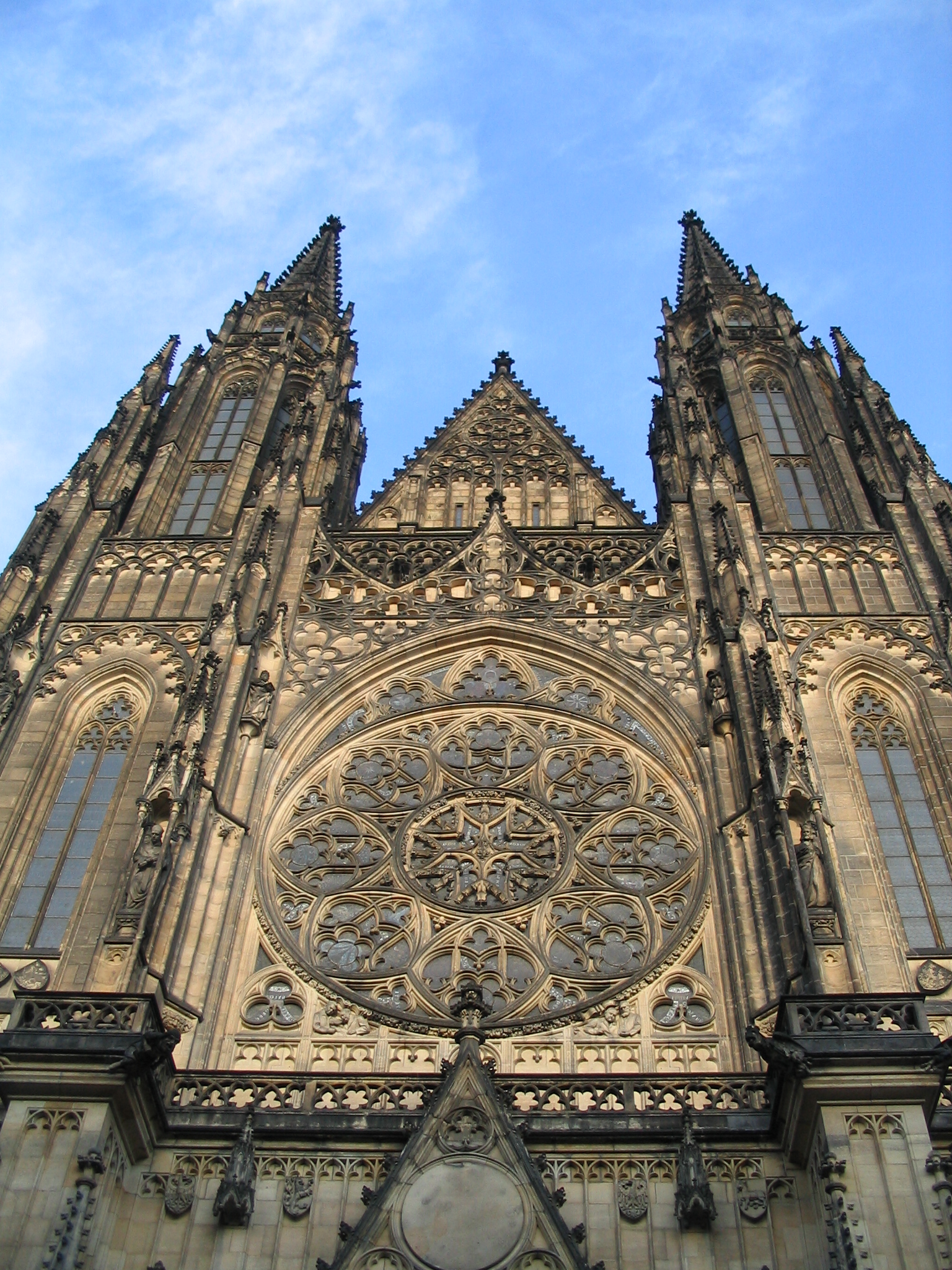
Portal of St. Vitus Cathedral wit rose window, stone masonry, Prague, via wiki commons courtesy of Vaylag

With mass tourism being such lively enterprise, many people are able to see a lot, but often this is knowledge given by the tour guides. Pity when among Gothic cathedrals only Chartres or Notre Dame rings the bell, but Amiens is a total mystery. I mean I don't argue to visit all possible sites, but to read. I wonder, maybe it is the fault of art historians, or popularizes, or people like me who can't make the subject interesting? For ex. authors who make Chartres a place of mystery reshaping its once famous cathedral school, (but one of many cathedral schools of the day) into some esoteric tradition school have the upper hand, as captivating story is given. Facts can be captivating? I think so, but then I am an art history geek.

There is also a curious situation regarding the Middle Ages: most popular knowledge deals with Western, parts of Central Europe, little with Eastern Europe. Byzantium is kind of a lost empire. Prague, luckily, developed into a tourist attraction. Krakow (Cracow) seems to be on its way now. I am Polish, and I am sometimes surprised when some people are surprised when they see that this country had Romanesque, Gothic, Renaissance, etc. It seems that it was such an empty hole in European history, regarding some countries, due to long slumber behind the iron curtain. Once I felt like someone coming totally out of empty space when I watched supposed to be educational video (US produced VHS), about Battle of Vienna. It made me laugh, as the video mentioned only prince Eugene of Savoy, as army commander. No mention about Polish army, even though it was a bi-national enterprise, and actually the Polish king, Johan III Sobieski was more in charge than Prince Eugene. Not that I care so much, and during times of Wikipedia such things are corrected, but it was really funny, how big of  a hole in knowledge can be created in one piece of material. One of the most decisive battles in European history, two big armies of two nations, and you totally forget one army plus the commander in chief? What a curious and amusing case of selective blindness! Cold War legacy? ;-)

Along the line of random info spreading, the Czechs had their own brand of Protestantism, c. one century before Luther (Jan Hus, Czech Brethren, etc.). Poland had religious tolerance guaranteed by law, including Statutes of Kalisz, about the protection of Jews. (Not as bad as in other countries, but it didn't mean it was a totally safe heaven). Religiously different people lived there, including the Cathars. The Kinghts Templars too. Or other crusaders who went for Northern Crusades, (often turned against Poles) . One blog writer from Czech Republic claims that every village in his country has some legend about the Knights Templars. Templar legends in general are not so very French-centered.

 Lots of mysterious, interesting stuff in other parts of Europe. For example devil in Polish art was treated as humorous nasty  figure and was often ridiculed, not a scary being like in the Western Europe. Devils form St. Mary Church in Cracow were painted in strong colors. In another Central European country, Germany, devil was feared, and stakes witches were burned. The conspiracy theory about witches came to Poland during the Renaissance, when the witch hunts intensified, but it was less common, and actually the Latin Church was not by law excluded form participation: only secular power did it. Strange? No. This is info is to point out the diversity of Europe during the Middle Ages and the Renaissance.

I don't have links about Gothic art in Slovenia, but Gothic went there via Prague, and Parler.I am mentioning Slovenia, as it it a very pictoresque country, (my hubby loved it), which enjoys, rightly so, many tourists visits. Very, very interesting landscapes, history, architecture, coasts in general.
A beautiful Corvin Castle in Romania you can see clicking on this sentence.

Here is a link to a site, in Polish; I apologize, but just for the sake of the pictures. There are iconic examples, such as Chartres, Nuamberg, Limbourg Brothers, Sluter, Crucifix of Geron, but also believed to be a miracle working crucifix from Cracow, and other examples, like the biggest Gothic altar in the St.Mary Church in Cracow, or probably the first authoportrait by Peter Parler in Prague, and wonderful St. Vitus Cathedral, Malbork Castle, and  "armor Madonnas" (Crusaders art, can be opened as cabinets!), and other exciting examples. The other is the link to St. Vitus Cathedral Wikipedia article. Enjoy!
http://www.historiasztuki.com.pl/001_KANON_GOT_2.html
http://en.wikipedia.org/wiki/St._Vitus_Cathedral