Friday, June 21, 2013

Kupala Night during the Summer Solsitce: Festival of Fire and Water


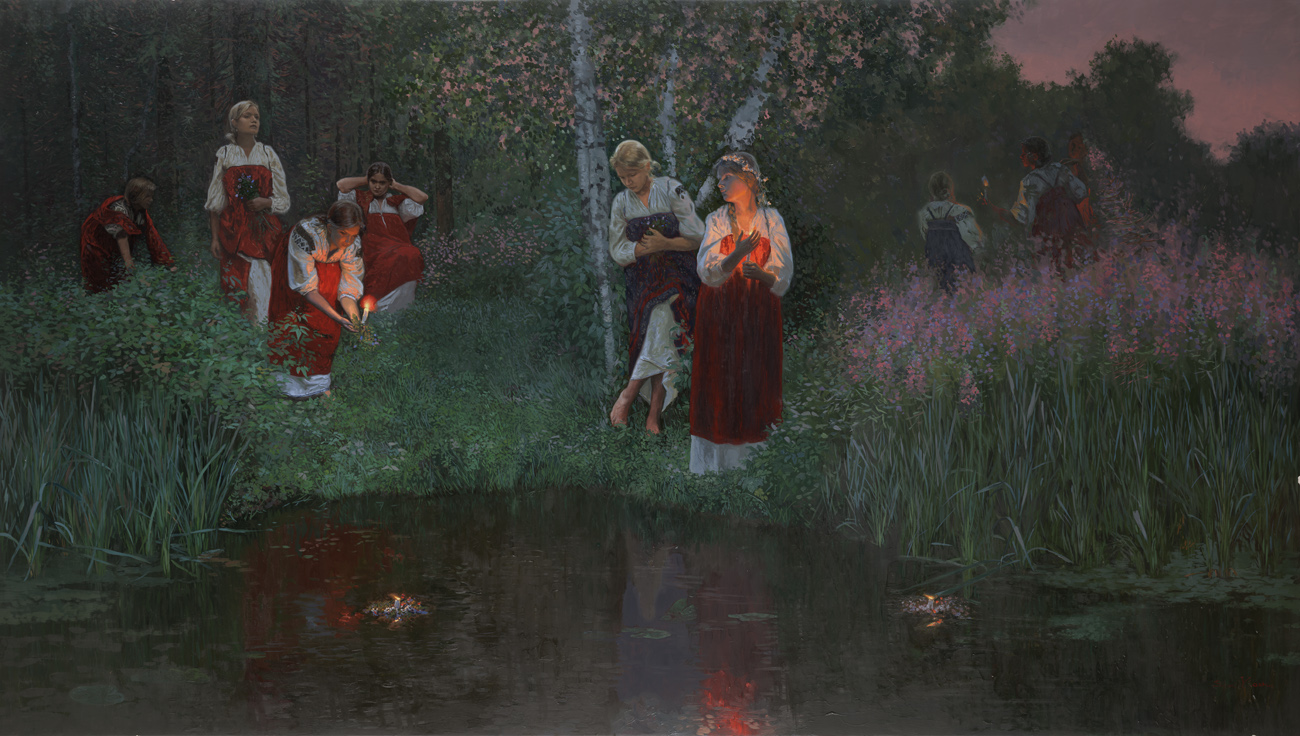
Kupala Night by Siomon Kozhin

Summer Solstice festival as we know it: it is linked to paganism and bonfires, and dances. It was celebrated once all over Europe in very similar forms. Slavs, Celts and Germanic people treated it as a sacred time where fire and water meets. Some remnants of the festival I still remember from my childhood and teenage years, but it was more a social event with flower wreaths floating,candle  light, bonfire, and and wild jumping over fire, this was was left from the days of old,  then after all, who doesn't like a good bonfire?  Summer Solstice was renamed as Night of the John the Baptist, as the ritual of bathing in the lake of rivers was so important, in Slavic countries, Greece and Balkans this was very important rite.Name  Kupala was supposed to be derived form old Slavic word for bathing, bu tit might be even come from Proto-Slavic word kup, which meant comming together. I am not so familiar how it was on British Isles and other countries, if this was a more solar and less lunar festival, more bonfires, or immersion in natural waters was also important.


The movie is kind of nicely done, romanticized, in reality this festival of fire, water, purification, love and fertility was wouldn't be so acceptable by today's standards: animal sacrifice was practiced,  etc. The church was trying to eradicate it, as a pagan festival, also certain behavior was considered indecent, people kindled big fonefires also in the cities, etc. and during for ex. XIIIc among Polish peasantry the importance of this festival was diminishing, even as it was practiced. But than during the Renaissance, when the idea that close relation with nature is important, combined with Renaissance in Poland ideas about the  myth of Arcadia, also gave more persmision to this pagan festival, solar in nature. All fire in all houses was put out, people congregated close to water, and ritualistically rekindled a new fire. They also bathed in the lake, or river, it was believed that the water had healing powers.

 Before that day bathing was allowed only during the night. It was a day of purification, all negativity was  believed to be cleansed by bathing, or by jumping over fire. As it was also a festival of love and fertility, a couple who jumped over fire was considered married in old pagan law. Young unmarried women also made wreaths of flowers and were wearing them on their heads, to put them on a piece of wood with  candle in the middle, floated them over the  waters of lakes, or rivers. And young men were bringing them back, if they caught one dancing with the owner of a garland they caught. It was like today's carnival, and crazy things happen during carnivals. In general this was not only one day, an end of day of celebrations.

Magic was in the air, as this was believed to be a special time, so many ideas about what was supposed to be magic or healing, I could bore you if I would list it. Did you hear about the magic flower? It was supposed to be flowering fern,(which never blooms, by the way), one a year this day, only for short time, but the flower was beautiful, radiating light, and the person who picked it was able to find a hidden treasure. Finding the flower wasn't easy, as it was hidden in the depths of the dark forest,(solar mythology again)  but there was a lot of scary forest spirits and dangerous entities who could frighten the candidates for wealth. The problem was not with real danger, but with human capacity to get terribly scarred. Those who had stiff upper lip were more likely to find it, as the legend goes.


Here is  a clip about celebrations in Russia, people were trying to recreate more of old flavor, but don't worry, no animals harmed or even present, some kisses and shows of male prowess (wrestling, in my country was jumping over fire), and lots of fun.

On Monday, finally the story about holy Grail in  Bezlawki. Brother of Lithuanian ruler according to the legend got it from those who escaped Britain after the battle of Hasting, among them were children of Harold Godwinson. It is just a legend, but the fact is that Gytha of Wessex, together with her brothers escaped to Denmark, and she later married the Vladimoir Monomakh
Who was not a Lithuanian Duke, but close. Stay tuned.

Thursday, February 28, 2013

Things get repeated

My blog got neglected. In this week I hope to have enough time to post about the tradition about Holy Grail in the church of Bezlawki. Now simply my reflection about how things get repeated over and over again.

I watched for short moments the live broadcast by BBC  today, it was about pope retiring. One of the journalists said about the uniforms of the Swiss Guard that those were designed by Michelangleo. No, there were designed during the beginning of the XXc. Did Dan Brown was talking about it? Yes, he did. Pop cultural version of historical facts.

Form Wiki commons,  part of  treatise about opitcs by Bacon

 There are more opinions repeated as facts.For example that people during medieval times believed that Earth was flat. No, already ancient Greeks knew about spherical Earth and would be difficult to find any scholar who believed in flat Earth.Or that all believed that the Earth was center of the Universe. Or that medicine was based on prayers and superstition. ( Medieval medicine if wasn't folk medicine was exactly the same as in Antiquity). Or that in medicine there was no dissection of corpses at all. Or that there was no interest in chemistry. (It was, thanks to Arab writings which were  read by monks). There is quite a number of strange beliefs about history of the Middle Ages and the Renaissance, which don't get corrected by the pop culture.Why? Because those beliefs help to create those periods in some kind of monolitic icons which than have more popular appeal.

 After all it is more interesting to say and believe that the Swiss Guards uniforms were designed by such a giant as Michelangelo himself, instead of giving credit to some obscure commandant of XXc. People often say that history was written by victors ( not exactly correct, it was actually written by others than victors too). Not only victors shape views of history, also common biases and what are common preferences, what people gladly believe, and what they dismiss as uninteresting, even if the uninteresting facts are closer to historical truth than interesting historical pieces of gossip.

Sunday, September 9, 2012

Rock-hewn churches, cave monasteries, and stones: longing for travel

I come from a country with mostly flat terrain, some hills and mountains, but not much, lots of lakes and forests, and as you probably guess not many stone buildings. There are some, but most old buildings are made of bricks. Yes, brick Gothic is there too. Even the huge crusaders' fortress, Malbork Castle, is made of 35 millions bricks. Brick Gothic has its own fascinating features, and Gothic bricks themselves can be fascinating, but as you probably also guess I like stone buildings too. Actually I am really fascinated by them: huge cathedral or tiny shepherd chalet, I am hooked.

 So, the church of Notre Dame in Vals, Ariege in France (Pyrenees area) I find extremely interesting, this video lets you in.   Take a look at the humble Virgin statue, 1: 34. All it is element Earth in is glory, and very humble and simple at the same time.Gothic cathedrals have their beauty, but this one has own character, very Zen.


The Notre Dame church is Vals is Romanesque, partially build on the rock, (semi-cave church to be exact), has also very interesting frescoes, humble looking and with quite strong Byzantine influences, unusual in France, in addition to the only depiction of archangel Pantasaron, and depiction of scene after birth of Jesus.  Byzantine in appearance, as this is more often  found in Byzantine art, and also has strong Catalan influences, which is not so surprising given this is a neighbouring area to this region. The site was surveyed by archaeologists, and the conclusion is that there was human presence for thousands of years, even it must have been a cult site, at which point of the location  cannot be exactly said now, but the presence of ceramics used for religious purposes was there. But the site was at its peak during early Middle Ages, during the Merovingian times. I should write about the frescoes on another occasion, as they deserve attention on their own.

Landscape at Cote d' Azure, France, by Heidi Fuchs

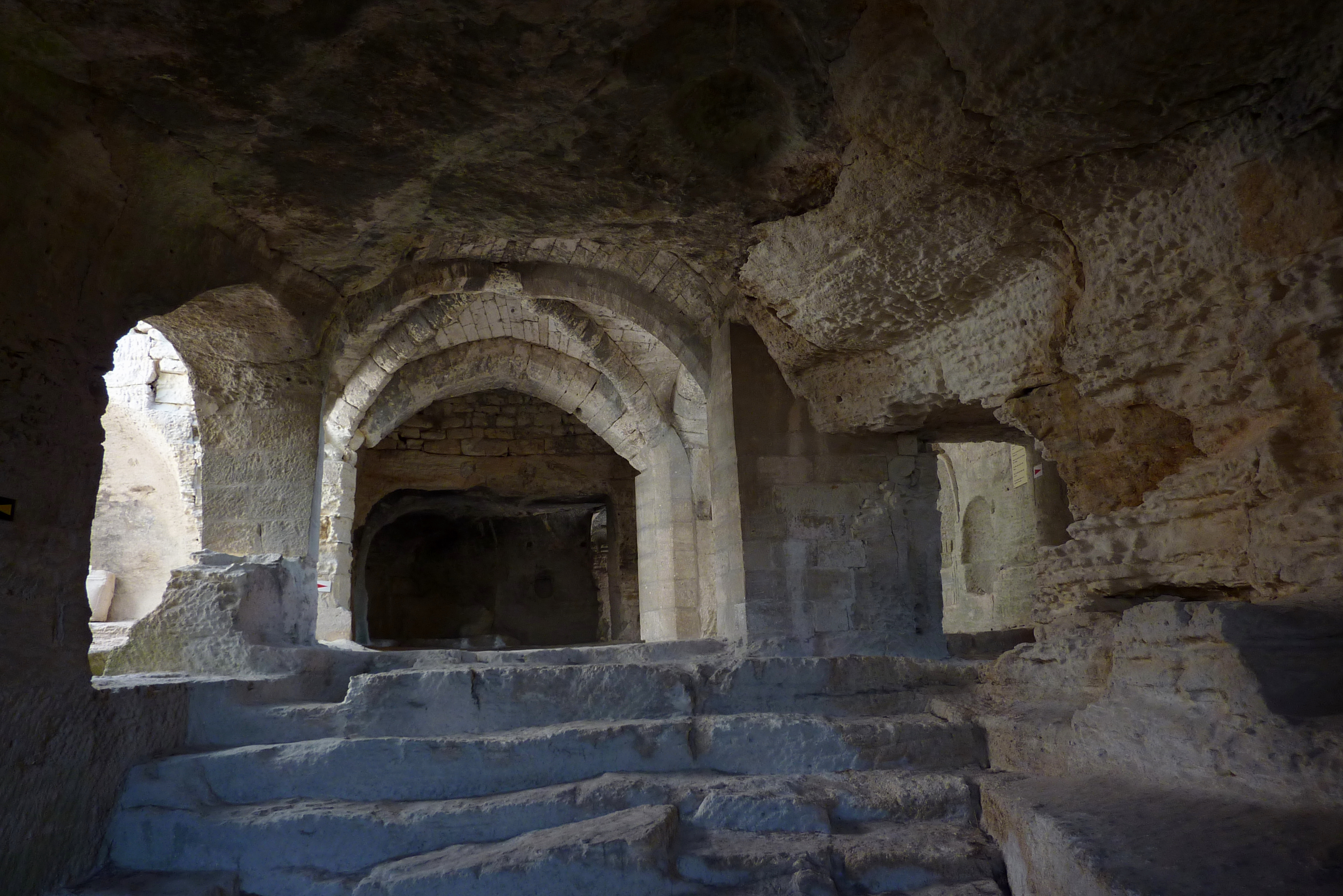
Those stone churches like the one in Vals, the rugged and humble ones are very much in harmony with the environment. Those rock formations, this time at Cote d'Azure area, in spite of being regular, are in perfect harmony with anything which surrounds them. I couldn't help myself to post this picture. They are simply a silent part of the environment, awe-inspiring. But when I was really young I couldn't warm up to this type of aesthetics, the vegetation was kind of too dried-up for me, I liked lush green seen in the North during the Summer. Now I am enthusiastic about it. But also take  a look at the cave monastery in France,  Beaucaire, abbey Saint-Roman, photo taken by G. Freihalter, (via wiki commons) you can zoom in very closely.


Cave churches or monasteries are rare, but there are still plenty for curious travelers.List of cave beauties on wikipedia

Quite a number of those is to be found in Bulgaria.And bellow is a picture from Bulgaria,  rock-hewn churches of Ivanovo, with Byzantine  frescoes.

Ivanovo rock-hewn monasteries, Bulgaria, by Denis Berthel, via wiki commons

And take a look at this photo of Todorka Mountain in Bulgaria. Makes me want to follow advice by my  Bulgarian expatriate friends and visit their home country. Sure, I would love to. Who can resist the lure of ancient art and architecture, and of such sundown  like this bellow on the magnificent mountain. But again, I need to postpone it again, even if at the momentI have what the Germans call Fernweh,  which means aching for the far away.
 The mountian bellow is Todorka Peak, in Bulgaria, by Evgeni Dinev, via. wiki common.
 Artlicle about this mountain mentions the legends too.

Todorka Peak, in Bulgaria, photo by Evgeni Dinev, via wiki commons

The author of the picture has more interesting photos of Bulgaria on Flickr, and his photo gallery there is great! Those pictures are my recent discovery on this media stream, and they make me think about maybe putting more links to Flickr albums by various photographers. Take a look at Evgeni Dinev's other awesome pictures.


Saturday, September 8, 2012

Green: Paradise and the color symbolism, history of color # 12

Green in Medieval times had rather varied symbolic meaning, depending if was used in the religious or secular context. In religious art it was a symbol of eternal happy existence, Paradise, and soul's hope for eternal bliss. Green robes symbolized eternal happiness through salvation, and often martyrs were dressed in red and green.

 As it was a happy color, specially the emerald was praised as the most beautiful jewel, in which all marvel of nature was incarnated and made imperishable. It was considered also an earthly representation of Paradise, and written about by monks. No wonder: emerald has strong color and is translucent, has light, and light and strong hues very important for the medieval aesthetics.

The painting on the left is by Hieronymus Bosch, who is often labeled as being  Northern Renaissance painter, but there is still so much of medieval elements in his paintings, also in this one. Bosch: a very mysterious painter, and lots was written about his speculated following of heresies. But this painting is quite conventional for Bosch's standards. It is the  left wing of the Last Judgement triptych, in the collection Gemaldesammlung der Akademie der Bildenden Kunste, in Vienna. It shows the fall of angels, and the story of creation of Adam and Eve, temptation and expulsion form Paradise. (Please click on the picture to view it bigger). It is about bliss, heavenly and earthly, and primordial sense of innocence, and about loss all of this. Also we see Jesus in Paradise. Why? Jesus was in medieval mystical writings and systems considered the Second Adam, the one who brings the Paradise back to the fallen human race.

But the hope of salvation was the expectation of something bigger, something which  could not be lost anymore, not a conditional existence in a Paradise in the story depicted in the Bosch's painting. It was about something above also the secular symbolism of green, which was found very limiting and temporary. In the secular world green was standing for Spring, new love, fertility. It was real hope for something beyond all  limitations, it was about the  life eternal, and the color of life was green, archetype of course,  but it got a new dimension: a heavenly one.

 And as such was totally elevated, wasn't anymore about life like in the Nature, where seasons  pass, or impermanent state of natural fertility which was bound with rebirth, suffering, aging and death. This life was about absolute perfection which never faded.

 And the hope, longing  for such existence was made one of the most important Christian virtues, (along with faith and unconditional love), and of course the color of it was green, because already showed symbolically what the all hope was about.

Mosaic of the apse int eh church of St Apolinare in Classe, Ravenna, Italy. Thank you Berthold Werner for releasing this picture into public domain.
 This happy symbolism of green came from the earlier Christian art- early frescoes and mosaics. In this post I follow the line form the youngest to the oldest art. Now a mosaic which is c. 900 years older than Bosch's painting. The picture above shows VI c. mosaic with St Apolinare in Paradise, adoring the cross, sheep around him, a very typical composition. Above, on the wall, Christ is giving his blessing, and we have the repetition of Paradise and the sheep. Click on the picture to see it bigger.

An earlier mosaic, this time from V c, is on the entrance wall of the mausoleum of Galla Palcidia, Also in Ravenna , Italy.

Jesus as the Good Shepherd, mosaic, V c. Galla Placidia Mausoleum, Ravenna, Italy
This type of mosaic is part of the iconographic tradition of  mosaics seen in the one with St Apolinar. The iconography is overlapping. But here we have Christs who is depicted as beardless youth was the typical figure in early Christian art. He is not the Pantacrator Jesus giving blessing, he is tender and pensive, and all sheep are looking is his direction.This was a common way of depicting Jesus: among his sheep, in Paradise, not hanging on the cross. He was shown as such even in earlier art, in a fresco, still in the catacombs, also as a good shepherd. One stream of the symbolism of the color green has a long lineage dating from early Christian art.


Wednesday, September 5, 2012

Paradise on Earth-the legend

Legends were extremely important during the Middle Ages, sure. Some were the source of psychological strength, like the legend of the terrestial paradise, which gave people sense of hope and was interchangeable with the idea of heaven. First during the Renaissance this belief  faded away, but not completely, and when people stopped to believe in the paradise on Earth, their belief system became more gloomy, more fearful of devil and the punishing God. The disappearance of the belief  in terrestrial paradise is not the only factor that the times became very somber: more of natural catastrophes, more wars, including religious wars, legacy of black death,  increased activity of Inquisition, all combined with fire and brimstone preaching through XV-XVII c. gave way to a more depressive mood.paradise was no more to be found on the Earth full of suffering.

Medieval people were more optimistic: they believed that Paradise existed on Earth in their present times in some far away land, and trusted that some travelers indeed have seen it with their own eyes. Ancient manuscripts have maps, the Paradise was located somewhere in Armenia, China, India, later in Japan: in general it was very far  in the East. The Tree of Life was there, wonderful climate, of course vegetation was fabulous and abundant, with plenty of fruit to eat. There was not even a glimpse of darkness, day time always, never falling of a night,  and the Paradise was filled with light seven times brighter than the daylight on the rest of the planet.  The multitude of precious stones of many kinds was joy for the eyes. Abraham and Jesus was there too. This illuminated page from shows Christ on the lap of Abraham, with personifications of fours rivers in the circles of four corners of the mandorla. Those rivers are Euphrates, Gihon, Pison and Hiddekel were the four great rivers of the Paradise.


The Three of Life was in the center, also a Fountain of Life, which cured all imperfections a human  body could have. Sabine Baring-Gould wrote about this myth ( Curious Myths of the Middle Ages), mentioned maps pointing the location of the Paradise, but also writes about the manuscripts in which the legend is recorded as a  true fact, also he lists the various authors of the narration. For example he states that St Brendan took the journey to Paradise because one monk traveled there, and told about the wonder for this place, and St Brendan became very curious. St Brendan went to the East, very far, and reported on the Paradise he visited, and told about going further until he came to the place no one alive was allowed to cross.  According to Sabine-Baring a map in the Cambridge collection depicted the Paradise as a round island  located close to the mouth of Ganges. According to another legend  Alexander the Great was eager to see this land of delights, but hadn't possessed proper mind, as it was an inner Paradise, not the physical one. But the most detailed account was given in the Icelandic narration of Eirkes Saga Vidforla, form XIV c. mixing pagan and Christian beliefs. The following centuries the Paradise narrations didn't die completely out, the occurred as "learned  treatises."

What I was not aware of is the fact that the legend was also given strong  theological validity, and is found often in the books of sermons. Books of sermons in general are quite numerous, and give a good insight into medieval religiosity,  they also repeat legends. The master dissertation by Gavin S. Fort gives examples how this legend was functioning in religious life, specially interesting is the relation of this legend to medieval  monasticism. Monasteries were supposed to be images of Paradise on Earth, were people had the great opportunity to cleanse their souls ans enter the state of perfection, and have angelic habits. In monastic life celibacy was equated with the attempt to live like angels, than celibacy was a requirement in monastic life, later the argument for angelic life became a point in deciding that the celibacy should be extended to priests also. Later the belief  in a geographical location of the Paradise developed into the abstract meditative practice on the inner Paradise. Are you interested in additional reading? I recommend the Master degree thesis by Gavin S. Fort about Paradisal language in Medieval reform

  Take a look at this mysterious  diagram of a mystical Paradise  from the Rare Manuscripts Collection of Walters Museum of Art, by Conrad of Hirsau, XIII c.

I didn't find the remnants of this legend in today's Europe, not a full narrative but just some short mention about which I am not sure if this is  truly oral tradition as told,  but this fragment is similar what wrote Baring-Gould. According to this mention the Paradise was sealed by the walls of fire, and is guarded by an angel and no one could step in. The walls of fire are relating to some medieval reports about inaccessibility, (Baring-Gould), the angel with sword is of course the cherubim of the Genesis.


Saturday, September 1, 2012

Dark Ages? Not everywhere: Byzantine love for classics

In popular opinions Dark Ages were taking over Europe until the Renaissance came with revival of classic traditions. This is only partially true. Byzantine Empire continued the tradition of Greece and Rome, combined with Eastern influences. Medieval renaissances of Europe, to be exact Western and Central Europe were brought by closer contact with Byzantine Empire.

 Byzantium was the name of the city, which was renamed by the emperor Constantine Nova Roma, meaning the New Rome, as it became new capital, but it was also renamed  Constantinople . It became Europe's biggest city, it had half million inhabitants.The people who inhabited this empire called themselves Romans, the empire was called Romania. Greek was spoken, as the local language and the language of educated elites, nothing unusual, even in Rome educated people spoke Greek, as Romans were totally admiring Greek culture and copied a lot from it. The library of Constantinople was very prominent, Byzantine equivalent of the great library of Alexandria. Ancient writings were not only preserved here, but also studied and copied, to keep the knowledge from disappearing. There were also periods of additional stronger interests in classics, such as Macedonian Renaissance of the X c. from which time the page of the manuscript called the Psalter of David is dated. King David is depicted as a Byzantine emperor, but the other two figures are very classical. No wonder: as Rome had  monuments of the classical past, so did this area of Byzantine Empire.

Penitence of David, Paris Psalter,  X c.Biblioteque Nationale, Paris

We see David twice: sitting on his throne, and also bowing feeling remorse for all the bad deeds  he has done. Classical figures are here- the admonishing prophet, and the female figure which is the personification of penitence. She is dressed in green and red, the colors later seen often in robes of Mary Magdalene. Why we know that this is penitence? One thing is that personifications were common in the art of Antiquity, another prof is her name written above. It was common in Byzantine art to include captions about the figures to indicate who was who. (People in Byzantine Empire were quite literate, the culture was vibrant). Also above the prostrating David we have the caption which spells his name, that the viewers shouldn't be confused. The writing connected to the female figure there is the word "Metanoia," which term meant repentance in Greek. Meant changing one's mind, turning point. The flagellants of Latin Christianity gave it bad connotations. Penitence was about making amendments, changing mind, changing lifestyle.

But Byzantine Empire was of course more sophisticated than Latin West, were tribal warfare and other struggles went on through some longer periods of time, but still medieval times were not as dark as it is held in popular imagination. The movies may show this time as era of ignorance, superstition, dirt, illness and decline, as this imagery adds drama, but the times were more lively and enlightened. Rather during the Renaissance, or general during the XV-XVII c.Europe had even more dark turmoils: more of  illness, witch hunts, inquisition, wars,  fears of devil,belief that magic equals science, etc. Even medieval universities were not all about faith, as is often assumed: popular belief is that science believed the Earth was flat, or in medicine there was no dissection of corpses, the medical knowledge of Antiquity wasn't practiced, etc. Not true, we know thanks to explosion of knowledge about the Middle Ages during he XX c. So, why the term Dark Ages?

First putting down on the predecessors occurred during the Renaissance, in order to point out the new achievements. Gothic art was called Gothic in a derogative way, as Goths were considered barbarians. The Renaissance mind was so enamored in the nostalgia for antiquity, that they couldn't really appreciate the art and achievements of earlier generations. This lack of appreciation went thorough centuries, and the era of Enlightenment in order to contrast is own achievements needed the idea contrasting light and darkness, needed the term Dark Ages. In addition the term Age of Faith was used, in order to brand the times as irrational and dark. The Enlightenment prided itself not only for its light, but also for reason as opposite to faith. There were even attempts to create temples of reason in churches.

Byzantine manuscript, X c. Paris Psalter, King David Playing Harp, very much in the tradition of classical frescoes

During the XIX c. the scholars were talking still about Dark Ages as the time from which were not too many written records left, but there was also medieval fashion . (Pre-Rafaelites, Romanticism, Gothic Revival, etc). This intense interest in all things medieval was combined with the Romanticism's love for mystery, the  fantastic, emotional and the irrational. Hard reason of previous era wasn't the fashionable idea. During the XX c. however, the term Dark Ages started to be criticized, in light of the new scholarship, and the term was used in a more neutral way, and even the neutrality of the term was disputed. It was argued that the scholars may know that the usage isn't negative, but the general public will not interpret it such way. And the criticism was right on target.

And myself I used the term provocatively in the title of this post. Still, I think in popular culture Byzantine Empire doesn't get enough credit, and this was an empire of great sophistication and influence, and lasted of a millennium. Holy Roman Empire lasted almost a millennium, but there were empires which existed for much shorter time: The British Empire, Austrian Empire, Empire of Austria and Hungary, Bulgarian Empire, and others. So, maybe it is time to refresh the memory of this part of common history? But still, I think the movie industry, mainstream literature, computer games, TV, advertisements, press,some popular chanels historical documentary movies, and others are still in the dark about not-so Dark-Ages.

Quite often there is a misconception of great Rome which fall:yes, Rome was sacked, but before became very empoverished because of Byzantium. The idea of "fall of Roman Empire" first was again talked about during he Renaissance, by popes. It was an idea supporting propaganda: Pagan empire which "fall," quite clever idea, remember, there was the schism between Byzantium and Latin Christianity. It is not very historically accurate common misconception, but quite often still, in XXI c. has place in the classroom.


Thursday, August 30, 2012

Byzantine tradition: icons, garments and liturgy

Once strolling through the old streets close to Krakow's Old Town Market Square I heard amazing singing, Orthodox choir. I stood on the street and listen, assuming someone had a nice CD playing, the sound coming from one of the open windows. But listening more carefully I heard that the sound came  the courtyard. Knowing from experience that those centuries-old houses quite often have beautiful an intriguing yards surrounded by walls, I went, slowly. Somehow the music pulled me. Than I saw the sign, "Orthodox Church," and an arrow. I followed, after climbing some steps in one of the old buildings I entered a church which was housed among apartments, not a regular Orthodox church building I normally knew and view from afar, but never visited during liturgy. There I saw the choir: three women with white kerchiefs covering their heads, and with them was one man, all very focused and singing beautifully. The congregation was very small, but there were icons on the walls, with  lamps hanging before them, and the liturgy was celebrated. In my country Orthodox Christians have a reputation of being excellent singers, and here was the proof, there were just so good that I was thinking it was a CD!  After the liturgy people were kissing the icons. All was very touching, I was moved by the music, liturgy, and by the solemn atmosphere. Something like in the videos below, specially the second one, the link.

The icon here is Christ Pantecrator, XXI c. by anonymous maker for tourist industry in Bulgaria, but I love it anyway!

Religions don't bother me, (unless there is some kind of abuse going on), but in general I find a lot of beauty in this kind of human involvement. The word religion comes form the words re-ligare, which means reconnect. I like this interpretation of the word's origins.

I will be writing more about Byzantine traditions, as they are important. They are part of Europe's cultural heritage, and without Byzantium there wouldn't be Italian Renaissance as we know it, nor it would there be European heritage as we know it. There the traditions of  Greece and Rome lived while in Western Europe it was a strong break. Not that ancient  philosophies were not read in the West during the Middle Ages, after all Latin Europe had medieval renaissances, but those parts of Europe were culturally developing in their own direction, and were much poorer.

Byzantine art was a mixture of classical Greek and Roman  traditions influenced by Eastern mysticism and love for imagination. Icons represented Jesus, or Mary, saints and angels, but also in its highly stylized canon there was representation of aesthetics and fashions of the imperial court. So, Jesus and Mary are dressed in robes of imperial purple, or the saints and angels depicted as dressed like important people of the imperial court. Icons didn't change much. Of course there are various schools of icon painting, and there also some influences among those schools which are more Westernized, but in general the icons are preserving the past very well, now and here. The tradition is followed rather strictly, and we can see how people were dressed long time ago, still can today see the stripes of fabric called loros still part of the garments, or see the color which are in the range of hue variations of real purple of Tyre. We can see how some courtiers looked like at the court of Constantinople, which was than the city of amazing luxury.

What fascinates me that when you look at the traditional icons or frescoes in Byzantine style and you see the liturgical garments used today, you recognize that some garment are very similar to what we see on the icons.Byzantine fashion of a millennium ago. I hope you will enjoy the beauty of the chants, and the visual part, and see similarities of the garments worn by the clergy mirroring the garments of the saints on the frescoes. It is like being among the people of Constantinople of old.

And take a loo at the fresco at 8:45, the creature with one face and six red wings with some writing (reads Cherubim) is an archaic depiction of a cherubim, one of the highest angels in angelic hierarchy. Stained glass window at 12: 25 shows also a cherubim or a seraph, those were often interchangeable. This is a sequence of very interesting and beautiful  pictures, not a liturgy video. Enjoy!


And just  in case you want more, here is another video! http://www.youtube.com/watch?v=UsL61X5fOLU The piece sung here is Agni Parthene, a non-liturgical hymnopoem to Virgin Mary. Have blessed time!