Saturday, September 8, 2012

Green: Paradise and the color symbolism, history of color # 12

Green in Medieval times had rather varied symbolic meaning, depending if was used in the religious or secular context. In religious art it was a symbol of eternal happy existence, Paradise, and soul's hope for eternal bliss. Green robes symbolized eternal happiness through salvation, and often martyrs were dressed in red and green.

 As it was a happy color, specially the emerald was praised as the most beautiful jewel, in which all marvel of nature was incarnated and made imperishable. It was considered also an earthly representation of Paradise, and written about by monks. No wonder: emerald has strong color and is translucent, has light, and light and strong hues very important for the medieval aesthetics.

The painting on the left is by Hieronymus Bosch, who is often labeled as being  Northern Renaissance painter, but there is still so much of medieval elements in his paintings, also in this one. Bosch: a very mysterious painter, and lots was written about his speculated following of heresies. But this painting is quite conventional for Bosch's standards. It is the  left wing of the Last Judgement triptych, in the collection Gemaldesammlung der Akademie der Bildenden Kunste, in Vienna. It shows the fall of angels, and the story of creation of Adam and Eve, temptation and expulsion form Paradise. (Please click on the picture to view it bigger). It is about bliss, heavenly and earthly, and primordial sense of innocence, and about loss all of this. Also we see Jesus in Paradise. Why? Jesus was in medieval mystical writings and systems considered the Second Adam, the one who brings the Paradise back to the fallen human race.

But the hope of salvation was the expectation of something bigger, something which  could not be lost anymore, not a conditional existence in a Paradise in the story depicted in the Bosch's painting. It was about something above also the secular symbolism of green, which was found very limiting and temporary. In the secular world green was standing for Spring, new love, fertility. It was real hope for something beyond all  limitations, it was about the  life eternal, and the color of life was green, archetype of course,  but it got a new dimension: a heavenly one.

 And as such was totally elevated, wasn't anymore about life like in the Nature, where seasons  pass, or impermanent state of natural fertility which was bound with rebirth, suffering, aging and death. This life was about absolute perfection which never faded.

 And the hope, longing  for such existence was made one of the most important Christian virtues, (along with faith and unconditional love), and of course the color of it was green, because already showed symbolically what the all hope was about.

Mosaic of the apse int eh church of St Apolinare in Classe, Ravenna, Italy. Thank you Berthold Werner for releasing this picture into public domain.
 This happy symbolism of green came from the earlier Christian art- early frescoes and mosaics. In this post I follow the line form the youngest to the oldest art. Now a mosaic which is c. 900 years older than Bosch's painting. The picture above shows VI c. mosaic with St Apolinare in Paradise, adoring the cross, sheep around him, a very typical composition. Above, on the wall, Christ is giving his blessing, and we have the repetition of Paradise and the sheep. Click on the picture to see it bigger.

An earlier mosaic, this time from V c, is on the entrance wall of the mausoleum of Galla Palcidia, Also in Ravenna , Italy.

Jesus as the Good Shepherd, mosaic, V c. Galla Placidia Mausoleum, Ravenna, Italy
This type of mosaic is part of the iconographic tradition of  mosaics seen in the one with St Apolinar. The iconography is overlapping. But here we have Christs who is depicted as beardless youth was the typical figure in early Christian art. He is not the Pantacrator Jesus giving blessing, he is tender and pensive, and all sheep are looking is his direction.This was a common way of depicting Jesus: among his sheep, in Paradise, not hanging on the cross. He was shown as such even in earlier art, in a fresco, still in the catacombs, also as a good shepherd. One stream of the symbolism of the color green has a long lineage dating from early Christian art.


Wednesday, September 5, 2012

Paradise on Earth-the legend

Legends were extremely important during the Middle Ages, sure. Some were the source of psychological strength, like the legend of the terrestial paradise, which gave people sense of hope and was interchangeable with the idea of heaven. First during the Renaissance this belief  faded away, but not completely, and when people stopped to believe in the paradise on Earth, their belief system became more gloomy, more fearful of devil and the punishing God. The disappearance of the belief  in terrestrial paradise is not the only factor that the times became very somber: more of natural catastrophes, more wars, including religious wars, legacy of black death,  increased activity of Inquisition, all combined with fire and brimstone preaching through XV-XVII c. gave way to a more depressive mood.paradise was no more to be found on the Earth full of suffering.

Medieval people were more optimistic: they believed that Paradise existed on Earth in their present times in some far away land, and trusted that some travelers indeed have seen it with their own eyes. Ancient manuscripts have maps, the Paradise was located somewhere in Armenia, China, India, later in Japan: in general it was very far  in the East. The Tree of Life was there, wonderful climate, of course vegetation was fabulous and abundant, with plenty of fruit to eat. There was not even a glimpse of darkness, day time always, never falling of a night,  and the Paradise was filled with light seven times brighter than the daylight on the rest of the planet.  The multitude of precious stones of many kinds was joy for the eyes. Abraham and Jesus was there too. This illuminated page from shows Christ on the lap of Abraham, with personifications of fours rivers in the circles of four corners of the mandorla. Those rivers are Euphrates, Gihon, Pison and Hiddekel were the four great rivers of the Paradise.


The Three of Life was in the center, also a Fountain of Life, which cured all imperfections a human  body could have. Sabine Baring-Gould wrote about this myth ( Curious Myths of the Middle Ages), mentioned maps pointing the location of the Paradise, but also writes about the manuscripts in which the legend is recorded as a  true fact, also he lists the various authors of the narration. For example he states that St Brendan took the journey to Paradise because one monk traveled there, and told about the wonder for this place, and St Brendan became very curious. St Brendan went to the East, very far, and reported on the Paradise he visited, and told about going further until he came to the place no one alive was allowed to cross.  According to Sabine-Baring a map in the Cambridge collection depicted the Paradise as a round island  located close to the mouth of Ganges. According to another legend  Alexander the Great was eager to see this land of delights, but hadn't possessed proper mind, as it was an inner Paradise, not the physical one. But the most detailed account was given in the Icelandic narration of Eirkes Saga Vidforla, form XIV c. mixing pagan and Christian beliefs. The following centuries the Paradise narrations didn't die completely out, the occurred as "learned  treatises."

What I was not aware of is the fact that the legend was also given strong  theological validity, and is found often in the books of sermons. Books of sermons in general are quite numerous, and give a good insight into medieval religiosity,  they also repeat legends. The master dissertation by Gavin S. Fort gives examples how this legend was functioning in religious life, specially interesting is the relation of this legend to medieval  monasticism. Monasteries were supposed to be images of Paradise on Earth, were people had the great opportunity to cleanse their souls ans enter the state of perfection, and have angelic habits. In monastic life celibacy was equated with the attempt to live like angels, than celibacy was a requirement in monastic life, later the argument for angelic life became a point in deciding that the celibacy should be extended to priests also. Later the belief  in a geographical location of the Paradise developed into the abstract meditative practice on the inner Paradise. Are you interested in additional reading? I recommend the Master degree thesis by Gavin S. Fort about Paradisal language in Medieval reform

  Take a look at this mysterious  diagram of a mystical Paradise  from the Rare Manuscripts Collection of Walters Museum of Art, by Conrad of Hirsau, XIII c.

I didn't find the remnants of this legend in today's Europe, not a full narrative but just some short mention about which I am not sure if this is  truly oral tradition as told,  but this fragment is similar what wrote Baring-Gould. According to this mention the Paradise was sealed by the walls of fire, and is guarded by an angel and no one could step in. The walls of fire are relating to some medieval reports about inaccessibility, (Baring-Gould), the angel with sword is of course the cherubim of the Genesis.


Saturday, September 1, 2012

Dark Ages? Not everywhere: Byzantine love for classics

In popular opinions Dark Ages were taking over Europe until the Renaissance came with revival of classic traditions. This is only partially true. Byzantine Empire continued the tradition of Greece and Rome, combined with Eastern influences. Medieval renaissances of Europe, to be exact Western and Central Europe were brought by closer contact with Byzantine Empire.

 Byzantium was the name of the city, which was renamed by the emperor Constantine Nova Roma, meaning the New Rome, as it became new capital, but it was also renamed  Constantinople . It became Europe's biggest city, it had half million inhabitants.The people who inhabited this empire called themselves Romans, the empire was called Romania. Greek was spoken, as the local language and the language of educated elites, nothing unusual, even in Rome educated people spoke Greek, as Romans were totally admiring Greek culture and copied a lot from it. The library of Constantinople was very prominent, Byzantine equivalent of the great library of Alexandria. Ancient writings were not only preserved here, but also studied and copied, to keep the knowledge from disappearing. There were also periods of additional stronger interests in classics, such as Macedonian Renaissance of the X c. from which time the page of the manuscript called the Psalter of David is dated. King David is depicted as a Byzantine emperor, but the other two figures are very classical. No wonder: as Rome had  monuments of the classical past, so did this area of Byzantine Empire.

Penitence of David, Paris Psalter,  X c.Biblioteque Nationale, Paris

We see David twice: sitting on his throne, and also bowing feeling remorse for all the bad deeds  he has done. Classical figures are here- the admonishing prophet, and the female figure which is the personification of penitence. She is dressed in green and red, the colors later seen often in robes of Mary Magdalene. Why we know that this is penitence? One thing is that personifications were common in the art of Antiquity, another prof is her name written above. It was common in Byzantine art to include captions about the figures to indicate who was who. (People in Byzantine Empire were quite literate, the culture was vibrant). Also above the prostrating David we have the caption which spells his name, that the viewers shouldn't be confused. The writing connected to the female figure there is the word "Metanoia," which term meant repentance in Greek. Meant changing one's mind, turning point. The flagellants of Latin Christianity gave it bad connotations. Penitence was about making amendments, changing mind, changing lifestyle.

But Byzantine Empire was of course more sophisticated than Latin West, were tribal warfare and other struggles went on through some longer periods of time, but still medieval times were not as dark as it is held in popular imagination. The movies may show this time as era of ignorance, superstition, dirt, illness and decline, as this imagery adds drama, but the times were more lively and enlightened. Rather during the Renaissance, or general during the XV-XVII c.Europe had even more dark turmoils: more of  illness, witch hunts, inquisition, wars,  fears of devil,belief that magic equals science, etc. Even medieval universities were not all about faith, as is often assumed: popular belief is that science believed the Earth was flat, or in medicine there was no dissection of corpses, the medical knowledge of Antiquity wasn't practiced, etc. Not true, we know thanks to explosion of knowledge about the Middle Ages during he XX c. So, why the term Dark Ages?

First putting down on the predecessors occurred during the Renaissance, in order to point out the new achievements. Gothic art was called Gothic in a derogative way, as Goths were considered barbarians. The Renaissance mind was so enamored in the nostalgia for antiquity, that they couldn't really appreciate the art and achievements of earlier generations. This lack of appreciation went thorough centuries, and the era of Enlightenment in order to contrast is own achievements needed the idea contrasting light and darkness, needed the term Dark Ages. In addition the term Age of Faith was used, in order to brand the times as irrational and dark. The Enlightenment prided itself not only for its light, but also for reason as opposite to faith. There were even attempts to create temples of reason in churches.

Byzantine manuscript, X c. Paris Psalter, King David Playing Harp, very much in the tradition of classical frescoes

During the XIX c. the scholars were talking still about Dark Ages as the time from which were not too many written records left, but there was also medieval fashion . (Pre-Rafaelites, Romanticism, Gothic Revival, etc). This intense interest in all things medieval was combined with the Romanticism's love for mystery, the  fantastic, emotional and the irrational. Hard reason of previous era wasn't the fashionable idea. During the XX c. however, the term Dark Ages started to be criticized, in light of the new scholarship, and the term was used in a more neutral way, and even the neutrality of the term was disputed. It was argued that the scholars may know that the usage isn't negative, but the general public will not interpret it such way. And the criticism was right on target.

And myself I used the term provocatively in the title of this post. Still, I think in popular culture Byzantine Empire doesn't get enough credit, and this was an empire of great sophistication and influence, and lasted of a millennium. Holy Roman Empire lasted almost a millennium, but there were empires which existed for much shorter time: The British Empire, Austrian Empire, Empire of Austria and Hungary, Bulgarian Empire, and others. So, maybe it is time to refresh the memory of this part of common history? But still, I think the movie industry, mainstream literature, computer games, TV, advertisements, press,some popular chanels historical documentary movies, and others are still in the dark about not-so Dark-Ages.

Quite often there is a misconception of great Rome which fall:yes, Rome was sacked, but before became very empoverished because of Byzantium. The idea of "fall of Roman Empire" first was again talked about during he Renaissance, by popes. It was an idea supporting propaganda: Pagan empire which "fall," quite clever idea, remember, there was the schism between Byzantium and Latin Christianity. It is not very historically accurate common misconception, but quite often still, in XXI c. has place in the classroom.


Thursday, August 30, 2012

Byzantine tradition: icons, garments and liturgy

Once strolling through the old streets close to Krakow's Old Town Market Square I heard amazing singing, Orthodox choir. I stood on the street and listen, assuming someone had a nice CD playing, the sound coming from one of the open windows. But listening more carefully I heard that the sound came  the courtyard. Knowing from experience that those centuries-old houses quite often have beautiful an intriguing yards surrounded by walls, I went, slowly. Somehow the music pulled me. Than I saw the sign, "Orthodox Church," and an arrow. I followed, after climbing some steps in one of the old buildings I entered a church which was housed among apartments, not a regular Orthodox church building I normally knew and view from afar, but never visited during liturgy. There I saw the choir: three women with white kerchiefs covering their heads, and with them was one man, all very focused and singing beautifully. The congregation was very small, but there were icons on the walls, with  lamps hanging before them, and the liturgy was celebrated. In my country Orthodox Christians have a reputation of being excellent singers, and here was the proof, there were just so good that I was thinking it was a CD!  After the liturgy people were kissing the icons. All was very touching, I was moved by the music, liturgy, and by the solemn atmosphere. Something like in the videos below, specially the second one, the link.

The icon here is Christ Pantecrator, XXI c. by anonymous maker for tourist industry in Bulgaria, but I love it anyway!

Religions don't bother me, (unless there is some kind of abuse going on), but in general I find a lot of beauty in this kind of human involvement. The word religion comes form the words re-ligare, which means reconnect. I like this interpretation of the word's origins.

I will be writing more about Byzantine traditions, as they are important. They are part of Europe's cultural heritage, and without Byzantium there wouldn't be Italian Renaissance as we know it, nor it would there be European heritage as we know it. There the traditions of  Greece and Rome lived while in Western Europe it was a strong break. Not that ancient  philosophies were not read in the West during the Middle Ages, after all Latin Europe had medieval renaissances, but those parts of Europe were culturally developing in their own direction, and were much poorer.

Byzantine art was a mixture of classical Greek and Roman  traditions influenced by Eastern mysticism and love for imagination. Icons represented Jesus, or Mary, saints and angels, but also in its highly stylized canon there was representation of aesthetics and fashions of the imperial court. So, Jesus and Mary are dressed in robes of imperial purple, or the saints and angels depicted as dressed like important people of the imperial court. Icons didn't change much. Of course there are various schools of icon painting, and there also some influences among those schools which are more Westernized, but in general the icons are preserving the past very well, now and here. The tradition is followed rather strictly, and we can see how people were dressed long time ago, still can today see the stripes of fabric called loros still part of the garments, or see the color which are in the range of hue variations of real purple of Tyre. We can see how some courtiers looked like at the court of Constantinople, which was than the city of amazing luxury.

What fascinates me that when you look at the traditional icons or frescoes in Byzantine style and you see the liturgical garments used today, you recognize that some garment are very similar to what we see on the icons.Byzantine fashion of a millennium ago. I hope you will enjoy the beauty of the chants, and the visual part, and see similarities of the garments worn by the clergy mirroring the garments of the saints on the frescoes. It is like being among the people of Constantinople of old.

And take a loo at the fresco at 8:45, the creature with one face and six red wings with some writing (reads Cherubim) is an archaic depiction of a cherubim, one of the highest angels in angelic hierarchy. Stained glass window at 12: 25 shows also a cherubim or a seraph, those were often interchangeable. This is a sequence of very interesting and beautiful  pictures, not a liturgy video. Enjoy!


And just  in case you want more, here is another video! http://www.youtube.com/watch?v=UsL61X5fOLU The piece sung here is Agni Parthene, a non-liturgical hymnopoem to Virgin Mary. Have blessed time!


Monday, August 27, 2012

Dragon of the Wawel Castle, Kracow, and some dragon examples

On the left is a snapshot from small part of the courtyard of  the Wawel Castle in Cracow. I revisited this city, I liked to go there since I was in my late teens. When I was a child, like every kid  I read the legend about the dragon, which is actually a founding myth of the city of Cracow. And the dragon's den is still there, the cave at the Wawel Castle Hill, open for the tourists to walk trough its dimly lit entrails, than coming out to the light at the other side, toward the Vistula River. It would be a perfect initiatory cave for pre-Christian pagan worship including symbolic death and rebirth. Only a part is open for tourists, the rest is the domain of the scientists, also the rare small animals living there.Would be also too difficult to pass through, even though the names such as "Coronation Hall" could be enticing.

In the founding legend the terrible dragon lived in this cave, and the voracious  beast terrorized the people who needed to give him lots of cattle as an offering every week. When the dragon wasn't satisfied, he used to devour humans also. The latest version, if I am right dating  from the XVI c. says that a clever shoemaker apprentice decided to slay the monster. No one really believed that he would come back alive, but he did. He filled a sheep skin with sulfur and gave to the hungry dragon. The beast devoured it in an instant, and felt very thirsty right away. The dragon went to the river and drunk, and drunk, but his thirst was not possible to quench. He drunk so much that his belly exploded, everyone was saved, and the courageous and the clever young man was elected the leader of the tribe. In the other version the savign hero, Krak, when he died after prosperous reign, thankful  people with their own hands and effort created a mount, still in Cracow, kurghan -type construction. But archeological excavation of the kurghan (usually a grave mount) didn't result in any finding of an ancient burial.

The older version of the legend, not much known, as was less flattering.This relation dates from the XII c. and was written down by Kadlubek, the early chronicler, and  involves two sons of the tribal leader Krak. The brothers killed the terrorizing beast the same way as the shoemaker's apprentice did, but one of the brothers killed the other, hungry for power. As he returned he told his father that the brother was killed by the dragon, and as a hero he became the new tribal leader. But in two years the fratricide was revealed, and he was expelled from the community. Wanda  the princes became the ruler instead, and she also lead army to battle against invading Germanic powers. The legendary Wanda and the versions of the legends about her was used as argument supporting the reign of some of the female monarchs in Poland, but sadly  also became a part of anti- German sentiments fueling XIX c. Polish nationalism.
Sebastian Münster, woodcut, Cosmographia Universalis, 1544
 Wawel Hill was inhabited already during the stone age, and pagan temple was close to the Vistula river.Cracow was  neighbouring the Moravenses terra Moravia, the short-lived Kingdom of Moravia. First mention about Cracow as a city comes form X c. and the city than was ruled by one of the PÅ™emyslids, a cruel prince who was indeed charged with fratricide.He was the descendant of legendary princes Libuse, and here we come to another ancestor named Krak.  Krak, or Krok was also mentioned in Czech chronicles as father of three daughters, one of them, Libuse became the legendary founder of city of Prague. She was also the matriarch of the PÅ™emyslid dynasty which ruled until XIV. c. and had a flaming she-eagle as their family crest. Prague is still the capital of the Czech Republic, Cracow was the capital of Poland until the end of XVI c. when Warsaw became a seat of Polish kings and place where they were elected.

In general in early history Cracow was thriving, until the ravages of the war with Sweden which was called the Deluge, as created as much destruction as WW II, and big parts of the Wawel Castle were burned and looted. Some parts of the buildings at the Wawel Hill were not  rebuilt anymore, but still the place has a lot to offer. It was a castle of proud monarch who wanted to show their glory. Wawel Castle was occupied by the Nazis, and in German  also can be described as Wawelburg, (Wawelthe name, Burg is castle, German combined words). But is not the same as the Wawelburg  the rumored place of the Holy Grail of also rumored Nazi mysticism. But Wawel Castle has visitors who are searching for the energy of the mystical stone, to the annoyance of the Wawel Castle personnel.

Dragon legends were common in Europe, (and not only there). The dragon of Wawel Castle is one of the main figures in the founding myth, and three is also the theory that Kadlubek just wrote his version of the legend about Alexander the Great battling a dragon, as this legend was very popular during the Middle Ages.Kadlubek was educated in Italy and France, where the legend was popular, known as The Romance about Alexander the Great, based on writing by pseudo-Callistenes. So, we don't know if this was truly a legend in local oral tradition, or Kadlubek's embellishment.

The old  architectural details of the Wawel castle show dragons, also two churches at the Wawel Hill  were dedicated to St George and St Michael, the known in Christian legends as dragon slayers.Churches were not rebuild anymore, just parts of the walls are still remaining. And at the entrance to the Wawel Cathedral, on the left,  are hanging  bones of a mammoth and a whale which were presented and believed through the ages as the true and real  bones of the dragon himself- until the development of more modern of sciences. The pictures of St George and St Margaret, both victorious over dragons, are also present. Dragon was a symbol of evil,  in iconography. But the Slavic dragons also have their peculiarities, and while for ex. the crest of Moscow has St George slaying dragon,  another Slavic capital, Ljubljana has a protective dragon in its crest.  Also quite a number of cities have dragons in their crests, not slayed, just being themselves, as they were also believed to be benevolent.
A heraldic dragon, but not a viwern
But also Arthurian legends were adapted in Poland, and wivern the green dragon of King Arthur becomes the heraldic animal of the Piast  princes of Czersk, visible on seals, crests of cities and towns, also appears on coins. This article is in Polish, but shows the crests with the green wivern. See wiverns in Poland.  Czersk line of Piasts died out in XVI c. Unusual phenomenon in heraldry, as the dragon as such was clearly a negative symbol then. Dragon appeared also as crest of the voivods of Transylvania during the XIV c.

 According to scholar from Maria Sklodowska-Curie University in Lublin, Wojciech Gorczak, Polish heraldic symbols are not well known in Europe, and a common misconception is that the wiverns  appear only in the heraldry of  British Isles, as connected to the Arthurian legends. Gorczak quotes sources where the King Arthur is called "the highest dragon," and of course the dragon is the symbol of the ruler himself. So, quite positive. But also dragon in the same form, but different color as King Arthur's is the symbol of the Mazovian Piasts of Czersk, and became also a territorial symbol.Gall the Anonymous, the chronicler used the word draco-dragon, describing the ruler of Czersk. In Europe only in the Arthurian legends the ruler is described as dragon in a positive manner (King Arthur as dragon) and the Piasts of Czersk. By the way, the Excalibur-like sword is included in the Polish verion too.

In addition Gorczak found that in the old chronicles form the XIII c. are quite number of similarities with the Arthurian legends, and the Grail story.  Presence of Holy Grail legend and place bound with it I mentioned only shortly before in another post. It seems that Poland had a phase of adaptation of Arthurian legends, and some real historical rulers were personifications of common ideas of the romance literature. If you are interested to know more, here is the article by above mentioned scholar, in Polish. Google translator makes funny mistakes, like for example making Industry from the name Przemysl, or Monet is instead of coins, but Polish is complicated. It is easy to understand what the article is about. Interesting how the stories were adapted. Interesting how the rulers were eager to present themselves, or the chroniclers were eager to present them as fitting the ideal of the Arthurian romance.

Thursday, August 23, 2012

Mountain of Venus: legend about Tannhauser

Recently I saw with my husband the movie Wagner's Dream. Totally fascinating documentary (and my husband told me it was very interesting to watch me watching the movie, my reactions, etc.) It was about the Ring of Nibelungen cycle, but this brings me to Tannhuaser, the other hero of Wagner's operatic world, and the legend about Mountain of Venus, a real mountain called Venusberg close to Horschelsberg. Located between Gotha and Eisenau in Thuringia, Germany. This area was explored by ethnographers of the XIX c., the Grimm Brothers included.Certain legends are as significant in German cultural heritage as the legends of King Arthur in Britain. This one is about Tannhauser, a knight and  a poet who supposedly took part in the literary competition at the Wartburg Castle, along with few of other historically known knight-poets.The real life Tannhauser (or Tannhauser, as his name was also written), as a poet wrote very erotic and easy-going pieces, not as refined as the courtly love poems by the other knight-troubadours (Minnesangers in German,  literally singers of love).

The Mountain of Venus itself is located somehow close to the  Wartburg castle. Here according to records (which may or may not be true) took place a competition between Minnensangers, who were German troubadours. Among others beside Tannhuaser very famous names come up: Walter von der Vogelweide, also Wolfram von Eschenbach, who is probably most known as the author of the Grail romance; Perzival.
You can see  them and their poetry in the Codex Manese manuscript

Here at  this mountain  with caves,  according to the legend, Tannhauser, their real life peer,  knight and poet,  met the goddess of love, Venus herself. She was surrounded with her court of beautiful women, and invited him to her subterrean world. He followed gladly, as he was a very sensual person, and through they entered  through the cave into the earth. The knight resided there for seven years. Some versions talk about one year. He enjoyed the easy fulfilment of all his carnal desires, and was very happy, unaware of passing time.  But finally he started to  feel empty, longing for earth, in spite of all delights, including pleasures given by Venus herself.

Venus Cave bellow, auhtor: Metilsteiner.
Venus Cave, Venusberg Mountain, Thuringia
Venus, however, didn't allow him to leave. When he was thinking of Virgin Mary, yearning for freedom, the Virgin appeared in an instant, and all charm of the under-terrestial world disappeared. At once Tannhauser found himself at the feet of the Wartburg Castle.
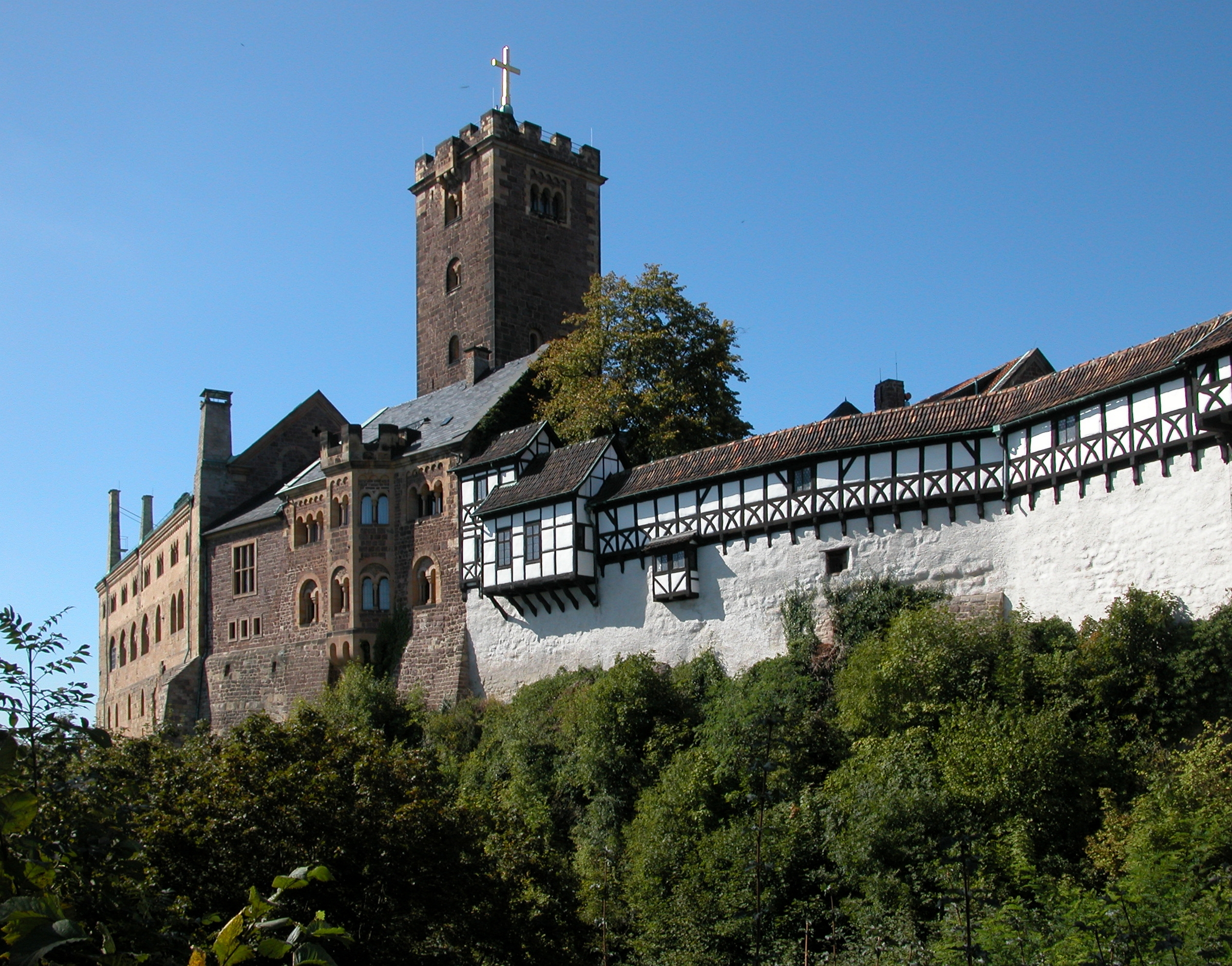
Wartburg Castle,  by Robert Scarth                          .
Yes, the same where Luther was given protection, the house of St. Elizabeth, and the place of competition of Minnensangers, and featured in Wagner's opera Tannhauser. Click on the picture to see high resolution.
Here he felt free , and in a state of rapture collected flowers. It was a kind of religious ecstasy. He decided to confess all his sexual debauchery, and ask Got for forgiveness. However, every priest who heard his confession was too shocked and didn't want to grant him absolution, telling that God will never, ever forgive such sins. Tannhauser even went to Rome in despair, confessed to the pope Urban IV himself, and asked for  forgiveness again. All this made the stern pope very upset: he said that first his pontifical staff  "will rather grow green, and bloom than God will forgive such lust." Depressed Tannhauser departed, decided to go back to the Venusberg, as there was no place for him on earth, he went back to the goddess and her realm of carnal pleasures. But after three days the pastoral staff of the pope greened with lush leaves, and flowered profusely. The pontiff send his  messengers after the desperate knight, but they couldn't find him anymore. The people in the village close to the  Venusberg told them he passed by, with somber face.He was never found again.

Picture on the left  is Tannhauser himself, from page of Codex Manese where some of his poetry are compiled, among them also a repentance song. The Codex is an anthology of medieval German poetry. The legend of Tannhauser made to German literature during XIX c. when literati  started to be interested in folklore and medieval world. But the strongest increase of popularity came after Richard Wagner's opera, named after the poet and retelling the Venus  legend, and the story about   competition at the Wartburg Castle, combined with Wagner's own creative liberties.

The Venusberg story is very interesting for three reasons: first it talks about real-life poet and maybe a real-life poetic competition, fits the history of a  personality, and his creative output into a legend. Second, it is an old legend Christianized, similar as the grail story was Christianized,it is a hybrid. It shows dynamism of a society which was in transition from culture of paganism to conforming into a new religion, and still quite new fedaul reality. The third reason: it gives a moral lesson about forgiveness, which it is not granted freely, and forces the protagonist to go back to the old ways.It shows that people are not forgiving, but the divine forgives. A lot of moralising here: about the goddess Venus and her court, personality of the  poet knight, but also about the hard hearts of the clergy.No one is spared, and in this story the divine gives a lesson that forgiveness should be granted freely and quickly, and this is a true loving way. The story is of course about carnal and spiritual love, and about serving a lady, but it is so multi layered. This were also times when Europe clarified its own ideas of romantic love.

Regarding an old legend combined with Christianity; Sabine Baring-Gould mentioned this one  in his book Curious Myths of the Middle Ages. He reported that the legend appears in its basic version in many countries in Europe, on which the local folklore built other layers. No confession and clerical invlovement is seen except Taanhauser story.Which I was not aware of. Basic version is that under-terrestrial beings want to contact human beings. A man comes in contact with them, has a very beautiful women as  a lover. He longs for earth, and escapes. However, he needs to return, as the earthly world is not receptive to him anymore. Baring-Gould gave examples of stories which have variations, but retain the basic roots. A very folklorist  view. Sometimes a pagan goddess, sometimes the goddess Venus herself  is present, and there is also a motive of ring and the marriage. There are also more mountains of Venus in Germany, also in Italy, there called Venus mountains, or mountains of Sybil. (I wonder if this has to do with Roman presence there). Baring-Gould also mentions that  the story of Tam Lin, tells stories from Catalonia, Farroe Islands, Sweden, Pomerania, Switzerland, etc. and mentions written versions by various ancient authors.Some are more related, some are more distant relatives.

 I also see now the connection between a legend from Poland, about a young knight who went through the waves into the heart of the lake to be married to some beautiful woman who held a court there. He was telling his loyal horse-or loyal friend who was a rider, depends on version- to go to and to tell his family he wedded a beautiful lady of the lake. The mother of the knight in the bottom of the lake knew the  he will never come back. Poland has of course many stories about aquatic world, courts and the cities, as there are so many lakes.

Tannhauser was present among supernatural beings, under the earth. Main ruler of the court here is chtonic type of the goddess, in spite of the goddes being Venus,a conflation. And the idea of under-terresatial folk itself reminds me of a huge bestseller, kind of  the Da Vinci Code of the turn of XIX c. It was a novel about Vril and subterrean super race living in  caves under the earth. The novel was an enormous financial success. Many people actually believed in reality of such race, and this belief was rumored to linger for long. Some of the Nazis supposedly believed it, it was believed in some occult circles, in Theosophy belief in Vril still exists to some extend. It was a novel, but seriously captured people's belief in reality. Vril, similar like the grail, is the idea about power granted, about  fulfillment of wishes. No wonder that both, the grail and the vril resonated so strongly with the audiences.  Recently we had The Secret phenomenon, which falls in the same category:  power of fulfilment of wishes, power of belief. Law of Attraction, another magical world for the frustrated. But I prefer the legends, I confess, Vril and the Secret don't attract me.  Are they an equivalent of today's court of Venus, where first after some time one sees the illusion?

As for the caves in Venusberg: local society hopes they will attract tourism, and the caves were explored. In them are diverse colonies of rare  bats, which hopefully will not suffer in case tourism increases one day. Iron bars at the entrance of some caves make a lot of sense, and here is a responsible way of protecting nature.

Monday, August 20, 2012

Yellow: Triumph and Fall, history of color #11

Yellow is unusual in art history regarding the attitudes people had toward this hue: it was held in high esteem until did fall low.

First during medieval times yellow was replacing gold when it was too expensive for the project, like for example usage for the background in frescoes, large surfaces. Sometimes of course, gold was used on frescoes also, it depended on how much a community could spend. Yellow was a much cheaper alternative and still represented divine light. In an earlier post I wrote about symbolism of gold as representing divine light, as the color symbolism is theological). But yellow wasn't used symbolically only, also when needed to give some beautfil robe to a saint, for composition purposes, the color was used freely.

Chromatically yellow is also the lightest color from all chromatic ones. (White is non chromatic). Also it was used in illuminated manuscripts, as we see in this masterwork of medieval art: the book of Kells, from Iona, dating from the times when Irish monks spread their culture and knowledge in Europe. Columba was visiting Reichenau, as I told you before. This folio showing Christ enthroned makes use of yellow, which is fine of a color to even line the cross and painted as color of Jesus' hair. The birds are peacocks, about symbolism of this bird in this this article. The circles at the feet, surprise, surprise! Those are angels, called Thrones, often depicted as wheels, sometimes as wheels with eyes and wing, specially in medieval Byzantine art. Wanted to mention it, as they are not uncommon, and people wonder about what is it. But also can mean the heads of the nails of the cross. The book Christ is holding represents the divine law.


Christus Enthroned, Book of Kells, Ireland, library of Trinity College, Dublin, via wiki commons


 The figures are angels, one angel is a seraf as the posture of his wings indicates (lower corner on the right, will write more about angels another time). This part of a wonderful lecture later describes the peacocks too: as incorruptibility of Christ's flesh, with chalices and hosts.

Closer to Renaissance the elevation of yellow to color of light started to diminish, when art started to be more realistic, the golden backgrounds fell out of fashion. Now yellow started to be viewed as color of falshood and treason. It was used to brand those who were considered socially less acceptable: prostitutes, Jews, heretics. Jews were ordered by law to wear yellow badge. About yellow as color of prostitution I wrote already when I wrote about Mary Magdalene.

And as we see in this fresco by Giotto, yellow was assigned to bad people.Jesus has a loving peaceful face, he is dressed in red and blue, Judas in all-yellow garment.
Giotto, Kiss of Judas, Scrovegni Chapel, Padua, Italy, via wiki commons

Cathars after Albigensian Crusade were forced to wear yellow cross, as badge of shame. Of course they couldn't be Cathars by choice, they needed to provide prof of marriage and repent, than their live were saved. Repentant heretic was important, as too many heroic personalities burned on stake wasn't good advertisement for ideological side of religion. Some of  information about Cathar religion we know from writing of a Cathar convert to Catholicism. Those crosses called las debanadoras were to be worn always outside the house. It depended on the depth of involvement in Catharism judged by the Inquisition in a trial of , if a person needed to wear one cross or two (front and back). Those crosses were usually six inches wide and had height of eight inches. Unless one was of aristocratic birth, the badge of shame was to be worn for the rest of someones life. Many simply didn't comply, or were unrepentant. It was not a simple badge of shame:Cathars didn't like the cross as a symbol, this refusal of the symbol was written in their religious philosophy. It was much more cruel punishement than a known more widely and younger scarlet letter for adultery. Following link will bring you the wikipedia articles about Cathars and yellow cross http://en.wikipedia.org/wiki/Cathar_yellow_cross 

As for heresies: they were not considered a religious offenders only, but in Western Europe heresies were viewed also as treason against the state, and considered anarchy. This was also one of the  reasons why it was relatively easy to prosecute those who didn't conform. Rulers were offended by heresies, specially because almost every heresy also criticized materialism of the status quo, preached poverty or renunciation of material world, Catharism did it to.