French Gothic art is very renown, and for good reason.
French cathedrals are magnificent, totally awe-inspiring.
Sadly, often it is only Gothic art known to travelers in Europe, and I understand that. Time and money can be a limiting factor. I consider myself lucky, growing and living where I could just take a walk and could step in a welcoming interior of a Gothic cathedral. Or a Gothic church, or a Baroque one, and other international styles. For sure this can nourish your aesthetic sensibilities. This is one reason I write this blog, to be able to share what I got for granted.
Sadly, often it is only Gothic art known to travelers in Europe, and I understand that. Time and money can be a limiting factor. I consider myself lucky, growing and living where I could just take a walk and could step in a welcoming interior of a Gothic cathedral. Or a Gothic church, or a Baroque one, and other international styles. For sure this can nourish your aesthetic sensibilities. This is one reason I write this blog, to be able to share what I got for granted.
Sure, Reims, Chartres, Notre Dame, etc. are worth the
journey, are iconic. So are Paris, Giverny, Carcassonne, and other beautiful
places. So is Cologne with magnificent and finished cathedral towers.Stump-like
towers of French cathedrals are unfinished, you know, those towers with flat tops? Those are unfinished ones, not just the intention of the builders.
Other German cathedrals or Gothic churches are also worth the visit. They look very much like the French ones, but the towers are usually much taller, truly the intention of Gothic, often with open work spires, lacy. Gothic was architecture which ambition was to grow as much in height as possible, the ideal was to get the numbers of the ratio of walls and floor space as much different as possible (1:1 would be a bad ratio!) Cologne cathedral has 1:4 ratio of surface vs. height. French cathedrals get to 1:3 ratio. It was like a racing toward the sky, and often the attempts of getting the ratio to the extremes resulted in collapses of the cathedrals.Here is shown what you can see, and hear at the Cologne Cathedral.
And here are the magnificent bells an the exterior of Cologne Cathedral
But there is of course beautiful lot of Gothic art in other countries too: England, Spain, Portugal, Czech Republic, Poland, Baltic States. Poland and Baltic States have examples of brick Gothic.
Other German cathedrals or Gothic churches are also worth the visit. They look very much like the French ones, but the towers are usually much taller, truly the intention of Gothic, often with open work spires, lacy. Gothic was architecture which ambition was to grow as much in height as possible, the ideal was to get the numbers of the ratio of walls and floor space as much different as possible (1:1 would be a bad ratio!) Cologne cathedral has 1:4 ratio of surface vs. height. French cathedrals get to 1:3 ratio. It was like a racing toward the sky, and often the attempts of getting the ratio to the extremes resulted in collapses of the cathedrals.Here is shown what you can see, and hear at the Cologne Cathedral.
And here are the magnificent bells an the exterior of Cologne Cathedral
But there is of course beautiful lot of Gothic art in other countries too: England, Spain, Portugal, Czech Republic, Poland, Baltic States. Poland and Baltic States have examples of brick Gothic.
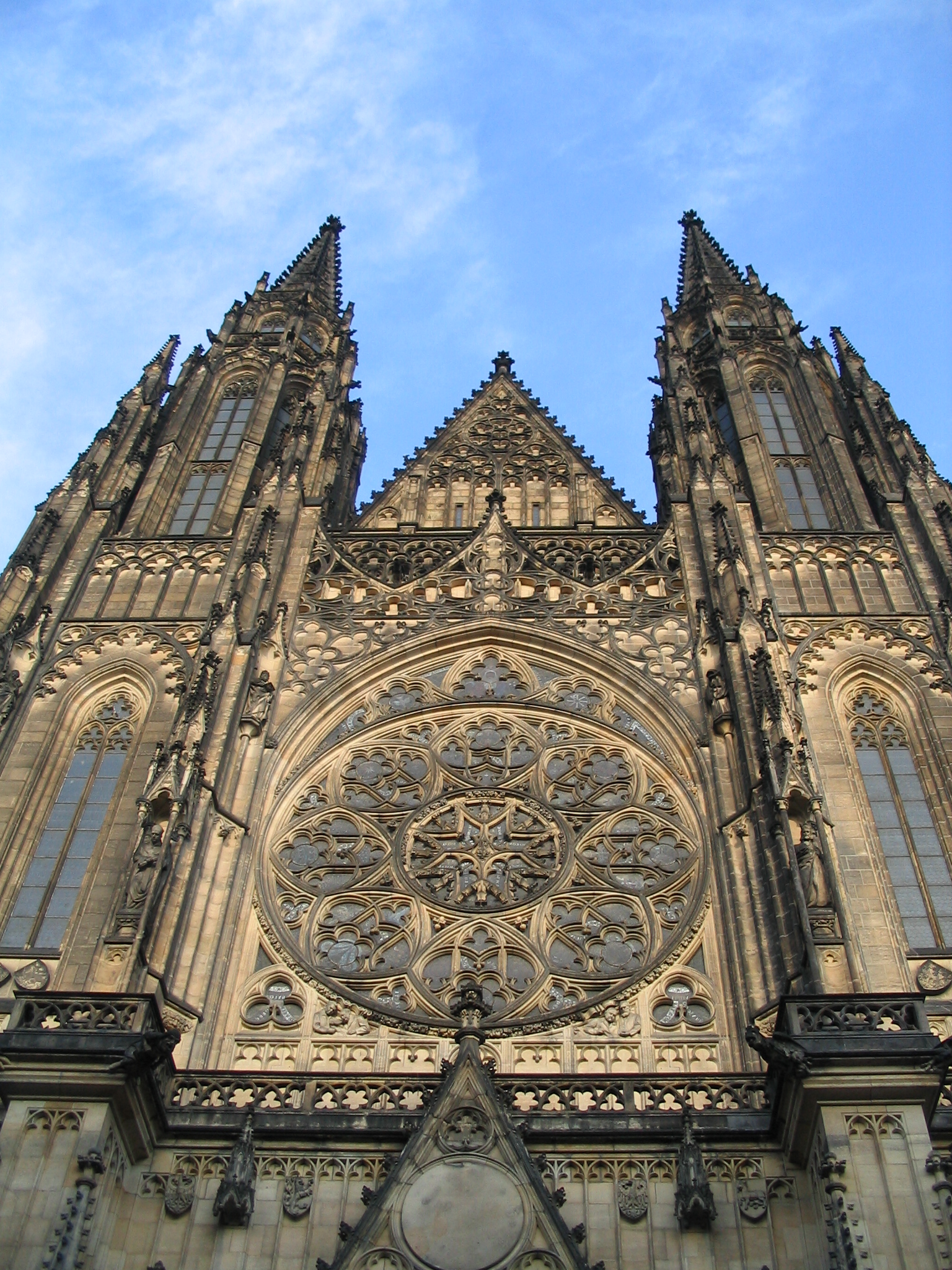 |
| Portal of St. Vitus Cathedral wit rose window, stone masonry, Prague, via wiki commons courtesy of Vaylag |
With mass tourism being such lively enterprise, many people
are able to see a lot, but often this is knowledge given by the tour guides.
Pity when among Gothic cathedrals only Chartres or Notre Dame rings the bell,
but Amiens is a total mystery. I mean I don't argue to visit all possible sites,
but to read. I wonder, maybe it is the fault of art historians, or popularizes,
or people like me who can't make the subject interesting? For ex. authors who
make Chartres a place of mystery reshaping its once famous cathedral school,
(but one of many cathedral schools of the day) into some esoteric tradition
school have the upper hand, as captivating story is given. Facts can be
captivating? I think so, but then I am an art history geek.
There is also a curious situation regarding the Middle Ages:
most popular knowledge deals with Western, parts of Central Europe, little with
Eastern Europe. Byzantium is kind of a lost empire. Prague, luckily, developed
into a tourist attraction. Krakow (Cracow) seems to be on its way now. I am Polish, and
I am sometimes surprised when some people are surprised when they see that this
country had Romanesque, Gothic, Renaissance, etc. It seems that it was such an
empty hole in European history, regarding some countries, due to long slumber behind the iron curtain.
Once I felt like someone coming totally out of empty space when I watched
supposed to be educational video (US produced VHS), about Battle of Vienna. It
made me laugh, as the video mentioned only prince Eugene of Savoy, as army
commander. No mention about Polish army, even though it was a bi-national
enterprise, and actually the Polish king, Johan III Sobieski was more in charge
than Prince Eugene. Not that I care so much, and during times of Wikipedia such things are corrected, but it was really funny, how big of a hole in knowledge can be
created in one piece of material. One of the most decisive battles in European history, two big armies of two nations, and you totally forget one army plus the commander in chief? What a curious and amusing case of selective blindness! Cold War legacy? ;-)
Along the line of random info spreading, the Czechs had their own brand of Protestantism,
c. one century before Luther (Jan Hus, Czech Brethren, etc.). Poland had
religious tolerance guaranteed by law, including Statutes of Kalisz, about the
protection of Jews. (Not as bad as in other countries, but it didn't mean it was a totally safe heaven). Religiously different people lived there, including the
Cathars. The Kinghts Templars too. Or other crusaders who went for Northern Crusades, (often turned against Poles) . One
blog writer from Czech Republic claims that every village in his country has some legend
about the Knights Templars. Templar legends in general are not so very
French-centered.
Lots of mysterious, interesting stuff in other parts of Europe. For example devil in Polish art was treated as humorous nasty figure and was often ridiculed, not a scary being like in the Western Europe. Devils form St. Mary Church in Cracow were painted in strong colors. In another Central European country, Germany, devil was feared, and stakes witches were burned. The conspiracy theory about witches came to Poland during the Renaissance, when the witch hunts intensified, but it was less common, and actually the Latin Church was not by law excluded form participation: only secular power did it. Strange? No. This is info is to point out the diversity of Europe during the Middle Ages and the Renaissance.
I don't have links about Gothic art in Slovenia, but Gothic went there via Prague, and Parler.I am mentioning Slovenia, as it it a very pictoresque country, (my hubby loved it), which enjoys, rightly so, many tourists visits. Very, very interesting landscapes, history, architecture, coasts in general.
A beautiful Corvin Castle in Romania you can see clicking on this sentence.
Lots of mysterious, interesting stuff in other parts of Europe. For example devil in Polish art was treated as humorous nasty figure and was often ridiculed, not a scary being like in the Western Europe. Devils form St. Mary Church in Cracow were painted in strong colors. In another Central European country, Germany, devil was feared, and stakes witches were burned. The conspiracy theory about witches came to Poland during the Renaissance, when the witch hunts intensified, but it was less common, and actually the Latin Church was not by law excluded form participation: only secular power did it. Strange? No. This is info is to point out the diversity of Europe during the Middle Ages and the Renaissance.
I don't have links about Gothic art in Slovenia, but Gothic went there via Prague, and Parler.I am mentioning Slovenia, as it it a very pictoresque country, (my hubby loved it), which enjoys, rightly so, many tourists visits. Very, very interesting landscapes, history, architecture, coasts in general.
A beautiful Corvin Castle in Romania you can see clicking on this sentence.
Here is a link to a site, in Polish; I apologize, but just
for the sake of the pictures. There are iconic examples, such as Chartres,
Nuamberg, Limbourg Brothers, Sluter, Crucifix of Geron, but also believed to be a miracle working crucifix from Cracow, and other
examples, like the biggest Gothic altar in the St.Mary Church in Cracow, or
probably the first authoportrait by Peter Parler in Prague, and wonderful St. Vitus Cathedral, Malbork Castle, and "armor Madonnas" (Crusaders art, can be opened as cabinets!),
and other exciting examples. The other is the link to St. Vitus Cathedral Wikipedia article. Enjoy!
http://www.historiasztuki.com.pl/001_KANON_GOT_2.html
http://en.wikipedia.org/wiki/St._Vitus_Cathedral
http://www.historiasztuki.com.pl/001_KANON_GOT_2.html
http://en.wikipedia.org/wiki/St._Vitus_Cathedral


