I noticed in my blog's statistics that some of you came to my blog searching
for info about the colors of Mary Magdalene's robes. I must have been a
disappointment to see so little about it. I hope this entry will give you more
of satisfying information.
Red was very common when she was depicted, but other colors were not rare either. I feel I need
to move beyond the Middle Ages, as I was writing about vermilion robe of Mary
Magdalene already. I am focusing in this post on Latin Christianity. Byzantine Christianity depicted her also in red robes, often with
red egg in her hand. In this tradition she also she was considered extremely virtuous, one generation older than Jesus, died in Ephesus, her relics (body) were revered in Constantinople. Disappeared of course, maybe together with other relics after sack and looting of Constantinople they, tradition say were brought to Western Europe. But we don't know for sure what happened.
 |
| Mary Magdalene, Orthodox icon |
Red was often the color of choice by the later painters as well, but I would advise not to rely on red so much. Some people do, to some degree
of annoyance of the well-educated art historians, when the non-art historians try to convince them, sometimes quite harshly, they know it better because they read a few popular books. Thing can turn rather grotesque.About annoyances and my defence of art historians later,
in another entry, now I focus on colors and Mary Magdalene as a cultural phenomenon.
Magdalene was shown in red robes, quite often in a green dress. Green
symbolized eternal life, color of paradise, hope and promise of eternal happiness in heaven. Green of the paradise was shown already in the early Christian art. Shouldn’t
be confused with non-religious matters, when green symbolized rebirth, Spring,
fertility, hope in matters other than theological. It is important to know about such differences, not only for knowledge sake, but also for avoiding mistakes, for example reshaping Mary Magdalene into fertility goddess, as it sometimes happens in some books authored by some non-art historians. The context of the art matters, quite a lot.
Red was common, yes, but not an exclusive color assigned to her only, nor she was shown in red only. This is a curious misconception, recently spreading. I would like to know about the sources of it. Assuming that she was shown
only in red robes, isn't in relation with factual history of art, it is huge over-simplification. Red in religious, not secular tradition represented love in sense of
charity, (
agape), martyrdom, sacrifice on the cross, redemption through
crucifixion.
But she was also depicted in lush and colorful robes, rich and beautifully embroidered,
often golden. Look at this picture, which I got through twitter. One of many
examples of colorful robes, from the collection in Kassel Museum, Germany. Cloak is elegant subtle shade of red.
Mary
Magdalene and Jesus as Gardner
Or click to see
life of Mary Magdalen at Chartres Cathedral stained glass window. Click on links to different images, and you will see range of colors, blue included.
Form gold we go to yellow, which was in certain times the color assigned by law to the
common prostitutes and courtesans. Red wasn't. There is another misconception that red was color of prostitutes, which is not true: yellow was. Red sometimes only. I wonder if this assumption comes from Scarlet Letter? Who knows. Mary Magdalene could be dressed in yellow, or only be a part of her garment, like
for ex. the sleeves were yellow, the dress itself is black and white, and no cloak. Etc.
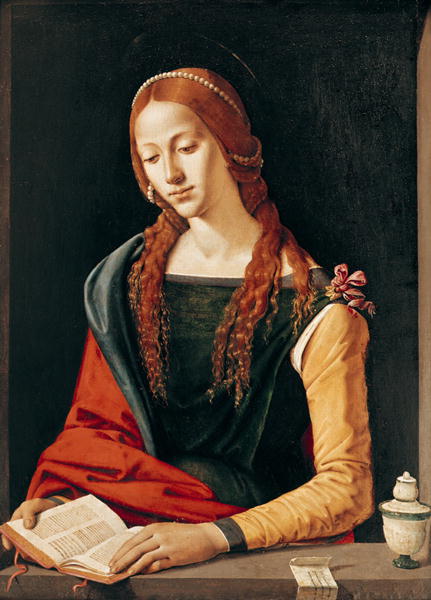 |
| Piero di Cosimo, Mary Magdalene, public domain, via Wikimedia Commons |
 |
| Penitent Magdalene by Artemisia Gentileschi,via wikimedia commons |
Colorful, rich
robes were shown too, or in very subdued colors, when she was depicted as a
meditating penitent. Or dressed in shiny silvery silk, XIX c. And I am glad she was not
depicted in red only, and not in vermilion only. She captured the imagination of
the people of Latin Christianity as a very colorful personality anyway, as someone who lived a whole
spectrum of human emotion and full spectrum of ethics. Why she should be than depicted in one color only? It would be very limiting. She was considered the
accessible saint, giver of hope to fallen humanity, and as a personality more a symphony than a simple melody. She was one of the Latin Christianity highly
elevated persons who was somehow considered unclean at the beginning.
 |
| Mary Magdalene by Jan van Scorel, via wikimedia commons |
To the masses of believers she was
the embodiment of a phenomenon of transformation. From a women from whom seven demons were expelled, a prostitute by profession, who than became no less than "Apostle to the apostles," the title given her by the Catholics church, a base metal changed alchemically to gold. Transformation which Oscar Wilde
one described as: "every saint had a past, every sinner has a future." Initially a bad girl, but with golden heart, also in accordance to some societal views about the harlot with a heart of gold. Europe loved such stories, Europeans were not Puritans. La Traviatta is one of those stories, for example. I don't think there is an equivalent in the US. Different cultures, different views, different archetypes.
And she was an embodiment of a loving, yet a very independent woman. Sometimes
I am asked if I believe Mary Magdalene was the Grail. Depends what you
understand as "grail". To me grail as an archetype can’t be confined to the ideas
of biological reductionism. Grail of the legends itself is an archetype of a quest, and it is elusive,
as quest is often about elusive goals. Many people are on quest, but don't know what the quest is about. And nothing wrong with it. Mary Magdalene: it is nothing wrong
in being a parent, it is something very noble in parenthood. I respect that. But did she really need to be a mother, a cup bearing diving
DNA in order to be more important to us?
 |
| Penitent Mary Magdalene, by Vaccaro, via wiki commons |
We may find out that today we are less tolerant
toward her than the people who didn’t believe that she was the mother of Jesus
offspring. Those people loved her anyway, even when they believed she was a reformed
fallen woman. It seems they were quite forgiving. She was loved and venerated the way she was perceived, with all
her imperfect humanity, the way she was seen. Imperfect saint? People didn’t mind. This is not about who she was historically, as stories were often confused. Mary the Egyptian for example, or dispute which body was the real Mary Magdalene, as at times there was more than one body claimed to be Mary Magdalene's. Holy relics were not such clear business, and there are also cases of spurious claims. Her story is not so much about her, but very much about us: how much were are willing to accept in a person, specially in a women, in order to consider someones contribution a worthy one.
And how many prejudices we have. Her story is a very interesting case in social history, indeed. Interesting, unique perspective
in a Guardian article by the novelist and columnist who was herself a prostitute, Tracy Quan. She mentions her visit in Southern France to see the relics whom she considers to be her patron saint. Specially important, I think, is the quote engraved on the stone tablets along the steps leading to the cave said to be saint's meditation hermitage: "Blessed are those who have been persecuted." Quan noticed this quote as she climbed the stairs. To me Quan's article was a gentle reminder and a rebuke, to all, me including, calling to not forget those who are in need, no matter who they are, or how "lowly" they are. Over a millennium and half Latin Christianity's message regarding this saint was: stop marginalizing, be open to others.
The founder of the first church in Europe was Lydia. She was a business woman, dealing with luxury goods prohibitively expensive purple cloth. She was unusual for the place and times, when women were considered deficient human beings, with human rights comparable of that of children assigned to them. Why she is not talked about now, along with Mary Magdalene? Not sexy enough? Not enough of sensationalistic dramas? No way to focus on her genitals/womb, as it was done in Mary Magdalene's case, and still is today?
In general this turmoil about Mary Magdalene and women, being not given enough enough respect, not given enough place for them in the church, as much as it is healthy and good has it own flaws: conveniently blaming the Catholics for everything evil seems to be a little bit displaced, when we take women as archetypes. In Orthodox Christianity there was no mention of her as prostitute, and there she also has churches devoted to her, and the legend saying that she traveled to Ephesus, stayed there and her grave is there. After the schism this is a competing legend, as the legend of Mary Magdalene traveling to France is more well known, as Western Europe is more well known. To me the position of Mary Magdalene is more problematic in Protestantism. It seems to me that the Catholic sisters of Protestantism don't complain as much about women not given enough place in the church theology, except complaints that women can't be ordained. And other issues not relating to theology, which I omit know as they don't relate to the subject directly. Mary Magdalene was always a very popular saint, tin Catholicism, if not the most popular one after all.
Here is Mary Magdalene in brown robe of a penitent, those often were extremely crude, made of goat hair or crude wool (other races of those animal than today), or was she was supposed to be covered only by her long flowing hair.
 |
Ascension of Mary Magdalene, Anonymous, via wiki commons
Mary Magdalene here taken to heaven is dressed in coarse penitent robe, or according to the legend,
her naked body was covered by her very long hair. |
Their (Catholics) equivalent of the Sacred Feminine, a term so often used now, is Virgin Mary, given the title of the co-saviour, as saving together with Jesus. Mary Magdalene is the apostle to the apostles. And other women saints. They say those personages are just humans among the Protestants, who reject cult of Virgin Mary, etc. not divine enough. Should we reject their opinions as illogical? Given the number of the churches devoted to Virgin Mary and and Mary Magdalene in Catholic countries in general? Look at the picture above, is this disrespectful? The word "vilified" is often used in relation to Mary Magdalene. Is she as vilified as it is complained in popular opinion? I think we need to to look deeper, it is easy to repeat catchy phrases, which can be emotionally satisfying, but on the long run those phrases make things shallow. And the subject of Mary Magdalene is not shallow, not matter which tradition we analyse or which one we like.
Art history gives another picture. On the last example above she is rather
glorified than vilified.And it was one of many kind of depictions of Mary Magdalene.
 Green in Medieval times had rather varied symbolic meaning, depending if was used in the religious or secular context. In religious art it was a symbol of eternal happy existence, Paradise, and soul's hope for eternal bliss. Green robes symbolized eternal happiness through salvation, and often martyrs were dressed in red and green.


