Showing posts with label gothic. Show all posts

Monday, July 15, 2013

Imagery of Ascention of Mary Magdalene

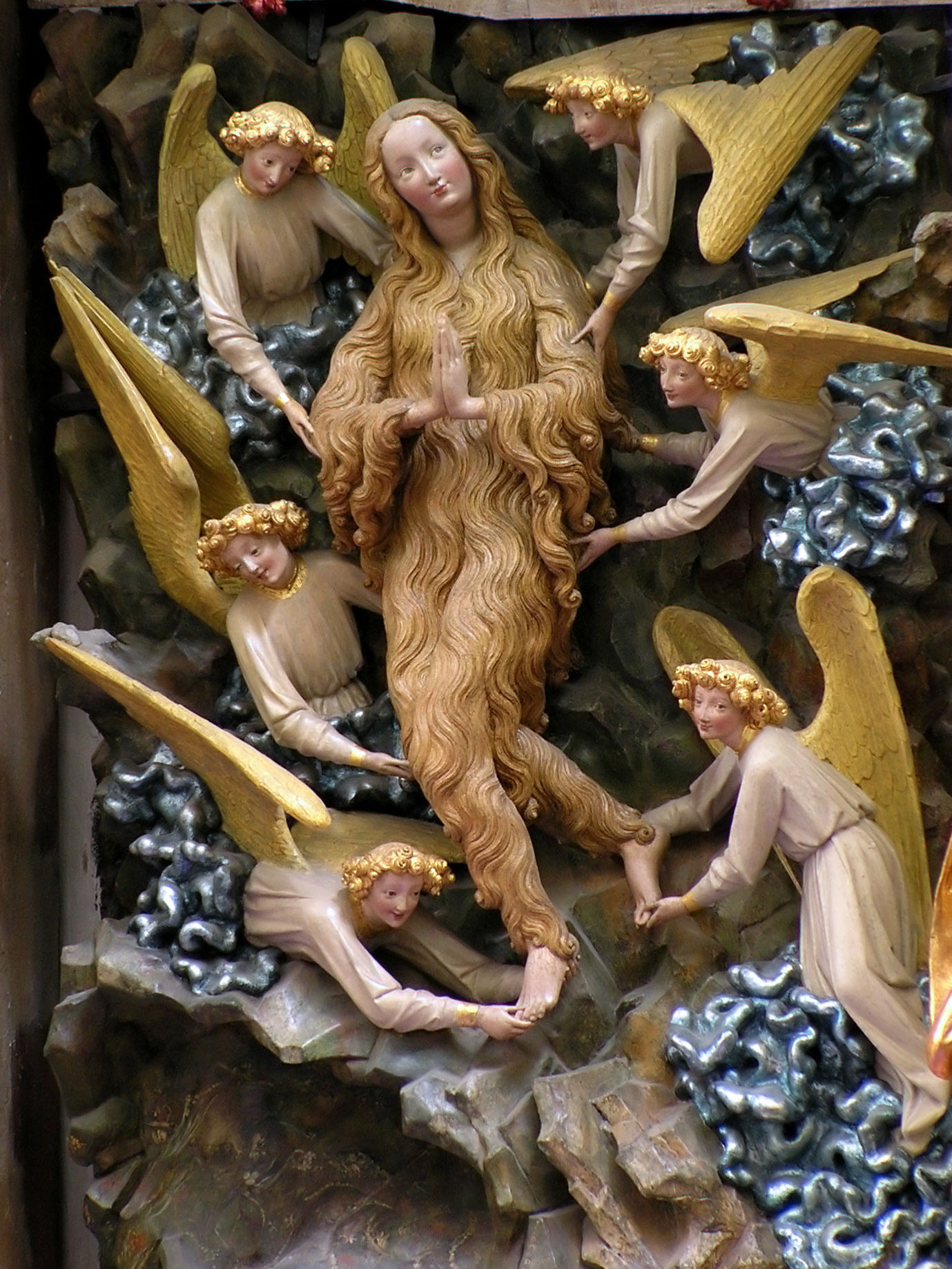
On this picture, originally from Gdansk today in National Museum in Warsaw National Museum, Warsaw we see ascension of Mary Magdalene. It is one type of many way of representing Mary Magdalene in art, here she is shown as a  saint who meditated so much that she was feed divine food by God himself, according to Medieval accounts. Latin church tradition says  happened seven times daily, angels took her before the throne of god where she was given nourishment.

Assention of Mary Magdalene, tempera on panel, 1430, 71x48in (182.5x122cm)
Very similar in form on canonical depictions of ascension of Virgin Mary. I was writing before that Mary Magdalene was the second most depicted woman in Catholic art, after Mary mother of Jesus. It comes at no surprise that the glorification images, painting or sculptures are often similar. Here we have Mary Magdalene crowned by Gods himself, held in sky by angels.  We know that this is Mary Magdalene because of hairy costume. But Mary Magdalene dressed in more ornate robes is represented also, see my other entries fro examples.

Another depiction of Mary Magdalene's ascension, also form my country, Poland, this time from St John's church in  Torun. I love the charm and joy of this one. And I am so glad that wiki commons has nice pictures, it is often a chore to take a good picture without flash. I never use flash while taking photos of art. As an artist I know that this is bad for the pigments.

Anonmymous artist, Ascension of Mary Magdalene, XIV c.
in Church of Saint John the Baptist and St. Evangelist
This graceful Mary Magdalene is shown as a hermit, but there is nothing austere in the scene. All is charming and lush, full of beatitude. About the austerities reminds her body covered with flowing hair, which is very beautiful, the rocks of the cave and flat belly. Those days a good muffin on the belly was a sign of female beauty, flat belly was indicating that someone hadn't enough to eat. What is beautiful today for us, for people living in times when Gothic art was created such flat belly wasn't beautiful, but it was signifying that the depicted saint wasn't eating much. Some fashion of medieval times is kind of strange for us today, and I think is worth a separate entry.


Illustration from Nurnberg Chronicle, 1491


Here we have a woodcut from Nurnber Chronicle ( via wikicommons, Schedel). Colorful wings of angels, very long robes with lots of draperies which formed angular folds, and round, protruding belly of the female figure was very typical for the art of the days, specially North of Alps.
Here, according to the artist,  we can say the divine nourishment was as filling as earthly food.

Here a few examples of Ascension of Mary Magdalene to browse
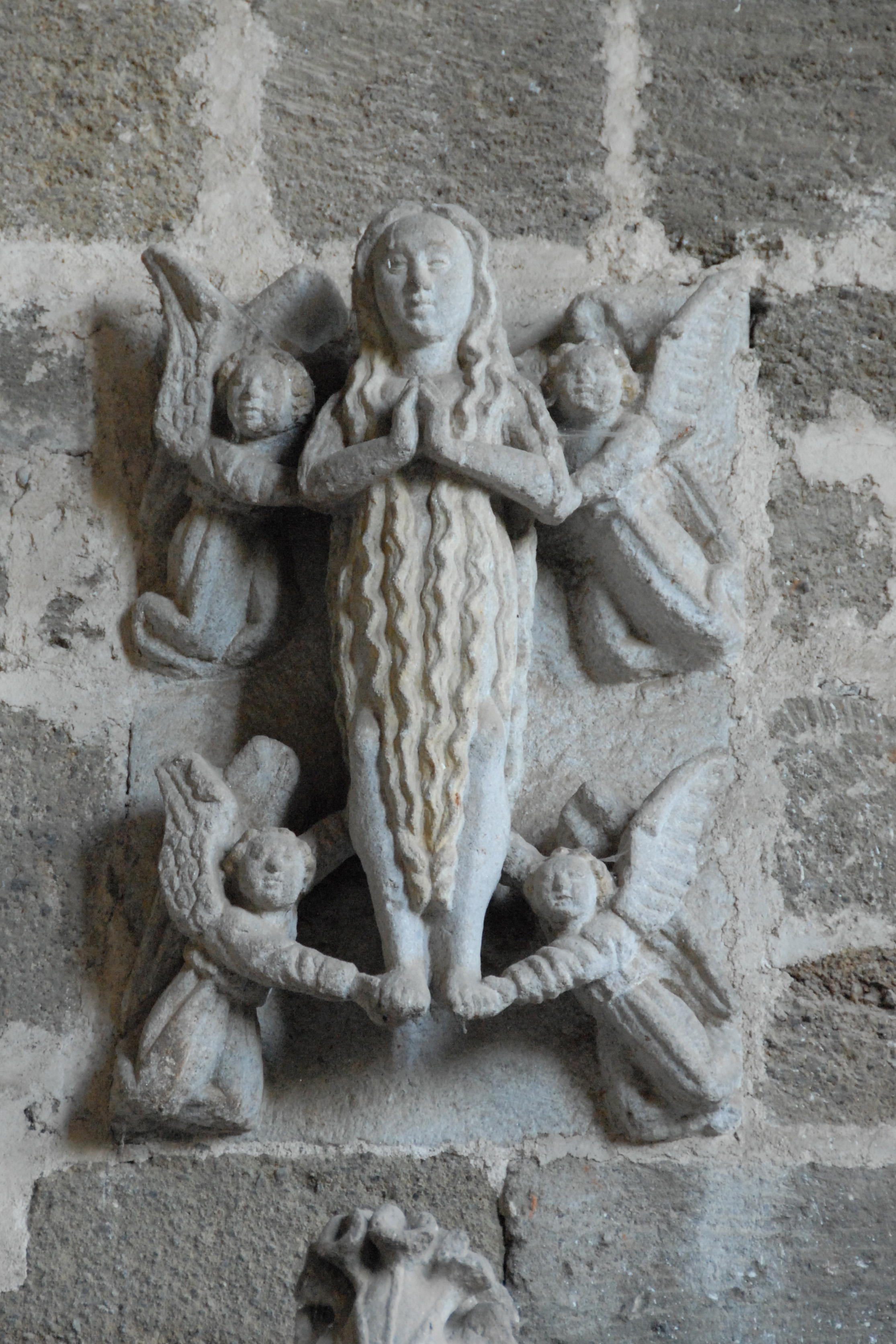
This Mary Magdalene sculpted in stone can be seen in Chanteuges Abbey. Wikipedia articles about this wonderful place are in German and French, so I don't include them here.
But those figures of Mary Magdalene and angles can be found in France, and not only there in various churches or abbeys.
They have their won charm and are of rugged beauty.
Photo by Jochen Jahnke.

Sunday, June 30, 2013

Forgoten Patron-Abbot Suger

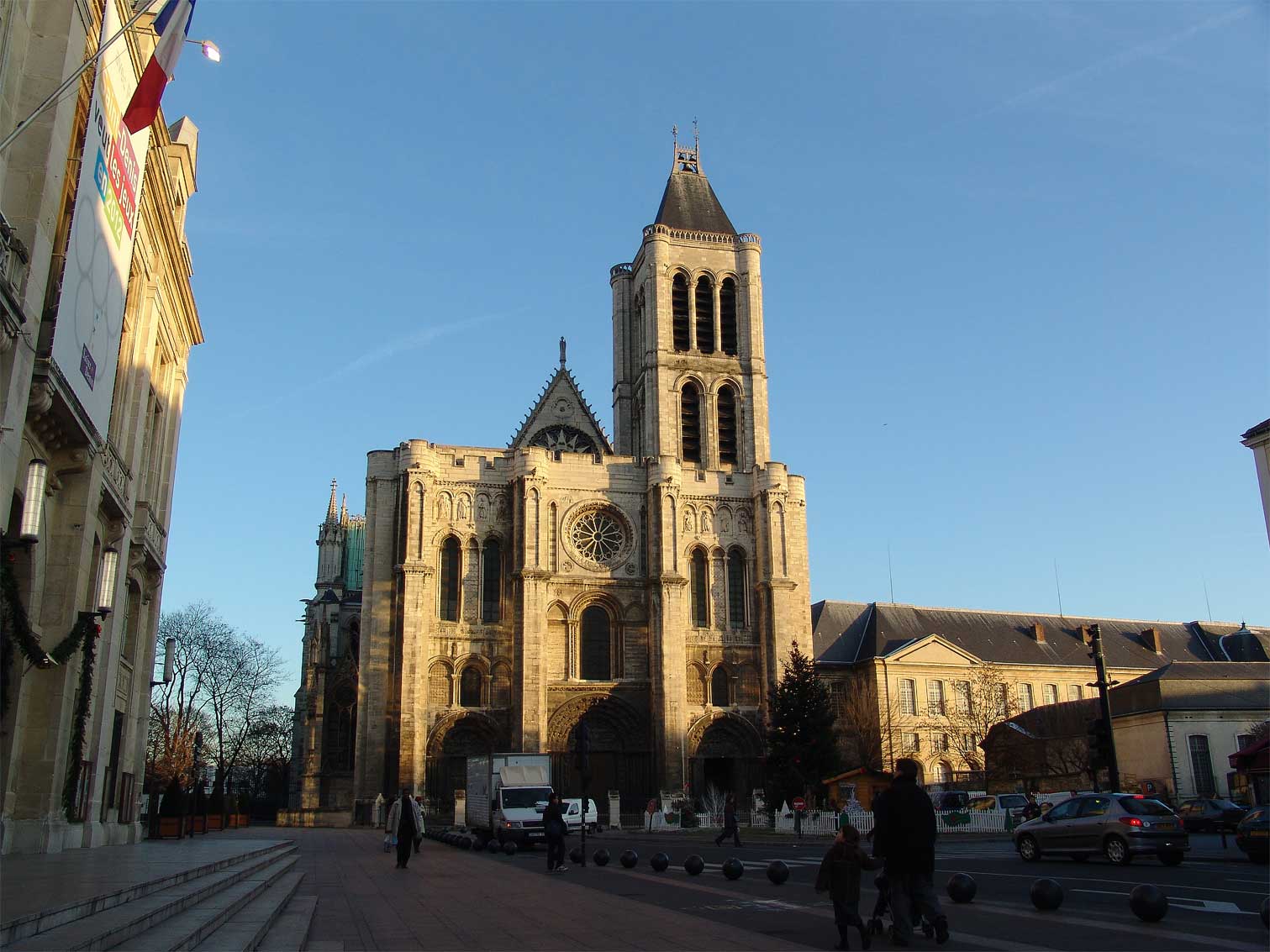
If you are interested in art history, specially if you are interested in Medieval art, sooner or later you will run in your conversation, or books people recommend to you, into stories about Templars, how they introduced and built Gothic cathedrals, and so on. One name is never mentioned in such conversations,  or books: Abbot Suger's. It seems he disappeared from popular culture as contributor to Gothic art, or maybe he was never accepted. Pity, as he did as much for the development of Gothic architecture as the Medici's family did for the Renaissance. Of course, he is known to people who are serious about art history, but doesn't he deserve his place in the pantheon of movers and shakers and patrons who fueled new forms?

Chapel of the Virgin, St Denis basilica, via wiki commons by Myrabella
Abbot Suger was a man of many talents: he was a politician, statesman who served as regent of France when king was on crusade, he was a historian, art theorist, theologian and of course manager of a big and influential Abbey of Saint Denis. Not to idealise him: as many people of his times, he was sometimes opposing crusades, but sometimes he was in favor of them. Basilica of St Denis on wikipedia article

He was friend and confidant of the kings, and patron of artists and builders who had new ideas but were not given proper chance to bloom.

Sometimes, however, another situation happens: Abbot Suger is talked about as a single inventor of a Gothic style. This is not completely true: he wrote about aesthetics, wanted the walls to be higher, lighter, windows big and colorful, designed himself, introduced new features, loved things ornate and precious. But he collaborated with people who wanted to do things in a different way.Redesigning of St Denis wasn't his and only his project. He was very engaged, but didn't handle projects and firmly said: "build exactly what I drew." He was giving ideas, he accepted ideas, he was the project manager. Through him was possible to introduce large windows with pointed arches, ribbed vaults, clusters of columns, flying buttress, ambulatory with chapels radiating form it, and lots of light.

As you see on the picture above some features are still Carolingian, like for example columns, they still look like those from Antiquity. But arches are pointed already, vault is more complex, and windows are big.

Gothic style was a natural development of Romanesque style: what happens the newer style tended to make the building more spread in smaller part, branching out, more differentiated in forms, less compact, in comparison to the solid mass of Romanesque churches. The style was adopted fast, specially in royal domain of Ille de France, but still a lot of experimentation was going on. It happened that not all architectural ideas worked perfectly, talking about Europe now in general, not only France. There were instances when parts of cathedrals collapsed, or bad accidents happened. But with time building science was catching up with new aesthetics of creating higher and higher churches with bigger and bigger windows.

Rosette window in St Denis, North side,via wiki commons by Amirwiki
About Zodiac, see my blog entry about Charters and Zodiac
A lot of enthusiasm was involved in such projects, specially in France. France was the cradle of Gothic style and from here the style radiated to other countries. More stones were moved in France during the era of building Gothic cathedrals than in old Egypt in construction of pyramids, and cathedral builders were properly compensated. People who helped were volunteers, no slave work involved.

Volunteers were amazing enthusiasts.They were religious, of course, those people were products of their times like we often are products of our times. Haimon, abbot of Saint Pierre sur Dives wrote in his letter from 1145 about the wave of building enthusiasm among people in France. He wrote about building of Chartres cathedral. According to him even princes and nobility together with those of humble origin were pulling carts full of olive, wood, crops, stones, and anything which was needed for fulfilling the needs of the people working on the construction, or for the building of the church. Often a thousand or more people were pulling a cart full of stones, in great silence, in spirit of forgiveness of each other imperfections and in spirit of universal brotherhood and sisterhood. If you could hear anything at all , those were only prayers, or confessions of wrong doings and words of forgiveness among them. It was like a contemplative movement of peace among people for whom at such times differences among humans were not important, they worked in the spirit of brotherly and sisterly love. So wrote Haimon.

 Suger's ideas of the new style spread fast, but it doesn't mean that they were widely accepted without criticism: some churchmen said that ornate and rich style shouldn't be part of church buildings, church interiors, or church services. Cystersians were proponents of such ideas of humbleness and actually during Medieval times there was ongoing controversy about humbleness versus showing things divine through color, gold, light   and all things which could inspire awe. A little about Cystersian aesthetics in my other entry. I am not saying one approach was better than the other,but  they were competing.

 Abbot Suger not only broke frames of Carolingian building, (the abbey was built in this style) when he commissioned the rebuilding, but also asserted that awe is important part of religious experience.

Cystersian were more for soft quiet focus and contemplation, were against appeal to senses in churches. Colors, sumptuous decorations, music, incense, this was not important, they viewed it as distracting form the experience of closeness to God. Suger said the divine manifests in beauty, light an d color. He wasn't alone: this idea was well and alive because of monastery in Cluny. Founder of the Cystersian order, St. Bernard of Clairveaux simply opposed Cluniac theories. But Suger was on the side of Cluny: to him the stained glass windows were like a vision,  gold reminded of divine wisdom, soaring heights of church ceilings were leading thoughts to heaven. For sure churches were sanctuaries of beauty and space in European, not only French cities, which were dirty, conditions were crowded, as for example width of a room was the width of a bed, etc. But people could just step in a church building  and were transported into another, more beautiful world.

Sunday, June 23, 2013

Holy Grail in Bezlawki, part 1, Escape after Hastings


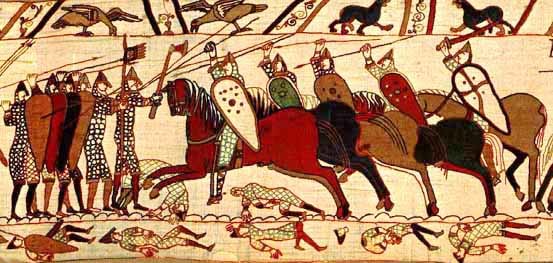
Bayeux tapestry, battle of Hastings. Via wiki commons, by Maxim

This blog has been neglected for long time. I planed and promised to write about the legend of the Holy Grail in Bezlawki, today's Poland. I mentioned before that it seems that Arthurian legends were very well received in Poland. But the legend of holy Grail in Bezalwki has some not very semi-historical events in it, and had people who are historical too. However, I am not saying here we need to believe the legend because of its historicity: it is just a legend based on real facts.

This is a story about a battle, escape, two chalices, two fighting brothers, the crusaders and a tower.
The battle in question was the battle of Hastings, when the last Anglo-Saxon king, the Harold II of England Harold II of England was killed. His children escaped to Denmark, as they were not safe anymore when  William the Conqueror became a new ruler. Short reminder: the mystical object of Medieval times, Holy Grail, was believed to be several things, one version was that it was the cup, or a chalice, into which Joseph of Arimathea collected blood of Jesus during the crucifixion. It became the ultimate  blood relic, which was brought by Joseph of Arimathea to the British Island. One version say that is connected to the Glastonbury Abbey.

 The tradition  also say that it was taken by escaping members of fallen dynasty more East, in order to save their lives, three people. They found refuge at the court of Danish king, their relative. They didn't escape empty handed, as you guess the story goes, they took  what they wanted, or rather what they thought was so precious they couldn't bear to leave behind. Among precious objects they considered worthy not to fall into the hands of William the Conqueror were two chalices, (from Britain and Greece). Finally  the grail was installed in this church, in Bezlawki, on the picture bellow. It stayed there for several centuries, still during the twenties of XX c. one travel book writer, Orlowicz, claimed he still saw one of the chalices in the church.

Church in Bezlawki today, empty, wiki commons, courtesy of Severus


Who were those three expatriate children of Harold II of England as real historical people? One of them was Gytha of Wessex Gytha of Wessex, who later became the wife of  Vladimir II Monomakh, the  ruler of  Byzantium influenced Kievan Rus. He is also known under name of Waldemar. Gytha's and Vladimir's son is mentioned in Norse sagas, there he is called Harald  his Slavic name was Mstislav. One of the brothers, Godwin, became the ruler of one of Lithuanian principalities, a duke. How it was possible? This was XI c. but Lithuania still was very similar to VI c. Britain: like at the court of king Arthur the knights took decisions during an assembly. Upward mobility was possible, still, during those days for a warrior who was considered worth of rule.

 Back to  Bezlawki: it was far away, actually when the chalices, (or chalice? ) first were installed there, the building which is the church today was not a church at all, but the fortified  tower of the crusaders. Not the Knights Templars, often they are associated in modern versions of the story with holy grail, but in this story we have Teutonic Knights, the worshipers of the Virgin Mary, with black crosses instead of red ones. They were  Order of Brothers of the German House of Saint Mary in Jerusalem. Knights form Europe joined them, not only from Germany. They were invited by pious Polish princes, Prussian Crusade was part of their military enterprise.


Church in Bezlawki, another view, wiki commons, courtesy of Jerzy Strzelecki

The Teutonic Knights came into the posession of the chalices later,but  it wasn't a war loot . It was a gift. From a rather pious ally.

Teutonic Knights, as a military order on a mission they  pressed East, however,  not South but  North, and who like those knights who went to the Holy Land got the blessing of  pope, they fought the  non-Christians, in this case the pagans, of today's Poland and Baltic states. They build a fortress which at the timescut the most east into the territories of the pagan Prussians, the Baltic people.  One  thing :  the English  version of article about Bezlawki mentions that the the fortress was a hunting lodge build by the Teutonic Knights. Not true, it was a fortified tower, a Wildhaus, as the knight called it, a house, a post in the wilderness. The forest was dense there, and I am sure there were hunters too, who hunted the wild  (it means game in German, also wilderness). However Jagd is hunting, hunting lodge is Jagdhaus. This was a fortress in which knights were stationed, not the hunters.

Two brothers, Lithuanian  dukes were in a bitter conflict. Jogaila, the older one,  who later became the king of Poland, was against the Teutonic Knights. His ascend to Polish throne happened after the Teutonic Knights were subdued and after Jogaila got baptized, it was the Christianisation of Lithuania. His younger brother,  Svitrigaila, sided with the Teutonic Knights, he also brought for them two mentioned chalices which were installed in the tower. Not too unusual, as the relics in the Medieval times were believed to help in difficult situations, and an outpost so far East probably was considered worth of help. Svitrigaila was invited to live in the tower together with his garrison. So, he didn't really give it away,  he moved with it. Svitrigaila still during XX c. was considered direct descendant of Harold II of England by Polish historians. Teutonic Knights promised him the crown of Lithuania.

More information follows soon.One Polish Medieval chronicle is somehow unusual,  it shows that Arthurian legend was taken seriously.Also two Lithuanian Grand Dukes were married to women who became divine: one was considered a goddess (she was a pagan), the other became a saint. Both were worshiped. Also the Nazis had it base very close: 30 buildings, 50 bunkers. It is today a tourist attraction, called Wolf's Lair.

As for the story, yes, it is kind of difficult to believe, it is a legend after all, we don't need to believe it. (I don't). Is it difficult to believe that such legend exists in Poland? Why? legends of escapes are not uncommon in Poland, it was a country to which refugees often went. And you can find this legend retold in polish on the net. Here are links to a website of a licenced tour guide (site in English) where the lady talks about  the legend, another is website of the town near Bezlawki. Not the only articles on net about this legend. This i part of tradition, really.

Blog entry by the tourist guide, she describes it well

Article in Polish, sorry, gmina Ketrzyn site, lots of hsitorical inforamtion


Monday, April 2, 2012

History of Science at Chartres Cathedral, and Zodiac

In the previous post there was Zodiac window form Chartres, today is the astronomical clock. Strange setting for such symbols?

No way. Zodiac then was nothing unusual in churches. So, why all the mystery so many tourists talk about? Actually there is nothing mysterious about it. Explanation follows.
Chartres Cathedral Choir, Astronomical Clock, via Wikimedia Commons, thanks to Harmonia Amanda
First, the clock comes form XVI c. but its ideological roots are medieval, and proto-scientific, not really esoteric. Astronomy, astrology, the synthesizing medieval minds didn't see the difference.

 It is a common misconception that the Middle Ages were not interested in science, only in religion, or there was no reading of Classical texts before the Renaissance. Actually the classics were read, not as widely as  during the Renaissance, of course, but were not unknown, rather kept in high esteem. Many Classical and Arabic texts of science were translated into Latin. Arabic texts about astronomy, mathematics, anatomy and chemistry, and medicine contributed a lot in development of Western medical sciences, we often forget about it. Or simply don't want to know. And there was no agreement about if the Sun was the center of Universe or moved around the Earth. The official decision   in favor of the Earth as the center of the Universe came later. Science was fine as long it didn't oppose any dogma. For example the theological idea of dignity of the human body was applied to the medical field, and this particular idea didn't allow dissecting human corpses for anatomical research. Dead animals were dissected instead, specially pigs. Sometimes, rarely, human bodies were dissected also.

Chartres itself had a cathedral school, as often was the case with such buildings: there were also centers of learning, not only part of religious live of communities as today. Chartres was one of such centers, and was among the famous ones. Neo-Platonism was flourishing there, sciences were treated as separated from theology. A number of so called than natural philosophers (philosophers interested in science) came from Chartres. School of Chartres became less influential when universities started to compete with cathedral schools, but this was a case with all cathedral schools.

So, if the clerics of Chartres were so scientifically minded, why such thing as Zodiac in the cathedral?

 Here we need to understand the mind of people who lived before us, and don't project our XXI c. world view on them. The clerics form Chartres were still products of their times, and during their times astrology was science, before the Catholic Church opposed it, and before it was mocked  by the scientists of the Enlightenment era as superstition, not a scinece. Medicine was part of curriculum at Chartres school, and astrology was officially part of medicine also. Here is the illumination dealing with the human body as related to Zodiac.

Anatomical Zodiac Man, Limburg Brothers, Book of Hours of Duke de Berry, illuminated manuscript tempera on vellum, public domain, via Wikimedia Commons, thanks to Petrus Berbygere


In addition to proto-scientific reasons, Zodiac was a very popular motive in depictions of passing time. One  was very common:  the labors of the months. Frequently months and Zodiac signs were tied together, and this is often found in medieval churches and religious  manuscripts. Labors of the months showed secular world. Zodiac window at Chartres belongs to this popular category. Here is incomplete list of  zodiacs and labours of months in churches.

 Another example, most famous of this type is the series of illuminations from the mentioned  Book of Hours of Duke de Berry, (the same book from which the illumination above comes from). It is not the only example of this kind, but among the most beautiful ones, if not the most skilfully rendered, so far. Here it is, via Wikipedia article and picture gallery.

The Book of Hours of Duke de Berry is  of the most beautiful examples of book illumination in International Gothic style, and contains a very good example of Gothic blue, specially loved and used in France.

 Art history itself is an interdisciplinary endeavor, and understanding history of science or cultural history can enhance knowledge of art. Art doesn't exist in historical vacuum. It is connected to the world around, it exists in historical contexts. Striping old art form its historical context can give us only partial insight, and lead to some  misunderstanding too, some of them can be quite funny.