Showing posts with label cloak. Show all posts

Sunday, August 12, 2012

Colors of Power: red and blue- History of Color in Middle Ages # 9


Red and blue, most prominent color duo of the Middle Ages. People just loved them so much, that even when writing about rainbow  they wrote often only blue and red! Also the existence of separated guilds of dyesrs dedicated for each color may be a testimony for high esteem and priceses of those particular colors.

 We see here in the video the colorful splendor of the Middle Ages, about illuminated manuscripts about British royals. Lots of color, but most prominently the duo of red and blue. Fresh colors, most of the time.Video window may not come up in an instant.
Interesting movie by BBC about royal illuminated manuscripts.

Here Charlemagne is  being crowned.

Emperor's Charlemagne Coronation, Illuminated mansucript, via wiki commons

Red and blue were colors of power in the secular world, why?  Red and blue dyes were expensive, not common, and people loved those hues, of course. Red was used after the purple of Tyre, very expensive and reserved only for the rulers, became less and less available. Red in a more dark, dignified edition was replacing purple,which had a brownish tinge, not what we commonly classify as purple today, until appeared in its pure form, lighter and brighter. As we see bellow, on the Annunciation picture.The same with blue, it was considered a very noble color, and as the blue dye became to symbolize affluence and also royals were using it. (Royal blue).


Announciation by Petrus Christus, via wiki commons


Here on this Anounciation by Petrus Christus we see Virgin Mary dresses in a red mantle. We see the typical elements of Announciation, as the lilies signifying Mary's purity, the vase a pure vesel, open book also is traditional. Always opened on the same page on all paintings, Isaiah 7:14, or psalter pages in earlier book. Other written words is the passage from Announciation of the New Testament, the words spoken by the archangel ("Ave Maria,  gracia, plena"etc) was directly written in the picture. Mary is here depicted as a fine lady, dresses in a rich garment, expensive mantle.  Click here to read more about Announciation symbolism.
This painting is considered early Northern Renaissance, but still has elements of Gothic art. For example the folds of the robes of the angels are still very hard and geometric, the angel's posture is typical for Medieval art, also his wings, strong color, not white. But we see already linear perspective on the tiles of the floor, increased realism of depiction in painting, eye for detail.


Court scene from November,  Book of Hours of the Duke de Berry, Via Wiki commons


What a rich blue wears this duke! Probably he is the Duc de Berry himself, it is a miniature by Limbourg brothers, form the Tres Riches Heurs di Duc de Berry, form the magnificent manuscripts collection of the Musee Condee.
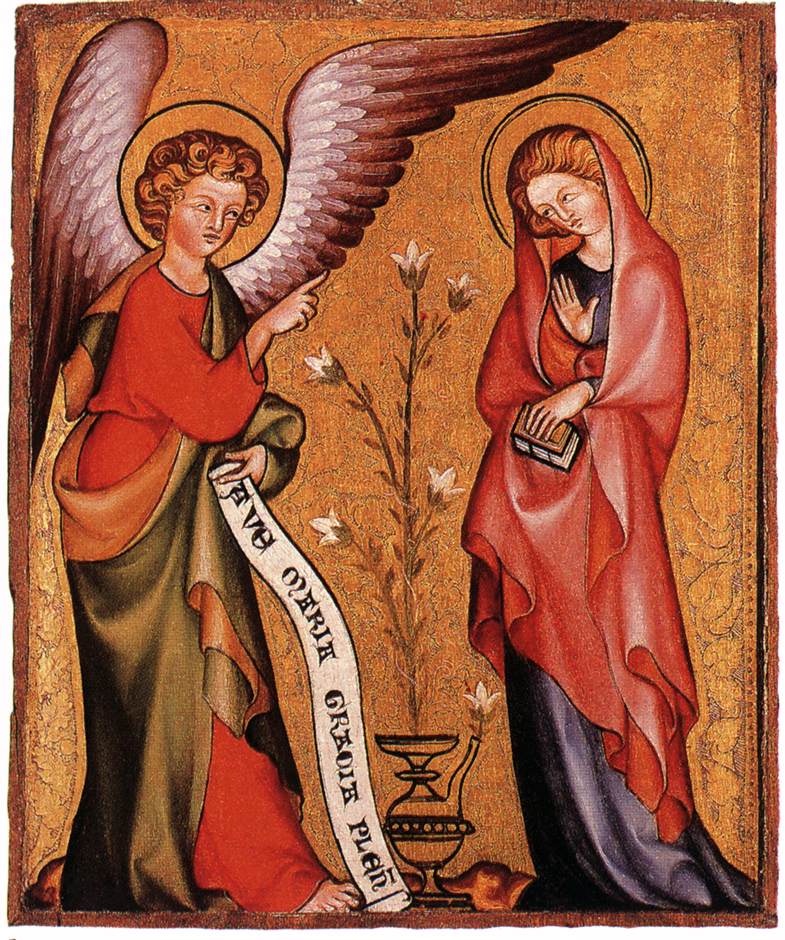
                                              
Announciation, unknown German Master, via wiki commons


The Announcaition again, this time we see all elements traditionally depicted in announciations, but this time the book is  not opened, but text is written on the banner held by the archangel.("Hail Mary, full of grace"). this banner as a speech bubble appears often.Wallraf Richttarzt Museum Cologne. Mary with a book again, it has significance, depends if closed or open, etc. Soon about Mary and book symbolism, an elaboration on this  important element of  iconography.

Altdorfer, Virgin Mary with Child, XIV.c via wiki commoms
Virgin Mary as queen, with infant Jesus in her arms, by Altdorfer, (German), museum in Budapest.Infant Jesus has a necklace symbolzsing his future Passion and death on the cross (coral ) which in secular symbolism and superstition of the days: it  was supposed to avert evil. The apple is relating to original sin, held by Jesus is a symbol of redemption, eradication of sin.
Death of the Virgin, by Konrad von Soest, Mary on her death bed attended by humans of saintly and common stature, and by angels themselves. We see richly embroidered blue mantle and blue angels, as the symbols of heavenly realm.Also prominent is red/blue color duo, gold background. Closed books also present, symbol of the Virgin. What is written on the open scroll, which is read by bearded man dressed in red, with his head covered as sign of respect and humility? The paleographers would tell. The saint whose hand holding quill  is almost touching Virgin's hand is, has "Saint John the Apostle" written on his hallo.

Death of Mary by Konrad von Soest, via wiki coomons


Monday, August 6, 2012

Mary Magdalene: Blue Color of Her Robes and Art Historians

 Here we have Lamentation by Petrus Christus from Royal Museum of Art in Brussels. Can you recognize who is who among both Marys? Both have blue robes. Mary, the mother of Jesus is depicted as fainting, her body lifted up by two people. Common depiction, Mary fainting at the lamentation scenes. Is one of the people attending her the Mary Magdalene because she has red dress? Well... no. Color symbolism was common, but not set in stone, there was nothing very dogmatic about it. Please, click on "Mary Magdalene robes"  among the labels/links at the bottom of this post, you can read posts about the other colors.

Lamentation by Petrus Christus, via Wiki commons, click on the picture to view it larger


 But where is Mary Magdalene in this painting? You can recognize her by one of her attributes: the skull. She is the one turned toward the cross and the skull. Ointment jar is another attribute, not in this painting, the cup behind her is the cup for throwing dice, as dice are one of the symbols of Christ's passion. Both Marys are in blue, which was for sure costly, ultramarine was the most expensive of pigments. Both are made clear who they are, made recognizable: one by the pose, another one by her attribute. The viewers of those days knew how both were depicted, today those things are more confusing, as people have less familiarity with iconography.

This example of using so much blue is rather unusual for Petrus Christus himself. He most often used red for Virgin Mary's robes, as was common in the Northern painting. Blue was more common in France. This is of course rough division, the geography, but this is a  more factual explanation to clarify this red and blue vision, than color coding Virgin Mary and Magdalene rigidly.


Rather dogmatic is thinking in red and blue, which sometimes happens today, as art historians and art history buffs say. This means the idiosyncratic idea that Mary the mother of Jesus was depicted only in blue robes, and Mary Magdalene was depicted only in red robes. Luckily the Old Masters where not as limited, or as color blind.But some art historians complain that it is difficult for some people to understand this fact, and even those people will rather aggressively defend their pet idea, in spite the fact that their knowledge is limited.Why is it, and why some people are so fiercely attached to this specific color combination, is a mystery for me. As one art historian said, the subject of the robes of those two venerated quickly reveals how much someone knows, or rather how much someone doesn't knows about art history.

Art historians are not as ignorant as they often gladly represented as: most important, they see a lot of art; when I took history of art on the exam we had c. 600 slides,which were part of the test in the introductory course only, later things were more complicated. Art history classes were compulsory for my degree. I had strong interest in art history quite early, started when I was 13 year sold, so I didn't struggle, but for those people in general who learn art history as elective, mostly it it not an easy A class. It depends on university and who teaches the class, but in general challenges are there, if you want an A, better work hard, as it is not hobby level art history.  

Art historians are very involved in general: they travel if needed, study artists' historical contracts by the patrons and artists, write books, keep current with current research. So, why this need to tell art historians they are so wrong, and specially by people whose knowledge belongs to the limitations of a hobby? Mystery, mystery...


Tuesday, April 3, 2012

Red: Mary Magdalene's Case:Medieval Art, History of Color # 7

Mary Magdalene wasn't depicted only in red though history, as Virgin Mary wasn't depicted in blue only. But let take a look at the red, as both Marys were depicted in red garments. For example the red of the robes of Mary Magdalene had a different, double symbolism, than for example red of other persons' cloaks. Mary Magdalene's robes were painted in cinnabar red, (vermillion), having more hint of orange. Red in general can tend toward more to direction of yellow, or blue, and during the Middle Ages the quality of red was important, which red was symbolizing which idea. The other red symbolized regal values and charity.

 Here comes Crucifixion by Juan Rexach from Northon Simon Museum, Los Angeles. Due to poor lighting conditions the color of Mary Magdalene robes not very accurate on this photograph, in person is like on the photo bellow.

 Crucifixtion by Jaun Rexach, Norton Simon Museum Los Angeles


Here you can see desctiption and a better quality photo 
You can zoom into, and see very well the specific color of Mary Magdalene's garment.

Crucifixion by Masaccio, Museo di Capodimonte, Naples,public domain,  via Wikimedia Commons
 
 I am glad that Maria Rzepinska wisely comments is her book about color that red in Middle Ages was not just red, but it had two aspects. Red was one color in which case people paid attention to its shade, shades had codified meaning. Two types of red were differentiated: the noble one, considered sublimed, and the earthly one, viewed as "sinful". Several examples of this red can be seen close to my living place in California: Norton Simon Museum and  the Huntington Library art collection.But today Massacio, as more widely known.

In general, red stood for love in sense of charity, blood of martyrs, sacrifice on the cross, redemption through crucifixion. But as it could be a color of love in spiritual sense, redemption, also when in specific tone, could symbolize sin, or lust, or both: redemption form sin.This dichotomy is visible in portrayals of Virgin Mary as the sinless one who is represented in another red than Mary  Magdalene  ( dressed in "sinful" red). A medieval painted wouldn't confuse those two reds.


We need to remember that color in medieval art isn't always symbolic: sometimes just the need of decorative usage of color was important. In Latin Christianity (Byzantium was another case) the robes of such a person as Virgin Mary wouldn't have been painted in the same as red of Mary Magdalene's.

Above the crucifixion scene by Masaccio, Mary Magdalene in dramatic gesture of devotion and anguish dressed in red so typical for her. Although there are quite a number of representations of Mary Magdalene in this type of red, specially at crucifixion, this one is probably the most famous one. It is still very medieval. But there are hints of coming of the new era: the Renaissance in Italian art,there are more of human emotions shown. Gothic was very emotional in other countries, (for example showing suffering of Jesus),  but art in Italy was more reserved, making more usage of  Byzantine ideals.

 All  older medieval representations of crucifixion in Latin Christianity would show Jesus fully dressed, each foot nailed separately, and no signs of his suffering. With the passing of time Jesus became more humanized, specially in the art of Northern and Central Europe. The body was more and more exposed, agony and blood shown, feet nailed together. For example in German art Jesus was shown with great attention to expression. From Jesus as a symbol there was a shift  toward showing Jesus as a human being.

What about Masaccio himself? His name was Tommaso di Ser Giovanni di Simone. He died when he was only 27 years old, and he wasn't as famous as the other painters of his times. Even his name was a humorous take on his given name. Masaccio, as he is known even today, is a form from Tom, meaning "clumsy" Tom, as separated form his collaborator Masolino,  the "delicate " Tom.

Yet Masaccio influenced the other Italian artists. It was his example which caused a shift in art:  more and more toward realistic representations of the world around. Here we see a paintings which is still medieval: composition, golden background.  But carved into the golden background humans who were much more real, not idealized, captured in a moment of strong emotion. Figures are real, not ideal.

Other colors of Mary Magdalne's robes in another post, more colors.
And my post about Mary Magdalene depicted in blue click here

Byzantine Christianity depicted her also in red,  with an egg in her hand. In this tradition she was an extremely virtuous woman in similar age of Jesus's mother, and both women died in Ephesus. Mary Magdalene's body was was kept in Constantinople as a very venerated relic. This dissapeared still during the Middle Ages, but also later her relics started to be venerated in Western Europe, Latin Christianity. Relics were hot commodity then, and many stolen from the Churches in Constantinople in 1204 when crusaders sacked and looted this cultured city. Virgin Mary's house is believed still to be there, what was one part of the Byzantine Empire, among ancient ruins of Ephesus, today in Turkey, in a rather remote location but among the most wonderful ruins.