Showing posts with label healing. Show all posts

Tuesday, July 16, 2013

Divine Mothers, part 2: Miraculous Icons and icon kissing

For those of you on whose devices is empty space instead of link to you tube video, click here and you will get there
 
Chant in praise of Virgin,sung  by  Orthodox monks.
Written by St Nectarios of Egina, an Orthodox saint considered 
miracle worker himself here you have translation of words

Talk about divine mothers wouldn't be complete without mentioning Orthodox icons, specially those which were and are believed to be working miracles. So many of  icons represent Virgin Mary, called Theotokos,  with baby Jesus, that this fact amazes how much respect was, and is, given to the idea of motherhood set in most sublime concepts of faith. Theotokos is translated in a simplified way as Mother of God, but exact meaning is "the birth giver to god." 
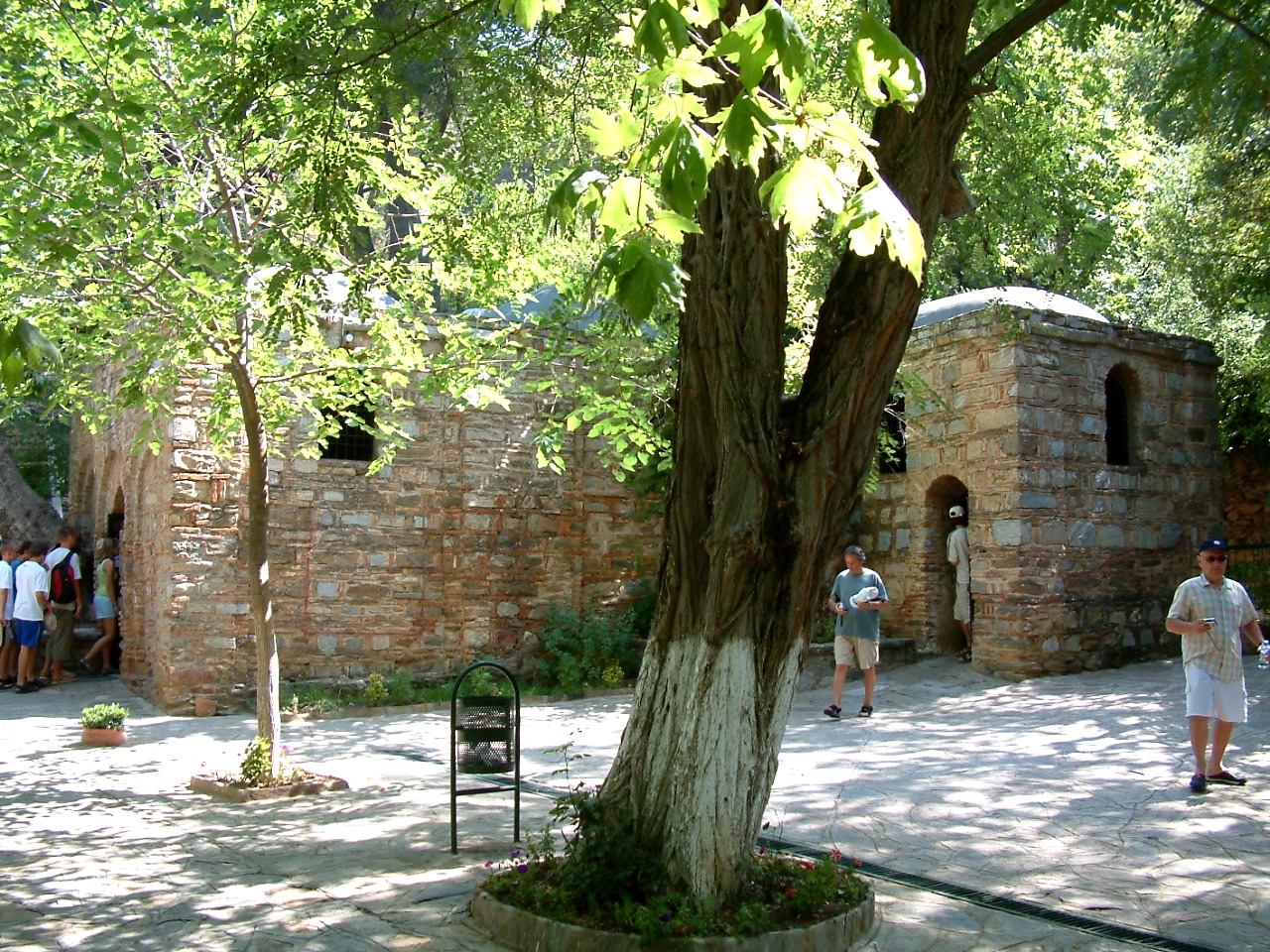
Her cult first developed in Epheus, today Turkey, where according to Eastern tradition she lived with John the Evangelist and Mary Magdalene who retired there after life of preaching, and they were visited by Paul. My apology to those of you who are St Baume Mary Magdalene enthusiasts. St Baume is a wonderful place, but I need to mention Mary Magdalene in Ephesus, as this version  is so ancient, I will do no justice to it by silence. On the left is the picture of house known today as Mary's House, where it is believed that Theotokos lived. According to tradition she was preaching and teaching people about art of healing.There is also a sacred springs which water is supposed to have healing qualities: spring of love, health and happiness. Thanks Radomil for the picture. Ephesus was also the place of the council where the dogma of divine motherhood of Virgin Mary was pronounced. There is also oral tradition in a about Mary's presence there, held by Orthodox Christian village.

As for icons:  those are not considered ordinary images, they are windows to the divine. For Orthodox Christians are presence of the sacred in this world. So, if the icon represents a given saint, this saint presence it there. The icon is treated with respect, can be touched and is kissed in love and honor, and given votive offerings after a performed miracle.

Our lady Vladimirskaya, patron protector of Russia, Eleusa type icon. The star patterns on her moforion  symbolize her VirginityThis icon is damaged, but there is strong sense of radiance.
Kissing in Eastern tradition was a very important gesture, honorific kissing included, it meaning was quite broad, which kissing the icons also includes.Western culture is only intimate sign of affection, of friendliness when the French kiss the cheeks to say hello, kisses between parents and children, and of course between lovers.In earlier days there was a lot of kissing, including kissing women on hand as sign of honor.It is still practiced in Poland and Vienna, the yearly opera event. 

In Biblical times there were kisses between men, family members who were loved, abut also between friends, or people were kissed out of respect. For ex. kissing someones feet was a sign of very strong reverence an honor.. The same in Jesus times. Christian kiss of peace is one example. Also in Greek there were three words expressing love: eros, filos, agape. Eros is erotic love, filos is friendship as love, agape is often translated as charity, but mean unconditional love, the spiritual kind, love as the essence of the divine, love totally selfless. For example the part in New Testament, where Jesus ask Peter "do you love me more than those,"and here he was referring to his disciples. I was introduced to it by someone who studied Koine Greek,  what is translated in English is love, but in Greek there are two words in questions and answers used: filos and agape. As you probably guess, the Theotokos as a mother is also example of such divine, all surpassing unconditional love.

It is an important distinction between kinds of love, and  it got somehow lost, as the distinction between kisses got lost. In the New Testament at the supper in a house of a Pharisee Jesus defended the woman who washed and anointed and kissed his feet (in Orthodox tradition it wasn't Mary Magdalene) and said: "you gave me no kiss," and praised how she showered his feet with kisses and she will be remembered. This was expression of highest reverence, and the Orthodox Christians remember that. But see by yourself not in my words, why Orthodox Christians kiss icons.

But certain  icons are not to available for kissing. Those are the miracle working icons set higher in the altar. 
The icon above is Eluesa type of Madonna, (Our Lady Valdimirskaya, today in Tretakov Gallery). Those graceful depictions are called Virgin of Tender Mercy, of Virgin Showing Mercy, also found in the West. Virgin's and baby Jesus' cheeks touch, or almost touch. Those human gestures of affection are very charming, and here is a small list of miraculous icons in this Eluesa type .

One of miracle icons is the Black Madonna of Czestochowa, this one is not an Eeleusa, but Hedegetria, The Guide as iconograhic type.  Hedegetria, called also Madonna Showing the Way, as gestures with her hand toward  baby Jesus. This is the oldest and the most common stylistic type.
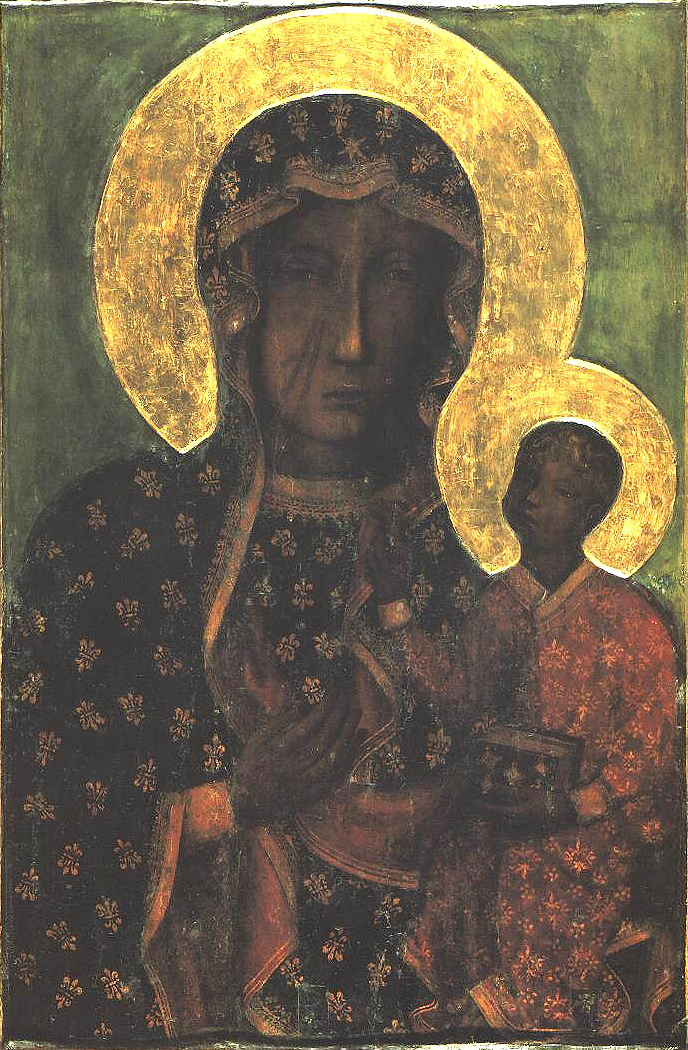
Black Madonna of Czestochowa, Byzantine origin icon of Hedegetria type

The Black Madonna of Czestochowa is the regal powerful mother, who is believed to heal you when you ask for it. Many of us remember from childhood when something hurt, like for example got a bruise from falling off kick scooter, the mother kissed the bruise and felt so much better. This is not to introduce banality in the reverence of miraculous icons, it is just for reminding that the veneration also includes tender feelings which relate to very basic human experiences. Basic, not base. 

She was crowned Queen of Poland. On the walls of the sanctuary there are votive offerings, as thanks from the donors for the miracles of healing: pieces of jewelery, pieces of silver in shapes of parts of human body, also you will see some real life crutches. 

The Black Madonna is viewed as powerful protectress. The icon is of Byzantine origin, showing Italianate influences. The legend says it was painted by St Luke himself on the table from the form  Virgin Mary's own household. It is one of several icons allegedly painted by St Luke. The pattern on Virgin's robes is fleur-de-lis.  There is over 130 iconographical types of depicting Virgin Mary on icons, this one is among the regal type images.

 Those Theotokos were shown like aristocrats of Byzantine imperial court. But the icon painting, or icon-type of style wasn't limited to the areas we today associate with icons: Italy had those too. Bellow  Hedegetria by Giotto. The stripes of fabric angels wear over their robes belong to a traditional fashion of imperial court in Constantinople. Even the Eleusa type has Byzantine moforion

A very imperial looking Theotokos by Giotto
Eastern Orthodox faith didn't develop Mariology as did the Latin Church, but the devotion to Theotokos was  given, even not much disputed in theological manner. The idea that Virgin Mary was elevated above any created being found its expersion  in showing her with as much dignity as depicting a powerful empress.

Wednesday, April 25, 2012

Templar Legends in Poland, part 2

Today about Templars who are remembered as good or neutral, not as crusaders only.

One type of legend talks about a wounded Templar. As an example: the tale  about a Knight Templar who was wounded, and not able to take part in a crusade to the Holy Land. Hi restored his own health after some time, as he was very knowledgeable about medicinal herbs. He lived as a hermit on an island on the lake, with only a white raven and a white dove as his companions. He worked as a healer, helping greatly the local population, giving them potions and herbs. When he was walking in search of medicinal plants, the white raven and the withe dove where always with him. They even where his  helpers, did their part whispering into his ear to diagnosed illnesses. This legend fits very much the category of legends about hermit Christian healers, with some supernatural mixed in. Maybe there was really a Templar who was very skilled at healing living a secluded life, and the collective memory about this particular person got clustered with the Hermit-type of legend, or the Wounded-Healer- type of legend.


Chant of Templars Pacem Domine

Another story is about a Templar as a victim. After a battle a wounded Templar was lying on the battle field, suffering terribly, his death was approaching slowly. One man came,  looked at the suffering Templar, and didn't help him at all, as what he set his greedy eyes on Templar's armor. The man was just so tempted to get the armor that he was staying close, waiting for the Templar to die. After the knight died, and his body wasn't even cold, the man took the armor and tried it on. It fitted! He was so happy! His happiness was not of the long living kind, and he wasn't living long either. After a while, when Templar's corpse was still warm, the armor started to burn and squeeze his body, and he tried to take it off quickly but he couldn't. He died in the stolen armor. Often among the hills there appear the ghost of the Templar and the ghost of the man who stole the armor, and they fight.

This legend is a moral tale for the purpose of teaching about the social mores, about the virtue of being a good Samaritan. But mostly it served in the reinforcing the taboo against the desecration of dead bodies. All dead people were supposed to get a decent burial; it was expected from Christians to fulfill such last duty. Taking something from a dead person very personal belongings was part of desecrating the corpse. In folk mentality if someone trespassed taboo, this person died.

Another story about the Knights Templars is that a fleet of Templar's ships came from the Baltic Sea, at the times of the Templars' troubles in France. Those ships were entering the Vistula River and were going upward the stream, and lowered their anchors at a specific town. There is also French legend about the fleet of Templar ships, carrying the Templar treasure, leaving the port of Marseilles when the king who was heavily in debt with them started to persecute them. There are of course also Polish legends about the treasure. Some are also very detailed, mentioning names of people and places, starting with: "When the king of Franks, le Bel heard that Templars escaped with their treasure to the town such-and-such, he did send some of his spies and knights to get it.” And so on, and so on. Actually the name of Phillip IV, who persecuted Templars, was in French Phillip le Bel. Are the accurate historical names inserted it the legends the proof of the veracity of the legend itself? Not necessarily. The treasure's story next time.

Friday, April 6, 2012

Oral tradition. Folk Stories Geneis and Finding Sacred Art

 I wrote before that during middle Ages some ideas took lives on their own (proto- sciences). Today I will talk about folklore.

There is folk current in European Christianity, for example the  folk Catholicism. Secular or pagan  stories which were liked were appropriated, so, the Christian/religious current and the pagan/secular one created very interesting stream.

One  story is form Ukraine, and Belarus,( if I am right), and it is about a bird: the raven. It tells that "the raven’s plumage was very colorful as a rainbow, and even was radiating rays. Raven was a true bird of Paradise." When the paradise was no more, the land become barren, and the raven become black. But his plumage will be back in its full glory the moment the Paradise is back on Earth. Medieval art represented Paradise as radiant and colorful, cathedrals and basilicas were earthly representations of ideal of Paradise.

Other legends relate to concrete objects,  art which were found and installed in local churches and enjoyed special devotion. Typical motive: the sculpture, for ex. a Black Madonna, or an  icon was lost during turmoil, than was found in a miraculous way. Or even appeared in a miraculous way from the beginning, without being lost. The finders were the animals, such as cattle, or an owl, or a sheep. It appears to me that the animals are the most frequent finders of religious art, but I am not a folklorist, and those are just my original studies. My formal studies in this subject are limited, were part of my anthropology class, and dealt with the subject of art objects which were subject of veneration in Catholicism, and especially those relating to healing. I don't claim special knowledge here, (reading and listening stories passed as part of living oral tradition).

Sometimes instead of the animals young children are the finders.find the art taken then to the local church, or a blind woman. The story about the blind woman whose blindness was healed when she stood in the river and the crucifix was floating on the water, the Jesus on the crucifix talked to her and she was healed. It relates to one small village in Poznan region, Poland. This particular story has variants, including the treasure which was dug up by the oxen. The finders are somehow innocent, or under-priviledged. Those stories represent the idea that the divine is very accessible, and approachable through intuition, no special intellectual training is needed.

But lets go back to the story about the blind women. When the women was told by Jesus on the crucifix he wanted to stay at the local church (common motive, the holy one depicted decides on location where he/she wants to stay). The crucifix was pulled out of the river and put on a cart which was supposed to be pulled by oxen. But the load became so heavy, the oxen couldn't pull the cart even a a single step forward. They just were stepping in place. They tried and tried, but couldn't move, were just digging deeper and deeper into the soil. And this is how the oxen dug up the chest with golden treasure, from which the money was spend for renovation of the church. The chest is still exhibited in the church; the crucifix itself is in Gothic style, dated by art historians as created during early 15 c. The church itself became a local pilgrimage site. The crucifix was moved to other churches, richer and more impressive.The crucifix appeared in a miraculous way back in its humble church which was chosen at the beginning. This is also common: the artifact wants to stay in one and only place. But always I didn't visit this place, I didn't see the crucifix and the chest, but I listen to the story told by very old people. Maybe one day, I will visit this place too.