Showing posts with label medieval art. Show all posts

Tuesday, July 16, 2013

Divine Mothers, part 2: Miraculous Icons and icon kissing

For those of you on whose devices is empty space instead of link to you tube video, click here and you will get there
 
Chant in praise of Virgin,sung  by  Orthodox monks.
Written by St Nectarios of Egina, an Orthodox saint considered 
miracle worker himself here you have translation of words

Talk about divine mothers wouldn't be complete without mentioning Orthodox icons, specially those which were and are believed to be working miracles. So many of  icons represent Virgin Mary, called Theotokos,  with baby Jesus, that this fact amazes how much respect was, and is, given to the idea of motherhood set in most sublime concepts of faith. Theotokos is translated in a simplified way as Mother of God, but exact meaning is "the birth giver to god." 
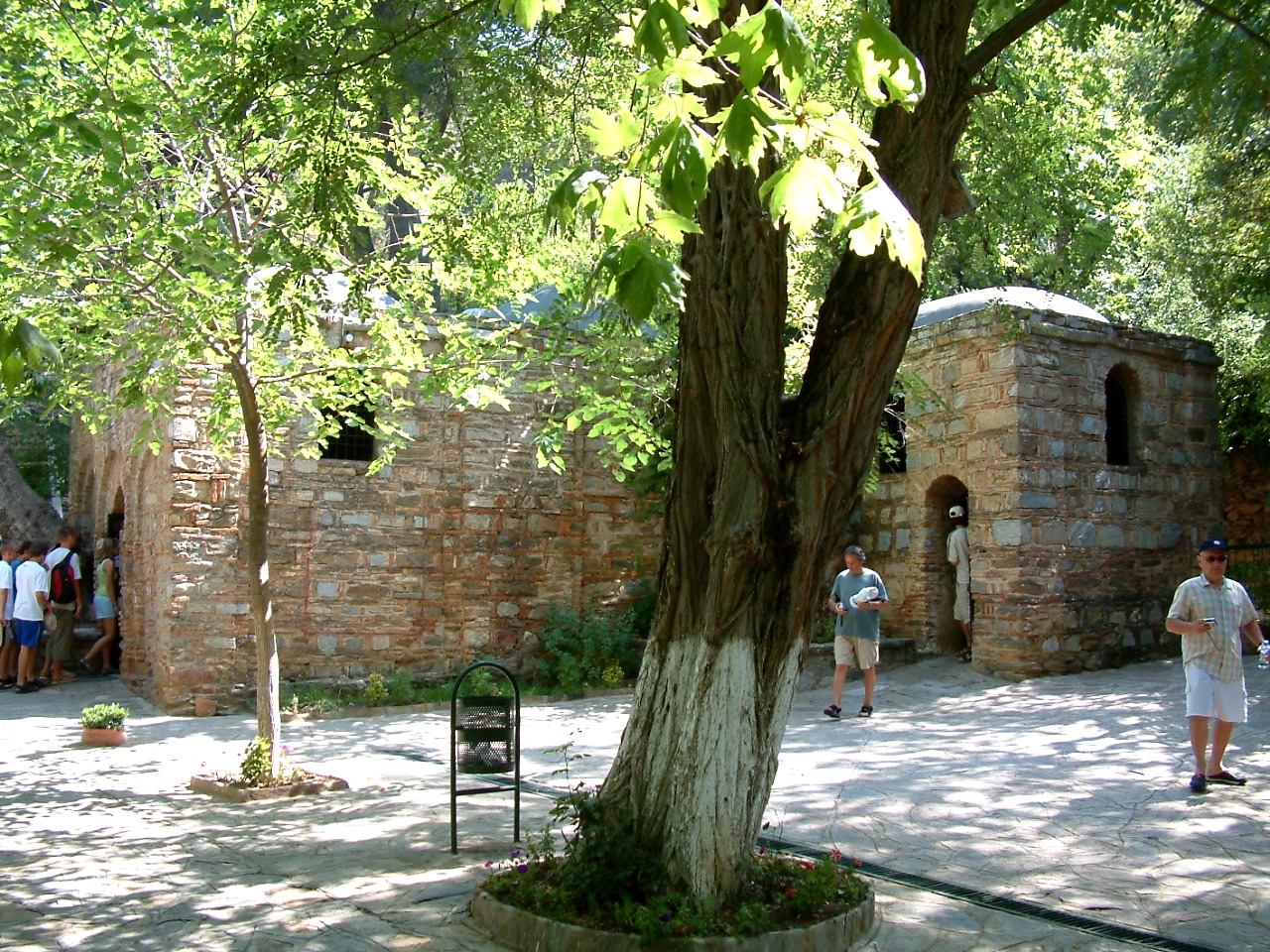
Her cult first developed in Epheus, today Turkey, where according to Eastern tradition she lived with John the Evangelist and Mary Magdalene who retired there after life of preaching, and they were visited by Paul. My apology to those of you who are St Baume Mary Magdalene enthusiasts. St Baume is a wonderful place, but I need to mention Mary Magdalene in Ephesus, as this version  is so ancient, I will do no justice to it by silence. On the left is the picture of house known today as Mary's House, where it is believed that Theotokos lived. According to tradition she was preaching and teaching people about art of healing.There is also a sacred springs which water is supposed to have healing qualities: spring of love, health and happiness. Thanks Radomil for the picture. Ephesus was also the place of the council where the dogma of divine motherhood of Virgin Mary was pronounced. There is also oral tradition in a about Mary's presence there, held by Orthodox Christian village.

As for icons:  those are not considered ordinary images, they are windows to the divine. For Orthodox Christians are presence of the sacred in this world. So, if the icon represents a given saint, this saint presence it there. The icon is treated with respect, can be touched and is kissed in love and honor, and given votive offerings after a performed miracle.

Our lady Vladimirskaya, patron protector of Russia, Eleusa type icon. The star patterns on her moforion  symbolize her VirginityThis icon is damaged, but there is strong sense of radiance.
Kissing in Eastern tradition was a very important gesture, honorific kissing included, it meaning was quite broad, which kissing the icons also includes.Western culture is only intimate sign of affection, of friendliness when the French kiss the cheeks to say hello, kisses between parents and children, and of course between lovers.In earlier days there was a lot of kissing, including kissing women on hand as sign of honor.It is still practiced in Poland and Vienna, the yearly opera event. 

In Biblical times there were kisses between men, family members who were loved, abut also between friends, or people were kissed out of respect. For ex. kissing someones feet was a sign of very strong reverence an honor.. The same in Jesus times. Christian kiss of peace is one example. Also in Greek there were three words expressing love: eros, filos, agape. Eros is erotic love, filos is friendship as love, agape is often translated as charity, but mean unconditional love, the spiritual kind, love as the essence of the divine, love totally selfless. For example the part in New Testament, where Jesus ask Peter "do you love me more than those,"and here he was referring to his disciples. I was introduced to it by someone who studied Koine Greek,  what is translated in English is love, but in Greek there are two words in questions and answers used: filos and agape. As you probably guess, the Theotokos as a mother is also example of such divine, all surpassing unconditional love.

It is an important distinction between kinds of love, and  it got somehow lost, as the distinction between kisses got lost. In the New Testament at the supper in a house of a Pharisee Jesus defended the woman who washed and anointed and kissed his feet (in Orthodox tradition it wasn't Mary Magdalene) and said: "you gave me no kiss," and praised how she showered his feet with kisses and she will be remembered. This was expression of highest reverence, and the Orthodox Christians remember that. But see by yourself not in my words, why Orthodox Christians kiss icons.

But certain  icons are not to available for kissing. Those are the miracle working icons set higher in the altar. 
The icon above is Eluesa type of Madonna, (Our Lady Valdimirskaya, today in Tretakov Gallery). Those graceful depictions are called Virgin of Tender Mercy, of Virgin Showing Mercy, also found in the West. Virgin's and baby Jesus' cheeks touch, or almost touch. Those human gestures of affection are very charming, and here is a small list of miraculous icons in this Eluesa type .

One of miracle icons is the Black Madonna of Czestochowa, this one is not an Eeleusa, but Hedegetria, The Guide as iconograhic type.  Hedegetria, called also Madonna Showing the Way, as gestures with her hand toward  baby Jesus. This is the oldest and the most common stylistic type.
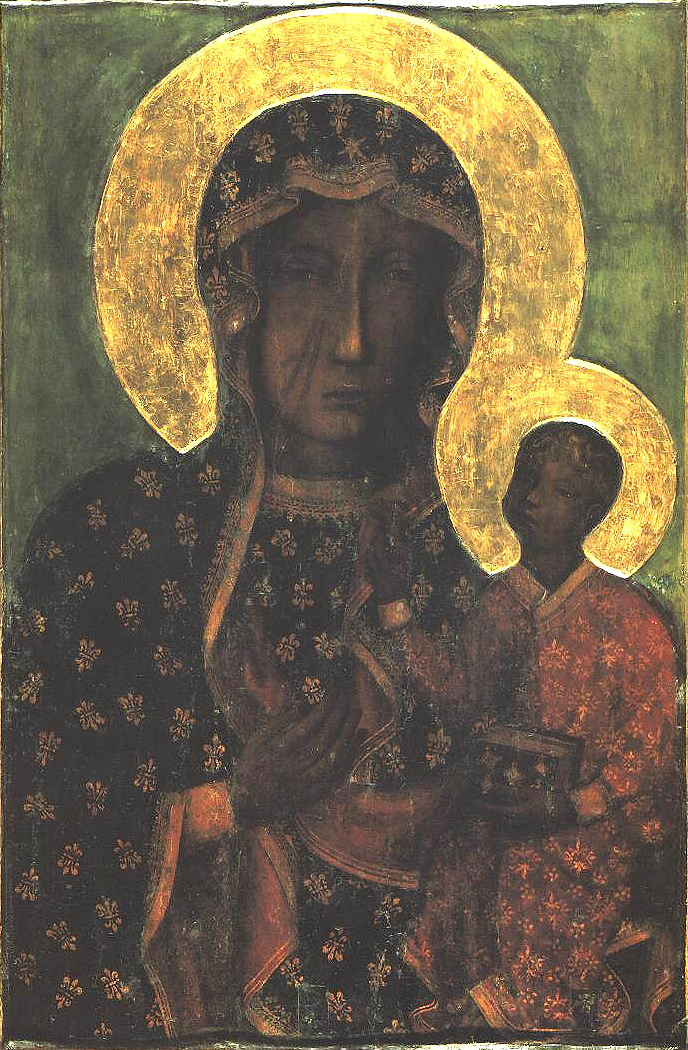
Black Madonna of Czestochowa, Byzantine origin icon of Hedegetria type

The Black Madonna of Czestochowa is the regal powerful mother, who is believed to heal you when you ask for it. Many of us remember from childhood when something hurt, like for example got a bruise from falling off kick scooter, the mother kissed the bruise and felt so much better. This is not to introduce banality in the reverence of miraculous icons, it is just for reminding that the veneration also includes tender feelings which relate to very basic human experiences. Basic, not base. 

She was crowned Queen of Poland. On the walls of the sanctuary there are votive offerings, as thanks from the donors for the miracles of healing: pieces of jewelery, pieces of silver in shapes of parts of human body, also you will see some real life crutches. 

The Black Madonna is viewed as powerful protectress. The icon is of Byzantine origin, showing Italianate influences. The legend says it was painted by St Luke himself on the table from the form  Virgin Mary's own household. It is one of several icons allegedly painted by St Luke. The pattern on Virgin's robes is fleur-de-lis.  There is over 130 iconographical types of depicting Virgin Mary on icons, this one is among the regal type images.

 Those Theotokos were shown like aristocrats of Byzantine imperial court. But the icon painting, or icon-type of style wasn't limited to the areas we today associate with icons: Italy had those too. Bellow  Hedegetria by Giotto. The stripes of fabric angels wear over their robes belong to a traditional fashion of imperial court in Constantinople. Even the Eleusa type has Byzantine moforion

A very imperial looking Theotokos by Giotto
Eastern Orthodox faith didn't develop Mariology as did the Latin Church, but the devotion to Theotokos was  given, even not much disputed in theological manner. The idea that Virgin Mary was elevated above any created being found its expersion  in showing her with as much dignity as depicting a powerful empress.

Monday, July 15, 2013

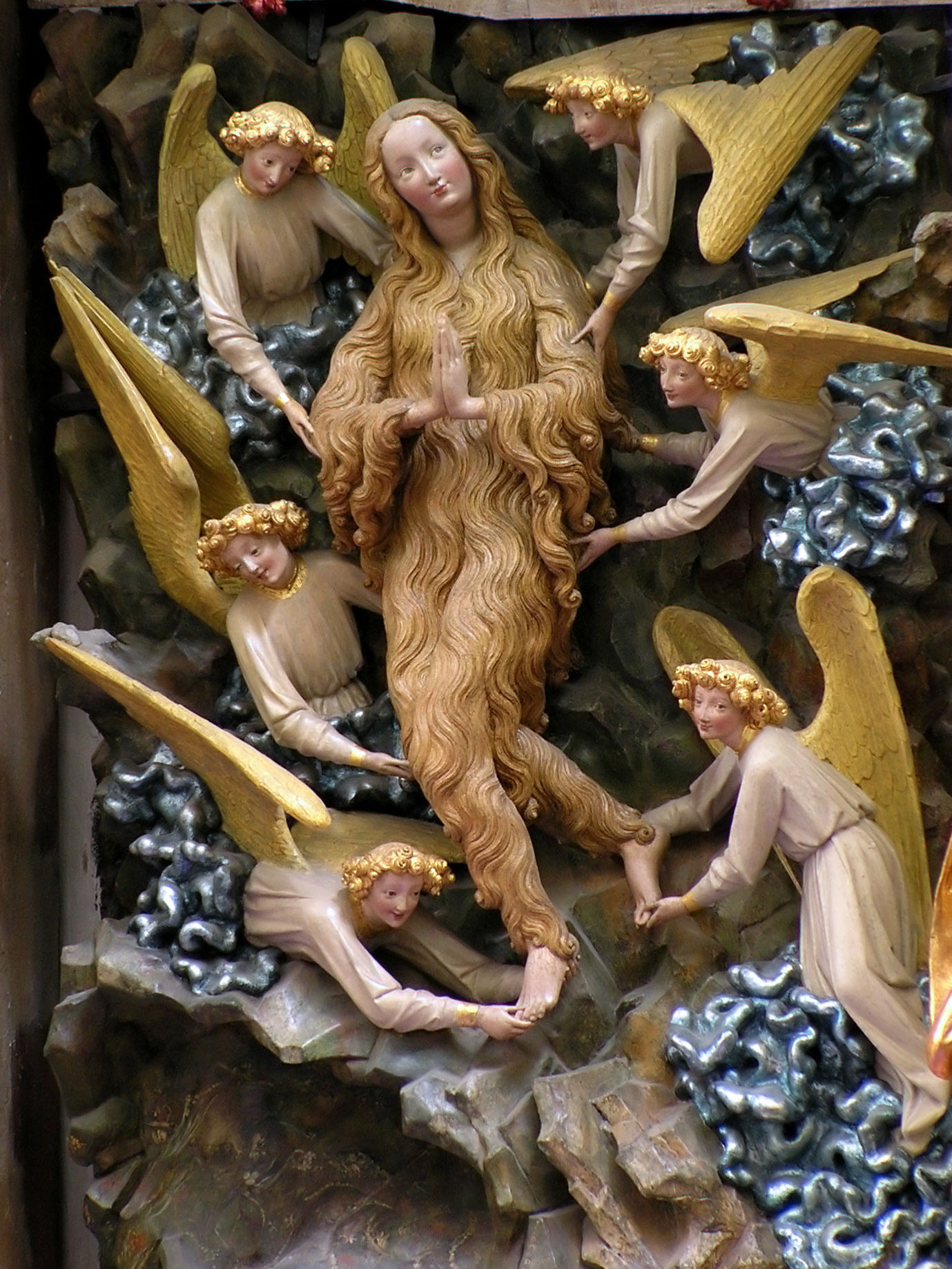
Imagery of Ascention of Mary Magdalene

On this picture, originally from Gdansk today in National Museum in Warsaw National Museum, Warsaw we see ascension of Mary Magdalene. It is one type of many way of representing Mary Magdalene in art, here she is shown as a  saint who meditated so much that she was feed divine food by God himself, according to Medieval accounts. Latin church tradition says  happened seven times daily, angels took her before the throne of god where she was given nourishment.

Assention of Mary Magdalene, tempera on panel, 1430, 71x48in (182.5x122cm)
Very similar in form on canonical depictions of ascension of Virgin Mary. I was writing before that Mary Magdalene was the second most depicted woman in Catholic art, after Mary mother of Jesus. It comes at no surprise that the glorification images, painting or sculptures are often similar. Here we have Mary Magdalene crowned by Gods himself, held in sky by angels.  We know that this is Mary Magdalene because of hairy costume. But Mary Magdalene dressed in more ornate robes is represented also, see my other entries fro examples.

Another depiction of Mary Magdalene's ascension, also form my country, Poland, this time from St John's church in  Torun. I love the charm and joy of this one. And I am so glad that wiki commons has nice pictures, it is often a chore to take a good picture without flash. I never use flash while taking photos of art. As an artist I know that this is bad for the pigments.

Anonmymous artist, Ascension of Mary Magdalene, XIV c.
in Church of Saint John the Baptist and St. Evangelist
This graceful Mary Magdalene is shown as a hermit, but there is nothing austere in the scene. All is charming and lush, full of beatitude. About the austerities reminds her body covered with flowing hair, which is very beautiful, the rocks of the cave and flat belly. Those days a good muffin on the belly was a sign of female beauty, flat belly was indicating that someone hadn't enough to eat. What is beautiful today for us, for people living in times when Gothic art was created such flat belly wasn't beautiful, but it was signifying that the depicted saint wasn't eating much. Some fashion of medieval times is kind of strange for us today, and I think is worth a separate entry.


Illustration from Nurnberg Chronicle, 1491


Here we have a woodcut from Nurnber Chronicle ( via wikicommons, Schedel). Colorful wings of angels, very long robes with lots of draperies which formed angular folds, and round, protruding belly of the female figure was very typical for the art of the days, specially North of Alps.
Here, according to the artist,  we can say the divine nourishment was as filling as earthly food.

Here a few examples of Ascension of Mary Magdalene to browse
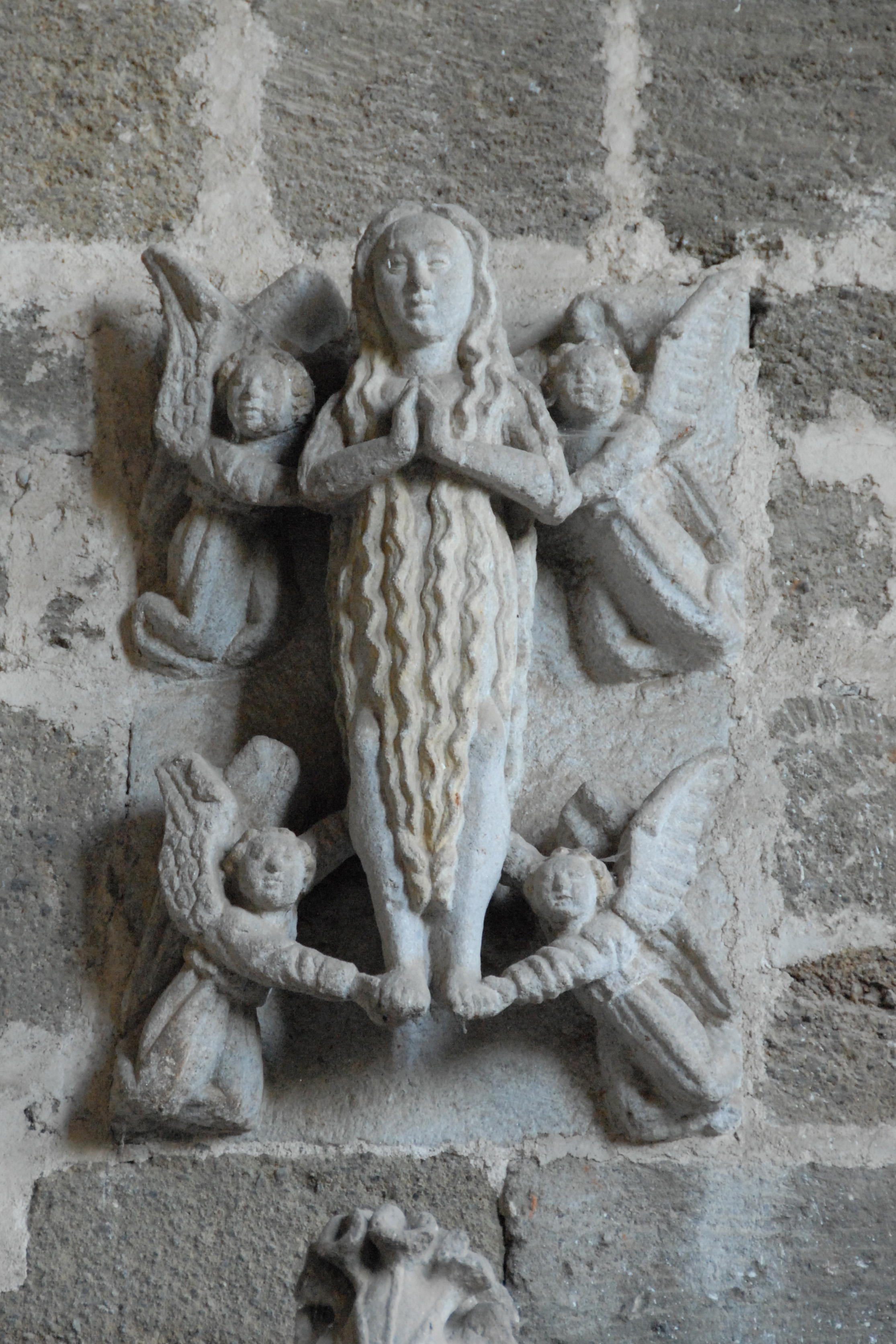
This Mary Magdalene sculpted in stone can be seen in Chanteuges Abbey. Wikipedia articles about this wonderful place are in German and French, so I don't include them here.
But those figures of Mary Magdalene and angles can be found in France, and not only there in various churches or abbeys.
They have their won charm and are of rugged beauty.
Photo by Jochen Jahnke.

Sunday, July 14, 2013

Divine Mothers, part 1: breastfeeding Madonna


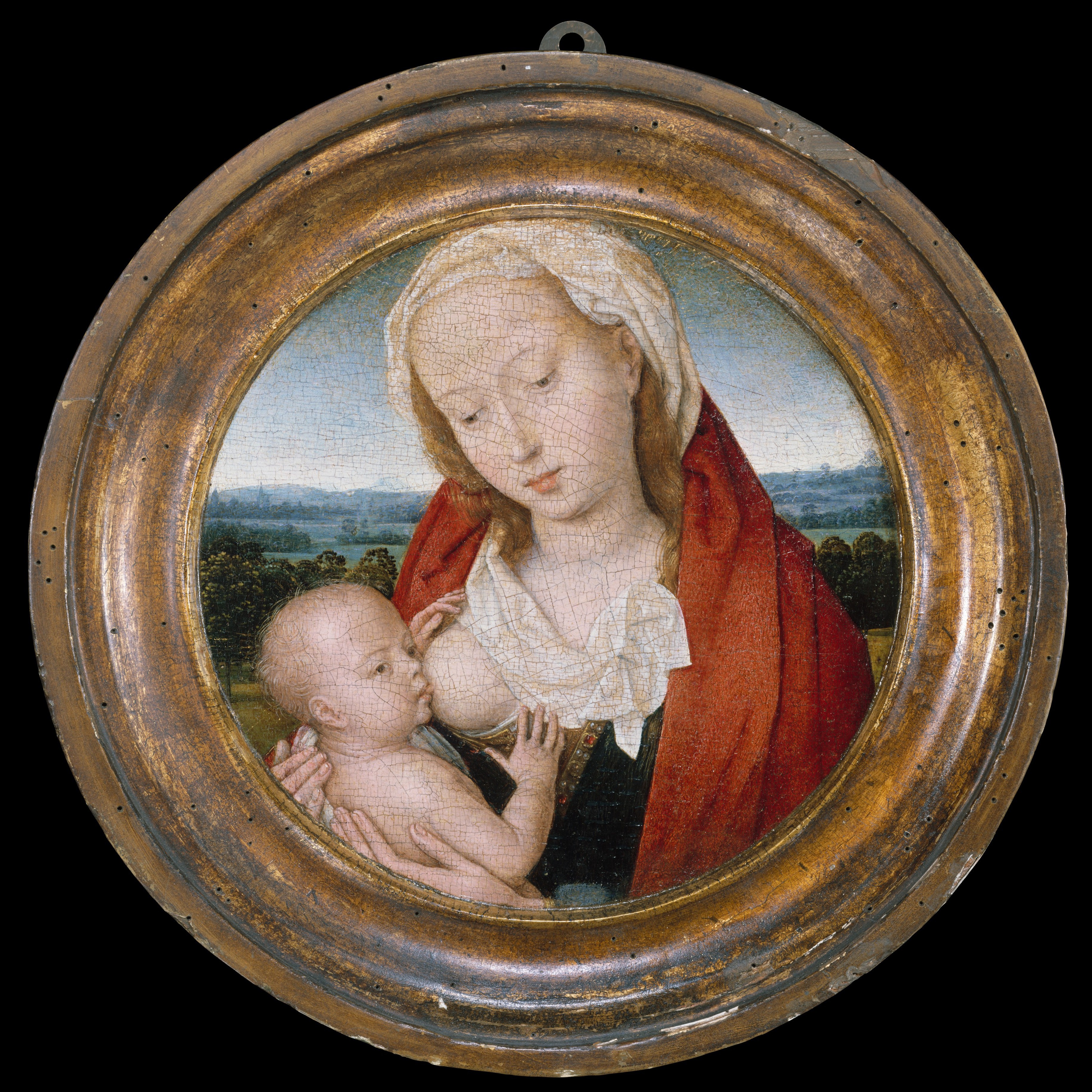
Hans Memling, Nursing Madonna

Today some people are kind of surprised that so many, specially women, like the idea of Mary Magdalene being the wife of Christ and the mother of his children, and talk about her being erased from history.

I am not surprised. In my earlier entry I wrote about how our ideas of Mary Magdalene represent something what is important in our society. Something what is maybe not so clear in our everyday awareness, but many know in some. Let me use that silly word for it: subconscious level.

First, in spite of the technological advances, the world in not becoming more cozy. Many of humans need things mytho-poetic when technology is invading their lives, even when it is to the advantage.We are humans, not cyborgs whose extensions of mind and body are machines. People turned to things mytho-poetic or considered less rational when huge technological advances were made, during the 19th c. and for example 20th century between wars. This trend now isn't new or surprising. It is a natural reaction when people feel that the pendulum went too far in one direction. So, there is a counter movement. It is evoking creative forces of the mind again.People don't want to be cheated out of this important part of human experience, mytho-poetic creativity is part of whole we call a human mind.

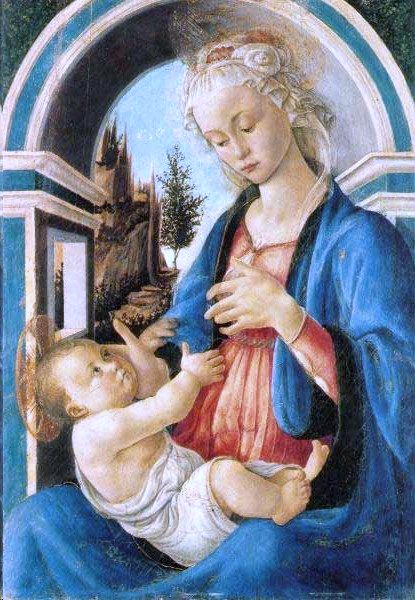
Sandro Botticelli, Madonna with Child, here Virgin Mary in a dress allowing easy nursing
As for Mary Magdalene being a mother and being pushed away: no wonder this idea is popular, lets take a look how we treat motherhood today, what our popular culture reveals, and how motherhood was treated earlier.  This is first entry on the subject of motherhood.First for his entry let consider breast feeding. Talking about things mytho-poetic:  Milky Way according to Greek mythology appeared because of  accidental squirt of Hera's milk while she was nursing Heracles, who as an infant was supposed to acquire god-like qualities by drinking from the breast of the goddess. The word galaxy comes from Greek word for milk.Nice story about milk of the goddess. Today's reality isn't poetic about breast feeding.

This link shows results of study about breast feeding mothers: prejudice. Also those mothers who breast-feed in public have personal stories to tell, how they were treated. Nothing encouraging. There is even a lawyer, a women, who tires to make breast feeding in public illegal. Because it is "disgusting." Not everyone finds it "disgusting," but it is enough for mothers to feel the hostility. Like not everyone is prejudiced against gay people, but enough to create hostile environment. Why so easily labels like "obscene, or"disgusting," "disturbing," are applied to something so positive, psychologically (bonding of mother and child) and what has proven health benefits for the baby?

Gerard David, Nursing Madonna
 Nursing Madonnas as images or part of Marian theology is a very interesting phenomenon. The imagery first appeared in Coptic church of Egypt, the iconography was borrowed from the depictions of Isis nursing Horus. Cultures borrow from each other, as languages borrow words.

Role of Virgin as divine mother was very elevated, she was a co-redeemer of humanity. Some old mystical pictures show her standing at the crucifixion, between her and crucified Jesus stands a chalice to which blood from Jesus' side flows and also milk form Virgin's exposed breast. This was analizsed by art history scholar Anna Boczkowska in her  book Triumph of Luna and Venus, about iconography of Paradise part of the Tryptych Garden of Earthly Delights by Heironymus Bosch.

It was elevation of milk to the same importance as blood of Eucharist, it symbolized grace. Of course this was only on symbolic level, as there was no mixing of milk with wine in ritual of Eucharist.

Milk was a symbol of wisdom, and not just an earthly wisdom. It was a supernatural wisdom of knowledge of things divine, and given as a gift of grace.

Milk was also believed to be transformed from blood, and as such to be part of Eucharist and it took its place in mystical writings. Today those writings maybe not easily understandable for our modern mindset, but people centuries ago understood all metaphors very well. Middle Ages were very poetic, made strong use of symbolic and abstract thinking. 

The type of iconographical depiction of Madonna as nursing mother was common during the Middle Ages, Renaissance and Baroque. Those images often depict  precious moments of human tenderness, but also they elevated motherhood to divine dimensions also. Probably the prototype of nursing Virgin Mary appeared first among Coptic Christians in Egypt, based on imagery of goddess Isis nursing baby Osiris. This doesn't mean that Iis was worshiped under a new name: it is like a new picture was put in an old frame.

 
 This icon of breast feeding Madonna is considered wonder-working in Easter Orthodox faith. It is Galaktotraufusa (Milk Giver) from Mount  Mount Athos Monastery, in Hilandar Monastery, part of Athos complex. It was put there in 13th century, brought here by  Saint Sava of Serbia and installed in iconostasis in an unusual place which was  reserved for icon of Jesus Christ and the Trinity. I have to admit I don't know what happened to this icon. The other icon brought by St Sava, Madonna of Three Hands is supposed to be there, 2004 was a terrible fire in the monastery.

I am not saying that elevating motherhood to such dimensions was all great and sure recipe for making all women happy: childless women suffered, and women conditions were not good in general. But at least mothers' contributions were not taken for granted, or there was an idea that they shouldn't be taken for granted. Motherhood was part of the totality of human experience, and it is, just not enough credit and respect is given to it now.Gender politics is visible in all art history, struggles related to gender continue today.


Francisco de Zurbaran, Holy Family


Ladies, those of you who are or will be mothers, I say: kudos to you for your patience, gentleness, pain, baby fat, hanging breasts, stretch marks. It is not a little thing to be a mother. Milk, pregnancy and labor pains were once revered in mystical writings about experience of the divine. About this another time.

Monday, July 8, 2013

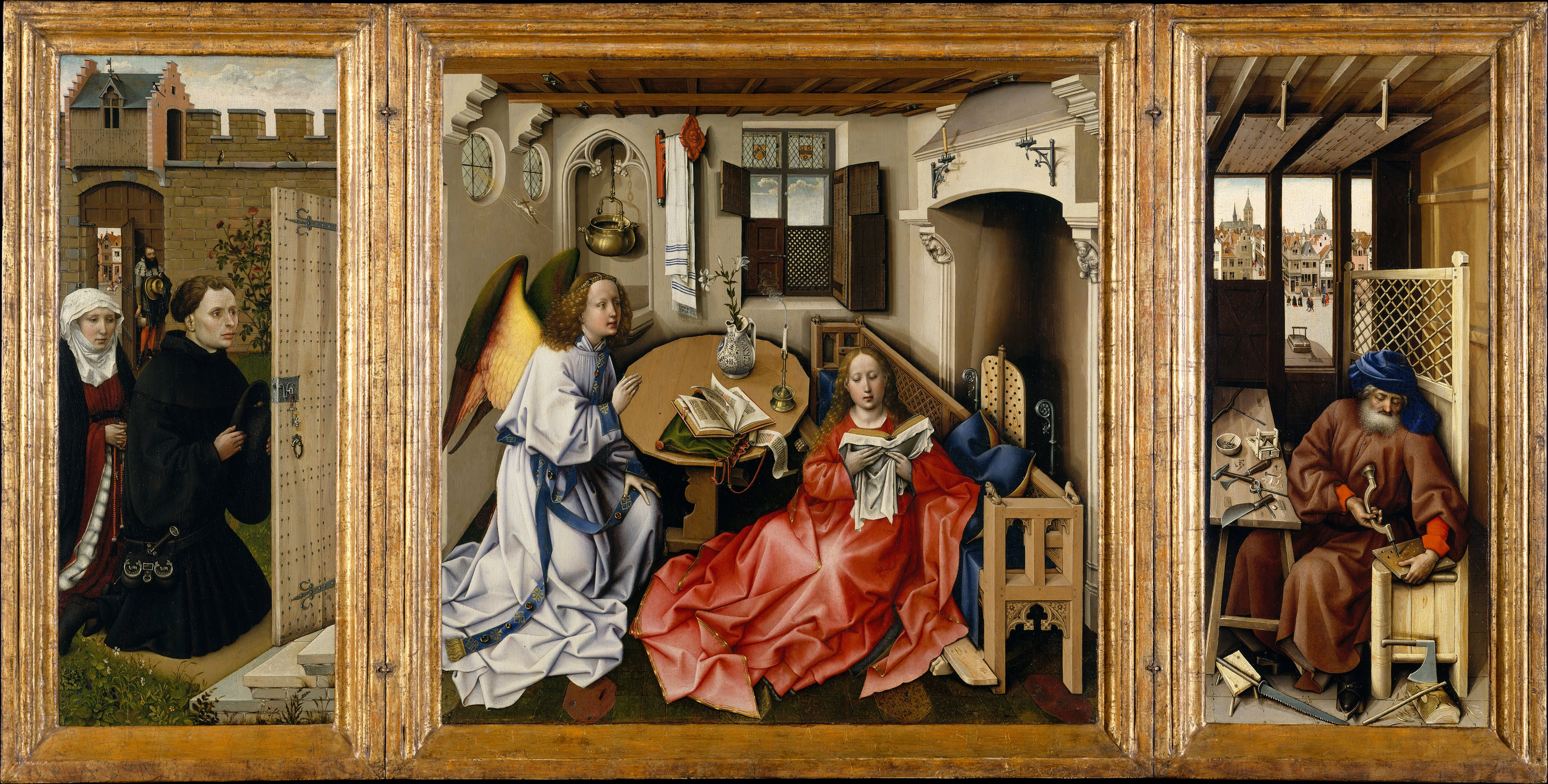
Iconography of Anounciation of Merode Altarpiece by Robert Campin

Robert Campin and apprentice, Annunciation triptych, Merode Altarpiece,  1427-1430 Cloisters, New York

This version of Annunciation is rich in symbolism which was easily understood by average person of the days this altarpiece was commissioned. Today anyone interested can see it at the Cloisters, branch of Metropolitan Museum of Art in New York, but in today's world an average person doesn't understand its symbolism. Usually someone notices what is going on and who is there, as we are trained to understand different type of symbols. This painting belongs to Northern Renaissance but has still many elements of Late Gothic. Click on the picture to see it bigger.

Who is there?  From right to left: Joseph, engaged in wood working in his workshop, secluded an din a different landscape as we see through the window. Virgin Mary, absorbed in reading a book and she is not noticing the Archangel Gabriel yet. Archangel just arrived, he looks as he is about to kneel.  Above him in the air  on the rays of light there is a tiny baby Jesus with the cross. Merode couple kneeling outside, open or semi-open door at front of them.Maybe they are watching the scene. And close to the wall in the background we see a messenger. As for those who dismiss Virgin Mary as Virgin Mary on artistic depictions anytime she is dressed in red: this is Virgin Mary indeed, and she was often depicted in this color, specially in Northern school to which the painting belongs, and no, she is not pregnant. The bump under heavy draped robe is just  her knee.

Joseph made two mouse traps. This relates to the sermon by St Augustine who described incarnation of Jesus as a bite for Satan, in some way as mice are trapped in mouse traps. There are two traps, if they represent Jesus and Mary as two participants in the process of incarnation, etc. I prefer to say I don't know instead of giving you my guesses. This can mean many things, and there is debate among scholars, so, as I am not someone specializing in this part of art history, I leave it at this point how it is, no point of adding my opinions to it.

The central panel has symbols of Mary's purity: white as color symbolizing purity, white vase and white lily (chastity), also the wash basin and towel: Mary was called a pure vessel.  Archangel Gabriel also dressed like a deacon, in white, underlines the idea of purity. I like the respect shown for books, they were considered precious objects and this painting shows it.

On the table the scroll represents  Testament, the book is the New Testament. Book represents law, here is the fulfillment of what was written in the book. Green of the cache for the book  is the color of hope, Paradise and resurrection. It is not symbolizing fertility in this case, as it is religious painting, not secular one, and green is tied to Paradise and resurrection. The incarnation of the divine here is not regular event relating to natural earthly fertility.

The candle which is extinguished symbolizes divine light extinguished in order to become human, in order to incarnate in human body. The divine light in eternal aspect is shown on the wings of Archangel: gold or yellow in its place was also symbolizing divine light. The window which now shows the sky and family crests was painted in gold earlier, before over-painting with what we see today. Seven rays on which baby Jesus is traveling stands for divine light, seven rays: seven is the sacred number. Bu the dark color on the wings stands for depth of divine mysteries, for which black stood. The tiny carved lions on the bench are symbols of the seat of Salomon.

 Red robe of the Virgin symbolizes her love: ( agape the unconditional love), charity, redemption by the sacrifice on the cross, but also is a fashionable robe of the days in a very expensive color. Campin showed a domestic setting, and fashion of the days, which was typical. Old paintings are also valuable resources for costume historians and costume designers, as there is so much historical information, specially in the case of the painters with great attention to details and skills in rendering them. What we see also is an interior of a typical home in a city. Usually Annunciation was shown in a church or palace, here we have an interior of a real home. Campin was a painter for the city people, not a painter for aristocrats or churches. This small altarpiece was not intended to be installed in a church, but was an object of private domestic devotion.

The courtyard where the three people who are real life persons of Campin's days are present (donor with his wife and the messenger) is alluding to garden, but is not the same as in depiction of Virgin Mary in gardens: here it is is more cloistered, not much vegetation. Those gardens were cloistered gardens, in which the Virgin was depicted but had more vegetation, here it is more sparse. Still it is enclosed garden, hortus conclusus, which symbolizes Mary's virginity. Here the vegetation relates less to Paradise, which was typical in those hortus conclusus types of paintings, but the flowers represent the virtues of the Virgin: rose stand for her charity, violet for her humility.

The scenes are like almost everyday situations, except angel showing up. In Gothic slowly the divide between sacred and real human life started to narrow. Here we see religious scene happening like in real life, the saintly people don't even have halos, it was unusual. Painting saints without halos happened one century later, in Renaissance Italy.

Perspective in this painting is partially correct. It is not a typical linear perspective, where mathematics rules.Here those rules are bend and we have some twisted angles, like for example the table is painted correctly to the rules, this is not realistic, but allowed the painter to show more details. Sometimes artists do such things in order to make greater visual impact. For example Pieta by Michelangelo, where Mary is so much bigger than Jesus, yet for viewers it looks very natural.

 Bellow we have another painting of Virgin, this time with baby, in an interior by Campin, for comparison. I think now you will be able to read with ease the symbols contained in this domestic scene.


Wednesday, July 3, 2013

Beuatiful Madonnas style in International Gothic and topoi of courtly love

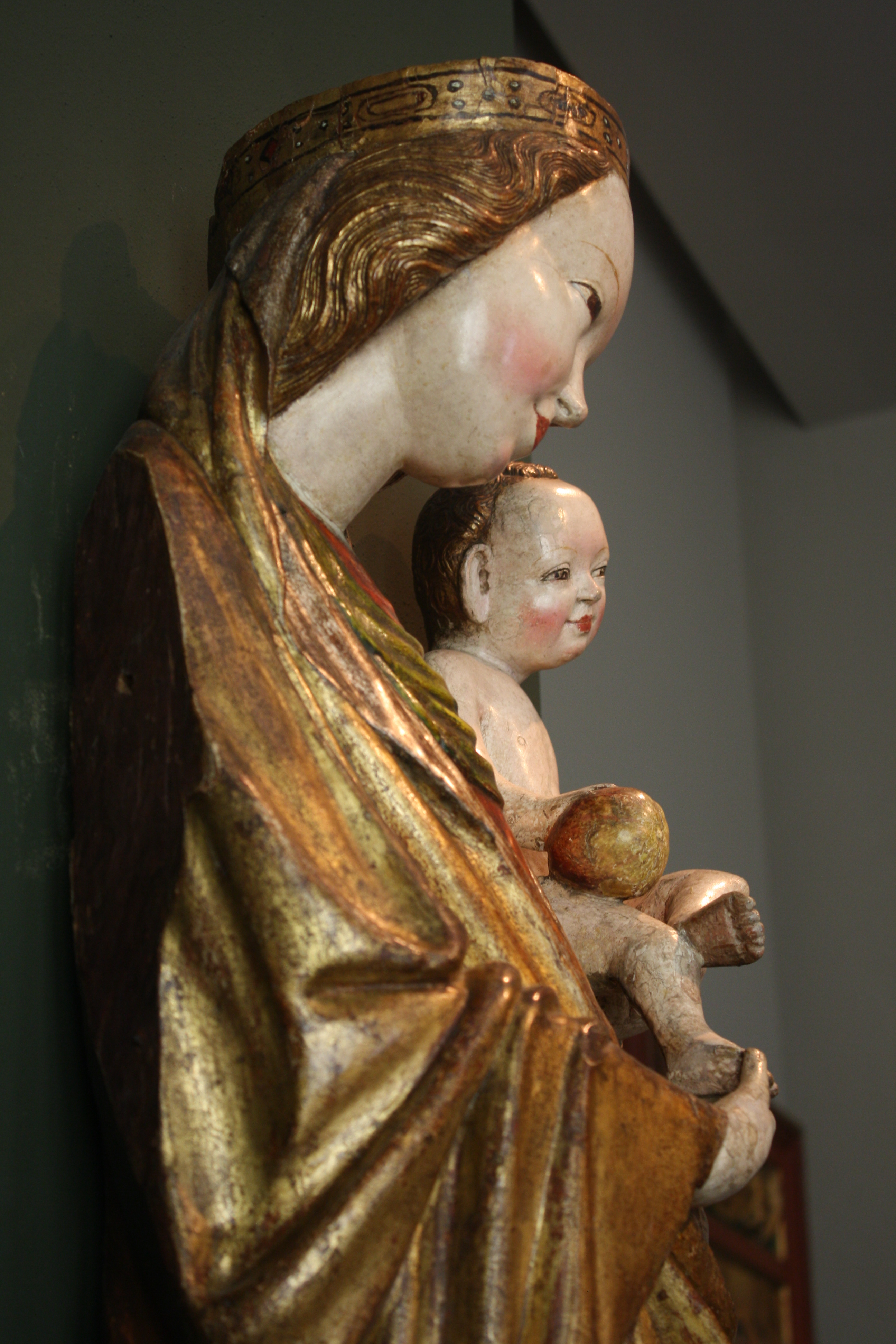
Today i want to show some Madonnas in style which was a branch of International Gothic. Those depictions of Virgin Mary are called in Beautiful Madonnas. This iconographic type emerged in Bohemia (Czech Republic today), and spread to neighbouring states: Holy Roman Empire including Silesia, Poland, Teutonic Knights Crusader State, Burgundy, Austria and France. Not surprising that in the Teutonic Knights' state,   the domain of militant order with their strong devotion to Virgin Mary this style spread rapidly.

Madonna of Kruzlowa, by Ludwig Schneider/Wikimedia
Beautiful Madonnas were mostly stone sculptures, but sometimes were made wood, sometimes of terracotta fully three dimensional, no reliefs sculptures.

This type was a re-edition of images of Madonna with child, which started already in Byzantium, but this time Madonna was depicted as a very young woman, with delicate hands and small head, beautiful and lyrical. There is a lot of charm in Beautiful Madonnas, it is very sublime style with gentle gestures, cascades of fabrics, emotions showed realistically also the was strong attention to detail as the artists wanted to depict her very realistically, in a less stylized manner. It is all very refined in comparison to the previous styles of representation of her.

Characteristic pose of Madonnas is so called S pose, where the person stands slightly slouching, belly forward, the spine is bend, not straight. This was also a common pose in International Gothic, or High Gothic in general. It was considered very elegant those days.

The example on the left Madonna from Kruzlowa is obviously very young, she looks like an ideal lady of the court culture of her times. About an ideal of beauty in Gothic another time, in a separate entry. Yes, the baby looking as if he was going bald was one of the beauty ideals, also women had very high foreheads, which gave them balding looks. It was a fashion once.

Here the Madonna of Kruzlowa and her child are represented as New Adam and New Eve. This maybe confusing for today's audiences, but there was a lot of theological disputes in the Middle Ages about Mary's role in  redemption of humanity. Medieval allegories and symbols can be strange, but they also can be explained in a simple manner, I hope I can do it without making things complicated: Virgin Mary and her son are the new humanity, both were new people born without original sin. Adam and Eve were the people of old times, before the redemptive powers of the Messiah appeared in human form. Both Virgin and child are human, but also are divine, closer to perfection as born without original sin.  In Catholic doctrine Mary is the co-Savior, and Jesus is Savior of the world. Both take part in salvation of fallen  humanity. Here we see the apple in baby Jesus hand, it has double nature: it is an apple from Eden, but also an apple as globe, part of royal regalia, showing him as the ruler of humanity.

Beautiful Madonna of Wroclaw, Anonymous of Wroclaw or Prague, via wikicommons/ Burgher S

You can view a gallery of Beautiful Madonnas on wikipedia article (which i sin Polish only, but has quite nice visuals.) Those Madonnas represented ideal beauty, those ladies are equivalent of  models of today.  This type of representation was not a stylized Madonna anymore, but one that looked like a woman from real world, dressed like her, standing, gesturing like her, interacting with her child like a real mother from real world.

Also they would be cherished as court ladies, their about their virtues troubadours would sing. Just she wouldn't be so real, as the ladies who were the subject of courtly love were supposed to be extremely virtuous, extremely good.Knight would fall in love just by hearing of their virtues, before seeing them in person. Love of such lady was supposed to transform the lover who worshiped her.

 Even though in secular world the poetry of courtly love also included erotic elements, there was also an element of total sublimation, spread by the philosophy of Neo-platonism. Certain ideas overlapped, for example the idea of total devotion which echoes in mystical writings among others in those by Bernard of Clairveau who adored Virgin Mary, not a lady in earthly form. The lady is so adored, that she becomes unreal, she becomes totally divine. An ideal lady in secular world was of course a queen, and often the Virgin is wearing a royal crown.

Bust of a Virgin, terreacota, Bohemia, XIVc, wikimedia/ Mieow Mieow


The love of the Virgin is similar to courtly love, but of course is platonic, totally mystical, often has symbolic forms, like the Song of Songs was interpreted symbolically. Medieval mysticism, or Mariology in general, can be confusing. Social context and a little bit of social history is needed in order to make more sense of it.

Certain elements of devotion to Virgin Mary have common points in the idea of courtly love, it is strong selfless adoration of a chosen woman. With time an earthly court lady was replaced by Madonna, the Heavenly Lady. When the times of courtly love, fin'amor, (fine love), came to an end, and new era came:  XIII c was time of strong devotion to the Virgin Mary and mystical experience of sublimated love which broke any connections to sensuality.

For example Daude de Pradas who was also a troubadour, wrote that God was ultimate ":fine love and truth," and who loves God is loved back perfectly by him. He used the term fin'amor  referring to God, the term which was used usually in connection with courtly love. Lanfranc Cigala, another troubadour, also wrote about fine love in his religious poems. In his Gloriosa sainta Maria he wrote that he now is praising Virgin Mary as his lady in his songs, as the earthly love gave him only disappointment and pain.

Was this the search for ultimate virtue which gave new characteristics to Mariology? Probably. But also more troubadours than before were admonished not to sing sensual songs after the Albigensian Crusade. At once the culture of Southern France, home of prominent troubadours, became "worse than of the Saracens."  This  is a typical excuse of the colonisers, to talk with contempt about the culture they conquered. It happened later, in cases of XIX c. colonisation as well, putting down on India, Africa, Indochina, etc. But sometimes the conquerors adopted certain things for themselves, "to pity to destroy," as one of my art history teachers said. Troubadours were not only there, but Occitan culture was the culture of troubadours like for example Germany has culture of philosophy and good engineering.

But ardent songs of earthly love had topoi which were easily translated and adopted into mystical experience of platonic love. Song of Songs was symbolic also. Metaphors of religious love included love of parents for their children, love of spouses and also love of siblings. It seems that we humans need things earthly to express things the most abstract but very real at the same time. Mystical experiences belong to such realm of strong abstraction and reality.

The Madonnas included in this article here you can see  in order of appearance in two museums in Poland  Madonna of Kruzlowa is in Krakow,  Wroclaw Madonna is in Warsaw,  and in Bohemian Madonna in New York.Article about courtly love from wikipedia


Sunday, September 9, 2012

Rock-hewn churches, cave monasteries, and stones: longing for travel

I come from a country with mostly flat terrain, some hills and mountains, but not much, lots of lakes and forests, and as you probably guess not many stone buildings. There are some, but most old buildings are made of bricks. Yes, brick Gothic is there too. Even the huge crusaders' fortress, Malbork Castle, is made of 35 millions bricks. Brick Gothic has its own fascinating features, and Gothic bricks themselves can be fascinating, but as you probably also guess I like stone buildings too. Actually I am really fascinated by them: huge cathedral or tiny shepherd chalet, I am hooked.

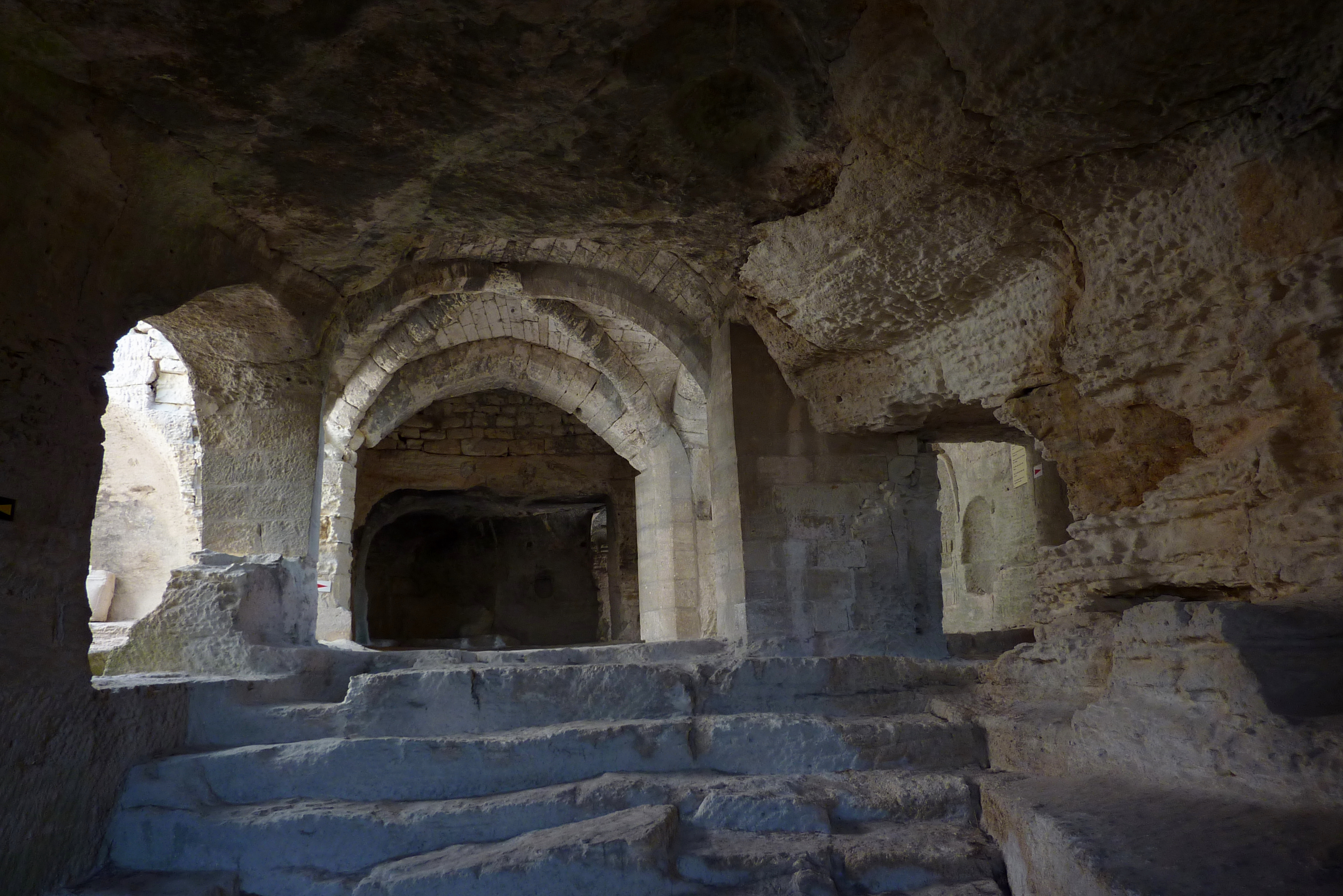
 So, the church of Notre Dame in Vals, Ariege in France (Pyrenees area) I find extremely interesting, this video lets you in.   Take a look at the humble Virgin statue, 1: 34. All it is element Earth in is glory, and very humble and simple at the same time.Gothic cathedrals have their beauty, but this one has own character, very Zen.


The Notre Dame church is Vals is Romanesque, partially build on the rock, (semi-cave church to be exact), has also very interesting frescoes, humble looking and with quite strong Byzantine influences, unusual in France, in addition to the only depiction of archangel Pantasaron, and depiction of scene after birth of Jesus.  Byzantine in appearance, as this is more often  found in Byzantine art, and also has strong Catalan influences, which is not so surprising given this is a neighbouring area to this region. The site was surveyed by archaeologists, and the conclusion is that there was human presence for thousands of years, even it must have been a cult site, at which point of the location  cannot be exactly said now, but the presence of ceramics used for religious purposes was there. But the site was at its peak during early Middle Ages, during the Merovingian times. I should write about the frescoes on another occasion, as they deserve attention on their own.

Landscape at Cote d' Azure, France, by Heidi Fuchs

Those stone churches like the one in Vals, the rugged and humble ones are very much in harmony with the environment. Those rock formations, this time at Cote d'Azure area, in spite of being regular, are in perfect harmony with anything which surrounds them. I couldn't help myself to post this picture. They are simply a silent part of the environment, awe-inspiring. But when I was really young I couldn't warm up to this type of aesthetics, the vegetation was kind of too dried-up for me, I liked lush green seen in the North during the Summer. Now I am enthusiastic about it. But also take  a look at the cave monastery in France,  Beaucaire, abbey Saint-Roman, photo taken by G. Freihalter, (via wiki commons) you can zoom in very closely.


Cave churches or monasteries are rare, but there are still plenty for curious travelers.List of cave beauties on wikipedia

Quite a number of those is to be found in Bulgaria.And bellow is a picture from Bulgaria,  rock-hewn churches of Ivanovo, with Byzantine  frescoes.

Ivanovo rock-hewn monasteries, Bulgaria, by Denis Berthel, via wiki commons

And take a look at this photo of Todorka Mountain in Bulgaria. Makes me want to follow advice by my  Bulgarian expatriate friends and visit their home country. Sure, I would love to. Who can resist the lure of ancient art and architecture, and of such sundown  like this bellow on the magnificent mountain. But again, I need to postpone it again, even if at the momentI have what the Germans call Fernweh,  which means aching for the far away.
 The mountian bellow is Todorka Peak, in Bulgaria, by Evgeni Dinev, via. wiki common.
 Artlicle about this mountain mentions the legends too.

Todorka Peak, in Bulgaria, photo by Evgeni Dinev, via wiki commons

The author of the picture has more interesting photos of Bulgaria on Flickr, and his photo gallery there is great! Those pictures are my recent discovery on this media stream, and they make me think about maybe putting more links to Flickr albums by various photographers. Take a look at Evgeni Dinev's other awesome pictures.


Saturday, September 8, 2012

Green: Paradise and the color symbolism, history of color # 12

Green in Medieval times had rather varied symbolic meaning, depending if was used in the religious or secular context. In religious art it was a symbol of eternal happy existence, Paradise, and soul's hope for eternal bliss. Green robes symbolized eternal happiness through salvation, and often martyrs were dressed in red and green.

 As it was a happy color, specially the emerald was praised as the most beautiful jewel, in which all marvel of nature was incarnated and made imperishable. It was considered also an earthly representation of Paradise, and written about by monks. No wonder: emerald has strong color and is translucent, has light, and light and strong hues very important for the medieval aesthetics.

The painting on the left is by Hieronymus Bosch, who is often labeled as being  Northern Renaissance painter, but there is still so much of medieval elements in his paintings, also in this one. Bosch: a very mysterious painter, and lots was written about his speculated following of heresies. But this painting is quite conventional for Bosch's standards. It is the  left wing of the Last Judgement triptych, in the collection Gemaldesammlung der Akademie der Bildenden Kunste, in Vienna. It shows the fall of angels, and the story of creation of Adam and Eve, temptation and expulsion form Paradise. (Please click on the picture to view it bigger). It is about bliss, heavenly and earthly, and primordial sense of innocence, and about loss all of this. Also we see Jesus in Paradise. Why? Jesus was in medieval mystical writings and systems considered the Second Adam, the one who brings the Paradise back to the fallen human race.

But the hope of salvation was the expectation of something bigger, something which  could not be lost anymore, not a conditional existence in a Paradise in the story depicted in the Bosch's painting. It was about something above also the secular symbolism of green, which was found very limiting and temporary. In the secular world green was standing for Spring, new love, fertility. It was real hope for something beyond all  limitations, it was about the  life eternal, and the color of life was green, archetype of course,  but it got a new dimension: a heavenly one.

 And as such was totally elevated, wasn't anymore about life like in the Nature, where seasons  pass, or impermanent state of natural fertility which was bound with rebirth, suffering, aging and death. This life was about absolute perfection which never faded.

 And the hope, longing  for such existence was made one of the most important Christian virtues, (along with faith and unconditional love), and of course the color of it was green, because already showed symbolically what the all hope was about.

Mosaic of the apse int eh church of St Apolinare in Classe, Ravenna, Italy. Thank you Berthold Werner for releasing this picture into public domain.
 This happy symbolism of green came from the earlier Christian art- early frescoes and mosaics. In this post I follow the line form the youngest to the oldest art. Now a mosaic which is c. 900 years older than Bosch's painting. The picture above shows VI c. mosaic with St Apolinare in Paradise, adoring the cross, sheep around him, a very typical composition. Above, on the wall, Christ is giving his blessing, and we have the repetition of Paradise and the sheep. Click on the picture to see it bigger.

An earlier mosaic, this time from V c, is on the entrance wall of the mausoleum of Galla Palcidia, Also in Ravenna , Italy.

Jesus as the Good Shepherd, mosaic, V c. Galla Placidia Mausoleum, Ravenna, Italy
This type of mosaic is part of the iconographic tradition of  mosaics seen in the one with St Apolinar. The iconography is overlapping. But here we have Christs who is depicted as beardless youth was the typical figure in early Christian art. He is not the Pantacrator Jesus giving blessing, he is tender and pensive, and all sheep are looking is his direction.This was a common way of depicting Jesus: among his sheep, in Paradise, not hanging on the cross. He was shown as such even in earlier art, in a fresco, still in the catacombs, also as a good shepherd. One stream of the symbolism of the color green has a long lineage dating from early Christian art.


Monday, August 20, 2012

Yellow: Triumph and Fall, history of color #11

Yellow is unusual in art history regarding the attitudes people had toward this hue: it was held in high esteem until did fall low.

First during medieval times yellow was replacing gold when it was too expensive for the project, like for example usage for the background in frescoes, large surfaces. Sometimes of course, gold was used on frescoes also, it depended on how much a community could spend. Yellow was a much cheaper alternative and still represented divine light. In an earlier post I wrote about symbolism of gold as representing divine light, as the color symbolism is theological). But yellow wasn't used symbolically only, also when needed to give some beautfil robe to a saint, for composition purposes, the color was used freely.

Chromatically yellow is also the lightest color from all chromatic ones. (White is non chromatic). Also it was used in illuminated manuscripts, as we see in this masterwork of medieval art: the book of Kells, from Iona, dating from the times when Irish monks spread their culture and knowledge in Europe. Columba was visiting Reichenau, as I told you before. This folio showing Christ enthroned makes use of yellow, which is fine of a color to even line the cross and painted as color of Jesus' hair. The birds are peacocks, about symbolism of this bird in this this article. The circles at the feet, surprise, surprise! Those are angels, called Thrones, often depicted as wheels, sometimes as wheels with eyes and wing, specially in medieval Byzantine art. Wanted to mention it, as they are not uncommon, and people wonder about what is it. But also can mean the heads of the nails of the cross. The book Christ is holding represents the divine law.


Christus Enthroned, Book of Kells, Ireland, library of Trinity College, Dublin, via wiki commons


 The figures are angels, one angel is a seraf as the posture of his wings indicates (lower corner on the right, will write more about angels another time). This part of a wonderful lecture later describes the peacocks too: as incorruptibility of Christ's flesh, with chalices and hosts.

Closer to Renaissance the elevation of yellow to color of light started to diminish, when art started to be more realistic, the golden backgrounds fell out of fashion. Now yellow started to be viewed as color of falshood and treason. It was used to brand those who were considered socially less acceptable: prostitutes, Jews, heretics. Jews were ordered by law to wear yellow badge. About yellow as color of prostitution I wrote already when I wrote about Mary Magdalene.

And as we see in this fresco by Giotto, yellow was assigned to bad people.Jesus has a loving peaceful face, he is dressed in red and blue, Judas in all-yellow garment.
Giotto, Kiss of Judas, Scrovegni Chapel, Padua, Italy, via wiki commons

Cathars after Albigensian Crusade were forced to wear yellow cross, as badge of shame. Of course they couldn't be Cathars by choice, they needed to provide prof of marriage and repent, than their live were saved. Repentant heretic was important, as too many heroic personalities burned on stake wasn't good advertisement for ideological side of religion. Some of  information about Cathar religion we know from writing of a Cathar convert to Catholicism. Those crosses called las debanadoras were to be worn always outside the house. It depended on the depth of involvement in Catharism judged by the Inquisition in a trial of , if a person needed to wear one cross or two (front and back). Those crosses were usually six inches wide and had height of eight inches. Unless one was of aristocratic birth, the badge of shame was to be worn for the rest of someones life. Many simply didn't comply, or were unrepentant. It was not a simple badge of shame:Cathars didn't like the cross as a symbol, this refusal of the symbol was written in their religious philosophy. It was much more cruel punishement than a known more widely and younger scarlet letter for adultery. Following link will bring you the wikipedia articles about Cathars and yellow cross http://en.wikipedia.org/wiki/Cathar_yellow_cross 

As for heresies: they were not considered a religious offenders only, but in Western Europe heresies were viewed also as treason against the state, and considered anarchy. This was also one of the  reasons why it was relatively easy to prosecute those who didn't conform. Rulers were offended by heresies, specially because almost every heresy also criticized materialism of the status quo, preached poverty or renunciation of material world, Catharism did it to.


Sunday, August 12, 2012

Colors of Power: red and blue- History of Color in Middle Ages # 9


Red and blue, most prominent color duo of the Middle Ages. People just loved them so much, that even when writing about rainbow  they wrote often only blue and red! Also the existence of separated guilds of dyesrs dedicated for each color may be a testimony for high esteem and priceses of those particular colors.

 We see here in the video the colorful splendor of the Middle Ages, about illuminated manuscripts about British royals. Lots of color, but most prominently the duo of red and blue. Fresh colors, most of the time.Video window may not come up in an instant.
Interesting movie by BBC about royal illuminated manuscripts.

Here Charlemagne is  being crowned.

Emperor's Charlemagne Coronation, Illuminated mansucript, via wiki commons

Red and blue were colors of power in the secular world, why?  Red and blue dyes were expensive, not common, and people loved those hues, of course. Red was used after the purple of Tyre, very expensive and reserved only for the rulers, became less and less available. Red in a more dark, dignified edition was replacing purple,which had a brownish tinge, not what we commonly classify as purple today, until appeared in its pure form, lighter and brighter. As we see bellow, on the Annunciation picture.The same with blue, it was considered a very noble color, and as the blue dye became to symbolize affluence and also royals were using it. (Royal blue).


Announciation by Petrus Christus, via wiki commons


Here on this Anounciation by Petrus Christus we see Virgin Mary dresses in a red mantle. We see the typical elements of Announciation, as the lilies signifying Mary's purity, the vase a pure vesel, open book also is traditional. Always opened on the same page on all paintings, Isaiah 7:14, or psalter pages in earlier book. Other written words is the passage from Announciation of the New Testament, the words spoken by the archangel ("Ave Maria,  gracia, plena"etc) was directly written in the picture. Mary is here depicted as a fine lady, dresses in a rich garment, expensive mantle.  Click here to read more about Announciation symbolism.
This painting is considered early Northern Renaissance, but still has elements of Gothic art. For example the folds of the robes of the angels are still very hard and geometric, the angel's posture is typical for Medieval art, also his wings, strong color, not white. But we see already linear perspective on the tiles of the floor, increased realism of depiction in painting, eye for detail.


Court scene from November,  Book of Hours of the Duke de Berry, Via Wiki commons


What a rich blue wears this duke! Probably he is the Duc de Berry himself, it is a miniature by Limbourg brothers, form the Tres Riches Heurs di Duc de Berry, form the magnificent manuscripts collection of the Musee Condee.
                                              
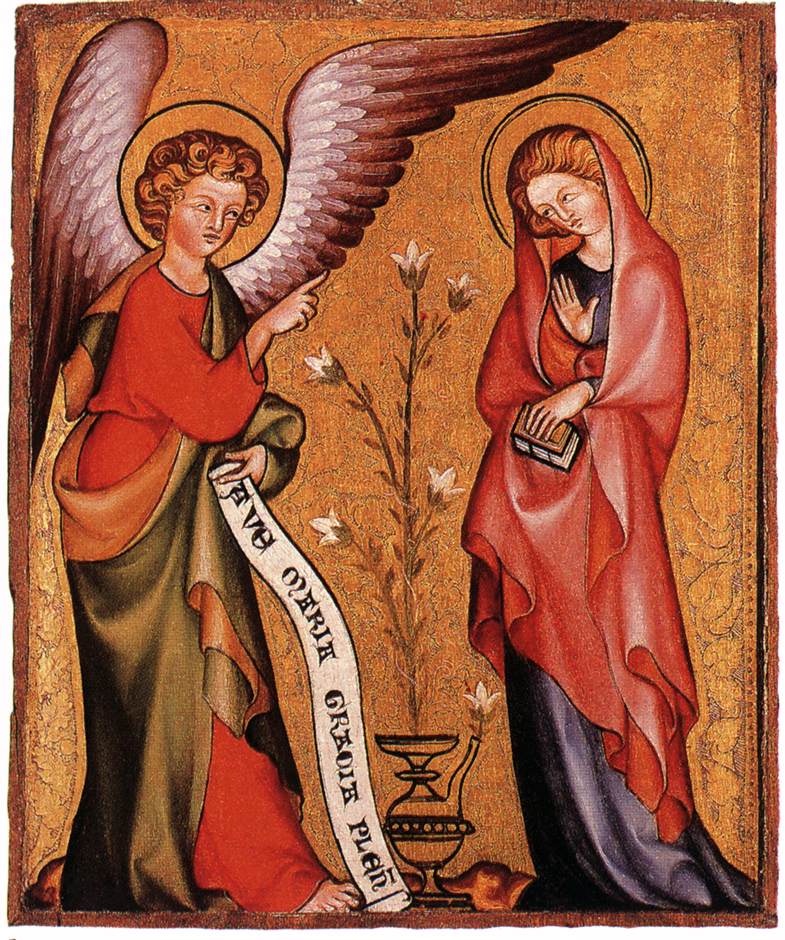
Announciation, unknown German Master, via wiki commons


The Announcaition again, this time we see all elements traditionally depicted in announciations, but this time the book is  not opened, but text is written on the banner held by the archangel.("Hail Mary, full of grace"). this banner as a speech bubble appears often.Wallraf Richttarzt Museum Cologne. Mary with a book again, it has significance, depends if closed or open, etc. Soon about Mary and book symbolism, an elaboration on this  important element of  iconography.

Altdorfer, Virgin Mary with Child, XIV.c via wiki commoms
Virgin Mary as queen, with infant Jesus in her arms, by Altdorfer, (German), museum in Budapest.Infant Jesus has a necklace symbolzsing his future Passion and death on the cross (coral ) which in secular symbolism and superstition of the days: it  was supposed to avert evil. The apple is relating to original sin, held by Jesus is a symbol of redemption, eradication of sin.
Death of the Virgin, by Konrad von Soest, Mary on her death bed attended by humans of saintly and common stature, and by angels themselves. We see richly embroidered blue mantle and blue angels, as the symbols of heavenly realm.Also prominent is red/blue color duo, gold background. Closed books also present, symbol of the Virgin. What is written on the open scroll, which is read by bearded man dressed in red, with his head covered as sign of respect and humility? The paleographers would tell. The saint whose hand holding quill  is almost touching Virgin's hand is, has "Saint John the Apostle" written on his hallo.

Death of Mary by Konrad von Soest, via wiki coomons


Friday, April 6, 2012

Oral tradition. Folk Stories Geneis and Finding Sacred Art

 I wrote before that during middle Ages some ideas took lives on their own (proto- sciences). Today I will talk about folklore.

There is folk current in European Christianity, for example the  folk Catholicism. Secular or pagan  stories which were liked were appropriated, so, the Christian/religious current and the pagan/secular one created very interesting stream.

One  story is form Ukraine, and Belarus,( if I am right), and it is about a bird: the raven. It tells that "the raven’s plumage was very colorful as a rainbow, and even was radiating rays. Raven was a true bird of Paradise." When the paradise was no more, the land become barren, and the raven become black. But his plumage will be back in its full glory the moment the Paradise is back on Earth. Medieval art represented Paradise as radiant and colorful, cathedrals and basilicas were earthly representations of ideal of Paradise.

Other legends relate to concrete objects,  art which were found and installed in local churches and enjoyed special devotion. Typical motive: the sculpture, for ex. a Black Madonna, or an  icon was lost during turmoil, than was found in a miraculous way. Or even appeared in a miraculous way from the beginning, without being lost. The finders were the animals, such as cattle, or an owl, or a sheep. It appears to me that the animals are the most frequent finders of religious art, but I am not a folklorist, and those are just my original studies. My formal studies in this subject are limited, were part of my anthropology class, and dealt with the subject of art objects which were subject of veneration in Catholicism, and especially those relating to healing. I don't claim special knowledge here, (reading and listening stories passed as part of living oral tradition).

Sometimes instead of the animals young children are the finders.find the art taken then to the local church, or a blind woman. The story about the blind woman whose blindness was healed when she stood in the river and the crucifix was floating on the water, the Jesus on the crucifix talked to her and she was healed. It relates to one small village in Poznan region, Poland. This particular story has variants, including the treasure which was dug up by the oxen. The finders are somehow innocent, or under-priviledged. Those stories represent the idea that the divine is very accessible, and approachable through intuition, no special intellectual training is needed.

But lets go back to the story about the blind women. When the women was told by Jesus on the crucifix he wanted to stay at the local church (common motive, the holy one depicted decides on location where he/she wants to stay). The crucifix was pulled out of the river and put on a cart which was supposed to be pulled by oxen. But the load became so heavy, the oxen couldn't pull the cart even a a single step forward. They just were stepping in place. They tried and tried, but couldn't move, were just digging deeper and deeper into the soil. And this is how the oxen dug up the chest with golden treasure, from which the money was spend for renovation of the church. The chest is still exhibited in the church; the crucifix itself is in Gothic style, dated by art historians as created during early 15 c. The church itself became a local pilgrimage site. The crucifix was moved to other churches, richer and more impressive.The crucifix appeared in a miraculous way back in its humble church which was chosen at the beginning. This is also common: the artifact wants to stay in one and only place. But always I didn't visit this place, I didn't see the crucifix and the chest, but I listen to the story told by very old people. Maybe one day, I will visit this place too.

Tuesday, April 3, 2012

Red: Mary Magdalene's Case:Medieval Art, History of Color # 7

Mary Magdalene wasn't depicted only in red though history, as Virgin Mary wasn't depicted in blue only. But let take a look at the red, as both Marys were depicted in red garments. For example the red of the robes of Mary Magdalene had a different, double symbolism, than for example red of other persons' cloaks. Mary Magdalene's robes were painted in cinnabar red, (vermillion), having more hint of orange. Red in general can tend toward more to direction of yellow, or blue, and during the Middle Ages the quality of red was important, which red was symbolizing which idea. The other red symbolized regal values and charity.

 Here comes Crucifixion by Juan Rexach from Northon Simon Museum, Los Angeles. Due to poor lighting conditions the color of Mary Magdalene robes not very accurate on this photograph, in person is like on the photo bellow.

 Crucifixtion by Jaun Rexach, Norton Simon Museum Los Angeles


Here you can see desctiption and a better quality photo 
You can zoom into, and see very well the specific color of Mary Magdalene's garment.

Crucifixion by Masaccio, Museo di Capodimonte, Naples,public domain,  via Wikimedia Commons
 
 I am glad that Maria Rzepinska wisely comments is her book about color that red in Middle Ages was not just red, but it had two aspects. Red was one color in which case people paid attention to its shade, shades had codified meaning. Two types of red were differentiated: the noble one, considered sublimed, and the earthly one, viewed as "sinful". Several examples of this red can be seen close to my living place in California: Norton Simon Museum and  the Huntington Library art collection.But today Massacio, as more widely known.

In general, red stood for love in sense of charity, blood of martyrs, sacrifice on the cross, redemption through crucifixion. But as it could be a color of love in spiritual sense, redemption, also when in specific tone, could symbolize sin, or lust, or both: redemption form sin.This dichotomy is visible in portrayals of Virgin Mary as the sinless one who is represented in another red than Mary  Magdalene  ( dressed in "sinful" red). A medieval painted wouldn't confuse those two reds.


We need to remember that color in medieval art isn't always symbolic: sometimes just the need of decorative usage of color was important. In Latin Christianity (Byzantium was another case) the robes of such a person as Virgin Mary wouldn't have been painted in the same as red of Mary Magdalene's.

Above the crucifixion scene by Masaccio, Mary Magdalene in dramatic gesture of devotion and anguish dressed in red so typical for her. Although there are quite a number of representations of Mary Magdalene in this type of red, specially at crucifixion, this one is probably the most famous one. It is still very medieval. But there are hints of coming of the new era: the Renaissance in Italian art,there are more of human emotions shown. Gothic was very emotional in other countries, (for example showing suffering of Jesus),  but art in Italy was more reserved, making more usage of  Byzantine ideals.

 All  older medieval representations of crucifixion in Latin Christianity would show Jesus fully dressed, each foot nailed separately, and no signs of his suffering. With the passing of time Jesus became more humanized, specially in the art of Northern and Central Europe. The body was more and more exposed, agony and blood shown, feet nailed together. For example in German art Jesus was shown with great attention to expression. From Jesus as a symbol there was a shift  toward showing Jesus as a human being.

What about Masaccio himself? His name was Tommaso di Ser Giovanni di Simone. He died when he was only 27 years old, and he wasn't as famous as the other painters of his times. Even his name was a humorous take on his given name. Masaccio, as he is known even today, is a form from Tom, meaning "clumsy" Tom, as separated form his collaborator Masolino,  the "delicate " Tom.

Yet Masaccio influenced the other Italian artists. It was his example which caused a shift in art:  more and more toward realistic representations of the world around. Here we see a paintings which is still medieval: composition, golden background.  But carved into the golden background humans who were much more real, not idealized, captured in a moment of strong emotion. Figures are real, not ideal.

Other colors of Mary Magdalne's robes in another post, more colors.
And my post about Mary Magdalene depicted in blue click here

Byzantine Christianity depicted her also in red,  with an egg in her hand. In this tradition she was an extremely virtuous woman in similar age of Jesus's mother, and both women died in Ephesus. Mary Magdalene's body was was kept in Constantinople as a very venerated relic. This dissapeared still during the Middle Ages, but also later her relics started to be venerated in Western Europe, Latin Christianity. Relics were hot commodity then, and many stolen from the Churches in Constantinople in 1204 when crusaders sacked and looted this cultured city. Virgin Mary's house is believed still to be there, what was one part of the Byzantine Empire, among ancient ruins of Ephesus, today in Turkey, in a rather remote location but among the most wonderful ruins.

Monday, April 2, 2012

History of Science at Chartres Cathedral, and Zodiac

In the previous post there was Zodiac window form Chartres, today is the astronomical clock. Strange setting for such symbols?

No way. Zodiac then was nothing unusual in churches. So, why all the mystery so many tourists talk about? Actually there is nothing mysterious about it. Explanation follows.
Chartres Cathedral Choir, Astronomical Clock, via Wikimedia Commons, thanks to Harmonia Amanda
First, the clock comes form XVI c. but its ideological roots are medieval, and proto-scientific, not really esoteric. Astronomy, astrology, the synthesizing medieval minds didn't see the difference.

 It is a common misconception that the Middle Ages were not interested in science, only in religion, or there was no reading of Classical texts before the Renaissance. Actually the classics were read, not as widely as  during the Renaissance, of course, but were not unknown, rather kept in high esteem. Many Classical and Arabic texts of science were translated into Latin. Arabic texts about astronomy, mathematics, anatomy and chemistry, and medicine contributed a lot in development of Western medical sciences, we often forget about it. Or simply don't want to know. And there was no agreement about if the Sun was the center of Universe or moved around the Earth. The official decision   in favor of the Earth as the center of the Universe came later. Science was fine as long it didn't oppose any dogma. For example the theological idea of dignity of the human body was applied to the medical field, and this particular idea didn't allow dissecting human corpses for anatomical research. Dead animals were dissected instead, specially pigs. Sometimes, rarely, human bodies were dissected also.

Chartres itself had a cathedral school, as often was the case with such buildings: there were also centers of learning, not only part of religious live of communities as today. Chartres was one of such centers, and was among the famous ones. Neo-Platonism was flourishing there, sciences were treated as separated from theology. A number of so called than natural philosophers (philosophers interested in science) came from Chartres. School of Chartres became less influential when universities started to compete with cathedral schools, but this was a case with all cathedral schools.

So, if the clerics of Chartres were so scientifically minded, why such thing as Zodiac in the cathedral?

 Here we need to understand the mind of people who lived before us, and don't project our XXI c. world view on them. The clerics form Chartres were still products of their times, and during their times astrology was science, before the Catholic Church opposed it, and before it was mocked  by the scientists of the Enlightenment era as superstition, not a scinece. Medicine was part of curriculum at Chartres school, and astrology was officially part of medicine also. Here is the illumination dealing with the human body as related to Zodiac.

Anatomical Zodiac Man, Limburg Brothers, Book of Hours of Duke de Berry, illuminated manuscript tempera on vellum, public domain, via Wikimedia Commons, thanks to Petrus Berbygere


In addition to proto-scientific reasons, Zodiac was a very popular motive in depictions of passing time. One  was very common:  the labors of the months. Frequently months and Zodiac signs were tied together, and this is often found in medieval churches and religious  manuscripts. Labors of the months showed secular world. Zodiac window at Chartres belongs to this popular category. Here is incomplete list of  zodiacs and labours of months in churches.

 Another example, most famous of this type is the series of illuminations from the mentioned  Book of Hours of Duke de Berry, (the same book from which the illumination above comes from). It is not the only example of this kind, but among the most beautiful ones, if not the most skilfully rendered, so far. Here it is, via Wikipedia article and picture gallery.

The Book of Hours of Duke de Berry is  of the most beautiful examples of book illumination in International Gothic style, and contains a very good example of Gothic blue, specially loved and used in France.

 Art history itself is an interdisciplinary endeavor, and understanding history of science or cultural history can enhance knowledge of art. Art doesn't exist in historical vacuum. It is connected to the world around, it exists in historical contexts. Striping old art form its historical context can give us only partial insight, and lead to some  misunderstanding too, some of them can be quite funny.

Saturday, March 31, 2012

Lost Secrets of Chartres Blue? History of color, and why astrology in a church?

 A story instead of history? It happens.

Some people believe that making of blue color from the medieval stained glass windows of Chartres Cathedral was kept very secret, and the secret vanished. Since Middle Ages no one was able to re-create the famous Chartres-blue. Interesting story, very romantic, but simply not true. It is a part of cultural phenomenon involving romanticizing and sensationalizing art history. Specially the mystery of Chartre's blue was beloved during the era of Romanticism. Such sensationalizing happens most often in archeology, but art history isn't free from such exciting modern legends.

 In fact, there are enough of ancient "recipes" for making stained glass which survived until today. Problem with medieval recipes is that they often don't makes sense, because terminology is confusing, like for example the idea that sapphire was added  in making stained, glass, when this was also latinized name for  saffer, which was name of cobalt oxide. Often the color is also affected by patina, impurities, or the main compound: the sand. Subtle differences matter, for ex. if the was taken from the river or if was sea sand. We can't know exactly, we know which compounds were added, but in which form we don't know. Also the combination of blue with other colors on the installed window itself makes it look specific way, using the optical principle of color contrast.

But modern glass makers are fully capable of recreating the" mysterious" or "lost" Chartres-blue. It is sad to think so little about their skills and talents. Maria Rzepinska in her expertly researched book about history of color mentions those recipes, and even tells how color of the glass mass changed in relation of time involved in heating in the glass making kilns.Known phenomenon, nothing new,  just a reminder. Also some impurities, air bubbles, etc. which were the result of working in more crude conditions affect the color. Today's glass is extremely  pure.

But there is the  kernel of truth in this disappearance story: after the Age of Faith the Chartres-blue, or to be more exact, the presence of  strong colors diminished to almost disappear from stained glass windows, to reappear during XIX c. in their full glory.

So, what is the secret?

Stained glass window, with the Zodiac Sign of Pisces, Chartres Cathedral, via Wikimedia, photo taken by Dinkum
  It fact after the Middle Ages there was less interest in installing very colorful stained glass windows of the types as those seen in Chartres and the other Gothic cathedrals or churches. The reason was simple: colorful stained glass windows were prohibitively expensive. The cost of stained glass was closer to the price of precious stones than to the cost of the stained glass of today, as Maria Rzepinska says. (And she has also has a strong supportive bibliography which is a great resource for me). We also need to keep in mind that in addition to the already extremely high cost of its production, Gothic stained glass windows were very thick, which made the price even higher than those which are made of thin glass panels today. And thickness makes colors more intense too.Stained glass windows at Chartres Cathedral are for example c.1 inch thick. Due to progress of technologies, today's stained glass which is similar to the glass of XIX c. Gothic Revival has only a fraction of the thickness (c. 1/8 of inch) of the Gothic glass window panels. Gothic Revival brought colored window back into buildings but adjusted with new technologies. Religious buildings of the Middle Ages needed masses of expensive glass.
The tastes also changed, after jewel-like colors of the  Middle Ages white and grissaille glass became popular. With time people also became less religiously devoted than during the Age of Faith. Unstoppable religious enthusiasm which fueled building of the great cathedrals simply diminished with time.

 The window above is a curious case in popular imagination, as some other objects at Chartres. Many people think the Zodiac signs were too esoteric, and foreign to the doctrines of Christian religion, and as such couldn't find place in any church building.

One thing: Zodiac isn't anything unusual in Gothic churches. Actually it was a common subject. Astrology was intertwined with astronomy, as other proto-sciences of the day were.  Proto-science was called natural philosophy in those days. Zodiac itself represented to people God's role in creating order in Universe, and showed the idea that all things are inter-connected. Medieval people, even priests, didn't have problem with Zodiac. Zodiac wasn't esoteric in real sense, it was a perfect illustration of the idea of perfect order in the Universe.

The science of old was a mixture of experimentation, science, theology, metaphysics and superstition. The divide between science and theology, philosophy and metaphysics was drawn first during the XVIII c. Astrology was part of sciences and was legitimate than,  and was as legitimate as anatomy today is legitimate part of medicine.  During the Middle Ages astrology was part of medicine, and even clerics learned astrology. What the Church forbid in relation to astrology  was the belief in fatalism, and astrology was supposed to be something which didn't determine human fate completely, it was supposed  to give people some free will. Even Newton was still involved in a mixture of philosophy, theology, science and even alchemy. This of course relates to the history of science itself, but as you see art history involves partially history of science, not only in this particular case..

Zodiac window at Chartres cathedral from Sacred Destinations travel page

Here another one stained glass window, very jewel-like.
Stained glass window at Chartres cathedral, via Wikmedia, courtesy of Juan J.Rodriguez
 As the there was no clear division between the rational  and irrational in medieval sciences, as the division between science and religion didn't exist in the form  as we see it today, the same was with fine arts and crafts. Art and crafts were woven together in the same aesthetic system, and art often imitated craft. For example the stained glass window as above was reminding of jeweled and enameled objects crafted by jewelry makers.

 Mentioning Rzepinka again: she writes that people believed the only difference which existed between precious stones and stained glass was  that the natural jewels possessed magic powers, and glass was not effective. Even clerics were writing that the powers and colors of precious stones were virtues given to them by God. We need to take in account the differences in human knowledge and thinking when interpreting art done by humans from eras long gone, if we want to understand their art more fully.

Jewel-like aesthetics in stained glass windows was later replaced by imitative qualities of painting. Even during XIX c. particular paintings were recreated as stained glass version, a tribute to the value of the art of painting. Painting became "true" art," stained glass became craft. But as it was the case with theology, mysticism and proto-science, there was no divide between art and craft, no value judgement in this regard. Medieval mind was kind of holistic mind.

I have chosen those windows not only because stained glass is such a strong mark of Gothic art, but also because shows the duo of blue and red, a color contrast of the Middle Ages.
Tomorrow more about medieval zodiac and science, more about blue in illuminated manuscripts.