Showing posts with label grail. Show all posts

Wednesday, July 10, 2013

Grail in Bezlawki part 2: Mary Magdalene patronage and pagans


The second part of the legend of grail in Bezlawki. How the grail was taken from Britain, by whom, in my previous entry about what happened after the battle of Hastings. 

This is a legend, we don't know how old it is, bu tit is very interesting as a story, and has historical events, as well people who lived in real life. A bit of historic  background of the story.

After Svidrigaila installed the grail and his army in today's Bezlawki, in a fortified tower which belonged to Teutonic Knights, military order crusading against the pagans of the East North, he lived like a prince. Historical records show food provided by Teutonic Knights, among them very costly morsels and spices imported from afar. Teutonic Knights promised him to become the grand duke of Lithuania, even though Svitrigaila didn't qualify, as Lithuania had the law of primogeniture, and he was the younger brother in line to the throne. His older brother, Jogailla was a pagan. They were also engaged in a bitter feud with their uncle, who also was keen of becoming the only ruler of Lithuania. It seemed that those three men had reasons to fear for their lives. The fortress in Bezlawki, in the middle of dense forest was a safe place for Svitrigaila.


 Here is video how Bezlawki tower was changing through centuries. For those of you who have trouble to watch the video's embedded in this blog, here is the to the youtube video.About  4 min on shows the change for Svidrigaila, making it more fit for princely residence.

One of the people who was on diplomatic missions dealing with Teutonic Knights, who were considered those days unstoppable, was young Polish queen Jadwiga. Or rather a young king who was a woman. Why? Because in Poland by law kings were ruling, so, if the sovereign wasn't male, she got the title of king, that meant she was a ruler on her own, not a queen consort.She was elected a king, and crowned as such at a tender age of 11, like some of the Merovingian child-king. But she was an extremely capable young genius.

Jadwiga of Poland was half Hungarian, half Bosnian, but from both parents she had genetic ties with native Polish Piast dynasty. She was also from Angevine dynasty, therefore the fleur-de-lys. Her mother, Elisabeth of Bosnia was ruling Poland, as the last king of Poland decided that his sons are no capable enough. Poland didn't have law of primogeniture. king or the nobles could decide who was the best candidate for the throne. But Elisabeth of Bosnia  wasn't  capable enough as a monarch to please the nobles and she  was replaced by her daughter, Jadwiga.

Jadwiga of Poland  by Antoni Piotrowski, at Jagiellonian University
Note the chalice on the right. Picture painted in 1901. 
Jadwiga of Poland grew up in Hungary in royal court of Buda, she was a polyglot speaking six languages, spent one year at royal court in Vienna, as it was common to send children of noble birth to be educated at other courts.She was supposed to be the future wife of William of Austria, one of the Habsburg dukes, was engaged to him as a little girl (sponsalia). The Habsburgs were expanding their influence by marrying heiresses, this engagement was an early attempt in such politics.

Jadwiga was a politician and patron of culture, in addition she was very religious: she revered four saints, specially Mary Magdalene and her sister Martha. Mary Magdalene was the patron saint of Angevin dynasty, after Charles II, Count of Provence and king of Naples discovered the body of Mary Magdalene in Provence, at  Saint-Maximin-la-Sainte-Baume.Mary Magdalene was immensely popular saint and enjoyed patronage of rulers, but the Angevins were the most important in spreading and strengthening her cult. Without them Saint Baume pilgrimage site wouldn't exist, her cult in France wouldn't be as strong.

Charles II discovered the body of Mary Magdalene in 1279, he was called Charles of Salerno at this time, he became Charles II later.  At this moment this popular saint became the dynastic patron, so, no wonder Jadwiga venerated dynastic saint who according to the legend converted pagans of Provence to Christianity A scholarly article to read about Angevins and Mary Magdalene as their patron saint, and Angevins role is spreading the cult of Mary Magdalene in Provence, Naples and so supporting also the legitimacy of their dynasty, of which they claimed, Mary Magdalene was a miraculous founder.
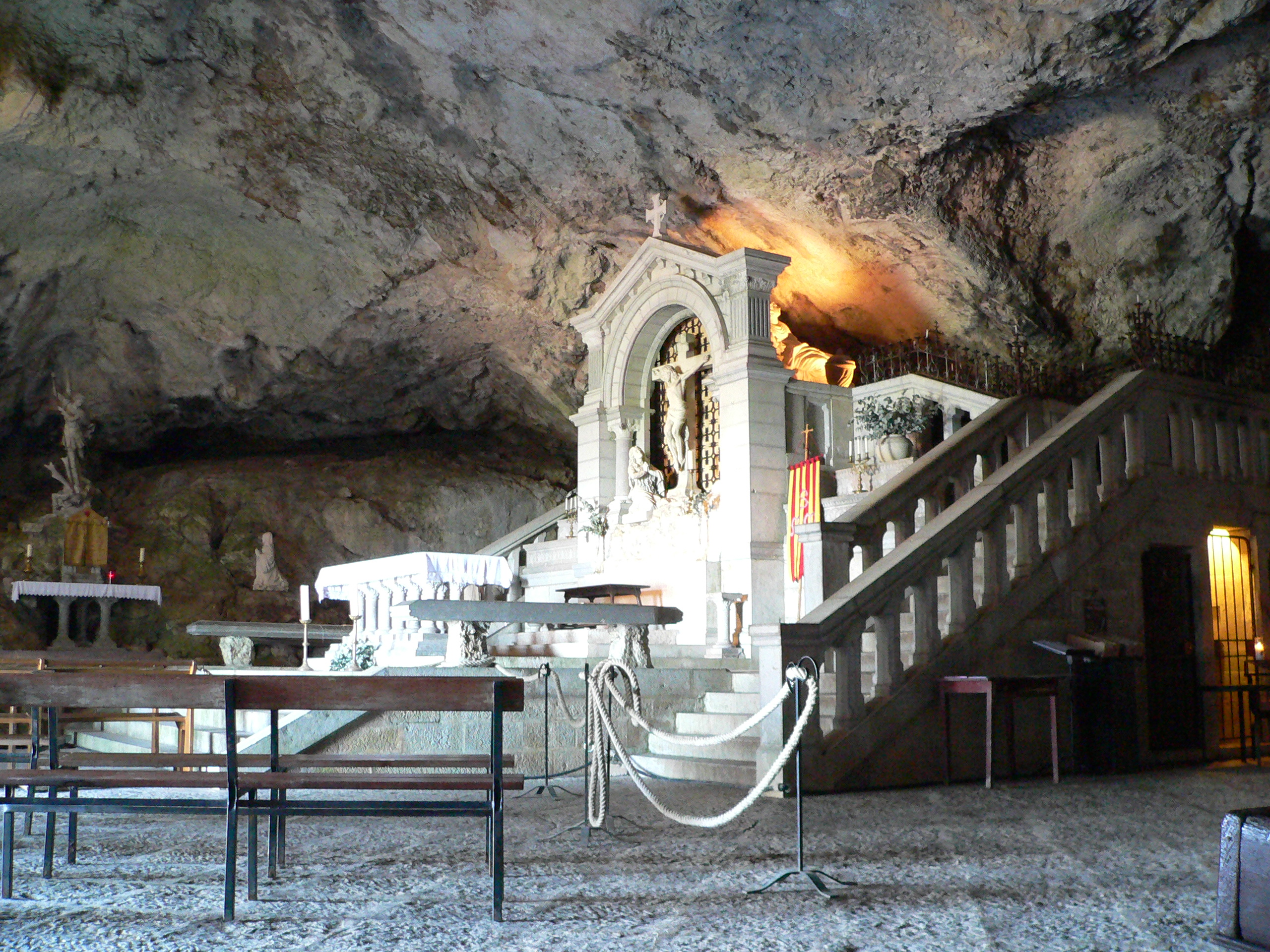
Grotto of Mary Magdalene in Sainte-Baume, by Disdero
http://www.escholarship.org/uc/item/7pz6w018
by Dr. Sarah Wilkins, professor of art history and design.

When Jadwiga was enthroned, however, several suitors appeared, hopeful for marriage and crown. William also appeared at the court in Krakow, as he was thinking now was the right time to got get married, after all Jadwiga was his fiancee. He was bitterly disappointed: the young sovereign declared the annulment of their contract, and the Habsburg duke went home.

Jadwiga got married three years later, she was 13 years old. Her king consort became duke Jogaila of Lithuania, who being a pagan needed to convert to Christianity. And through Jadwiga's influence the last pagan country of Europe was Christianized.She didn't need to preach to pagans: she just made the requirement that he husband to be needed to be Roman Catholic.

Svitrigaila  the owner of holy chalice (which one of two?)  lived with his hopes for Lithuanian throne in Bezlawki, in the area of crusader state of the Teutonic Knights, the military order which also targeted pagan Lithuania in their Northern Crusades. His alliance seemed easy, as the Teutonic Knights were believed to be invincible. Yet they were crushed, one day, and by no one else than his brother Jogaila with armies of allies.Life of Svidrigaila was marked by wars and dynastic struggles. He became grand duke of Lithuania for two years, noting more.

As Jogaila was baptised in Wawel Castle in Krakow, Christianization of Lithuania was official in 1386 The marriage couldn't happen without Jogaila's

 Svidrigialla also got baptized with his brother at the Wawel Castle. He converted from Greek Orthodox faith of his mother into Roman Catholicism.But in his case it was of no great political advantage. 

Because Jogaila became king of Poland, this didn't mean that Jadwiga was now a queen consort. She was the ruler, marriage didn't chip away her power, he was the king consort, but of course both were politically active. Jadwiga was known for her charity, good character and for her support of good causes. She was so much liked and revered by people that she was considered a saint, and legends of her miraculous powers spread. This was a queen of a true noble ideal of a virutous lady.She died young, only 26 years old, after complicated child birth. She and her daughter lived only one month. This was nothing unusual in those days, even among people who were very privileged, such deaths happened among ruling families too.
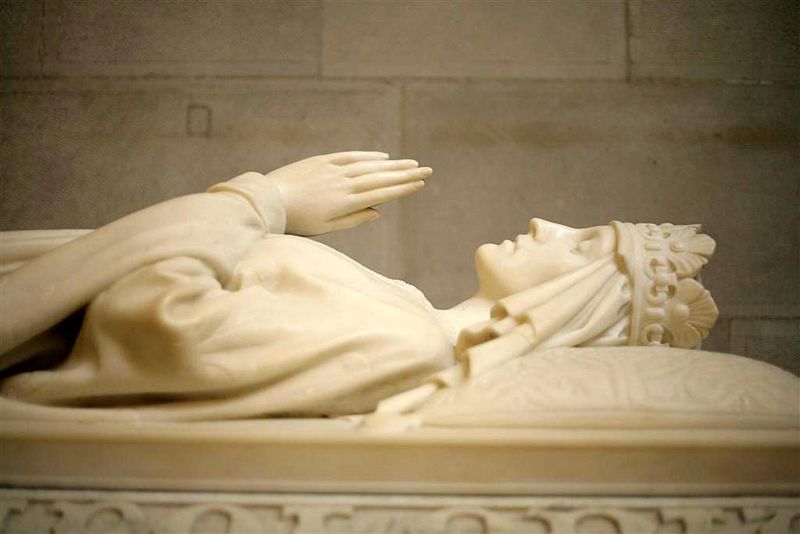
Sarcophagus of Jawdiga of Poland, Wawel Castle Cathedral
After Jadwiga died she was declared a saint by people, and her cult spread. Her relics are in the Wawel Cathedral under the crucifix at front of which she prayed. Even she was considered a saint and worshiped as such, her beatification happened as late as 1980, and she was officially declared a saint by Vatican in 1997, by the pope John Paul II as you may guess. He prayed at her sarcophagus. Pity I didn't take the picture, the sarcophagus sculpture includes a nice lap dog at Jadwiga's feet.Thank you Cezary Piwowarski for the picture. (Dog symbolized loyalty). Close to the sarcophagus her regal insignia are exhibited: the scepter and the globe. They are made of wood, painted gold. Maybe those were lighter for a child ruler to hold, but also she is remembered by her unusual generosity, she sold her jewels in order to support Krakow University (today Jagiellonian University) etc.

After Jadwiga's death it didn't mean that Jogaila as consort was now entitled to rule. There were several candidates, but he was considered the most suitable one, so, he became the king.

 As for pagans in Lithuania: they were left unmolested, their priests also. As officially Lithuania was a Christian country, crusades stopped after battle of Tannenberg in 1410.

Jadwiga's patronage of art and culture is continuation of  Angevin artistic patronage of the Neapolitan Angevin dynasty. She had good examples. In the article you will see also the image of funerary monument of Mary of Hungary, Queen of Naples, who was also patroness of arts, and like Jadwiga also connected to Hungarian Arpad dynasty. Mary's mother was a pagan of Cuman tribe who converted to Christianity in order to marry Stephen V, king of Hungary, and Dalmatia, Croatia, Rama, Bulgaria, Serbia, Galicia, Lodomeria and Cumania; Duke of Styria.

More about grail in Bezlawki, also historical background, soon, I hope, and I hope you enjoy it. Knowing the legend is one thing, but knowing the people in the legend can shed additional light, in my opinion. Again, we don't need to believe in the legend, that there are historical persons it doesn't make it automatically more credible. It is just a legend after all. Wasn't the legend  about Joseph of Arimathea who brought grail to Britain also a legend of Christianisation?


Sunday, June 23, 2013

Holy Grail in Bezlawki, part 1, Escape after Hastings


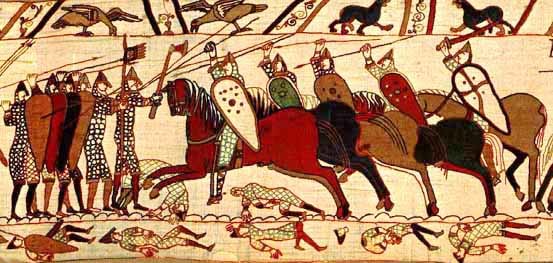
Bayeux tapestry, battle of Hastings. Via wiki commons, by Maxim

This blog has been neglected for long time. I planed and promised to write about the legend of the Holy Grail in Bezlawki, today's Poland. I mentioned before that it seems that Arthurian legends were very well received in Poland. But the legend of holy Grail in Bezalwki has some not very semi-historical events in it, and had people who are historical too. However, I am not saying here we need to believe the legend because of its historicity: it is just a legend based on real facts.

This is a story about a battle, escape, two chalices, two fighting brothers, the crusaders and a tower.
The battle in question was the battle of Hastings, when the last Anglo-Saxon king, the Harold II of England Harold II of England was killed. His children escaped to Denmark, as they were not safe anymore when  William the Conqueror became a new ruler. Short reminder: the mystical object of Medieval times, Holy Grail, was believed to be several things, one version was that it was the cup, or a chalice, into which Joseph of Arimathea collected blood of Jesus during the crucifixion. It became the ultimate  blood relic, which was brought by Joseph of Arimathea to the British Island. One version say that is connected to the Glastonbury Abbey.

 The tradition  also say that it was taken by escaping members of fallen dynasty more East, in order to save their lives, three people. They found refuge at the court of Danish king, their relative. They didn't escape empty handed, as you guess the story goes, they took  what they wanted, or rather what they thought was so precious they couldn't bear to leave behind. Among precious objects they considered worthy not to fall into the hands of William the Conqueror were two chalices, (from Britain and Greece). Finally  the grail was installed in this church, in Bezlawki, on the picture bellow. It stayed there for several centuries, still during the twenties of XX c. one travel book writer, Orlowicz, claimed he still saw one of the chalices in the church.

Church in Bezlawki today, empty, wiki commons, courtesy of Severus


Who were those three expatriate children of Harold II of England as real historical people? One of them was Gytha of Wessex Gytha of Wessex, who later became the wife of  Vladimir II Monomakh, the  ruler of  Byzantium influenced Kievan Rus. He is also known under name of Waldemar. Gytha's and Vladimir's son is mentioned in Norse sagas, there he is called Harald  his Slavic name was Mstislav. One of the brothers, Godwin, became the ruler of one of Lithuanian principalities, a duke. How it was possible? This was XI c. but Lithuania still was very similar to VI c. Britain: like at the court of king Arthur the knights took decisions during an assembly. Upward mobility was possible, still, during those days for a warrior who was considered worth of rule.

 Back to  Bezlawki: it was far away, actually when the chalices, (or chalice? ) first were installed there, the building which is the church today was not a church at all, but the fortified  tower of the crusaders. Not the Knights Templars, often they are associated in modern versions of the story with holy grail, but in this story we have Teutonic Knights, the worshipers of the Virgin Mary, with black crosses instead of red ones. They were  Order of Brothers of the German House of Saint Mary in Jerusalem. Knights form Europe joined them, not only from Germany. They were invited by pious Polish princes, Prussian Crusade was part of their military enterprise.


Church in Bezlawki, another view, wiki commons, courtesy of Jerzy Strzelecki

The Teutonic Knights came into the posession of the chalices later,but  it wasn't a war loot . It was a gift. From a rather pious ally.

Teutonic Knights, as a military order on a mission they  pressed East, however,  not South but  North, and who like those knights who went to the Holy Land got the blessing of  pope, they fought the  non-Christians, in this case the pagans, of today's Poland and Baltic states. They build a fortress which at the timescut the most east into the territories of the pagan Prussians, the Baltic people.  One  thing :  the English  version of article about Bezlawki mentions that the the fortress was a hunting lodge build by the Teutonic Knights. Not true, it was a fortified tower, a Wildhaus, as the knight called it, a house, a post in the wilderness. The forest was dense there, and I am sure there were hunters too, who hunted the wild  (it means game in German, also wilderness). However Jagd is hunting, hunting lodge is Jagdhaus. This was a fortress in which knights were stationed, not the hunters.

Two brothers, Lithuanian  dukes were in a bitter conflict. Jogaila, the older one,  who later became the king of Poland, was against the Teutonic Knights. His ascend to Polish throne happened after the Teutonic Knights were subdued and after Jogaila got baptized, it was the Christianisation of Lithuania. His younger brother,  Svitrigaila, sided with the Teutonic Knights, he also brought for them two mentioned chalices which were installed in the tower. Not too unusual, as the relics in the Medieval times were believed to help in difficult situations, and an outpost so far East probably was considered worth of help. Svitrigaila was invited to live in the tower together with his garrison. So, he didn't really give it away,  he moved with it. Svitrigaila still during XX c. was considered direct descendant of Harold II of England by Polish historians. Teutonic Knights promised him the crown of Lithuania.

More information follows soon.One Polish Medieval chronicle is somehow unusual,  it shows that Arthurian legend was taken seriously.Also two Lithuanian Grand Dukes were married to women who became divine: one was considered a goddess (she was a pagan), the other became a saint. Both were worshiped. Also the Nazis had it base very close: 30 buildings, 50 bunkers. It is today a tourist attraction, called Wolf's Lair.

As for the story, yes, it is kind of difficult to believe, it is a legend after all, we don't need to believe it. (I don't). Is it difficult to believe that such legend exists in Poland? Why? legends of escapes are not uncommon in Poland, it was a country to which refugees often went. And you can find this legend retold in polish on the net. Here are links to a website of a licenced tour guide (site in English) where the lady talks about  the legend, another is website of the town near Bezlawki. Not the only articles on net about this legend. This i part of tradition, really.

Blog entry by the tourist guide, she describes it well

Article in Polish, sorry, gmina Ketrzyn site, lots of hsitorical inforamtion


Thursday, August 23, 2012

Mountain of Venus: legend about Tannhauser

Recently I saw with my husband the movie Wagner's Dream. Totally fascinating documentary (and my husband told me it was very interesting to watch me watching the movie, my reactions, etc.) It was about the Ring of Nibelungen cycle, but this brings me to Tannhuaser, the other hero of Wagner's operatic world, and the legend about Mountain of Venus, a real mountain called Venusberg close to Horschelsberg. Located between Gotha and Eisenau in Thuringia, Germany. This area was explored by ethnographers of the XIX c., the Grimm Brothers included.Certain legends are as significant in German cultural heritage as the legends of King Arthur in Britain. This one is about Tannhauser, a knight and  a poet who supposedly took part in the literary competition at the Wartburg Castle, along with few of other historically known knight-poets.The real life Tannhauser (or Tannhauser, as his name was also written), as a poet wrote very erotic and easy-going pieces, not as refined as the courtly love poems by the other knight-troubadours (Minnesangers in German,  literally singers of love).

The Mountain of Venus itself is located somehow close to the  Wartburg castle. Here according to records (which may or may not be true) took place a competition between Minnensangers, who were German troubadours. Among others beside Tannhuaser very famous names come up: Walter von der Vogelweide, also Wolfram von Eschenbach, who is probably most known as the author of the Grail romance; Perzival.
You can see  them and their poetry in the Codex Manese manuscript

Here at  this mountain  with caves,  according to the legend, Tannhauser, their real life peer,  knight and poet,  met the goddess of love, Venus herself. She was surrounded with her court of beautiful women, and invited him to her subterrean world. He followed gladly, as he was a very sensual person, and through they entered  through the cave into the earth. The knight resided there for seven years. Some versions talk about one year. He enjoyed the easy fulfilment of all his carnal desires, and was very happy, unaware of passing time.  But finally he started to  feel empty, longing for earth, in spite of all delights, including pleasures given by Venus herself.

Venus Cave bellow, auhtor: Metilsteiner.
Venus Cave, Venusberg Mountain, Thuringia
Venus, however, didn't allow him to leave. When he was thinking of Virgin Mary, yearning for freedom, the Virgin appeared in an instant, and all charm of the under-terrestial world disappeared. At once Tannhauser found himself at the feet of the Wartburg Castle.

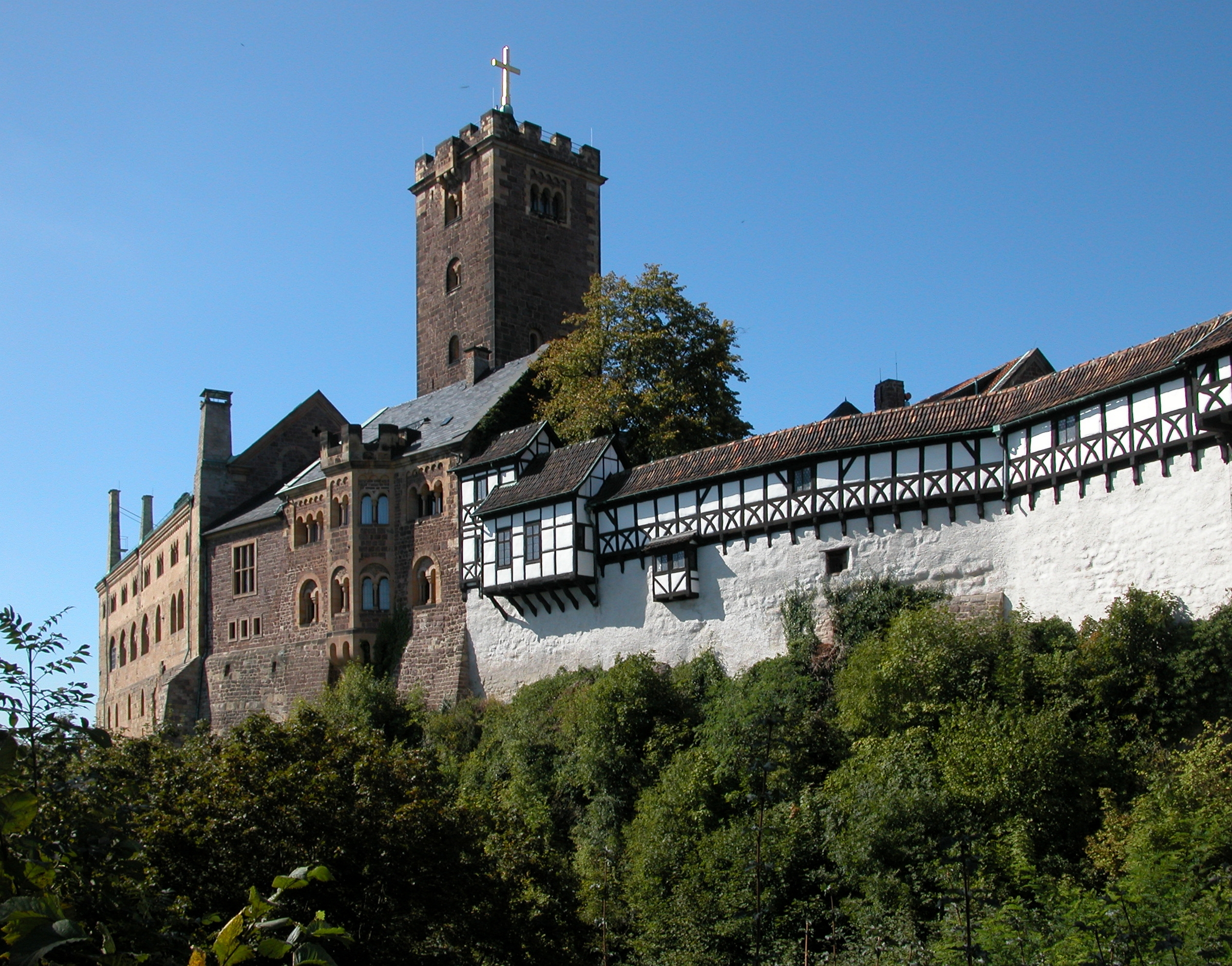
Wartburg Castle,  by Robert Scarth                          .
Yes, the same where Luther was given protection, the house of St. Elizabeth, and the place of competition of Minnensangers, and featured in Wagner's opera Tannhauser. Click on the picture to see high resolution.
Here he felt free , and in a state of rapture collected flowers. It was a kind of religious ecstasy. He decided to confess all his sexual debauchery, and ask Got for forgiveness. However, every priest who heard his confession was too shocked and didn't want to grant him absolution, telling that God will never, ever forgive such sins. Tannhauser even went to Rome in despair, confessed to the pope Urban IV himself, and asked for  forgiveness again. All this made the stern pope very upset: he said that first his pontifical staff  "will rather grow green, and bloom than God will forgive such lust." Depressed Tannhauser departed, decided to go back to the Venusberg, as there was no place for him on earth, he went back to the goddess and her realm of carnal pleasures. But after three days the pastoral staff of the pope greened with lush leaves, and flowered profusely. The pontiff send his  messengers after the desperate knight, but they couldn't find him anymore. The people in the village close to the  Venusberg told them he passed by, with somber face.He was never found again.

Picture on the left  is Tannhauser himself, from page of Codex Manese where some of his poetry are compiled, among them also a repentance song. The Codex is an anthology of medieval German poetry. The legend of Tannhauser made to German literature during XIX c. when literati  started to be interested in folklore and medieval world. But the strongest increase of popularity came after Richard Wagner's opera, named after the poet and retelling the Venus  legend, and the story about   competition at the Wartburg Castle, combined with Wagner's own creative liberties.

The Venusberg story is very interesting for three reasons: first it talks about real-life poet and maybe a real-life poetic competition, fits the history of a  personality, and his creative output into a legend. Second, it is an old legend Christianized, similar as the grail story was Christianized,it is a hybrid. It shows dynamism of a society which was in transition from culture of paganism to conforming into a new religion, and still quite new fedaul reality. The third reason: it gives a moral lesson about forgiveness, which it is not granted freely, and forces the protagonist to go back to the old ways.It shows that people are not forgiving, but the divine forgives. A lot of moralising here: about the goddess Venus and her court, personality of the  poet knight, but also about the hard hearts of the clergy.No one is spared, and in this story the divine gives a lesson that forgiveness should be granted freely and quickly, and this is a true loving way. The story is of course about carnal and spiritual love, and about serving a lady, but it is so multi layered. This were also times when Europe clarified its own ideas of romantic love.

Regarding an old legend combined with Christianity; Sabine Baring-Gould mentioned this one  in his book Curious Myths of the Middle Ages. He reported that the legend appears in its basic version in many countries in Europe, on which the local folklore built other layers. No confession and clerical invlovement is seen except Taanhauser story.Which I was not aware of. Basic version is that under-terrestrial beings want to contact human beings. A man comes in contact with them, has a very beautiful women as  a lover. He longs for earth, and escapes. However, he needs to return, as the earthly world is not receptive to him anymore. Baring-Gould gave examples of stories which have variations, but retain the basic roots. A very folklorist  view. Sometimes a pagan goddess, sometimes the goddess Venus herself  is present, and there is also a motive of ring and the marriage. There are also more mountains of Venus in Germany, also in Italy, there called Venus mountains, or mountains of Sybil. (I wonder if this has to do with Roman presence there). Baring-Gould also mentions that  the story of Tam Lin, tells stories from Catalonia, Farroe Islands, Sweden, Pomerania, Switzerland, etc. and mentions written versions by various ancient authors.Some are more related, some are more distant relatives.

 I also see now the connection between a legend from Poland, about a young knight who went through the waves into the heart of the lake to be married to some beautiful woman who held a court there. He was telling his loyal horse-or loyal friend who was a rider, depends on version- to go to and to tell his family he wedded a beautiful lady of the lake. The mother of the knight in the bottom of the lake knew the  he will never come back. Poland has of course many stories about aquatic world, courts and the cities, as there are so many lakes.

Tannhauser was present among supernatural beings, under the earth. Main ruler of the court here is chtonic type of the goddess, in spite of the goddes being Venus,a conflation. And the idea of under-terresatial folk itself reminds me of a huge bestseller, kind of  the Da Vinci Code of the turn of XIX c. It was a novel about Vril and subterrean super race living in  caves under the earth. The novel was an enormous financial success. Many people actually believed in reality of such race, and this belief was rumored to linger for long. Some of the Nazis supposedly believed it, it was believed in some occult circles, in Theosophy belief in Vril still exists to some extend. It was a novel, but seriously captured people's belief in reality. Vril, similar like the grail, is the idea about power granted, about  fulfillment of wishes. No wonder that both, the grail and the vril resonated so strongly with the audiences.  Recently we had The Secret phenomenon, which falls in the same category:  power of fulfilment of wishes, power of belief. Law of Attraction, another magical world for the frustrated. But I prefer the legends, I confess, Vril and the Secret don't attract me.  Are they an equivalent of today's court of Venus, where first after some time one sees the illusion?

As for the caves in Venusberg: local society hopes they will attract tourism, and the caves were explored. In them are diverse colonies of rare  bats, which hopefully will not suffer in case tourism increases one day. Iron bars at the entrance of some caves make a lot of sense, and here is a responsible way of protecting nature.

Thursday, August 9, 2012

Templar Treasure Legends in Poland, Templars-part 3

The believers of  the legends about the knights Templars escaping to Poland have one valid point: Poland was one of very few regions in Europe which practiced religious tolerance. Relatively, for those days. Later in the history several hundred different believers or atheists were killed. Poland wasn't "the country without burning stakes," as sometimes was called. This is a myth. However, the level of religious tolerance was higher than in other European countries, even later in comparison to for ex. tolerant Netherlands. For long no single religion dominated. However, the popular religious movements in Europe were also rebellions of the peasant and those of  urban poor as they spoke against the excesses of the religious leaders and aristocracy. Such rebellions were gladly helped by the feudal lords, who saw those as not only rebellions against religion, but also against their "God given" privileges. The Templars were of the privileged class.

One of the Templars forum member in Poland wrote once jokingly in his post that he will reveal where the Templar treasure is located, and this revelation will cause obsessions, mental illness etc. for those who will search for it. Poland, sadly, has its own brand of treasure hunters, who illegally dig and damage historical sites which could be properly excavated by archaeologists, and properly secured by them in order to prevent further damage. There is something of a touch of madness in such enterprises too by individuals armed with metal detectors, shovels, flash lights and night visors. Directed by greed and in search for becoming another Indiana Jones.Some inhabitants of the places associated with treasures fear them, (damage not only historical sites), and chase them away. In Rennes le Chateau associated with story about Templar treasure illegal digs was also a huge problem.

There are legends associated with Templar treasure in Poland, and in an old German folk song, telling about the Templars, their castle and their treasure in Poland. In Poland the  treasure legends are relatively numerous in comparison to the legend of the location of the Holly Grail, which is bound with one location only.

 I mentioned the legend of Templar fleet which was sailing from Marseilles to the Baltic Sea down the river Vistula already. It was supposed to carry Templar treasure from France, away from the greedy hands of the king Phillipe the Bel.

Some legends mention him by name, and there are other names of people involved, their kinship, if applicable, nationality, etc.One particular legend, which according to another oral tradition, resulted in treasure hunt by the Swedish, who during the Deluge (war with Sweden) were taking apart the walls of the castle of the local lord whose predecessor allegedly took the treasure for himself. This legend is strangely detailed, with the names of all people  involved, all details mentioned above, rank in the  Templar order, events such as hunting,  injuries on parts of their bodies, emotional and family relations etc.Long and very detailed story. With lots of details, which can of course make someones head spin. This is the story how a Polish local lord together with his relatives attempted robbery, knowing about the treasure, when the plan of the robbery didn't bring any desired results-as robbery happened,but  treasure wasn't there- they spied on the treasurer who hid it. (He was form Western Europe). Than they stole the treasure, and were in fight with the treasurer, with swords, when one of the robbers killed the treasurer with an arrow shot form the distance, a very un-knightly behaviour in addition to the robbery.

 I am omitting here the details of the story, which is long, and out of respect for the past troubles which this story excited. I was born and lived not too far from one of the locations of alleged Templar treasures, I respect oral traditions, but I found out that not everyone shares similar respect. Mentioned the treasure hunters already. Not like you and me, for  some people this stuff  simply creates confusion, oral tradition is only as interesting as can allegedly point to the location of the treasure. Sad but true.

The other legends about the Templar treasures are of course bound with the locations of former Templar commanderies, of villages owned by them with sometimes telling names as Templewo. Quite often they are very similar to the legends which were  teaching social mores, and were against the vice of greed. They are very similar to the legends about the treasure connected to the Summer Solstice hoard, just the treasure was Templars' and the access there was only during the Winter Solstice, during the Midnight mass, when the guardian spirits or the devils leaved the place leaving the doors open. The versions tell about one man who found the place, and was courageous enough not to be sacred of the spirits. Each year took some of the treasure, but one year he took too big of the sack, and busy to fill it with riches was captured there forever as the doors closed again when the mass was over. He was changed into one of the guarding spirits.

What about the legends which are not fantastic at all, like the legend above, which mentions just the events, without any supernatural involved? May they be true? Maybe yes, maybe not. People were gossiping during the Middle Ages and later, and were even paid for their gossip, when they told interesting story, as today. Their story might have been a sort of bestseller when they were journeying from village tot village, and from castle to castle, story telling was a profession. As today. Those stories than took life on their own when were retold. But sometimes the stories in oral traditions give pointers to the truth which is than confirmed by archaeologists, as the tale about Johannites, one of the military orders with which the Templars merged. The legend said that those knights were growing unloyal toward the Polish king, and also were minting counterfeit coins. The angry king took over their castle. Today's excavations in the castle lead by archaeologists unearthed minting presses and fake coins of various origins, among them fake coins of the Teutonic Knights, the other crusaders present in the country .

Sometimes I wish the rumors of the treasure will be combined with the treasure found in Poland, extremely valuable, hidden during XIV.c. found during the second half of the XX c. now is possession of museums.Why not to say this was the lost Templar treasure, and stop digging for it? Among the treasure's precious objects was also this beautiful royal crown. It is difficult to appraisals of  treasures, but this one was is worth today from 50 million to 100 million dollars. Fitting rich organization, like Templars.

Via Wikipedia Commons 
 And here is a rather creepy edited video with some castles in Poland, some of them associated with Templar treasure. I dislike the soundtrack, very much to be honest.


 Ruins of the Castle Ogrodzieniec is one of the alleged sites of the Templar treasure location. There is the well, recognized by the cross bars, from which according to another tale appears a huge black hound, very terrifying beast appears from time to time.  This  is the ghost of the one's of the owners who rebuilt the castle, and he was an immensely rich man. The castle itself was very rich. Actually competed in splendor with the royal castle in Cracow. But its owner was also a sadist, very protective of his treasures, and as the legend say, he was punished for his cruelties by becoming a hunting spirit in the the form of this huge black dog.
Treasure were always stuff of the legends, and excited human emotions as lotteries and Las Vegas slot machines are. Treasure stories are also archetypical belong to the quest category.