I wrote before that during middle Ages some ideas took lives on their
own (proto- sciences). Today I will talk
about folklore.
There is folk current in European Christianity, for example the folk
Catholicism. Secular or pagan stories which were liked were appropriated, so, the Christian/religious current and
the pagan/secular one created very interesting stream.
One story is form Ukraine, and Belarus,( if I am right), and it is about a bird: the raven. It tells that "the raven’s plumage was very colorful
as a rainbow, and even was radiating rays. Raven was a true bird of Paradise." When
the paradise was no more, the land become barren, and the raven become
black. But his plumage will be back in its full glory the moment the Paradise is
back on Earth. Medieval art represented Paradise as radiant and colorful,
cathedrals and basilicas were earthly representations of ideal of
Paradise.
Other legends relate to concrete objects, art which were found and installed in
local churches and enjoyed special devotion. Typical motive: the sculpture, for ex. a Black Madonna, or an icon
was lost during turmoil, than was found in a miraculous way. Or even appeared
in a miraculous way from the beginning, without being lost. The finders were the animals, such as cattle, or an owl, or a
sheep. It appears to me that the animals are the most frequent finders of religious art, but I am not a folklorist, and
those are just my original studies. My formal studies in this subject are limited,
were part of my anthropology class, and dealt with the subject of art objects which were subject of veneration in Catholicism, and especially those relating to healing. I don't
claim special knowledge here, (reading and listening stories passed as
part of living oral tradition).
Sometimes instead of the animals young children are the finders.find the art taken then to
the local church, or a blind woman. The story about the blind woman whose
blindness was healed when she stood in the river and the crucifix was floating
on the water, the Jesus on the crucifix talked to her and she was healed. It relates to one small village in Poznan region, Poland. This
particular story has variants, including the treasure which was dug up by the
oxen. The finders are somehow innocent, or under-priviledged. Those stories represent the idea that the divine is very accessible, and approachable through intuition, no special intellectual training is needed.
But lets go back to the story about the blind women. When the women was told by Jesus on the crucifix he wanted to stay at the
local church (common motive, the holy one depicted decides on location where
he/she wants to stay). The crucifix was pulled out of the river and put on a cart which was supposed to be pulled by oxen. But the load became so heavy, the oxen couldn't pull the cart even a a single step forward. They just were stepping in
place. They tried and tried, but couldn't move, were just digging deeper and deeper into
the soil. And this is how the oxen dug up the chest with golden treasure, from which the
money was spend for renovation of the church. The chest is still exhibited in
the church; the crucifix itself is in Gothic style, dated by art historians as
created during early 15 c. The church itself became a local pilgrimage site. The crucifix was moved to other churches, richer and more impressive.The crucifix appeared in a miraculous way back in its humble church which was chosen at the beginning. This is also common: the artifact wants to stay in one and only place. But always I
didn't visit this place, I didn't see the crucifix and the chest, but I listen to
the story told by very old people. Maybe one day, I will visit this place too.
Friday, April 6, 2012
Tuesday, April 3, 2012
Red: Mary Magdalene's Case:Medieval Art, History of Color # 7
Mary Magdalene wasn't depicted only in red though history, as Virgin
Mary wasn't depicted in blue only. But let take a look at the red, as
both Marys were depicted in red garments. For example the red of the
robes of Mary Magdalene had a different, double symbolism, than for
example red of other persons' cloaks. Mary Magdalene's robes were
painted in cinnabar red, (vermillion), having more hint of orange. Red
in general can tend toward more to direction of yellow, or blue, and
during the Middle Ages the quality of red was important, which red was
symbolizing which idea. The other red symbolized regal values and
charity.
Here comes Crucifixion by Juan Rexach from Northon Simon Museum, Los Angeles. Due to poor lighting conditions the color of Mary Magdalene robes not very accurate on this photograph, in person is like on the photo bellow.
Here you can see desctiption and a better quality photo
You can zoom into, and see very well the specific color of Mary Magdalene's garment.
I am glad that Maria Rzepinska wisely comments is her book about color
that red in Middle Ages was not just red, but it had two aspects. Red
was one color in which case people paid attention to its shade, shades
had codified meaning. Two types of red were differentiated: the noble
one, considered sublimed, and the earthly one, viewed as "sinful".
Several examples of this red can be seen close to my living place in
California: Norton Simon Museum and the Huntington Library art
collection.But today Massacio, as more widely known.
In general, red stood for love in sense of charity, blood of martyrs, sacrifice on the cross, redemption through crucifixion. But as it could be a color of love in spiritual sense, redemption, also when in specific tone, could symbolize sin, or lust, or both: redemption form sin.This dichotomy is visible in portrayals of Virgin Mary as the sinless one who is represented in another red than Mary Magdalene ( dressed in "sinful" red). A medieval painted wouldn't confuse those two reds.
We need to remember that color in medieval art isn't always symbolic: sometimes just the need of decorative usage of color was important. In Latin Christianity (Byzantium was another case) the robes of such a person as Virgin Mary wouldn't have been painted in the same as red of Mary Magdalene's.
Above the crucifixion scene by Masaccio, Mary Magdalene in dramatic gesture of devotion and anguish dressed in red so typical for her. Although there are quite a number of representations of Mary Magdalene in this type of red, specially at crucifixion, this one is probably the most famous one. It is still very medieval. But there are hints of coming of the new era: the Renaissance in Italian art,there are more of human emotions shown. Gothic was very emotional in other countries, (for example showing suffering of Jesus), but art in Italy was more reserved, making more usage of Byzantine ideals.
All older medieval representations of crucifixion in Latin Christianity would show Jesus fully dressed, each foot nailed separately, and no signs of his suffering. With the passing of time Jesus became more humanized, specially in the art of Northern and Central Europe. The body was more and more exposed, agony and blood shown, feet nailed together. For example in German art Jesus was shown with great attention to expression. From Jesus as a symbol there was a shift toward showing Jesus as a human being.
What about Masaccio himself? His name was Tommaso di Ser Giovanni di Simone. He died when he was only 27 years old, and he wasn't as famous as the other painters of his times. Even his name was a humorous take on his given name. Masaccio, as he is known even today, is a form from Tom, meaning "clumsy" Tom, as separated form his collaborator Masolino, the "delicate " Tom.
Yet Masaccio influenced the other Italian artists. It was his example which caused a shift in art: more and more toward realistic representations of the world around. Here we see a paintings which is still medieval: composition, golden background. But carved into the golden background humans who were much more real, not idealized, captured in a moment of strong emotion. Figures are real, not ideal.
Other colors of Mary Magdalne's robes in another post, more colors.
And my post about Mary Magdalene depicted in blue click here
Byzantine Christianity depicted her also in red, with an egg in her hand. In this tradition she was an extremely virtuous woman in similar age of Jesus's mother, and both women died in Ephesus. Mary Magdalene's body was was kept in Constantinople as a very venerated relic. This dissapeared still during the Middle Ages, but also later her relics started to be venerated in Western Europe, Latin Christianity. Relics were hot commodity then, and many stolen from the Churches in Constantinople in 1204 when crusaders sacked and looted this cultured city. Virgin Mary's house is believed still to be there, what was one part of the Byzantine Empire, among ancient ruins of Ephesus, today in Turkey, in a rather remote location but among the most wonderful ruins.
Here comes Crucifixion by Juan Rexach from Northon Simon Museum, Los Angeles. Due to poor lighting conditions the color of Mary Magdalene robes not very accurate on this photograph, in person is like on the photo bellow.
 |
| Crucifixtion by Jaun Rexach, Norton Simon Museum Los Angeles |
Here you can see desctiption and a better quality photo
You can zoom into, and see very well the specific color of Mary Magdalene's garment.
 |
| Crucifixion by Masaccio, Museo di Capodimonte, Naples,public domain, via Wikimedia Commons |
In general, red stood for love in sense of charity, blood of martyrs, sacrifice on the cross, redemption through crucifixion. But as it could be a color of love in spiritual sense, redemption, also when in specific tone, could symbolize sin, or lust, or both: redemption form sin.This dichotomy is visible in portrayals of Virgin Mary as the sinless one who is represented in another red than Mary Magdalene ( dressed in "sinful" red). A medieval painted wouldn't confuse those two reds.
We need to remember that color in medieval art isn't always symbolic: sometimes just the need of decorative usage of color was important. In Latin Christianity (Byzantium was another case) the robes of such a person as Virgin Mary wouldn't have been painted in the same as red of Mary Magdalene's.
Above the crucifixion scene by Masaccio, Mary Magdalene in dramatic gesture of devotion and anguish dressed in red so typical for her. Although there are quite a number of representations of Mary Magdalene in this type of red, specially at crucifixion, this one is probably the most famous one. It is still very medieval. But there are hints of coming of the new era: the Renaissance in Italian art,there are more of human emotions shown. Gothic was very emotional in other countries, (for example showing suffering of Jesus), but art in Italy was more reserved, making more usage of Byzantine ideals.
All older medieval representations of crucifixion in Latin Christianity would show Jesus fully dressed, each foot nailed separately, and no signs of his suffering. With the passing of time Jesus became more humanized, specially in the art of Northern and Central Europe. The body was more and more exposed, agony and blood shown, feet nailed together. For example in German art Jesus was shown with great attention to expression. From Jesus as a symbol there was a shift toward showing Jesus as a human being.
What about Masaccio himself? His name was Tommaso di Ser Giovanni di Simone. He died when he was only 27 years old, and he wasn't as famous as the other painters of his times. Even his name was a humorous take on his given name. Masaccio, as he is known even today, is a form from Tom, meaning "clumsy" Tom, as separated form his collaborator Masolino, the "delicate " Tom.
Yet Masaccio influenced the other Italian artists. It was his example which caused a shift in art: more and more toward realistic representations of the world around. Here we see a paintings which is still medieval: composition, golden background. But carved into the golden background humans who were much more real, not idealized, captured in a moment of strong emotion. Figures are real, not ideal.
Other colors of Mary Magdalne's robes in another post, more colors.
And my post about Mary Magdalene depicted in blue click here
Byzantine Christianity depicted her also in red, with an egg in her hand. In this tradition she was an extremely virtuous woman in similar age of Jesus's mother, and both women died in Ephesus. Mary Magdalene's body was was kept in Constantinople as a very venerated relic. This dissapeared still during the Middle Ages, but also later her relics started to be venerated in Western Europe, Latin Christianity. Relics were hot commodity then, and many stolen from the Churches in Constantinople in 1204 when crusaders sacked and looted this cultured city. Virgin Mary's house is believed still to be there, what was one part of the Byzantine Empire, among ancient ruins of Ephesus, today in Turkey, in a rather remote location but among the most wonderful ruins.

Monday, April 2, 2012
History of Science at Chartres Cathedral, and Zodiac
In the previous post there was Zodiac window form Chartres, today is the astronomical clock. Strange setting for such symbols?
No way. Zodiac then was nothing unusual in churches. So, why all the mystery so many tourists talk about? Actually there is nothing mysterious about it. Explanation follows.
First, the clock comes form XVI c. but its ideological roots are medieval, and proto-scientific, not really esoteric. Astronomy, astrology, the synthesizing medieval minds didn't see the difference.
It is a common misconception that the Middle Ages were not interested in science, only in religion, or there was no reading of Classical texts before the Renaissance. Actually the classics were read, not as widely as during the Renaissance, of course, but were not unknown, rather kept in high esteem. Many Classical and Arabic texts of science were translated into Latin. Arabic texts about astronomy, mathematics, anatomy and chemistry, and medicine contributed a lot in development of Western medical sciences, we often forget about it. Or simply don't want to know. And there was no agreement about if the Sun was the center of Universe or moved around the Earth. The official decision in favor of the Earth as the center of the Universe came later. Science was fine as long it didn't oppose any dogma. For example the theological idea of dignity of the human body was applied to the medical field, and this particular idea didn't allow dissecting human corpses for anatomical research. Dead animals were dissected instead, specially pigs. Sometimes, rarely, human bodies were dissected also.
No way. Zodiac then was nothing unusual in churches. So, why all the mystery so many tourists talk about? Actually there is nothing mysterious about it. Explanation follows.
 |
| Chartres Cathedral Choir, Astronomical Clock, via Wikimedia Commons, thanks to Harmonia Amanda |
It is a common misconception that the Middle Ages were not interested in science, only in religion, or there was no reading of Classical texts before the Renaissance. Actually the classics were read, not as widely as during the Renaissance, of course, but were not unknown, rather kept in high esteem. Many Classical and Arabic texts of science were translated into Latin. Arabic texts about astronomy, mathematics, anatomy and chemistry, and medicine contributed a lot in development of Western medical sciences, we often forget about it. Or simply don't want to know. And there was no agreement about if the Sun was the center of Universe or moved around the Earth. The official decision in favor of the Earth as the center of the Universe came later. Science was fine as long it didn't oppose any dogma. For example the theological idea of dignity of the human body was applied to the medical field, and this particular idea didn't allow dissecting human corpses for anatomical research. Dead animals were dissected instead, specially pigs. Sometimes, rarely, human bodies were dissected also.
Chartres itself had a cathedral school, as often was the case with such buildings: there were also centers of learning, not only part of religious live of communities as today. Chartres was one of such centers, and was among the famous ones. Neo-Platonism was flourishing there, sciences were treated as separated from theology. A number of so called than natural philosophers (philosophers interested in science) came from Chartres. School of Chartres became less influential when universities started to compete with cathedral schools, but this was a case with all cathedral schools.
So, if the clerics of Chartres were so scientifically minded, why such thing as Zodiac in the cathedral?
Here we need to understand the mind of people who lived before us, and don't project our XXI c. world view on them. The clerics form Chartres were still products of their times, and during their times astrology was science, before the Catholic Church opposed it, and before it was mocked by the scientists of the Enlightenment era as superstition, not a scinece. Medicine was part of curriculum at Chartres school, and astrology was officially part of medicine also. Here is the illumination dealing with the human body as related to Zodiac.
In addition to proto-scientific reasons, Zodiac was a very popular motive in depictions of passing time. One was very common: the labors of the months. Frequently months and Zodiac signs were tied together, and this is often found in medieval churches and religious manuscripts. Labors of the months showed secular world. Zodiac window at Chartres belongs to this popular category. Here is incomplete list of zodiacs and labours of months in churches.
Another example, most famous of this type is the series of illuminations from the mentioned Book of Hours of Duke de Berry, (the same book from which the illumination above comes from). It is not the only example of this kind, but among the most beautiful ones, if not the most skilfully rendered, so far. Here it is, via Wikipedia article and picture gallery.
The Book of Hours of Duke de Berry is of the most beautiful examples of book illumination in International Gothic style, and contains a very good example of Gothic blue, specially loved and used in France.
Art history itself is an interdisciplinary endeavor, and understanding history of science or cultural history can enhance knowledge of art. Art doesn't exist in historical vacuum. It is connected to the world around, it exists in historical contexts. Striping old art form its historical context can give us only partial insight, and lead to some misunderstanding too, some of them can be quite funny.
So, if the clerics of Chartres were so scientifically minded, why such thing as Zodiac in the cathedral?
Here we need to understand the mind of people who lived before us, and don't project our XXI c. world view on them. The clerics form Chartres were still products of their times, and during their times astrology was science, before the Catholic Church opposed it, and before it was mocked by the scientists of the Enlightenment era as superstition, not a scinece. Medicine was part of curriculum at Chartres school, and astrology was officially part of medicine also. Here is the illumination dealing with the human body as related to Zodiac.
 |
| Anatomical Zodiac Man, Limburg Brothers, Book of Hours of Duke de Berry, illuminated manuscript tempera on vellum, public domain, via Wikimedia Commons, thanks to Petrus Berbygere |
In addition to proto-scientific reasons, Zodiac was a very popular motive in depictions of passing time. One was very common: the labors of the months. Frequently months and Zodiac signs were tied together, and this is often found in medieval churches and religious manuscripts. Labors of the months showed secular world. Zodiac window at Chartres belongs to this popular category. Here is incomplete list of zodiacs and labours of months in churches.
Another example, most famous of this type is the series of illuminations from the mentioned Book of Hours of Duke de Berry, (the same book from which the illumination above comes from). It is not the only example of this kind, but among the most beautiful ones, if not the most skilfully rendered, so far. Here it is, via Wikipedia article and picture gallery.
The Book of Hours of Duke de Berry is of the most beautiful examples of book illumination in International Gothic style, and contains a very good example of Gothic blue, specially loved and used in France.
Art history itself is an interdisciplinary endeavor, and understanding history of science or cultural history can enhance knowledge of art. Art doesn't exist in historical vacuum. It is connected to the world around, it exists in historical contexts. Striping old art form its historical context can give us only partial insight, and lead to some misunderstanding too, some of them can be quite funny.
Saturday, March 31, 2012
Lost Secrets of Chartres Blue? History of color, and why astrology in a church?
A story instead of history? It happens.
Some people believe that making of blue color from the medieval stained glass windows of Chartres Cathedral was kept very secret, and the secret vanished. Since Middle Ages no one was able to re-create the famous Chartres-blue. Interesting story, very romantic, but simply not true. It is a part of cultural phenomenon involving romanticizing and sensationalizing art history. Specially the mystery of Chartre's blue was beloved during the era of Romanticism. Such sensationalizing happens most often in archeology, but art history isn't free from such exciting modern legends.
Some people believe that making of blue color from the medieval stained glass windows of Chartres Cathedral was kept very secret, and the secret vanished. Since Middle Ages no one was able to re-create the famous Chartres-blue. Interesting story, very romantic, but simply not true. It is a part of cultural phenomenon involving romanticizing and sensationalizing art history. Specially the mystery of Chartre's blue was beloved during the era of Romanticism. Such sensationalizing happens most often in archeology, but art history isn't free from such exciting modern legends.
In fact, there are enough of ancient "recipes" for
making stained glass which survived until today. Problem with medieval recipes is that they often don't makes sense, because terminology is confusing, like for example the idea that sapphire was added in making stained, glass, when this was also latinized name for saffer, which was name of cobalt oxide. Often the color is also affected by patina, impurities, or the main compound: the sand. Subtle differences matter, for ex. if the was taken from the river or if was sea sand. We can't know exactly, we know which compounds were added, but in which form we don't know. Also the combination of blue with other colors on the installed window itself makes it look specific way, using the optical principle of color contrast.
But modern glass makers are fully capable of recreating the" mysterious" or "lost" Chartres-blue. It is sad to think so little about their skills and talents. Maria Rzepinska in her expertly researched book about history of color mentions those recipes, and even tells how color of the glass mass changed in relation of time involved in heating in the glass making kilns.Known phenomenon, nothing new, just a reminder. Also some impurities, air bubbles, etc. which were the result of working in more crude conditions affect the color. Today's glass is extremely pure.
But there is the kernel of truth in this disappearance story: after the Age of Faith the Chartres-blue, or to be more exact, the presence of strong colors diminished to almost disappear from stained glass windows, to reappear during XIX c. in their full glory.
So, what is the secret?
 |
| Stained glass window, with the Zodiac Sign of Pisces, Chartres Cathedral, via Wikimedia, photo taken by Dinkum |
It fact after the Middle
Ages there was less interest in installing very colorful stained glass windows
of the types as those seen in Chartres and the other Gothic cathedrals or churches. The
reason was simple: colorful stained glass windows were prohibitively expensive.
The cost of stained glass was closer to the price of precious stones than to the
cost of the stained glass of today, as Maria Rzepinska says. (And she has also has a strong supportive bibliography which is a great resource for me). We
also need to keep in mind that in addition to the already extremely high cost of its production, Gothic stained glass
windows were very thick, which made the price even higher than those which are made of thin glass panels today. And thickness makes colors more intense too.Stained glass
windows at Chartres Cathedral are for example c.1 inch thick. Due to progress
of technologies, today's stained glass which is similar to the glass of XIX c. Gothic
Revival has only a fraction of the thickness (c. 1/8 of inch) of the Gothic
glass window panels. Gothic Revival brought colored window back into buildings but adjusted with new technologies. Religious buildings of the Middle Ages needed masses of expensive glass.
The tastes also changed, after jewel-like colors of the Middle Ages white and grissaille glass became popular. With time people also became less religiously devoted than during the Age of Faith. Unstoppable religious enthusiasm which fueled building of the great cathedrals simply diminished with time.
The tastes also changed, after jewel-like colors of the Middle Ages white and grissaille glass became popular. With time people also became less religiously devoted than during the Age of Faith. Unstoppable religious enthusiasm which fueled building of the great cathedrals simply diminished with time.
The window above is a curious case in popular imagination,
as some other objects at Chartres. Many people think the Zodiac signs were too
esoteric, and foreign to the doctrines of Christian religion, and as such couldn't
find place in any church building.
One thing: Zodiac isn't anything unusual in Gothic churches.
Actually it was a common subject. Astrology was intertwined with astronomy, as other proto-sciences of the day
were. Proto-science was called natural
philosophy in those days. Zodiac itself represented to people God's role in creating order in
Universe, and showed the idea that all things are inter-connected. Medieval people,
even priests, didn't have problem with Zodiac. Zodiac wasn't esoteric in real sense, it was a perfect illustration of the idea of perfect order in the Universe.
The science of old was a mixture of experimentation, science, theology, metaphysics and superstition. The divide between science and theology, philosophy and metaphysics was drawn first during the XVIII c. Astrology was part of sciences and was legitimate than, and was as legitimate as anatomy today is legitimate part of medicine. During the Middle Ages astrology was part of medicine, and even clerics learned astrology. What the Church forbid in relation to astrology was the belief in fatalism, and astrology was supposed to be something which didn't determine human fate completely, it was supposed to give people some free will. Even Newton was still involved in a mixture of philosophy, theology, science and even alchemy. This of course relates to the history of science itself, but as you see art history involves partially history of science, not only in this particular case..
Zodiac window at Chartres cathedral from Sacred Destinations travel page
Here another one stained glass window, very jewel-like.
 |
| Stained glass window at Chartres cathedral, via Wikmedia, courtesy of Juan J.Rodriguez |
Mentioning Rzepinka again: she writes that people believed the only difference which existed between precious stones and stained glass was that the natural jewels possessed magic powers, and glass was not effective. Even clerics were writing that the powers and colors of precious stones were virtues given to them by God. We need to take in account the differences in human knowledge and thinking when interpreting art done by humans from eras long gone, if we want to understand their art more fully.
Jewel-like aesthetics in stained glass windows was later replaced by imitative qualities of painting. Even during XIX c. particular paintings were recreated as stained glass version, a tribute to the value of the art of painting. Painting became "true" art," stained glass became craft. But as it was the case with theology, mysticism and proto-science, there was no divide between art and craft, no value judgement in this regard. Medieval mind was kind of holistic mind.
I have chosen those windows not only because stained glass is such a strong mark of Gothic art, but also because shows the duo of blue and red, a color contrast of the Middle Ages.
Tomorrow more about medieval zodiac and science, more about blue in illuminated manuscripts.
Wednesday, March 28, 2012
The Famous Blue: History of Color # 5- the Middle Ages
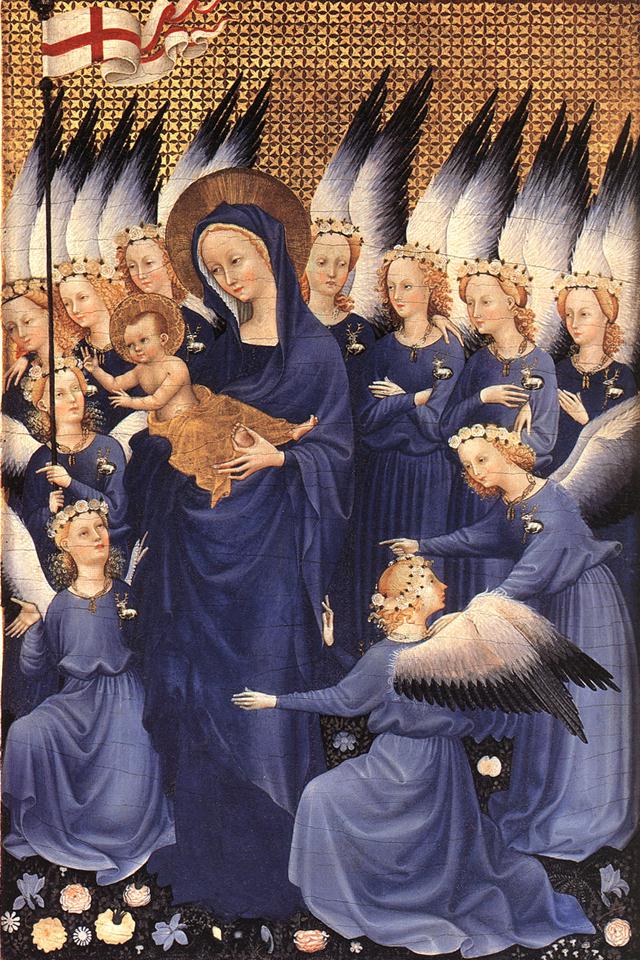 | |
| Wilton Diptych: Virgin and Child with Angels, Unknown French Master, via Wikimedia Commons |
Still during 15th century Cennino Cennini, (artist, who was also a writer and theorist of painting techniques) wrote that blue was “illustrious, beautiful, and most perfect, beyond all other colors”.
People talked and wrote a lot about this color. It was considered extremely beautiful and working good on human psyche, it was praised a lot. Also blue pigment was extremely expensive, and for this reason people talked about it in a very different context: painting was a business like any other enterprise, and business talks and written contracts regarding commissions in which using blue was necessary, specified how much blue should be used. Blue pigment was almost as expensive as gold, sometimes more than gold. It had a beautiful name: ultramarine. It was imported from a valley which is today Afghanistan, made from nothing less than high quality semi-precious lapis lazuli stone, also used in jewelry. The poetic name ultramarine means "from beyond the seas." The stone was extremely difficult to grind, which added to the high price of the pigment.
Artists wanted to make sure how much of ultramarine was to be used, on which parts of the painting. Because of the high price of the pigment, and together with red it was usually reserved for painting robes of the Madonna and Jesus. This example is saturated with blue. Blue was specially the color of French Gothic, especially Late Gothic. Many Madonnas in French art had blue robes, after times of purple and red. (Red for Madonnas’ robes was used more often in the North).
What is the symbolism included in this painting? You know already about gold as diving light and wisdom, blue as divine wisdom and contemplation, things heavenly. This picture is about joys of heavenly existence. First, we have the banner of victory, the banner of resurrection. The colors represent purity of the soul, the sins of humanity washed clean with blood of love ( the sacrifice on the cross) . Wreaths of white roses on the heads of angels symbolize purity and joy of heavenly life. The broaches of the stags represent Jesus: stag means purity and destruction of evil (stag tramples on evil and destroys it). Black on of angels wings stands for depth of the divine mystery.
Flowers: white rose represents purity and is the flower of the Virgin. The iris was also her emblem, and daisies stand for baby Jesus, his purity and innocence. A lot about purity, right? The vegetation was also emblem of purity; the Virgin was often shown in a garden, which was her emblem, hortus conclusus, "enclosed garden," symbolizing her virginity. Garden had also other meaning starting from early on in Christian art: it was representation of heavenly paradise.
This painting was commissioned for King Richard II. Here the Virgin looks like a fine courtly lady surrounded by ladies in waiting. During Medieval times adoration of the Virgin and courtly love had often similar visual and linguistic vocabulary.
Sunday, March 25, 2012
Symbolism of Color, Medieval: Red, Blue, White and Gold History of Color # 4
During the Middle Ages the idea of splendor and light was extremely important in material creative expression. Very rich vocabulary was used to describe light in art theory and in theology. Colors were seen as a part of symbolic expression, they were not supposed so much to imitate nature, as it happened later, during the Renaissance, but the goal of using colors was to express an ideal reality. Therefore was not much interest in showing shadow in art, but a lot of interest in showing the most possible clarity in colors. Paints were even mixed such way that they stayed as close as possible to the ideal hue of the best of pigments. And beauty was a representation of some kind of ideal reality, was it luxury of secular art, or visionary and also luxurious world of religious art. This ideal reality was thought to exist in colors, and colors had, in opinions of medieval people, their own inner light.
This thinking about the ideal essences of things was the legacy of the Classics, of Plato and than of Plotinus. I hope not to make things too complicated, but symbolism, philosophy, iconography, mysticism, theology, and technicalities of making art were all interconnected.
Medieval art put extreme emphasis on purity of colors. When digging deeper in art history we will see that there were some differences between Latin Christianity and the Byzantine Christianity, but in general color ruled the art world.
You see here the four most important colors of the Middle Ages. Yes, gold was considered a color, unlike today. Speaking of hues, we have almost primary colors, red, blue and yellow, as gold is close to yellow, and was replaced by cheaper yellow sometimes. Plus a neutral: white.
I start this part with two of those powders on the picture, (one raw pigment, one metal powder), which were relating to light: white and gold.
White: symbolized light, also in theology which influenced art. White was a symbol of purity, innocence and renewal of spiritual life. During the early Middle Ages angles were shown as white, but later were colorful. It truly depends on time and place: later Middle Ages had colorful angels. Also the elders of Apocalypse, robes of Jesus, prophets, newly baptized people, considered innocent, the righteous people, Jesus in moment of transfiguration. But Jesus was not always shown in transfiguration in white robes only, Middle Ages had codified symbolism, but not rigid rules.
This example shows white as light (stars), and as a symbol of innate purity as seen in this white lamb from St. Sever Apocalypse manuscript.
Gold: as white was more representing physical light in the world, and also had symbolic meaning, the divine light was gold. The light reflecting properties were used freely, not only for decorative purposes but also to communicate theological truth, to show light out of this world. As the divine light was closely relating to the idea of absolute divine wisdom which it represented, the backgrounds of paintings and mosaics are golden. But not always, blue was used too. Gold symbolizing divine light represented spiritual illumination, and to indicate this state of blessedness, connection to the divine, or divinity itself. Halos were golden most of the time. But also there were halos painted blue.
Here is the link to Hagia Sophia interior video. for those of you on whose search engines videos embedded in this blog do not show.Hagia Sophia means the Holy Wisdom in Greek, and it was the most magnificent church in the Constantinople, the capital of the Byzantine Empire. Usage of gold is befitting the name of the church very well.
Red was color of love in sense of selfless love, like Christ's love fro humanity, agape which is the unconditional love, and blood of redemption and blood of martyrs. Blue was symbol of heaven,contemplation, things which are divine, life lived in accordance to the highest standards. More about those colors later.
We need to keep in mind that system of color symbol was not rigid. There were canons in iconography, but it doesn't mean that the artists were slavishly following them. The philosophers and theologians were interpreting colors quite freely as well, a lot of abstract thinking went into writings about colors. Does it means we can't rely at all on color symbolism in Medieval art? Yes, we can. But we should approach it with open mind, and remember that there are no absolutes. Also the symbolic language of colors in religious art was adopted by secular art, but the meaning of one color in religious art many not be exact the same in secular art. For example white was worn by French queens as the color of mourning. Purple was color of mourning too, in addition of symbolizing royal, or imperial power.
A very informative article about color http://renaissanceclothing.blogspot.com/2011/02/meaning-of-renaissance-and-medieval.html in Renaissance and Medieval clothing. Not only is the author very well informed, but also gives warning not to interpret things too rigidly.
This thinking about the ideal essences of things was the legacy of the Classics, of Plato and than of Plotinus. I hope not to make things too complicated, but symbolism, philosophy, iconography, mysticism, theology, and technicalities of making art were all interconnected.
Medieval art put extreme emphasis on purity of colors. When digging deeper in art history we will see that there were some differences between Latin Christianity and the Byzantine Christianity, but in general color ruled the art world.
 |
| Raw pigments, powdered metal. Yes, I prepare some of my paint from time to time, like in old days. |
You see here the four most important colors of the Middle Ages. Yes, gold was considered a color, unlike today. Speaking of hues, we have almost primary colors, red, blue and yellow, as gold is close to yellow, and was replaced by cheaper yellow sometimes. Plus a neutral: white.
I start this part with two of those powders on the picture, (one raw pigment, one metal powder), which were relating to light: white and gold.
White: symbolized light, also in theology which influenced art. White was a symbol of purity, innocence and renewal of spiritual life. During the early Middle Ages angles were shown as white, but later were colorful. It truly depends on time and place: later Middle Ages had colorful angels. Also the elders of Apocalypse, robes of Jesus, prophets, newly baptized people, considered innocent, the righteous people, Jesus in moment of transfiguration. But Jesus was not always shown in transfiguration in white robes only, Middle Ages had codified symbolism, but not rigid rules.
 |
| St Sever Apocalypse manuscript. Public domain, courtesy of French Wikipedia |
Gold: as white was more representing physical light in the world, and also had symbolic meaning, the divine light was gold. The light reflecting properties were used freely, not only for decorative purposes but also to communicate theological truth, to show light out of this world. As the divine light was closely relating to the idea of absolute divine wisdom which it represented, the backgrounds of paintings and mosaics are golden. But not always, blue was used too. Gold symbolizing divine light represented spiritual illumination, and to indicate this state of blessedness, connection to the divine, or divinity itself. Halos were golden most of the time. But also there were halos painted blue.
Here is the link to Hagia Sophia interior video. for those of you on whose search engines videos embedded in this blog do not show.Hagia Sophia means the Holy Wisdom in Greek, and it was the most magnificent church in the Constantinople, the capital of the Byzantine Empire. Usage of gold is befitting the name of the church very well.
Red was color of love in sense of selfless love, like Christ's love fro humanity, agape which is the unconditional love, and blood of redemption and blood of martyrs. Blue was symbol of heaven,contemplation, things which are divine, life lived in accordance to the highest standards. More about those colors later.
We need to keep in mind that system of color symbol was not rigid. There were canons in iconography, but it doesn't mean that the artists were slavishly following them. The philosophers and theologians were interpreting colors quite freely as well, a lot of abstract thinking went into writings about colors. Does it means we can't rely at all on color symbolism in Medieval art? Yes, we can. But we should approach it with open mind, and remember that there are no absolutes. Also the symbolic language of colors in religious art was adopted by secular art, but the meaning of one color in religious art many not be exact the same in secular art. For example white was worn by French queens as the color of mourning. Purple was color of mourning too, in addition of symbolizing royal, or imperial power.
A very informative article about color http://renaissanceclothing.blogspot.com/2011/02/meaning-of-renaissance-and-medieval.html in Renaissance and Medieval clothing. Not only is the author very well informed, but also gives warning not to interpret things too rigidly.
Saturday, March 24, 2012
History of Color # 3 Not Colorful Enough, or?
 | |
| Medieval fresco with traces of paint, monastery in Baden Baden, Germany. |
Dramatic scene. Expressive image, emotions shown in movement, clarity of composition. Fine work, but 600 or 700 years ago it would be considered just not colorful enough. Brown was perceived as a very ugly color, just way too humble. Those contours were the first step in painting, preparatory drawing before filling in color. But we can appreciate it very much. Similar situation of differences in perception of beauty through ages is the case of the sculptures and architecture of Antiquity, from Greece and Rome.White, unpainted marble delighted and delights modern sensibilities, but for the Greeks and Romans was just way too plain.
So, lots of paint was put on it, often in garish colors. But the Medieval colors were not really garish, as I mentioned before, they were jewel-like, as imitating colors of precious stones was so important then.
This is the stone vault of the bell tower of Freiburg Cathedral. This beautiful Gothic construction detail of the tower of the tower is beautiful for us today, but centuries ago would be just much too grey. When it was newer, it was fresher, much lighter, but still it was just a technical detail. Even though, it is touching to see the clover leaf adornment chiseled out of stone with such love for detail.

The tower itself is one tenth of the mile high. When I was there, I first visited the framer market at front of the cathedral. After all during the medieval times markets were common at front of such visited sacred houses. I truly enjoyed this market with buckets of freshly cut flowers, organic food, fragrant hand made soaps, it was very sensual, music, colors, fragrances. Than I entered the cathedral, looked around, contemplated the art, so typical for a visit on a trip. It was more elevated experience, meditative, sublime.
But this place also offered one interesting option in addition: to climb the bell tower tower, to be able to see the bells and to admire the view of the old town. Of course I needed to do it. One tenth of the mile high climb: narrow, rather steep stairs, spiraling, twilight. The climb seemed have no end to me. And than at the top this unusual feeling when you face all those bells which are tons heavy, this stone vault beyond which is the spire of lacy stone carving, becoming less and less material, the essence of Gothic architecture, sublimation of the material world into the heavenly one. And the view of the blue sky. It was a very strange juxtaposition: stones and the sky.
We, the viewers of today, we like patina. Old artifacts are allowed to have patina, their market value can even diminish if the patina is removed. But for people of Middle Ages, this vault would have been too dirty.
Yes, there is accumulated dirt on the vault, but we don't mind it as much as people would do hundreds of years ago. They disliked brown, grey, as those colors don't have enough chromatic intensity. Poor peoples' clothes were in neutral colors of raw fabric, made of flax, wool. Wool was often beige, or brown. The richer ones wore colors.
Those stones from the Reichenau Monastery, which was once of the greatest centers of learning, hosting a very large library, and busting with life, are charming to most of us, modern viewers.

But than, a thousand years ago when scribes of Reichenau produced delicately illustrated books, this combination of brown floor tiles and gray stones would be plain ugly. Medieval mind loved color. Bright, luminous color. Neutral colors were not of much of use in art.
There were of course exceptions, like frescoes in Umbria, Italy, painted with lots of browns. But this is unusual. Other exception are Cistercian monasteries, with simple, unadorned interiors.Cistercian church is beautiful to us, in its simplicity, and probably was considered as such by the monastic community which valued the life of poverty. But the general idea of the times was that a church is supposed to represent to some degree a paradise on earth, or the heavenly Jerusalem, and needs to be adorned with pure colors.

From my experience when discussing Medieval tastes for things colorful, pure, shiny and glossy, sooner or later comes a comment: "but they were so terribly dirty!" (This comment comes when discussing Rococo also, understandable). However, the idea of Middle Ages as filthy ages is disputed by historians. Some lean toward idea that indeed, dirt was common, and there is truth in it, but others point otherwise, and there is also truth in it. For example Byzantine Empire had system of waste removal, water flushed toilets, and high level of hygiene. Latin Middle Ages had the system of public baths, which were more like spas: hangouts were it was possible to take a bath, eat while soaking in the communal bathtub, and listen to life music, to gossip, and play games. Bathing was a social occasion, and baths were frequented, making the members of the bather gilt rich. Banya in Russia, sauna in Scandinavia, hot springs through Germany and Switzerland, and numerous public baths everywhere point to rather cleaner people than we are willing give them credit for.
For example in Poland bathing was so common that even the beggars were entitled by law to get free bath every two weeks. Or some in Europe monasteries might have as a rule not to bathe, but others required cleanliness rule to follow. Even some of the old monasteries were build close to hot springs, and bathing was a symbolic action of washing away sins, after confession. Above mentioned monastery of Baden Baden was close to hot springs. The Church didn't oppose hygiene, and was advocating cleanliness for health reasons, but was against a habit of too much bathing, as it seemed to be addictive to some: every day several hours in bathing house. I know, i know, I digress, but so many people have imprinted in their minds that Medieval times were ages of filth and darkness. I felt compelled to give additional information,as we talk about colors, splendor and light in Medieval art..
For more detailed information about Medieval hygiene, read this very interesting article.
Subscribe to:
Posts (Atom)