Showing posts with label Virgin Mary robes. Show all posts

Monday, July 8, 2013

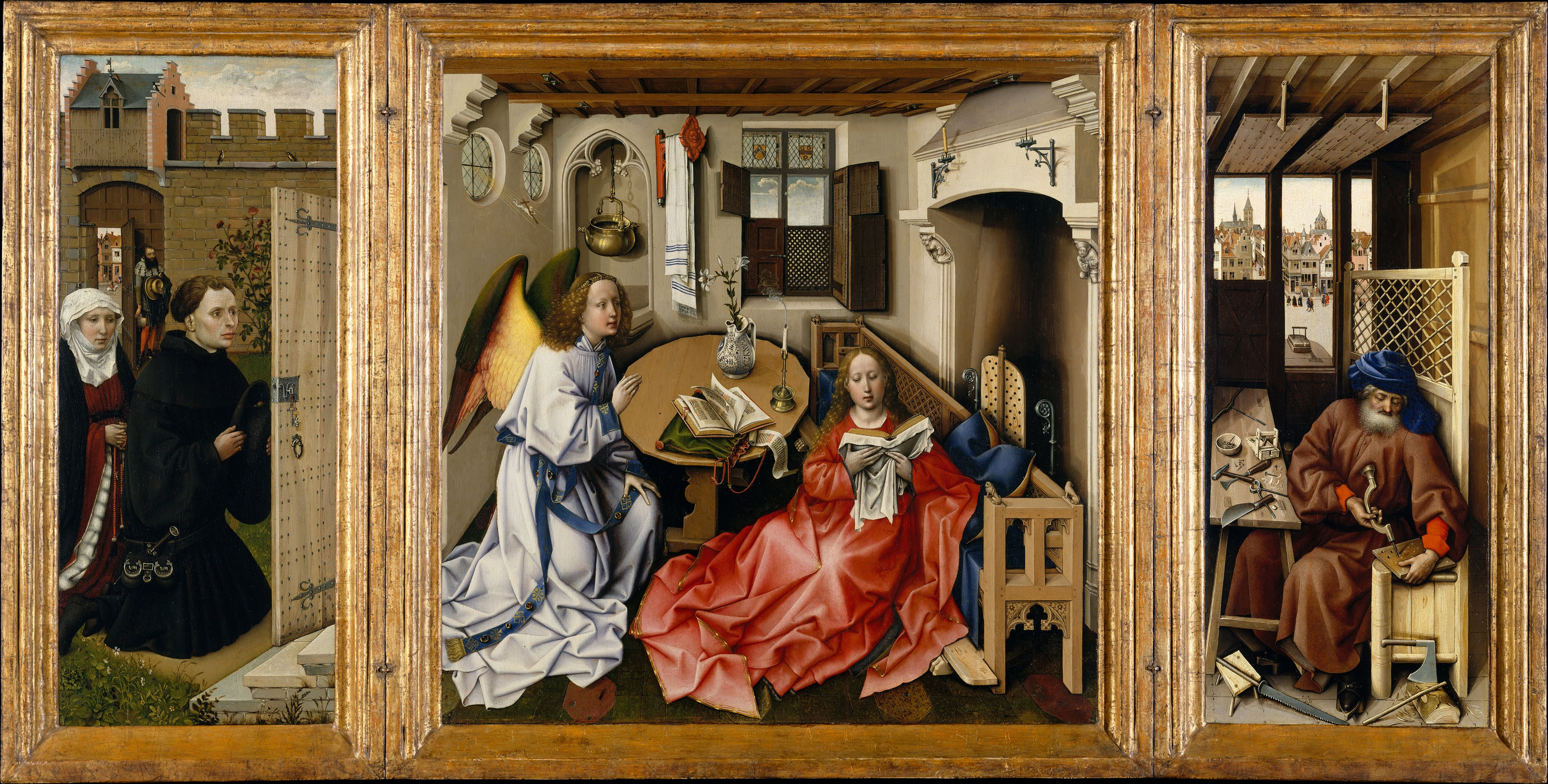
Iconography of Anounciation of Merode Altarpiece by Robert Campin

Robert Campin and apprentice, Annunciation triptych, Merode Altarpiece,  1427-1430 Cloisters, New York

This version of Annunciation is rich in symbolism which was easily understood by average person of the days this altarpiece was commissioned. Today anyone interested can see it at the Cloisters, branch of Metropolitan Museum of Art in New York, but in today's world an average person doesn't understand its symbolism. Usually someone notices what is going on and who is there, as we are trained to understand different type of symbols. This painting belongs to Northern Renaissance but has still many elements of Late Gothic. Click on the picture to see it bigger.

Who is there?  From right to left: Joseph, engaged in wood working in his workshop, secluded an din a different landscape as we see through the window. Virgin Mary, absorbed in reading a book and she is not noticing the Archangel Gabriel yet. Archangel just arrived, he looks as he is about to kneel.  Above him in the air  on the rays of light there is a tiny baby Jesus with the cross. Merode couple kneeling outside, open or semi-open door at front of them.Maybe they are watching the scene. And close to the wall in the background we see a messenger. As for those who dismiss Virgin Mary as Virgin Mary on artistic depictions anytime she is dressed in red: this is Virgin Mary indeed, and she was often depicted in this color, specially in Northern school to which the painting belongs, and no, she is not pregnant. The bump under heavy draped robe is just  her knee.

Joseph made two mouse traps. This relates to the sermon by St Augustine who described incarnation of Jesus as a bite for Satan, in some way as mice are trapped in mouse traps. There are two traps, if they represent Jesus and Mary as two participants in the process of incarnation, etc. I prefer to say I don't know instead of giving you my guesses. This can mean many things, and there is debate among scholars, so, as I am not someone specializing in this part of art history, I leave it at this point how it is, no point of adding my opinions to it.

The central panel has symbols of Mary's purity: white as color symbolizing purity, white vase and white lily (chastity), also the wash basin and towel: Mary was called a pure vessel.  Archangel Gabriel also dressed like a deacon, in white, underlines the idea of purity. I like the respect shown for books, they were considered precious objects and this painting shows it.

On the table the scroll represents  Testament, the book is the New Testament. Book represents law, here is the fulfillment of what was written in the book. Green of the cache for the book  is the color of hope, Paradise and resurrection. It is not symbolizing fertility in this case, as it is religious painting, not secular one, and green is tied to Paradise and resurrection. The incarnation of the divine here is not regular event relating to natural earthly fertility.

The candle which is extinguished symbolizes divine light extinguished in order to become human, in order to incarnate in human body. The divine light in eternal aspect is shown on the wings of Archangel: gold or yellow in its place was also symbolizing divine light. The window which now shows the sky and family crests was painted in gold earlier, before over-painting with what we see today. Seven rays on which baby Jesus is traveling stands for divine light, seven rays: seven is the sacred number. Bu the dark color on the wings stands for depth of divine mysteries, for which black stood. The tiny carved lions on the bench are symbols of the seat of Salomon.

 Red robe of the Virgin symbolizes her love: ( agape the unconditional love), charity, redemption by the sacrifice on the cross, but also is a fashionable robe of the days in a very expensive color. Campin showed a domestic setting, and fashion of the days, which was typical. Old paintings are also valuable resources for costume historians and costume designers, as there is so much historical information, specially in the case of the painters with great attention to details and skills in rendering them. What we see also is an interior of a typical home in a city. Usually Annunciation was shown in a church or palace, here we have an interior of a real home. Campin was a painter for the city people, not a painter for aristocrats or churches. This small altarpiece was not intended to be installed in a church, but was an object of private domestic devotion.

The courtyard where the three people who are real life persons of Campin's days are present (donor with his wife and the messenger) is alluding to garden, but is not the same as in depiction of Virgin Mary in gardens: here it is is more cloistered, not much vegetation. Those gardens were cloistered gardens, in which the Virgin was depicted but had more vegetation, here it is more sparse. Still it is enclosed garden, hortus conclusus, which symbolizes Mary's virginity. Here the vegetation relates less to Paradise, which was typical in those hortus conclusus types of paintings, but the flowers represent the virtues of the Virgin: rose stand for her charity, violet for her humility.

The scenes are like almost everyday situations, except angel showing up. In Gothic slowly the divide between sacred and real human life started to narrow. Here we see religious scene happening like in real life, the saintly people don't even have halos, it was unusual. Painting saints without halos happened one century later, in Renaissance Italy.

Perspective in this painting is partially correct. It is not a typical linear perspective, where mathematics rules.Here those rules are bend and we have some twisted angles, like for example the table is painted correctly to the rules, this is not realistic, but allowed the painter to show more details. Sometimes artists do such things in order to make greater visual impact. For example Pieta by Michelangelo, where Mary is so much bigger than Jesus, yet for viewers it looks very natural.

 Bellow we have another painting of Virgin, this time with baby, in an interior by Campin, for comparison. I think now you will be able to read with ease the symbols contained in this domestic scene.


Wednesday, August 15, 2012

Purple, the Imperial Color, History of Color #10

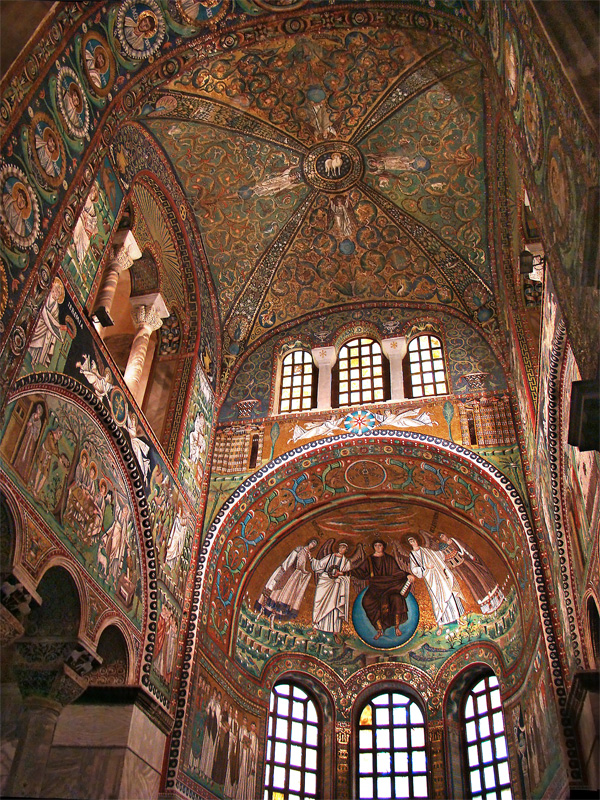
Byzantine Emperor Justinian, mosaic in St Vitale church, Ravenna, Italy

I wrote about red and blue as colors of power in my recent entry. But the ultimate color of power was purple, before red and blue rose to higher prominence. It was before the sack of Constantinople during the Fourth Crusade in 1204, which I mentioned in the entry about the holy blood relic in Reichenau and Bruges. Constantinople never recovered enough to produce purple dyed clothes again. This fact might give you some insight how expensive purple dye was.

 The purple dye was so expensive that it was a subject of sumptuary laws, and mostly restricted for the imperial or royal families. It was produced from Murex sea snail, and tens of thousands were needed to dye one piece of garment. Color purple took the name from the dye, wasn't the description of color itself. The price of dye was equal of weight in gold.  The main center of the craft of dyeing in purple was Tyre, in Phoenicia. The name Purple of Tyre comes from it. This purple wasn't the hue we perceive today as such: it was more reddish brownish, a very muted but intense color. The emperors robe on the mosaic above looks more blueish than in person. The robe of Jesus looks more brownish, but it is difficult to take very accurate pictures of mosaics in the interior, where every detail will be of exact color. And the purple of Tyre doesn't get reproduced very well on the computer screens either. But you get the idea.
Mosaics at San Vitale church, Ravenna, Italy, via wiki commons, thanks to Tango


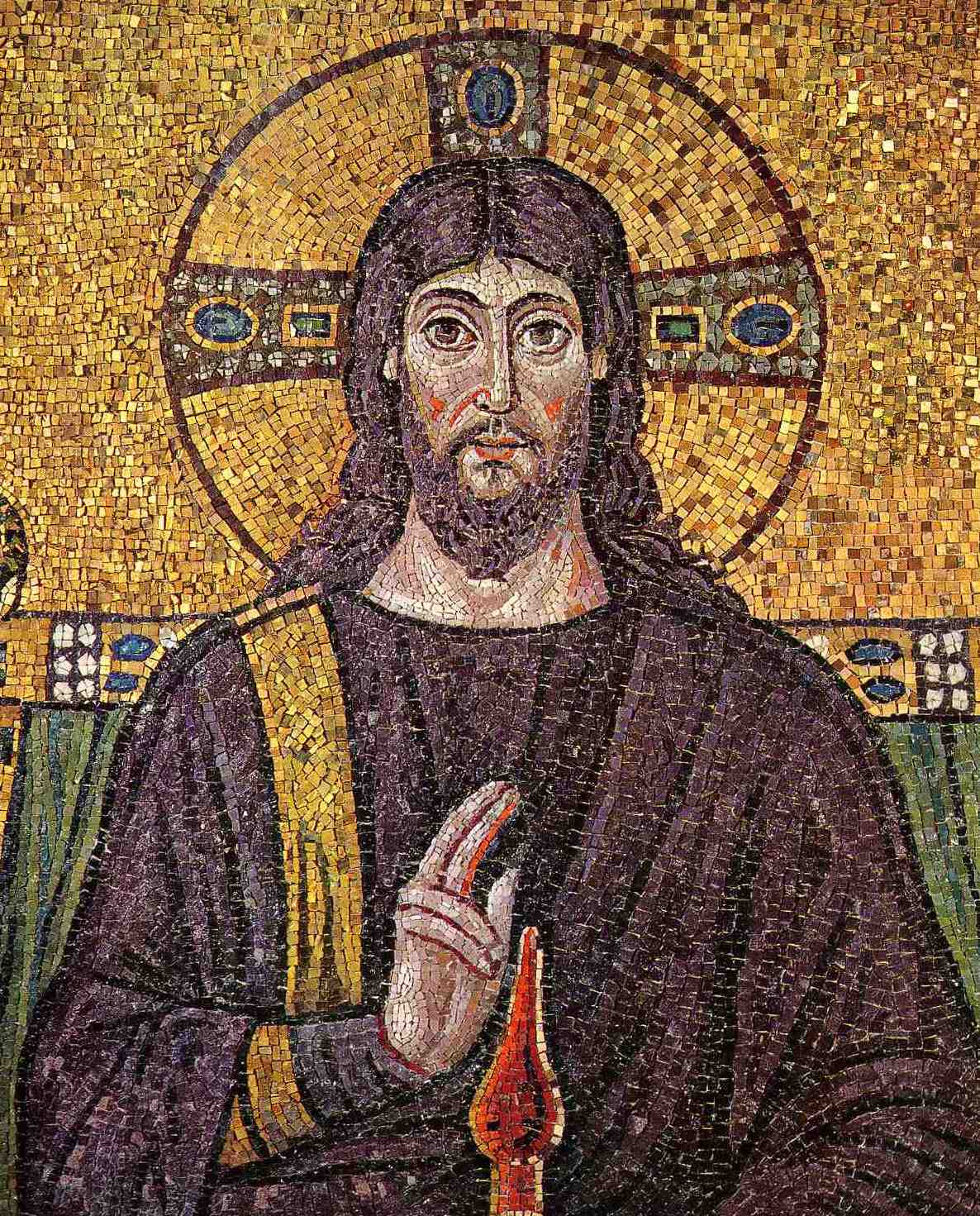
Not only rulers were depicted in purple, but also Jesus and Virgin Mary. Byzantine art showed them as rulers, full of dignity and somehow stern looking, as does the Christ dressed in purple on Byzantine mosaic from the church St Apolinare Nouvo, Ravenna, Italy (via wiki commons) The style is Early Byzantine.


And here is shroud of Charlemagne, early IXc. manufactured in Constantinople, today in Paris, Musée National du Moyen Âge. (via wiki commons). Purple on silk created wonderful effects that enchanted the eye: depending on light looked more blueish or reddish, had luster fro which was prized too. Not many fabric are left from Byzantine times, mostly fragments, and like this one found in the graves of the rulers of the time.

Shroud of emperor Charlemagne, purple dyed silk
 The purple was known already in Antiquity, and was mythologically credited to be discovered by the dog of Hercules. Plato mentioned this color in his Symposium as the greatest hue of all. It was used in Egypt, and became the color of Roman emperors. Sometimes the law was not harsh and women were allowed to wear purple, but other times anyone else than emperor wearing a purple robe would be killed. The first church in Europe was founded because of religious devotion and courtesy of a woman, Lydia, who was a business woman, a merchant in purple dyed fabrics. She must have only rich clients.

One of the Roman emperors forbid his wife to buy additional purples robes, as he considered too expensive.

Today, to all my knowledge there is only one pigment manufacturer mill, Kremmer Pigmente from Germany, which sells  this kind of  purple for art conservation purposes. One ounce would be 153,120 $, of course on the website for the art conservators this dye is sold in fractions of  1gram (1 once has 30 grams, to remind you), so , it is sold sold here in fractions of grams
According to Kremmer Pigmente, it takes 10,000 snails to make 1 gram of purple, which would be 300, 000 to make one ounce.

Later instead of purple silks were dyed with kermes, which was red dye made of the bodies of dried insects. I am for sure glad we use different process in fabric dyeing today, not involving killing masses of mollusc, or insects. (But still,  today fashion industry is terribly unfriendly toward the environment, one of the main polluters). Lucky for me, a fine artist, I can pick and chose which pigments I want. Honestly, I couldn't bear to buy paints or dyes containing colors made out of living creatures. I don't wear silk either for this reason.

This red coronation mantle of Roger II, silk and gold thread, pearls and precious jewels was done in royal workshops  from Palermo, Sicily. Now in Vienna treasury.We see the new fashion coming, replacing purple with red, which resulted in pictures of royals, nobles and Virgin Mary dressed in red mantles.

Roger's II coronation mantle, via wiki commons, by Gryfindor

Sunday, August 12, 2012

Colors of Power: red and blue- History of Color in Middle Ages # 9


Red and blue, most prominent color duo of the Middle Ages. People just loved them so much, that even when writing about rainbow  they wrote often only blue and red! Also the existence of separated guilds of dyesrs dedicated for each color may be a testimony for high esteem and priceses of those particular colors.

 We see here in the video the colorful splendor of the Middle Ages, about illuminated manuscripts about British royals. Lots of color, but most prominently the duo of red and blue. Fresh colors, most of the time.Video window may not come up in an instant.
Interesting movie by BBC about royal illuminated manuscripts.

Here Charlemagne is  being crowned.

Emperor's Charlemagne Coronation, Illuminated mansucript, via wiki commons

Red and blue were colors of power in the secular world, why?  Red and blue dyes were expensive, not common, and people loved those hues, of course. Red was used after the purple of Tyre, very expensive and reserved only for the rulers, became less and less available. Red in a more dark, dignified edition was replacing purple,which had a brownish tinge, not what we commonly classify as purple today, until appeared in its pure form, lighter and brighter. As we see bellow, on the Annunciation picture.The same with blue, it was considered a very noble color, and as the blue dye became to symbolize affluence and also royals were using it. (Royal blue).


Announciation by Petrus Christus, via wiki commons


Here on this Anounciation by Petrus Christus we see Virgin Mary dresses in a red mantle. We see the typical elements of Announciation, as the lilies signifying Mary's purity, the vase a pure vesel, open book also is traditional. Always opened on the same page on all paintings, Isaiah 7:14, or psalter pages in earlier book. Other written words is the passage from Announciation of the New Testament, the words spoken by the archangel ("Ave Maria,  gracia, plena"etc) was directly written in the picture. Mary is here depicted as a fine lady, dresses in a rich garment, expensive mantle.  Click here to read more about Announciation symbolism.
This painting is considered early Northern Renaissance, but still has elements of Gothic art. For example the folds of the robes of the angels are still very hard and geometric, the angel's posture is typical for Medieval art, also his wings, strong color, not white. But we see already linear perspective on the tiles of the floor, increased realism of depiction in painting, eye for detail.


Court scene from November,  Book of Hours of the Duke de Berry, Via Wiki commons


What a rich blue wears this duke! Probably he is the Duc de Berry himself, it is a miniature by Limbourg brothers, form the Tres Riches Heurs di Duc de Berry, form the magnificent manuscripts collection of the Musee Condee.
                                              
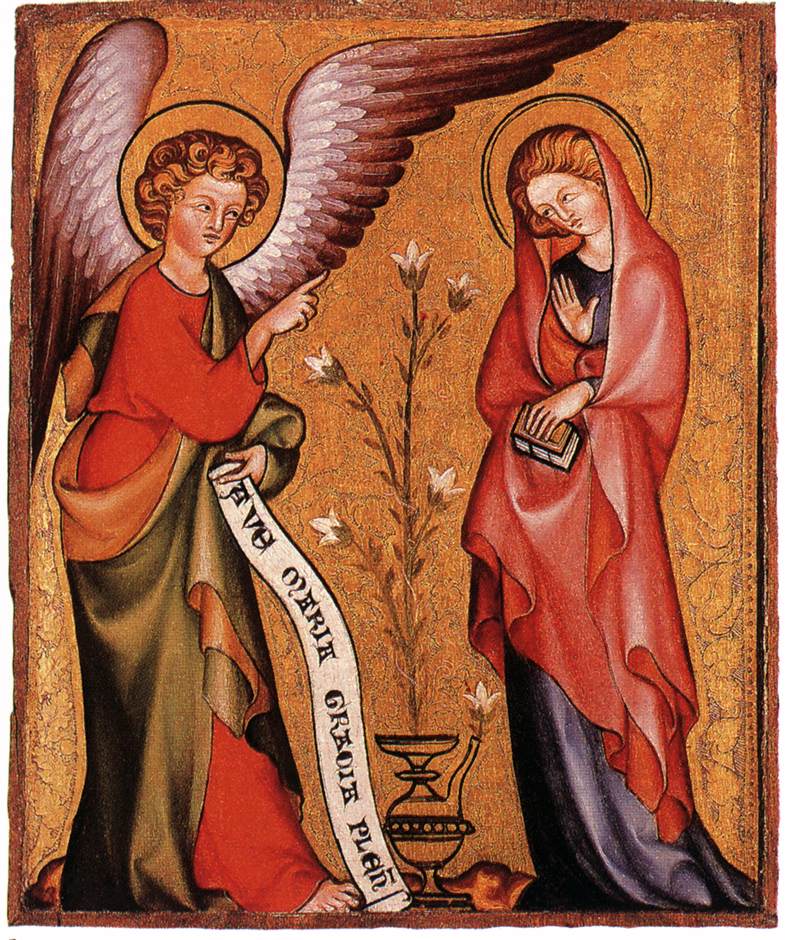
Announciation, unknown German Master, via wiki commons


The Announcaition again, this time we see all elements traditionally depicted in announciations, but this time the book is  not opened, but text is written on the banner held by the archangel.("Hail Mary, full of grace"). this banner as a speech bubble appears often.Wallraf Richttarzt Museum Cologne. Mary with a book again, it has significance, depends if closed or open, etc. Soon about Mary and book symbolism, an elaboration on this  important element of  iconography.

Altdorfer, Virgin Mary with Child, XIV.c via wiki commoms
Virgin Mary as queen, with infant Jesus in her arms, by Altdorfer, (German), museum in Budapest.Infant Jesus has a necklace symbolzsing his future Passion and death on the cross (coral ) which in secular symbolism and superstition of the days: it  was supposed to avert evil. The apple is relating to original sin, held by Jesus is a symbol of redemption, eradication of sin.
Death of the Virgin, by Konrad von Soest, Mary on her death bed attended by humans of saintly and common stature, and by angels themselves. We see richly embroidered blue mantle and blue angels, as the symbols of heavenly realm.Also prominent is red/blue color duo, gold background. Closed books also present, symbol of the Virgin. What is written on the open scroll, which is read by bearded man dressed in red, with his head covered as sign of respect and humility? The paleographers would tell. The saint whose hand holding quill  is almost touching Virgin's hand is, has "Saint John the Apostle" written on his hallo.

Death of Mary by Konrad von Soest, via wiki coomons


Monday, August 6, 2012

Mary Magdalene: Blue Color of Her Robes and Art Historians

 Here we have Lamentation by Petrus Christus from Royal Museum of Art in Brussels. Can you recognize who is who among both Marys? Both have blue robes. Mary, the mother of Jesus is depicted as fainting, her body lifted up by two people. Common depiction, Mary fainting at the lamentation scenes. Is one of the people attending her the Mary Magdalene because she has red dress? Well... no. Color symbolism was common, but not set in stone, there was nothing very dogmatic about it. Please, click on "Mary Magdalene robes"  among the labels/links at the bottom of this post, you can read posts about the other colors.

Lamentation by Petrus Christus, via Wiki commons, click on the picture to view it larger


 But where is Mary Magdalene in this painting? You can recognize her by one of her attributes: the skull. She is the one turned toward the cross and the skull. Ointment jar is another attribute, not in this painting, the cup behind her is the cup for throwing dice, as dice are one of the symbols of Christ's passion. Both Marys are in blue, which was for sure costly, ultramarine was the most expensive of pigments. Both are made clear who they are, made recognizable: one by the pose, another one by her attribute. The viewers of those days knew how both were depicted, today those things are more confusing, as people have less familiarity with iconography.

This example of using so much blue is rather unusual for Petrus Christus himself. He most often used red for Virgin Mary's robes, as was common in the Northern painting. Blue was more common in France. This is of course rough division, the geography, but this is a  more factual explanation to clarify this red and blue vision, than color coding Virgin Mary and Magdalene rigidly.


Rather dogmatic is thinking in red and blue, which sometimes happens today, as art historians and art history buffs say. This means the idiosyncratic idea that Mary the mother of Jesus was depicted only in blue robes, and Mary Magdalene was depicted only in red robes. Luckily the Old Masters where not as limited, or as color blind.But some art historians complain that it is difficult for some people to understand this fact, and even those people will rather aggressively defend their pet idea, in spite the fact that their knowledge is limited.Why is it, and why some people are so fiercely attached to this specific color combination, is a mystery for me. As one art historian said, the subject of the robes of those two venerated quickly reveals how much someone knows, or rather how much someone doesn't knows about art history.

Art historians are not as ignorant as they often gladly represented as: most important, they see a lot of art; when I took history of art on the exam we had c. 600 slides,which were part of the test in the introductory course only, later things were more complicated. Art history classes were compulsory for my degree. I had strong interest in art history quite early, started when I was 13 year sold, so I didn't struggle, but for those people in general who learn art history as elective, mostly it it not an easy A class. It depends on university and who teaches the class, but in general challenges are there, if you want an A, better work hard, as it is not hobby level art history.  

Art historians are very involved in general: they travel if needed, study artists' historical contracts by the patrons and artists, write books, keep current with current research. So, why this need to tell art historians they are so wrong, and specially by people whose knowledge belongs to the limitations of a hobby? Mystery, mystery...