Showing posts with label neo-platonism. Show all posts

Sunday, July 14, 2013

Divine Mothers, part 1: breastfeeding Madonna


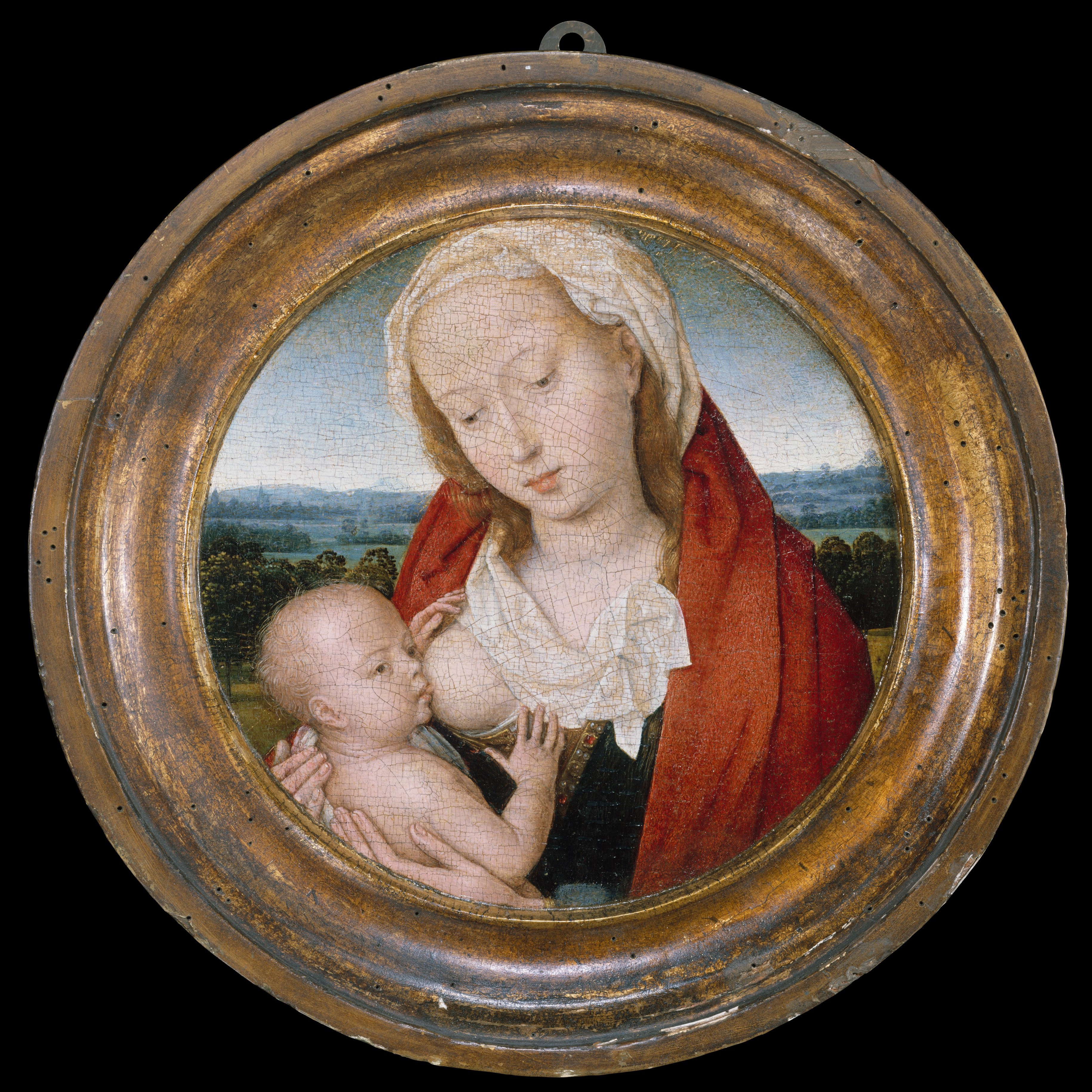
Hans Memling, Nursing Madonna

Today some people are kind of surprised that so many, specially women, like the idea of Mary Magdalene being the wife of Christ and the mother of his children, and talk about her being erased from history.

I am not surprised. In my earlier entry I wrote about how our ideas of Mary Magdalene represent something what is important in our society. Something what is maybe not so clear in our everyday awareness, but many know in some. Let me use that silly word for it: subconscious level.

First, in spite of the technological advances, the world in not becoming more cozy. Many of humans need things mytho-poetic when technology is invading their lives, even when it is to the advantage.We are humans, not cyborgs whose extensions of mind and body are machines. People turned to things mytho-poetic or considered less rational when huge technological advances were made, during the 19th c. and for example 20th century between wars. This trend now isn't new or surprising. It is a natural reaction when people feel that the pendulum went too far in one direction. So, there is a counter movement. It is evoking creative forces of the mind again.People don't want to be cheated out of this important part of human experience, mytho-poetic creativity is part of whole we call a human mind.
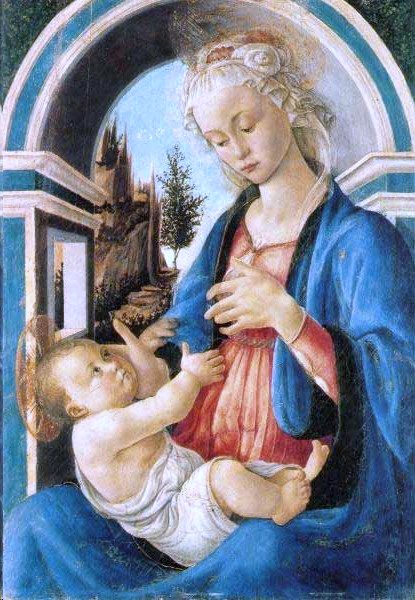
Sandro Botticelli, Madonna with Child, here Virgin Mary in a dress allowing easy nursing
As for Mary Magdalene being a mother and being pushed away: no wonder this idea is popular, lets take a look how we treat motherhood today, what our popular culture reveals, and how motherhood was treated earlier.  This is first entry on the subject of motherhood.First for his entry let consider breast feeding. Talking about things mytho-poetic:  Milky Way according to Greek mythology appeared because of  accidental squirt of Hera's milk while she was nursing Heracles, who as an infant was supposed to acquire god-like qualities by drinking from the breast of the goddess. The word galaxy comes from Greek word for milk.Nice story about milk of the goddess. Today's reality isn't poetic about breast feeding.

This link shows results of study about breast feeding mothers: prejudice. Also those mothers who breast-feed in public have personal stories to tell, how they were treated. Nothing encouraging. There is even a lawyer, a women, who tires to make breast feeding in public illegal. Because it is "disgusting." Not everyone finds it "disgusting," but it is enough for mothers to feel the hostility. Like not everyone is prejudiced against gay people, but enough to create hostile environment. Why so easily labels like "obscene, or"disgusting," "disturbing," are applied to something so positive, psychologically (bonding of mother and child) and what has proven health benefits for the baby?

Gerard David, Nursing Madonna
 Nursing Madonnas as images or part of Marian theology is a very interesting phenomenon. The imagery first appeared in Coptic church of Egypt, the iconography was borrowed from the depictions of Isis nursing Horus. Cultures borrow from each other, as languages borrow words.

Role of Virgin as divine mother was very elevated, she was a co-redeemer of humanity. Some old mystical pictures show her standing at the crucifixion, between her and crucified Jesus stands a chalice to which blood from Jesus' side flows and also milk form Virgin's exposed breast. This was analizsed by art history scholar Anna Boczkowska in her  book Triumph of Luna and Venus, about iconography of Paradise part of the Tryptych Garden of Earthly Delights by Heironymus Bosch.

It was elevation of milk to the same importance as blood of Eucharist, it symbolized grace. Of course this was only on symbolic level, as there was no mixing of milk with wine in ritual of Eucharist.

Milk was a symbol of wisdom, and not just an earthly wisdom. It was a supernatural wisdom of knowledge of things divine, and given as a gift of grace.

Milk was also believed to be transformed from blood, and as such to be part of Eucharist and it took its place in mystical writings. Today those writings maybe not easily understandable for our modern mindset, but people centuries ago understood all metaphors very well. Middle Ages were very poetic, made strong use of symbolic and abstract thinking. 

The type of iconographical depiction of Madonna as nursing mother was common during the Middle Ages, Renaissance and Baroque. Those images often depict  precious moments of human tenderness, but also they elevated motherhood to divine dimensions also. Probably the prototype of nursing Virgin Mary appeared first among Coptic Christians in Egypt, based on imagery of goddess Isis nursing baby Osiris. This doesn't mean that Iis was worshiped under a new name: it is like a new picture was put in an old frame.

 
 This icon of breast feeding Madonna is considered wonder-working in Easter Orthodox faith. It is Galaktotraufusa (Milk Giver) from Mount  Mount Athos Monastery, in Hilandar Monastery, part of Athos complex. It was put there in 13th century, brought here by  Saint Sava of Serbia and installed in iconostasis in an unusual place which was  reserved for icon of Jesus Christ and the Trinity. I have to admit I don't know what happened to this icon. The other icon brought by St Sava, Madonna of Three Hands is supposed to be there, 2004 was a terrible fire in the monastery.

I am not saying that elevating motherhood to such dimensions was all great and sure recipe for making all women happy: childless women suffered, and women conditions were not good in general. But at least mothers' contributions were not taken for granted, or there was an idea that they shouldn't be taken for granted. Motherhood was part of the totality of human experience, and it is, just not enough credit and respect is given to it now.Gender politics is visible in all art history, struggles related to gender continue today.


Francisco de Zurbaran, Holy Family


Ladies, those of you who are or will be mothers, I say: kudos to you for your patience, gentleness, pain, baby fat, hanging breasts, stretch marks. It is not a little thing to be a mother. Milk, pregnancy and labor pains were once revered in mystical writings about experience of the divine. About this another time.

Thursday, February 28, 2013

Things get repeated

My blog got neglected. In this week I hope to have enough time to post about the tradition about Holy Grail in the church of Bezlawki. Now simply my reflection about how things get repeated over and over again.

I watched for short moments the live broadcast by BBC  today, it was about pope retiring. One of the journalists said about the uniforms of the Swiss Guard that those were designed by Michelangleo. No, there were designed during the beginning of the XXc. Did Dan Brown was talking about it? Yes, he did. Pop cultural version of historical facts.

Form Wiki commons,  part of  treatise about opitcs by Bacon

 There are more opinions repeated as facts.For example that people during medieval times believed that Earth was flat. No, already ancient Greeks knew about spherical Earth and would be difficult to find any scholar who believed in flat Earth.Or that all believed that the Earth was center of the Universe. Or that medicine was based on prayers and superstition. ( Medieval medicine if wasn't folk medicine was exactly the same as in Antiquity). Or that in medicine there was no dissection of corpses at all. Or that there was no interest in chemistry. (It was, thanks to Arab writings which were  read by monks). There is quite a number of strange beliefs about history of the Middle Ages and the Renaissance, which don't get corrected by the pop culture.Why? Because those beliefs help to create those periods in some kind of monolitic icons which than have more popular appeal.

 After all it is more interesting to say and believe that the Swiss Guards uniforms were designed by such a giant as Michelangelo himself, instead of giving credit to some obscure commandant of XXc. People often say that history was written by victors ( not exactly correct, it was actually written by others than victors too). Not only victors shape views of history, also common biases and what are common preferences, what people gladly believe, and what they dismiss as uninteresting, even if the uninteresting facts are closer to historical truth than interesting historical pieces of gossip.

Saturday, September 1, 2012

Dark Ages? Not everywhere: Byzantine love for classics

In popular opinions Dark Ages were taking over Europe until the Renaissance came with revival of classic traditions. This is only partially true. Byzantine Empire continued the tradition of Greece and Rome, combined with Eastern influences. Medieval renaissances of Europe, to be exact Western and Central Europe were brought by closer contact with Byzantine Empire.

 Byzantium was the name of the city, which was renamed by the emperor Constantine Nova Roma, meaning the New Rome, as it became new capital, but it was also renamed  Constantinople . It became Europe's biggest city, it had half million inhabitants.The people who inhabited this empire called themselves Romans, the empire was called Romania. Greek was spoken, as the local language and the language of educated elites, nothing unusual, even in Rome educated people spoke Greek, as Romans were totally admiring Greek culture and copied a lot from it. The library of Constantinople was very prominent, Byzantine equivalent of the great library of Alexandria. Ancient writings were not only preserved here, but also studied and copied, to keep the knowledge from disappearing. There were also periods of additional stronger interests in classics, such as Macedonian Renaissance of the X c. from which time the page of the manuscript called the Psalter of David is dated. King David is depicted as a Byzantine emperor, but the other two figures are very classical. No wonder: as Rome had  monuments of the classical past, so did this area of Byzantine Empire.

Penitence of David, Paris Psalter,  X c.Biblioteque Nationale, Paris

We see David twice: sitting on his throne, and also bowing feeling remorse for all the bad deeds  he has done. Classical figures are here- the admonishing prophet, and the female figure which is the personification of penitence. She is dressed in green and red, the colors later seen often in robes of Mary Magdalene. Why we know that this is penitence? One thing is that personifications were common in the art of Antiquity, another prof is her name written above. It was common in Byzantine art to include captions about the figures to indicate who was who. (People in Byzantine Empire were quite literate, the culture was vibrant). Also above the prostrating David we have the caption which spells his name, that the viewers shouldn't be confused. The writing connected to the female figure there is the word "Metanoia," which term meant repentance in Greek. Meant changing one's mind, turning point. The flagellants of Latin Christianity gave it bad connotations. Penitence was about making amendments, changing mind, changing lifestyle.

But Byzantine Empire was of course more sophisticated than Latin West, were tribal warfare and other struggles went on through some longer periods of time, but still medieval times were not as dark as it is held in popular imagination. The movies may show this time as era of ignorance, superstition, dirt, illness and decline, as this imagery adds drama, but the times were more lively and enlightened. Rather during the Renaissance, or general during the XV-XVII c.Europe had even more dark turmoils: more of  illness, witch hunts, inquisition, wars,  fears of devil,belief that magic equals science, etc. Even medieval universities were not all about faith, as is often assumed: popular belief is that science believed the Earth was flat, or in medicine there was no dissection of corpses, the medical knowledge of Antiquity wasn't practiced, etc. Not true, we know thanks to explosion of knowledge about the Middle Ages during he XX c. So, why the term Dark Ages?

First putting down on the predecessors occurred during the Renaissance, in order to point out the new achievements. Gothic art was called Gothic in a derogative way, as Goths were considered barbarians. The Renaissance mind was so enamored in the nostalgia for antiquity, that they couldn't really appreciate the art and achievements of earlier generations. This lack of appreciation went thorough centuries, and the era of Enlightenment in order to contrast is own achievements needed the idea contrasting light and darkness, needed the term Dark Ages. In addition the term Age of Faith was used, in order to brand the times as irrational and dark. The Enlightenment prided itself not only for its light, but also for reason as opposite to faith. There were even attempts to create temples of reason in churches.

Byzantine manuscript, X c. Paris Psalter, King David Playing Harp, very much in the tradition of classical frescoes

During the XIX c. the scholars were talking still about Dark Ages as the time from which were not too many written records left, but there was also medieval fashion . (Pre-Rafaelites, Romanticism, Gothic Revival, etc). This intense interest in all things medieval was combined with the Romanticism's love for mystery, the  fantastic, emotional and the irrational. Hard reason of previous era wasn't the fashionable idea. During the XX c. however, the term Dark Ages started to be criticized, in light of the new scholarship, and the term was used in a more neutral way, and even the neutrality of the term was disputed. It was argued that the scholars may know that the usage isn't negative, but the general public will not interpret it such way. And the criticism was right on target.

And myself I used the term provocatively in the title of this post. Still, I think in popular culture Byzantine Empire doesn't get enough credit, and this was an empire of great sophistication and influence, and lasted of a millennium. Holy Roman Empire lasted almost a millennium, but there were empires which existed for much shorter time: The British Empire, Austrian Empire, Empire of Austria and Hungary, Bulgarian Empire, and others. So, maybe it is time to refresh the memory of this part of common history? But still, I think the movie industry, mainstream literature, computer games, TV, advertisements, press,some popular chanels historical documentary movies, and others are still in the dark about not-so Dark-Ages.

Quite often there is a misconception of great Rome which fall:yes, Rome was sacked, but before became very empoverished because of Byzantium. The idea of "fall of Roman Empire" first was again talked about during he Renaissance, by popes. It was an idea supporting propaganda: Pagan empire which "fall," quite clever idea, remember, there was the schism between Byzantium and Latin Christianity. It is not very historically accurate common misconception, but quite often still, in XXI c. has place in the classroom.


Monday, April 2, 2012

History of Science at Chartres Cathedral, and Zodiac

In the previous post there was Zodiac window form Chartres, today is the astronomical clock. Strange setting for such symbols?

No way. Zodiac then was nothing unusual in churches. So, why all the mystery so many tourists talk about? Actually there is nothing mysterious about it. Explanation follows.
Chartres Cathedral Choir, Astronomical Clock, via Wikimedia Commons, thanks to Harmonia Amanda
First, the clock comes form XVI c. but its ideological roots are medieval, and proto-scientific, not really esoteric. Astronomy, astrology, the synthesizing medieval minds didn't see the difference.

 It is a common misconception that the Middle Ages were not interested in science, only in religion, or there was no reading of Classical texts before the Renaissance. Actually the classics were read, not as widely as  during the Renaissance, of course, but were not unknown, rather kept in high esteem. Many Classical and Arabic texts of science were translated into Latin. Arabic texts about astronomy, mathematics, anatomy and chemistry, and medicine contributed a lot in development of Western medical sciences, we often forget about it. Or simply don't want to know. And there was no agreement about if the Sun was the center of Universe or moved around the Earth. The official decision   in favor of the Earth as the center of the Universe came later. Science was fine as long it didn't oppose any dogma. For example the theological idea of dignity of the human body was applied to the medical field, and this particular idea didn't allow dissecting human corpses for anatomical research. Dead animals were dissected instead, specially pigs. Sometimes, rarely, human bodies were dissected also.

Chartres itself had a cathedral school, as often was the case with such buildings: there were also centers of learning, not only part of religious live of communities as today. Chartres was one of such centers, and was among the famous ones. Neo-Platonism was flourishing there, sciences were treated as separated from theology. A number of so called than natural philosophers (philosophers interested in science) came from Chartres. School of Chartres became less influential when universities started to compete with cathedral schools, but this was a case with all cathedral schools.

So, if the clerics of Chartres were so scientifically minded, why such thing as Zodiac in the cathedral?

 Here we need to understand the mind of people who lived before us, and don't project our XXI c. world view on them. The clerics form Chartres were still products of their times, and during their times astrology was science, before the Catholic Church opposed it, and before it was mocked  by the scientists of the Enlightenment era as superstition, not a scinece. Medicine was part of curriculum at Chartres school, and astrology was officially part of medicine also. Here is the illumination dealing with the human body as related to Zodiac.

Anatomical Zodiac Man, Limburg Brothers, Book of Hours of Duke de Berry, illuminated manuscript tempera on vellum, public domain, via Wikimedia Commons, thanks to Petrus Berbygere


In addition to proto-scientific reasons, Zodiac was a very popular motive in depictions of passing time. One  was very common:  the labors of the months. Frequently months and Zodiac signs were tied together, and this is often found in medieval churches and religious  manuscripts. Labors of the months showed secular world. Zodiac window at Chartres belongs to this popular category. Here is incomplete list of  zodiacs and labours of months in churches.

 Another example, most famous of this type is the series of illuminations from the mentioned  Book of Hours of Duke de Berry, (the same book from which the illumination above comes from). It is not the only example of this kind, but among the most beautiful ones, if not the most skilfully rendered, so far. Here it is, via Wikipedia article and picture gallery.

The Book of Hours of Duke de Berry is  of the most beautiful examples of book illumination in International Gothic style, and contains a very good example of Gothic blue, specially loved and used in France.

 Art history itself is an interdisciplinary endeavor, and understanding history of science or cultural history can enhance knowledge of art. Art doesn't exist in historical vacuum. It is connected to the world around, it exists in historical contexts. Striping old art form its historical context can give us only partial insight, and lead to some  misunderstanding too, some of them can be quite funny.