Showing posts with label archetype. Show all posts

Tuesday, July 16, 2013

Divine Mothers, part 2: Miraculous Icons and icon kissing

For those of you on whose devices is empty space instead of link to you tube video, click here and you will get there
 
Chant in praise of Virgin,sung  by  Orthodox monks.
Written by St Nectarios of Egina, an Orthodox saint considered 
miracle worker himself here you have translation of words

Talk about divine mothers wouldn't be complete without mentioning Orthodox icons, specially those which were and are believed to be working miracles. So many of  icons represent Virgin Mary, called Theotokos,  with baby Jesus, that this fact amazes how much respect was, and is, given to the idea of motherhood set in most sublime concepts of faith. Theotokos is translated in a simplified way as Mother of God, but exact meaning is "the birth giver to god." 

Her cult first developed in Epheus, today Turkey, where according to Eastern tradition she lived with John the Evangelist and Mary Magdalene who retired there after life of preaching, and they were visited by Paul. My apology to those of you who are St Baume Mary Magdalene enthusiasts. St Baume is a wonderful place, but I need to mention Mary Magdalene in Ephesus, as this version  is so ancient, I will do no justice to it by silence. On the left is the picture of house known today as Mary's House, where it is believed that Theotokos lived. According to tradition she was preaching and teaching people about art of healing.There is also a sacred springs which water is supposed to have healing qualities: spring of love, health and happiness. Thanks Radomil for the picture. Ephesus was also the place of the council where the dogma of divine motherhood of Virgin Mary was pronounced. There is also oral tradition in a about Mary's presence there, held by Orthodox Christian village.

As for icons:  those are not considered ordinary images, they are windows to the divine. For Orthodox Christians are presence of the sacred in this world. So, if the icon represents a given saint, this saint presence it there. The icon is treated with respect, can be touched and is kissed in love and honor, and given votive offerings after a performed miracle.

Our lady Vladimirskaya, patron protector of Russia, Eleusa type icon. The star patterns on her moforion  symbolize her VirginityThis icon is damaged, but there is strong sense of radiance.
Kissing in Eastern tradition was a very important gesture, honorific kissing included, it meaning was quite broad, which kissing the icons also includes.Western culture is only intimate sign of affection, of friendliness when the French kiss the cheeks to say hello, kisses between parents and children, and of course between lovers.In earlier days there was a lot of kissing, including kissing women on hand as sign of honor.It is still practiced in Poland and Vienna, the yearly opera event. 

In Biblical times there were kisses between men, family members who were loved, abut also between friends, or people were kissed out of respect. For ex. kissing someones feet was a sign of very strong reverence an honor.. The same in Jesus times. Christian kiss of peace is one example. Also in Greek there were three words expressing love: eros, filos, agape. Eros is erotic love, filos is friendship as love, agape is often translated as charity, but mean unconditional love, the spiritual kind, love as the essence of the divine, love totally selfless. For example the part in New Testament, where Jesus ask Peter "do you love me more than those,"and here he was referring to his disciples. I was introduced to it by someone who studied Koine Greek,  what is translated in English is love, but in Greek there are two words in questions and answers used: filos and agape. As you probably guess, the Theotokos as a mother is also example of such divine, all surpassing unconditional love.

It is an important distinction between kinds of love, and  it got somehow lost, as the distinction between kisses got lost. In the New Testament at the supper in a house of a Pharisee Jesus defended the woman who washed and anointed and kissed his feet (in Orthodox tradition it wasn't Mary Magdalene) and said: "you gave me no kiss," and praised how she showered his feet with kisses and she will be remembered. This was expression of highest reverence, and the Orthodox Christians remember that. But see by yourself not in my words, why Orthodox Christians kiss icons.

But certain  icons are not to available for kissing. Those are the miracle working icons set higher in the altar. 
The icon above is Eluesa type of Madonna, (Our Lady Valdimirskaya, today in Tretakov Gallery). Those graceful depictions are called Virgin of Tender Mercy, of Virgin Showing Mercy, also found in the West. Virgin's and baby Jesus' cheeks touch, or almost touch. Those human gestures of affection are very charming, and here is a small list of miraculous icons in this Eluesa type .

One of miracle icons is the Black Madonna of Czestochowa, this one is not an Eeleusa, but Hedegetria, The Guide as iconograhic type.  Hedegetria, called also Madonna Showing the Way, as gestures with her hand toward  baby Jesus. This is the oldest and the most common stylistic type.
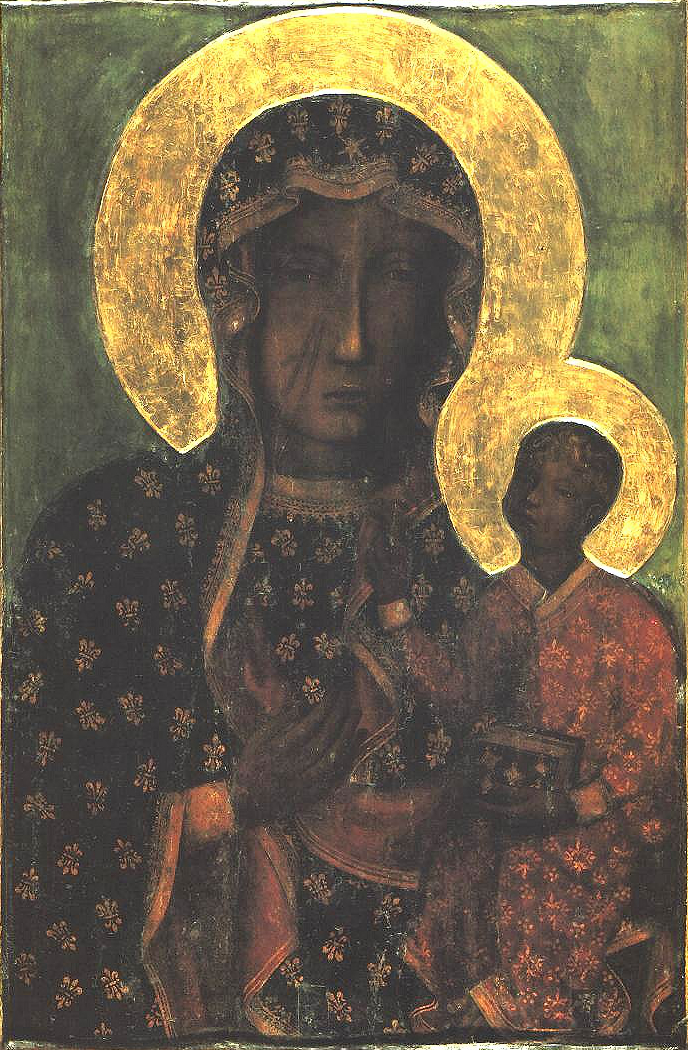
Black Madonna of Czestochowa, Byzantine origin icon of Hedegetria type

The Black Madonna of Czestochowa is the regal powerful mother, who is believed to heal you when you ask for it. Many of us remember from childhood when something hurt, like for example got a bruise from falling off kick scooter, the mother kissed the bruise and felt so much better. This is not to introduce banality in the reverence of miraculous icons, it is just for reminding that the veneration also includes tender feelings which relate to very basic human experiences. Basic, not base. 

She was crowned Queen of Poland. On the walls of the sanctuary there are votive offerings, as thanks from the donors for the miracles of healing: pieces of jewelery, pieces of silver in shapes of parts of human body, also you will see some real life crutches. 

The Black Madonna is viewed as powerful protectress. The icon is of Byzantine origin, showing Italianate influences. The legend says it was painted by St Luke himself on the table from the form  Virgin Mary's own household. It is one of several icons allegedly painted by St Luke. The pattern on Virgin's robes is fleur-de-lis.  There is over 130 iconographical types of depicting Virgin Mary on icons, this one is among the regal type images.

 Those Theotokos were shown like aristocrats of Byzantine imperial court. But the icon painting, or icon-type of style wasn't limited to the areas we today associate with icons: Italy had those too. Bellow  Hedegetria by Giotto. The stripes of fabric angels wear over their robes belong to a traditional fashion of imperial court in Constantinople. Even the Eleusa type has Byzantine moforion

A very imperial looking Theotokos by Giotto
Eastern Orthodox faith didn't develop Mariology as did the Latin Church, but the devotion to Theotokos was  given, even not much disputed in theological manner. The idea that Virgin Mary was elevated above any created being found its expersion  in showing her with as much dignity as depicting a powerful empress.

Monday, July 1, 2013

Saints who once were crooks, criminals and bad people in general

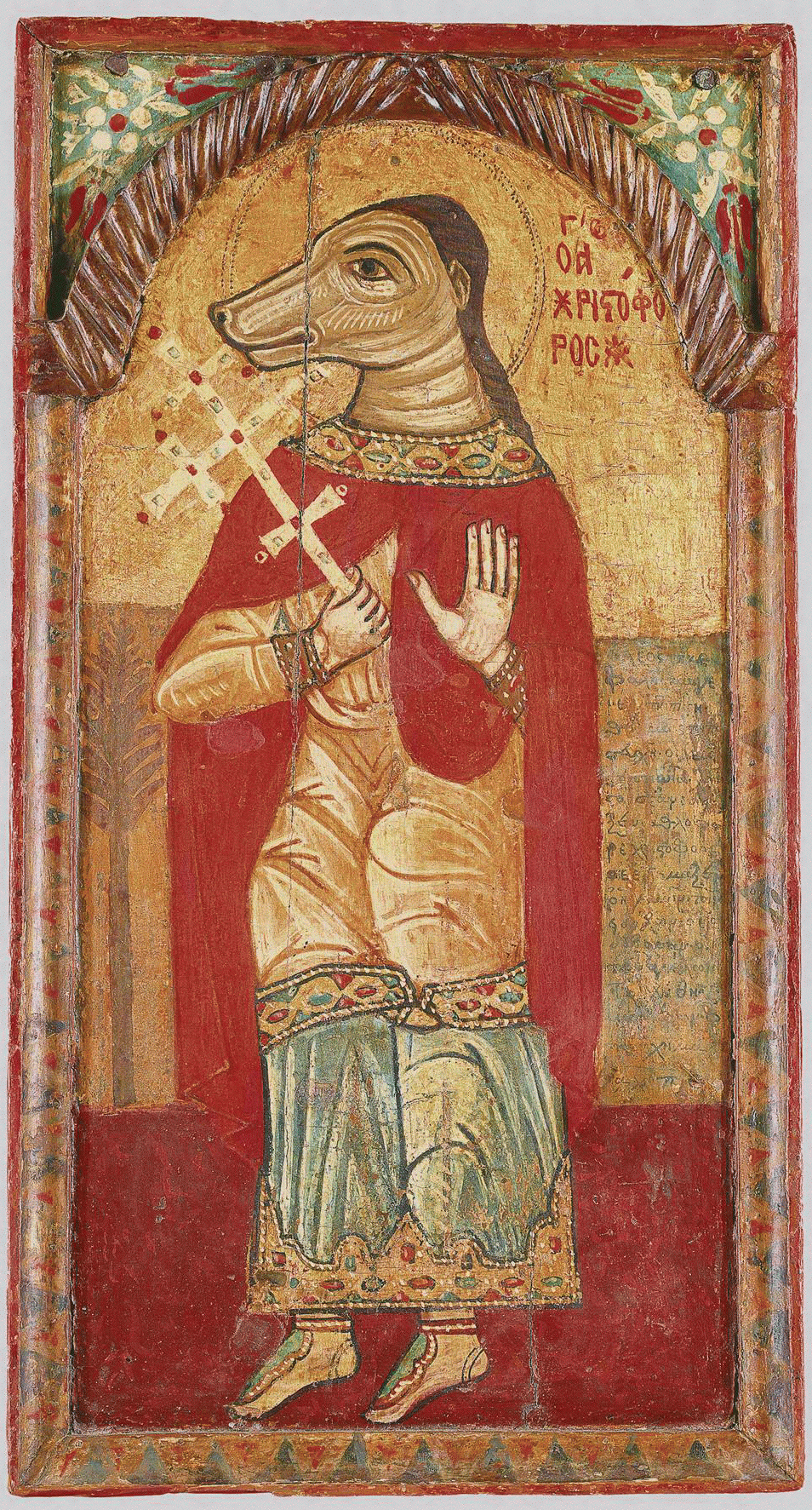
St Christopher, dog-headed saint,  icon
This entry will be not a light read partially, for it is about bad people who changed their ways and became saints, were reformed individuals.

 I was writing about Mary Magdalene and I see from my statistics that entries about her are quite popular. She was also an extremely popular saint, also in Catholicism which described her as a reformed prostitute for over a millennium.There is a disbelief, in general, regarding her alleged former profession and her super star status. It seems that branding someone as a prostitute would be a social death, and it was, normally. And here the logic of old days and logic of today clash: we talk today about erasing Mary Magdalene through smear campaign, all very upsetting. Logical point, not much to dispute from today's view point. After all we live in a society  in which  we can for example discredit a politician for marital infidelity. But she was a saint and she was worshiped by a society different than ours. She wasn't an average person: she was a saint.

We can't always apply our today logic to societies of days gone. Mary Magdalene was described as a  former prostitute, but also was called no less than Apostle to the Apostles. She was also the second most depicted saint: Virgin Mary was first. I know that modern day people struggle deeply with this paradox. Which is logical, of course. But keep in mind that societies of old were in some regards very, very different than ours, their beliefs, social mores, social system, in general their culture was different.

This maybe come as a surprise, but Mary Magdalene was not the only saint who "was a great sinner," as those saints were described relating to the phases in their lives before changing their ways. In her alleged status as a former sinner she wasn't even the worst one. There is over thirty saints who were very ungodly before they changed and after some time achieved saintly characters. (There were saints who had human lives on their conscience, for example). Hard to grasp? Maybe. If we don't know the cultural attitude toward transformation in earlier days, yes, those issues become incompatible, and it is surely  understandable that they are incompatible.

 Yet people during Medieval times,  Renaissance, and Baroque had different views. Actually as late as until Victorian times people were not shy about retelling the sins of the saints. Not at all. They told that St Olga had lots of blood on her hands, as she decided that revenge against murderers of her husband should be bloody and no ones life should be spared. St Paul, the one who authored parts of New Testament was forgiven prosecutor of Christians.  St Mary the Egyptian was a street prostitute. Margaret of Cortona was a sex addict. The first saint of all was the Good Thief:  he was one of the two criminals crucified with Jesus. St. Callixtus of Rome was convicted twice for felony, in addition embezzlement wasn't something he shied away from. St Moses the Egyptian was  boss of a violent gang, those men were killing people. St Camillus de Lellis was a con man, a mercenary, and card player for profit.And so on,this  list is not complete, and I don't see the reason to make it complete in this blog. You see the point anyway.

St Mary of Egypt, Russian icon, XVII c.
But Christianity isn't the only religion which has converted criminals as saints: Tibetan Buddhism has one such a person: Milarepa. He killed 35 people before he repented and became an example of goodness. Role of religious changes which emerged during  Axial Age was to tranform human ethics deeply on individual level.

So, not every saint was a paragon of virtue from early on. Some were examples of evil who later changed in the process of true alchemy of the soul. One of the last examples, from XX c. is a man who killed a policeman, and was the last person guillotined for his crime in France. He experienced conversion in prison and become unusually good and a shining example to others, his name was   Jaques Fesch. And here is the controversy for and against Jaques Fesch's case for sainthood as seen by the Catholics themselves.

Oscar Wild once said: "Evey saint has a past, every sinner has a future." For sure not every saint had "a past"  in sense of bad past, as there were some individuals who very immaculate from the beginning. But for sure path to sainthood wasn't excluding anyone. Mary Magdalene in her alleged profession was not paragon of virtue, but she was quite innocent in comparison to the others. So was another beloved saint,  Francis of Assisi, who according to  hagiography  was a bad boy who matured gradually to sainthood.Early on he wasn't a pacifist as he lived as a soldier, lead decadent life of revelry financed by his wealthy father. It was later when he changed his ways, and also married  "Lady Poverty." Word marriage symbolized his commitment to life in poverty.

Dog-Headed Cannibals, woodcut from Cartha Marina,  1530
What about the icon above, the saint with the head of a dog, adorning this post in a way so strange for us, the modern people? It is St Christopher, who was believed to belong to a cruel kind of people who were born with dog heads, and were extremely violent. In fact cannibals were depicted as dog-headed. Cane was Latin name for dog. St Christopher was such terrible man who after he met Jesus became a very good person, and one day he became saintly.

 Sainthood was and still is considered to be the life as most human and humane as it possibly can be. It was believed that every person without exception can become a saint, and the true miracles of transformation of a soul are possible. Miracle of changing water into wine was a miracle of transformation, and such transformation was considered possible for human soul with divine intervention and openness combined with willingness from the side of the sinner.

Today those things may appear difficult to grasp, but were quite simple for people of earlier days:  those saints were illustrations of great workings of divine grace. They were miracles in action and  embodiments of  hope given to every person, however imperfect a human being was, for sure there was hope. The hope was the promise that perfect transformation was possible because perfect forgiveness was possible, that God's love was all inclusive. If one abandoned for good the path of evil, the person could even become sanctified if the transformation was complete. The person was forgiven, and you didn't question divine forgiveness. To do so it would be to dwell on peoples' sins who were forgiven already, washed totally clean, no-existing. People went to confession and believed that their sins were forgiven also, that they were cleansed also.Accepting that this happened to others as well wasn't a big deal for them.It was the world in which confession and repentance was a sacrament of reconciliation, of giving freedom from sin.

Forgiveness as a concept and mystical experience is very prominent in Christianity. It makes transformation possible. Transformation into what? Into purity, life in sanctified grace.Mary Magdalene was considered completely transformed, and as someone who was pure she was also depicted as ascending to heaven. Those things need to be understood in relation to saints, specially those of them who had difficult past, who were not from the beginning like Mother Theresa. They had bad past but grew so far beyond it,that  they were not soiled by it anymore. Bad past was the memory of a  battle won, not something which was supposed to be held against them, as it showed the severe spiritual obstacles they overcame. You couldn't slander a saint, as the sins forgiven were considered erased forever, sins of any person, and not an object of discussion or doubt after they were removed.

 Holding their past against them would be like not accepting God's verdict of forgiveness, to be unforgiving against God's will, and people were warned that those who are unforgiving can't expect much forgiveness themselves. It was much deeper matter than we think about it today from our perspective, "oh, this saint had bad past, therefore was discredited." They couldn't be discredited, as their sins were considered forgiven, what was forgiven wasn't existing anymore.

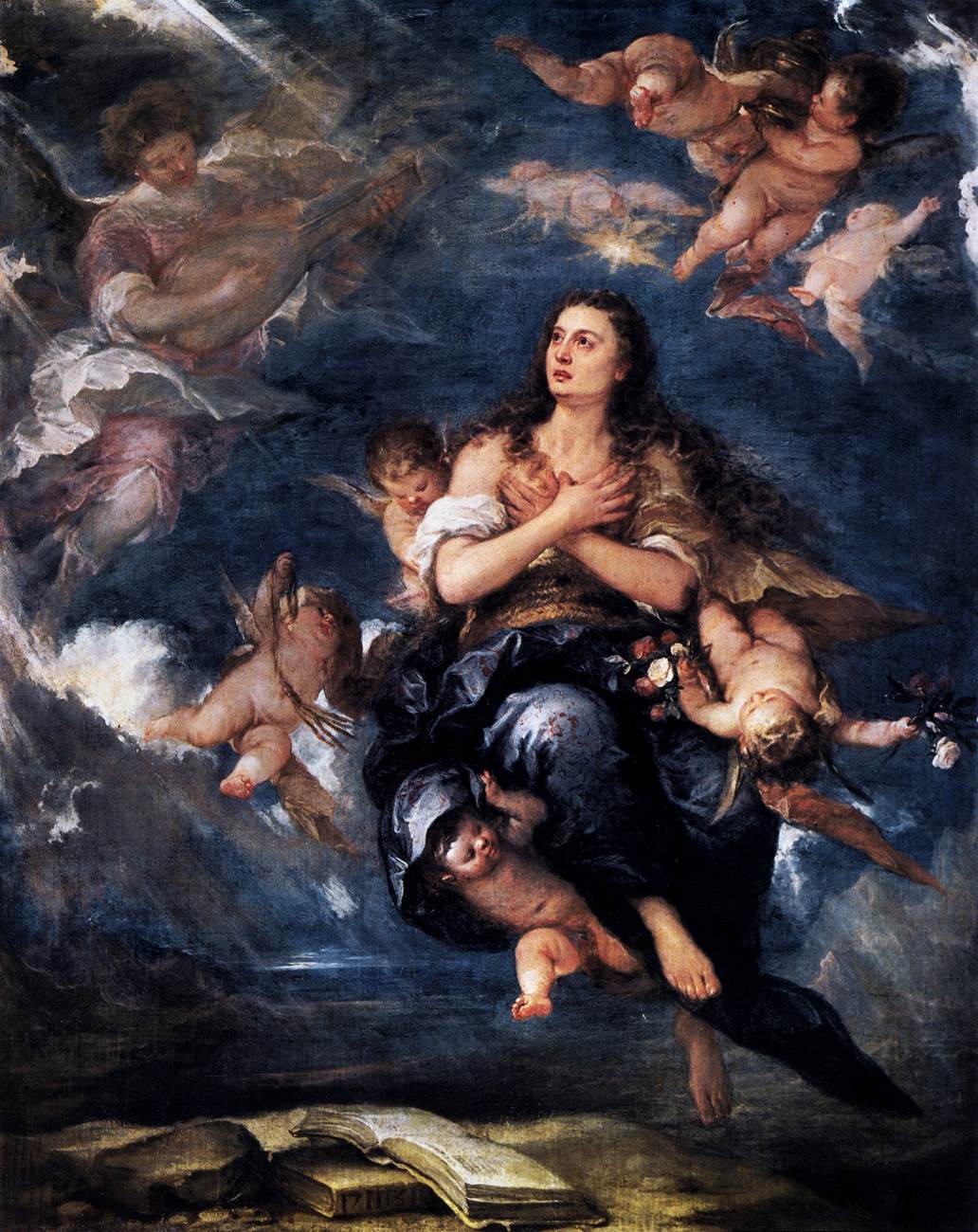
Assumption of Mary Magdalene by Jose Claudio Vicente Antolinez, XVII c.
Mary Magdalene has black hair here, not red. This is Spanish painting. Spanish artists depicted her with black hair, not as  a redhead.

As you see Mary Magdalene wasn't the only saint in Catholicism who had bad past, and who was sanctified in spite of it. Yes, early Christianity tried to figure out what to do with women, if they were allowed to be for example priests or not, etc. Misogyny was there. According to comparative religion scholar Karen Armstrong as long as Christianity was a secret and forbidden religion, when Christians met in catacombs or private homes, women were prominent. When Christianity became state religion, power was regarded as right  of men. And I say, no wonder, Mediterranean cultures were very misogynistic those days. People are very surprised when they read for example about position of women in Greece of Antiquity. And gender was not considered polarized, as we believe today. It was a different, kind of evolutionary concept which dealt with the belief what every thing was developing in nature. In this system which was linear and not polarized as today, man was the highest sentient being in the  hierarchy of life, woman was below him.She was the link between humans and animals. Yes, it was "really so bad." Religions as systems often adopt a lot of surrounding culture. Early Christianity maybe was socially very different at the beginning, but than normative  cultural prescriptions started to settle in. And for that no conspiracy was needed. People are not only products of their religions, but also of their cultures, and their times.


Thursday, August 23, 2012

Mountain of Venus: legend about Tannhauser

Recently I saw with my husband the movie Wagner's Dream. Totally fascinating documentary (and my husband told me it was very interesting to watch me watching the movie, my reactions, etc.) It was about the Ring of Nibelungen cycle, but this brings me to Tannhuaser, the other hero of Wagner's operatic world, and the legend about Mountain of Venus, a real mountain called Venusberg close to Horschelsberg. Located between Gotha and Eisenau in Thuringia, Germany. This area was explored by ethnographers of the XIX c., the Grimm Brothers included.Certain legends are as significant in German cultural heritage as the legends of King Arthur in Britain. This one is about Tannhauser, a knight and  a poet who supposedly took part in the literary competition at the Wartburg Castle, along with few of other historically known knight-poets.The real life Tannhauser (or Tannhauser, as his name was also written), as a poet wrote very erotic and easy-going pieces, not as refined as the courtly love poems by the other knight-troubadours (Minnesangers in German,  literally singers of love).

The Mountain of Venus itself is located somehow close to the  Wartburg castle. Here according to records (which may or may not be true) took place a competition between Minnensangers, who were German troubadours. Among others beside Tannhuaser very famous names come up: Walter von der Vogelweide, also Wolfram von Eschenbach, who is probably most known as the author of the Grail romance; Perzival.
You can see  them and their poetry in the Codex Manese manuscript

Here at  this mountain  with caves,  according to the legend, Tannhauser, their real life peer,  knight and poet,  met the goddess of love, Venus herself. She was surrounded with her court of beautiful women, and invited him to her subterrean world. He followed gladly, as he was a very sensual person, and through they entered  through the cave into the earth. The knight resided there for seven years. Some versions talk about one year. He enjoyed the easy fulfilment of all his carnal desires, and was very happy, unaware of passing time.  But finally he started to  feel empty, longing for earth, in spite of all delights, including pleasures given by Venus herself.

Venus Cave bellow, auhtor: Metilsteiner.
Venus Cave, Venusberg Mountain, Thuringia
Venus, however, didn't allow him to leave. When he was thinking of Virgin Mary, yearning for freedom, the Virgin appeared in an instant, and all charm of the under-terrestial world disappeared. At once Tannhauser found himself at the feet of the Wartburg Castle.

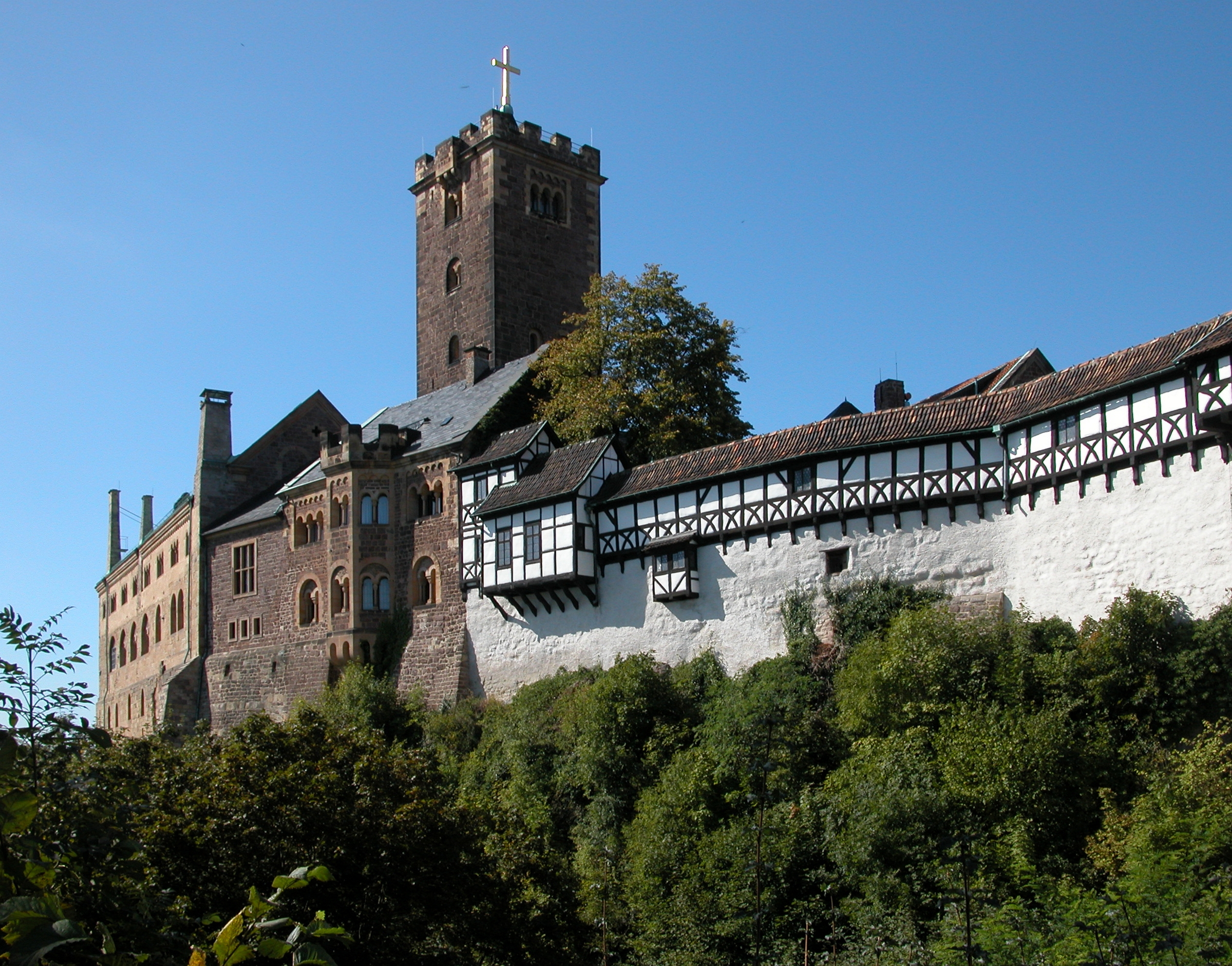
Wartburg Castle,  by Robert Scarth                          .
Yes, the same where Luther was given protection, the house of St. Elizabeth, and the place of competition of Minnensangers, and featured in Wagner's opera Tannhauser. Click on the picture to see high resolution.
Here he felt free , and in a state of rapture collected flowers. It was a kind of religious ecstasy. He decided to confess all his sexual debauchery, and ask Got for forgiveness. However, every priest who heard his confession was too shocked and didn't want to grant him absolution, telling that God will never, ever forgive such sins. Tannhauser even went to Rome in despair, confessed to the pope Urban IV himself, and asked for  forgiveness again. All this made the stern pope very upset: he said that first his pontifical staff  "will rather grow green, and bloom than God will forgive such lust." Depressed Tannhauser departed, decided to go back to the Venusberg, as there was no place for him on earth, he went back to the goddess and her realm of carnal pleasures. But after three days the pastoral staff of the pope greened with lush leaves, and flowered profusely. The pontiff send his  messengers after the desperate knight, but they couldn't find him anymore. The people in the village close to the  Venusberg told them he passed by, with somber face.He was never found again.

Picture on the left  is Tannhauser himself, from page of Codex Manese where some of his poetry are compiled, among them also a repentance song. The Codex is an anthology of medieval German poetry. The legend of Tannhauser made to German literature during XIX c. when literati  started to be interested in folklore and medieval world. But the strongest increase of popularity came after Richard Wagner's opera, named after the poet and retelling the Venus  legend, and the story about   competition at the Wartburg Castle, combined with Wagner's own creative liberties.

The Venusberg story is very interesting for three reasons: first it talks about real-life poet and maybe a real-life poetic competition, fits the history of a  personality, and his creative output into a legend. Second, it is an old legend Christianized, similar as the grail story was Christianized,it is a hybrid. It shows dynamism of a society which was in transition from culture of paganism to conforming into a new religion, and still quite new fedaul reality. The third reason: it gives a moral lesson about forgiveness, which it is not granted freely, and forces the protagonist to go back to the old ways.It shows that people are not forgiving, but the divine forgives. A lot of moralising here: about the goddess Venus and her court, personality of the  poet knight, but also about the hard hearts of the clergy.No one is spared, and in this story the divine gives a lesson that forgiveness should be granted freely and quickly, and this is a true loving way. The story is of course about carnal and spiritual love, and about serving a lady, but it is so multi layered. This were also times when Europe clarified its own ideas of romantic love.

Regarding an old legend combined with Christianity; Sabine Baring-Gould mentioned this one  in his book Curious Myths of the Middle Ages. He reported that the legend appears in its basic version in many countries in Europe, on which the local folklore built other layers. No confession and clerical invlovement is seen except Taanhauser story.Which I was not aware of. Basic version is that under-terrestrial beings want to contact human beings. A man comes in contact with them, has a very beautiful women as  a lover. He longs for earth, and escapes. However, he needs to return, as the earthly world is not receptive to him anymore. Baring-Gould gave examples of stories which have variations, but retain the basic roots. A very folklorist  view. Sometimes a pagan goddess, sometimes the goddess Venus herself  is present, and there is also a motive of ring and the marriage. There are also more mountains of Venus in Germany, also in Italy, there called Venus mountains, or mountains of Sybil. (I wonder if this has to do with Roman presence there). Baring-Gould also mentions that  the story of Tam Lin, tells stories from Catalonia, Farroe Islands, Sweden, Pomerania, Switzerland, etc. and mentions written versions by various ancient authors.Some are more related, some are more distant relatives.

 I also see now the connection between a legend from Poland, about a young knight who went through the waves into the heart of the lake to be married to some beautiful woman who held a court there. He was telling his loyal horse-or loyal friend who was a rider, depends on version- to go to and to tell his family he wedded a beautiful lady of the lake. The mother of the knight in the bottom of the lake knew the  he will never come back. Poland has of course many stories about aquatic world, courts and the cities, as there are so many lakes.

Tannhauser was present among supernatural beings, under the earth. Main ruler of the court here is chtonic type of the goddess, in spite of the goddes being Venus,a conflation. And the idea of under-terresatial folk itself reminds me of a huge bestseller, kind of  the Da Vinci Code of the turn of XIX c. It was a novel about Vril and subterrean super race living in  caves under the earth. The novel was an enormous financial success. Many people actually believed in reality of such race, and this belief was rumored to linger for long. Some of the Nazis supposedly believed it, it was believed in some occult circles, in Theosophy belief in Vril still exists to some extend. It was a novel, but seriously captured people's belief in reality. Vril, similar like the grail, is the idea about power granted, about  fulfillment of wishes. No wonder that both, the grail and the vril resonated so strongly with the audiences.  Recently we had The Secret phenomenon, which falls in the same category:  power of fulfilment of wishes, power of belief. Law of Attraction, another magical world for the frustrated. But I prefer the legends, I confess, Vril and the Secret don't attract me.  Are they an equivalent of today's court of Venus, where first after some time one sees the illusion?

As for the caves in Venusberg: local society hopes they will attract tourism, and the caves were explored. In them are diverse colonies of rare  bats, which hopefully will not suffer in case tourism increases one day. Iron bars at the entrance of some caves make a lot of sense, and here is a responsible way of protecting nature.

Monday, April 16, 2012

Mary Magdalene:Colors, Robes and Archetype History of Color # 8

I noticed in my blog's statistics that some of you came to my blog searching for info about the colors of Mary Magdalene's robes. I must have been a disappointment to see so little about it. I hope this entry will give you more of satisfying information.


Red was very common when she was depicted, but other colors were not rare either. I feel I need to move beyond the Middle Ages, as I was writing about vermilion robe of Mary Magdalene already. I am focusing in this post on Latin Christianity. Byzantine Christianity depicted her also in red robes, often with red egg in her hand. In this tradition she also she was considered extremely virtuous, one generation older than Jesus, died in Ephesus, her relics (body) were revered in Constantinople. Disappeared of course, maybe together with other relics after sack and looting of Constantinople they, tradition say were brought to Western Europe. But we don't know for sure what happened.

Mary Magdalene, Orthodox icon
 Red was often the color of choice by the later painters as well, but I would advise not to rely on red so much. Some people do, to some degree of annoyance of the well-educated art historians, when the non-art historians try to convince them, sometimes quite harshly,  they know it better because they read a few popular books. Thing can turn rather grotesque.About annoyances and my defence of art historians  later, in another entry, now I focus on colors and Mary Magdalene as a cultural phenomenon.

Magdalene was shown in red robes, quite often in a green dress. Green symbolized eternal life, color of paradise, hope and promise of eternal happiness in heaven. Green of the  paradise was shown already in the early Christian art. Shouldn’t be confused with non-religious matters, when green symbolized rebirth, Spring, fertility, hope in matters other than theological. It is important to know about such differences, not only for knowledge sake, but also for avoiding mistakes, for example reshaping Mary Magdalene into fertility goddess, as it sometimes happens in some books authored by some non-art historians. The context of the art matters, quite a lot.

 Red was common, yes, but not an exclusive color assigned to her only, nor she was shown in red only. This is a curious misconception, recently spreading. I would like to know about the sources of it. Assuming that she was shown only in red robes, isn't in relation with factual history of art, it is  huge over-simplification. Red in religious, not secular tradition  represented  love in sense of charity, (agape), martyrdom, sacrifice on the cross, redemption through crucifixion.

 But she was also depicted in lush and colorful robes, rich and beautifully embroidered, often golden. Look at this picture, which I got through twitter. One of many examples of colorful robes, from the collection in Kassel Museum, Germany. Cloak is elegant subtle shade of red.
Mary Magdalene and Jesus as Gardner

Or click to see life of Mary Magdalen at Chartres Cathedral stained glass window. Click on links to different images, and you will see range of colors, blue included.

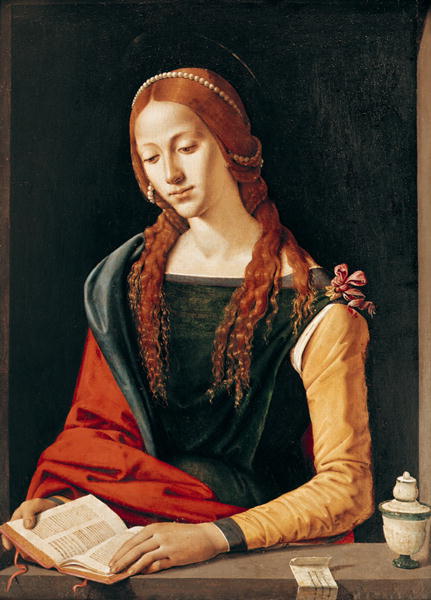
Form gold we go to yellow, which was in certain times the color assigned by law to the common prostitutes and courtesans. Red wasn't. There is another misconception that red was color of prostitutes, which is not true: yellow was. Red sometimes only. I wonder if this assumption comes from Scarlet Letter? Who knows. Mary Magdalene could be dressed in yellow, or only be a part of her garment, like for ex. the sleeves were yellow, the dress itself  is black and white, and no cloak. Etc.

Piero di Cosimo, Mary Magdalene, public domain, via Wikimedia Commons


Penitent Magdalene by Artemisia Gentileschi,via wikimedia commons


Colorful, rich robes were shown too, or in very subdued colors, when she was depicted as a meditating penitent. Or dressed in shiny silvery silk, XIX c. And I am glad she was not depicted in red only, and not in vermilion only. She captured the imagination of the people of Latin Christianity as a very colorful personality anyway, as someone who lived a whole spectrum of human emotion and full spectrum of ethics. Why she should be than depicted in one color only? It would be very limiting. She was considered the accessible saint, giver of hope to fallen humanity, and as a personality more a symphony than a simple melody. She was one of the Latin Christianity highly elevated persons who was somehow considered unclean at the beginning.

Mary Magdalene by Jan van Scorel, via wikimedia commons
To the masses of believers she was the embodiment of a phenomenon of transformation. From a women from whom seven demons were expelled, a prostitute by profession, who than became no less than "Apostle to the apostles," the title given her by the Catholics church, a base metal changed alchemically to gold. Transformation which Oscar Wilde one described as: "every saint had a past, every sinner has a future." Initially a bad girl, but with golden heart, also in accordance to some societal views about the harlot with a heart of gold. Europe loved such stories, Europeans were not Puritans. La Traviatta is one of those stories, for example. I don't think there is an equivalent in the US. Different cultures, different views, different archetypes.

And she was an embodiment of a loving, yet a very independent woman. Sometimes I am asked if I believe Mary Magdalene was the Grail. Depends what you understand as "grail". To me grail as an archetype can’t be confined to the ideas of biological reductionism. Grail of the legends itself is an archetype of a quest, and it is elusive, as quest is often about elusive goals. Many people are on quest, but don't know what the quest is about. And nothing wrong with it. Mary Magdalene: it is nothing wrong in being a parent, it is something very noble in parenthood. I respect that. But did she really need to be a mother, a cup bearing diving DNA in order to be more important to us?

Penitent Mary Magdalene, by Vaccaro, via wiki commons

We may find out that today we are less tolerant toward her than the people who didn’t believe that she was the mother of Jesus offspring. Those people loved her anyway, even when they believed she was a reformed fallen woman. It seems they were quite  forgiving. She was loved and venerated the way she was perceived, with all her imperfect humanity, the way she was seen. Imperfect saint? People didn’t mind. This is not about who she was historically, as stories were often confused. Mary the Egyptian for example, or dispute which body was the real Mary Magdalene, as at times there was more than one body claimed to be Mary Magdalene's. Holy relics were not such clear business, and there are also cases of spurious claims. Her story is not so much about her, but very much about us: how much were are willing to accept in a person, specially in a women, in order to consider someones contribution a worthy one.

 And how many prejudices we have. Her story is a very interesting case in social history, indeed. Interesting, unique perspective in a Guardian article by the novelist and  columnist who was herself a prostitute, Tracy Quan. She mentions her visit in Southern France to see the relics whom she considers to be her patron saint. Specially important, I think, is the quote engraved on the stone tablets along the steps leading to the cave said to be saint's meditation hermitage: "Blessed are those who have been persecuted." Quan noticed this quote as she climbed the stairs. To me Quan's article was a gentle reminder and a rebuke, to all, me including, calling to not forget those who are in need, no matter who they are, or how "lowly" they are. Over a millennium and half Latin Christianity's message regarding this saint was: stop marginalizing, be open to others. 

The founder of  the first church in Europe was Lydia. She was a business woman, dealing with luxury goods prohibitively expensive purple cloth. She was unusual for the place and times, when women were considered deficient human beings, with human rights comparable of that of children assigned to them. Why she is not talked about now, along with Mary Magdalene? Not sexy enough? Not enough of sensationalistic dramas? No way to focus on her genitals/womb, as it was done in Mary Magdalene's case, and still is today?

In general this turmoil about Mary Magdalene and women, being not given enough enough respect,  not given enough place for them in the church, as much as it is healthy and good has it own flaws: conveniently blaming the Catholics for everything evil seems to be a little bit displaced, when we take women as archetypes. In Orthodox Christianity there was no mention of her as prostitute, and there she also has churches devoted to her, and the legend saying that she traveled to Ephesus, stayed there and her grave is there. After the schism this is a competing legend, as the legend  of Mary Magdalene traveling to France is more well known, as Western Europe is more well known. To me the position of Mary Magdalene is more problematic in Protestantism. It seems to me that the Catholic sisters of Protestantism don't complain as much about women not given enough place in the church theology, except complaints that women can't be ordained. And other issues not relating to theology, which I omit know as they don't relate to the subject directly. Mary Magdalene was always a very popular saint, tin Catholicism, if not the most popular one after all.

Here is Mary Magdalene in brown robe of a penitent, those often were extremely crude, made of goat hair or crude wool (other races of those animal than today), or was she was supposed to be covered only by her long flowing hair.

Ascension of Mary Magdalene, Anonymous, via wiki commons
Mary Magdalene here taken to heaven is dressed in coarse penitent robe, or according to the legend, 
her naked body was covered by her very long hair.
Their (Catholics) equivalent of the Sacred Feminine, a term so often used now, is Virgin Mary, given the title of the co-saviour, as saving together with Jesus. Mary Magdalene is the  apostle to the apostles. And other women saints. They say those personages are just humans among the Protestants, who reject cult of Virgin Mary, etc. not divine enough. Should we reject their opinions as illogical? Given the number of the churches devoted to Virgin Mary and and Mary Magdalene in Catholic countries in general? Look at the picture above, is this disrespectful? The word "vilified" is often used in relation to Mary Magdalene. Is she as vilified as it is complained in popular opinion? I think we need to to look deeper, it is easy to repeat catchy phrases, which can be emotionally satisfying, but on the long run those phrases make things shallow. And the subject of Mary Magdalene is not shallow, not matter which tradition we analyse or which one we like.

Art history gives another picture. On the last example above she is rather glorified than vilified.And it was one of many kind of depictions of Mary Magdalene.