Showing posts with label saints. Show all posts

Sunday, July 14, 2013

Divine Mothers, part 1: breastfeeding Madonna


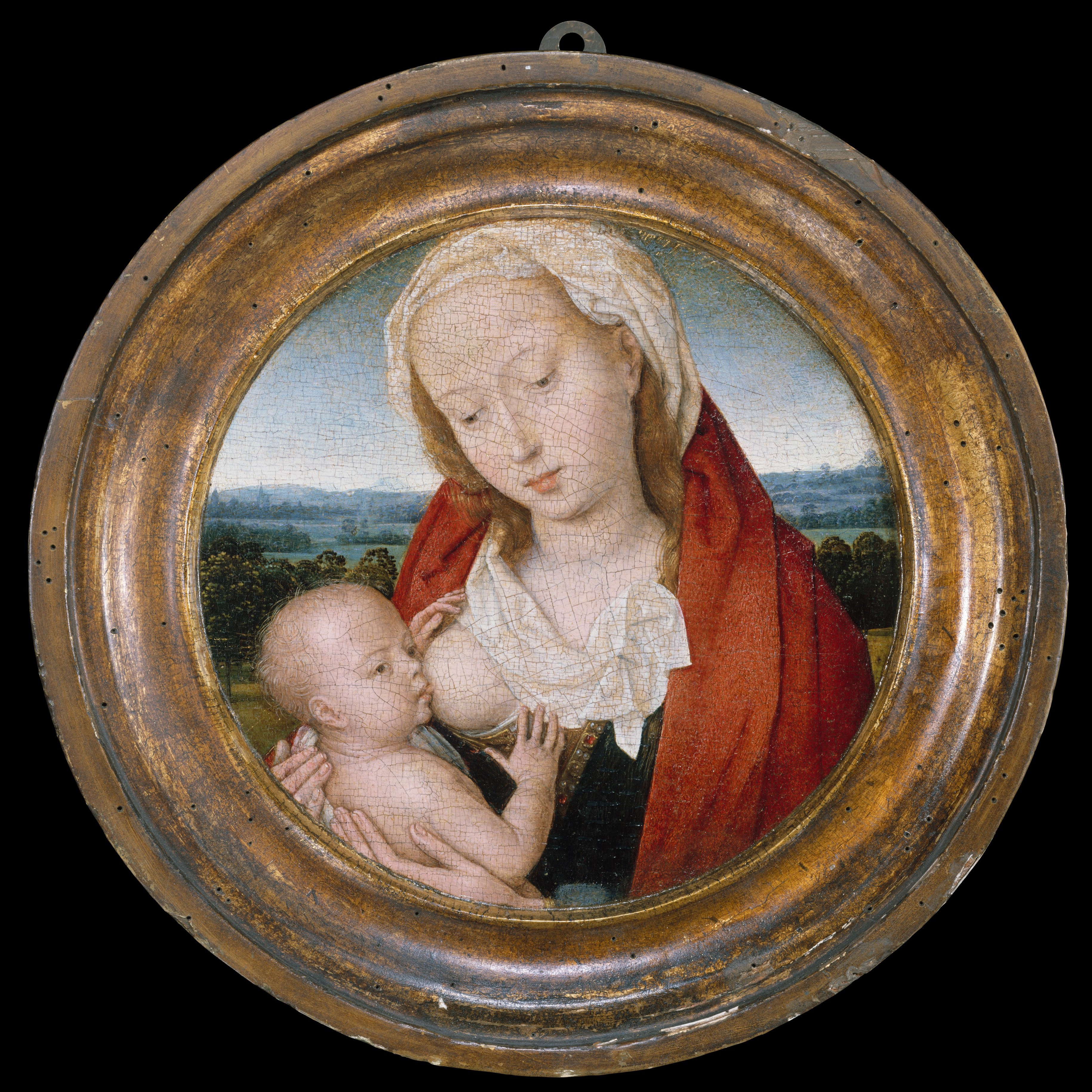
Hans Memling, Nursing Madonna

Today some people are kind of surprised that so many, specially women, like the idea of Mary Magdalene being the wife of Christ and the mother of his children, and talk about her being erased from history.

I am not surprised. In my earlier entry I wrote about how our ideas of Mary Magdalene represent something what is important in our society. Something what is maybe not so clear in our everyday awareness, but many know in some. Let me use that silly word for it: subconscious level.

First, in spite of the technological advances, the world in not becoming more cozy. Many of humans need things mytho-poetic when technology is invading their lives, even when it is to the advantage.We are humans, not cyborgs whose extensions of mind and body are machines. People turned to things mytho-poetic or considered less rational when huge technological advances were made, during the 19th c. and for example 20th century between wars. This trend now isn't new or surprising. It is a natural reaction when people feel that the pendulum went too far in one direction. So, there is a counter movement. It is evoking creative forces of the mind again.People don't want to be cheated out of this important part of human experience, mytho-poetic creativity is part of whole we call a human mind.
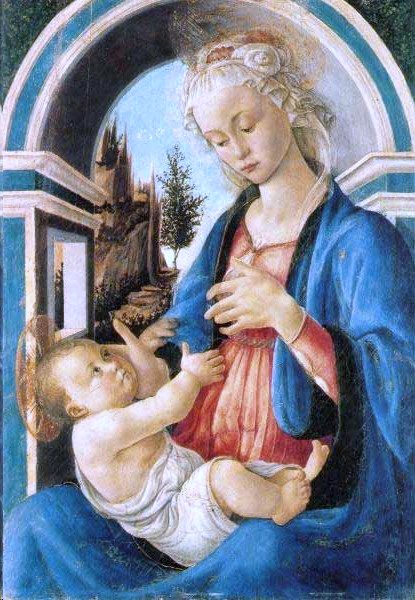
Sandro Botticelli, Madonna with Child, here Virgin Mary in a dress allowing easy nursing
As for Mary Magdalene being a mother and being pushed away: no wonder this idea is popular, lets take a look how we treat motherhood today, what our popular culture reveals, and how motherhood was treated earlier.  This is first entry on the subject of motherhood.First for his entry let consider breast feeding. Talking about things mytho-poetic:  Milky Way according to Greek mythology appeared because of  accidental squirt of Hera's milk while she was nursing Heracles, who as an infant was supposed to acquire god-like qualities by drinking from the breast of the goddess. The word galaxy comes from Greek word for milk.Nice story about milk of the goddess. Today's reality isn't poetic about breast feeding.

This link shows results of study about breast feeding mothers: prejudice. Also those mothers who breast-feed in public have personal stories to tell, how they were treated. Nothing encouraging. There is even a lawyer, a women, who tires to make breast feeding in public illegal. Because it is "disgusting." Not everyone finds it "disgusting," but it is enough for mothers to feel the hostility. Like not everyone is prejudiced against gay people, but enough to create hostile environment. Why so easily labels like "obscene, or"disgusting," "disturbing," are applied to something so positive, psychologically (bonding of mother and child) and what has proven health benefits for the baby?

Gerard David, Nursing Madonna
 Nursing Madonnas as images or part of Marian theology is a very interesting phenomenon. The imagery first appeared in Coptic church of Egypt, the iconography was borrowed from the depictions of Isis nursing Horus. Cultures borrow from each other, as languages borrow words.

Role of Virgin as divine mother was very elevated, she was a co-redeemer of humanity. Some old mystical pictures show her standing at the crucifixion, between her and crucified Jesus stands a chalice to which blood from Jesus' side flows and also milk form Virgin's exposed breast. This was analizsed by art history scholar Anna Boczkowska in her  book Triumph of Luna and Venus, about iconography of Paradise part of the Tryptych Garden of Earthly Delights by Heironymus Bosch.

It was elevation of milk to the same importance as blood of Eucharist, it symbolized grace. Of course this was only on symbolic level, as there was no mixing of milk with wine in ritual of Eucharist.

Milk was a symbol of wisdom, and not just an earthly wisdom. It was a supernatural wisdom of knowledge of things divine, and given as a gift of grace.

Milk was also believed to be transformed from blood, and as such to be part of Eucharist and it took its place in mystical writings. Today those writings maybe not easily understandable for our modern mindset, but people centuries ago understood all metaphors very well. Middle Ages were very poetic, made strong use of symbolic and abstract thinking. 

The type of iconographical depiction of Madonna as nursing mother was common during the Middle Ages, Renaissance and Baroque. Those images often depict  precious moments of human tenderness, but also they elevated motherhood to divine dimensions also. Probably the prototype of nursing Virgin Mary appeared first among Coptic Christians in Egypt, based on imagery of goddess Isis nursing baby Osiris. This doesn't mean that Iis was worshiped under a new name: it is like a new picture was put in an old frame.

 
 This icon of breast feeding Madonna is considered wonder-working in Easter Orthodox faith. It is Galaktotraufusa (Milk Giver) from Mount  Mount Athos Monastery, in Hilandar Monastery, part of Athos complex. It was put there in 13th century, brought here by  Saint Sava of Serbia and installed in iconostasis in an unusual place which was  reserved for icon of Jesus Christ and the Trinity. I have to admit I don't know what happened to this icon. The other icon brought by St Sava, Madonna of Three Hands is supposed to be there, 2004 was a terrible fire in the monastery.

I am not saying that elevating motherhood to such dimensions was all great and sure recipe for making all women happy: childless women suffered, and women conditions were not good in general. But at least mothers' contributions were not taken for granted, or there was an idea that they shouldn't be taken for granted. Motherhood was part of the totality of human experience, and it is, just not enough credit and respect is given to it now.Gender politics is visible in all art history, struggles related to gender continue today.


Francisco de Zurbaran, Holy Family


Ladies, those of you who are or will be mothers, I say: kudos to you for your patience, gentleness, pain, baby fat, hanging breasts, stretch marks. It is not a little thing to be a mother. Milk, pregnancy and labor pains were once revered in mystical writings about experience of the divine. About this another time.

Wednesday, July 10, 2013

Grail in Bezlawki part 2: Mary Magdalene patronage and pagans


The second part of the legend of grail in Bezlawki. How the grail was taken from Britain, by whom, in my previous entry about what happened after the battle of Hastings. 

This is a legend, we don't know how old it is, bu tit is very interesting as a story, and has historical events, as well people who lived in real life. A bit of historic  background of the story.

After Svidrigaila installed the grail and his army in today's Bezlawki, in a fortified tower which belonged to Teutonic Knights, military order crusading against the pagans of the East North, he lived like a prince. Historical records show food provided by Teutonic Knights, among them very costly morsels and spices imported from afar. Teutonic Knights promised him to become the grand duke of Lithuania, even though Svitrigaila didn't qualify, as Lithuania had the law of primogeniture, and he was the younger brother in line to the throne. His older brother, Jogailla was a pagan. They were also engaged in a bitter feud with their uncle, who also was keen of becoming the only ruler of Lithuania. It seemed that those three men had reasons to fear for their lives. The fortress in Bezlawki, in the middle of dense forest was a safe place for Svitrigaila.


 Here is video how Bezlawki tower was changing through centuries. For those of you who have trouble to watch the video's embedded in this blog, here is the to the youtube video.About  4 min on shows the change for Svidrigaila, making it more fit for princely residence.

One of the people who was on diplomatic missions dealing with Teutonic Knights, who were considered those days unstoppable, was young Polish queen Jadwiga. Or rather a young king who was a woman. Why? Because in Poland by law kings were ruling, so, if the sovereign wasn't male, she got the title of king, that meant she was a ruler on her own, not a queen consort.She was elected a king, and crowned as such at a tender age of 11, like some of the Merovingian child-king. But she was an extremely capable young genius.

Jadwiga of Poland was half Hungarian, half Bosnian, but from both parents she had genetic ties with native Polish Piast dynasty. She was also from Angevine dynasty, therefore the fleur-de-lys. Her mother, Elisabeth of Bosnia was ruling Poland, as the last king of Poland decided that his sons are no capable enough. Poland didn't have law of primogeniture. king or the nobles could decide who was the best candidate for the throne. But Elisabeth of Bosnia  wasn't  capable enough as a monarch to please the nobles and she  was replaced by her daughter, Jadwiga.

Jadwiga of Poland  by Antoni Piotrowski, at Jagiellonian University
Note the chalice on the right. Picture painted in 1901. 
Jadwiga of Poland grew up in Hungary in royal court of Buda, she was a polyglot speaking six languages, spent one year at royal court in Vienna, as it was common to send children of noble birth to be educated at other courts.She was supposed to be the future wife of William of Austria, one of the Habsburg dukes, was engaged to him as a little girl (sponsalia). The Habsburgs were expanding their influence by marrying heiresses, this engagement was an early attempt in such politics.

Jadwiga was a politician and patron of culture, in addition she was very religious: she revered four saints, specially Mary Magdalene and her sister Martha. Mary Magdalene was the patron saint of Angevin dynasty, after Charles II, Count of Provence and king of Naples discovered the body of Mary Magdalene in Provence, at  Saint-Maximin-la-Sainte-Baume.Mary Magdalene was immensely popular saint and enjoyed patronage of rulers, but the Angevins were the most important in spreading and strengthening her cult. Without them Saint Baume pilgrimage site wouldn't exist, her cult in France wouldn't be as strong.

Charles II discovered the body of Mary Magdalene in 1279, he was called Charles of Salerno at this time, he became Charles II later.  At this moment this popular saint became the dynastic patron, so, no wonder Jadwiga venerated dynastic saint who according to the legend converted pagans of Provence to Christianity A scholarly article to read about Angevins and Mary Magdalene as their patron saint, and Angevins role is spreading the cult of Mary Magdalene in Provence, Naples and so supporting also the legitimacy of their dynasty, of which they claimed, Mary Magdalene was a miraculous founder.
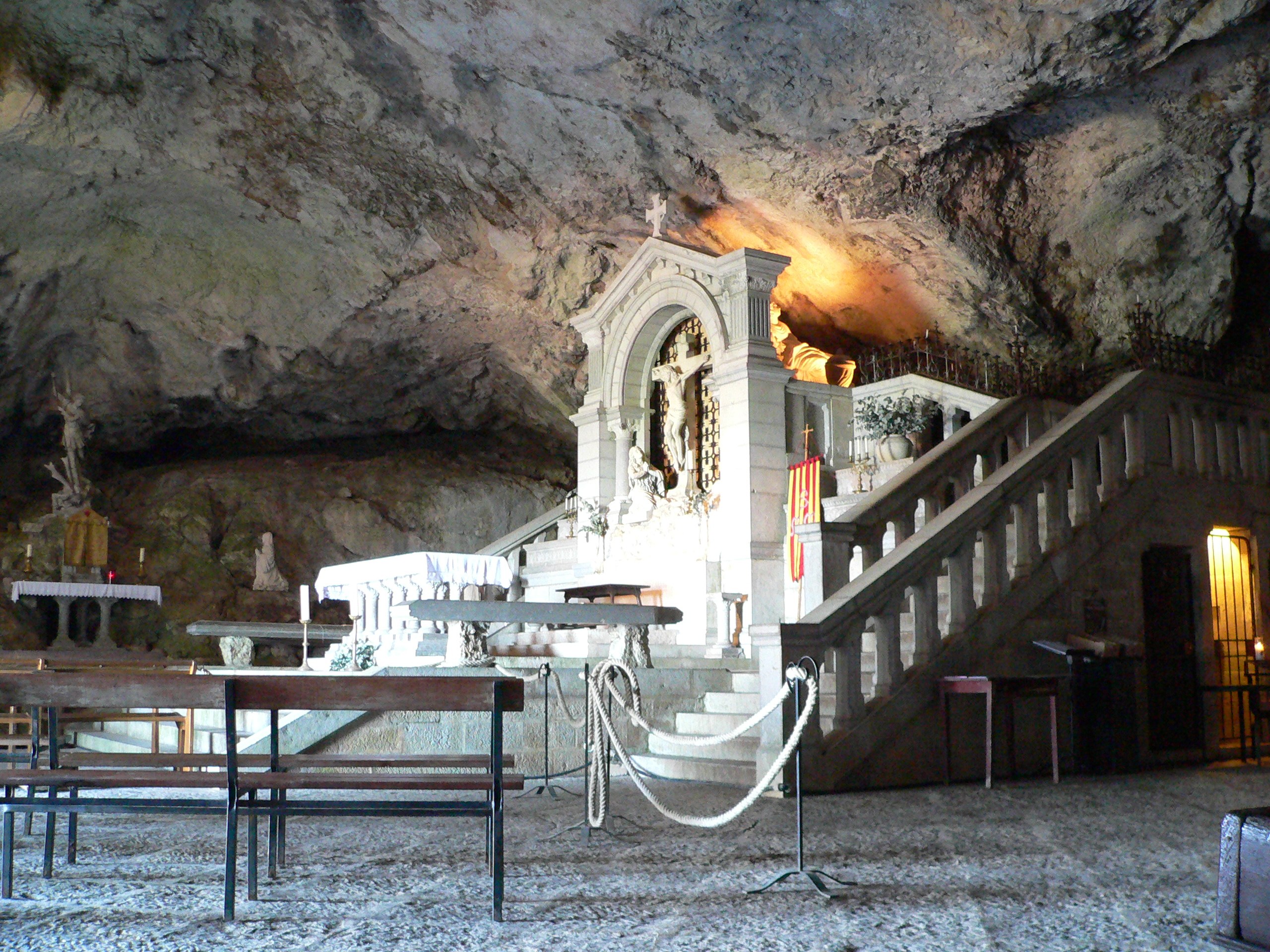
Grotto of Mary Magdalene in Sainte-Baume, by Disdero
http://www.escholarship.org/uc/item/7pz6w018
by Dr. Sarah Wilkins, professor of art history and design.

When Jadwiga was enthroned, however, several suitors appeared, hopeful for marriage and crown. William also appeared at the court in Krakow, as he was thinking now was the right time to got get married, after all Jadwiga was his fiancee. He was bitterly disappointed: the young sovereign declared the annulment of their contract, and the Habsburg duke went home.

Jadwiga got married three years later, she was 13 years old. Her king consort became duke Jogaila of Lithuania, who being a pagan needed to convert to Christianity. And through Jadwiga's influence the last pagan country of Europe was Christianized.She didn't need to preach to pagans: she just made the requirement that he husband to be needed to be Roman Catholic.

Svitrigaila  the owner of holy chalice (which one of two?)  lived with his hopes for Lithuanian throne in Bezlawki, in the area of crusader state of the Teutonic Knights, the military order which also targeted pagan Lithuania in their Northern Crusades. His alliance seemed easy, as the Teutonic Knights were believed to be invincible. Yet they were crushed, one day, and by no one else than his brother Jogaila with armies of allies.Life of Svidrigaila was marked by wars and dynastic struggles. He became grand duke of Lithuania for two years, noting more.

As Jogaila was baptised in Wawel Castle in Krakow, Christianization of Lithuania was official in 1386 The marriage couldn't happen without Jogaila's

 Svidrigialla also got baptized with his brother at the Wawel Castle. He converted from Greek Orthodox faith of his mother into Roman Catholicism.But in his case it was of no great political advantage. 

Because Jogaila became king of Poland, this didn't mean that Jadwiga was now a queen consort. She was the ruler, marriage didn't chip away her power, he was the king consort, but of course both were politically active. Jadwiga was known for her charity, good character and for her support of good causes. She was so much liked and revered by people that she was considered a saint, and legends of her miraculous powers spread. This was a queen of a true noble ideal of a virutous lady.She died young, only 26 years old, after complicated child birth. She and her daughter lived only one month. This was nothing unusual in those days, even among people who were very privileged, such deaths happened among ruling families too.

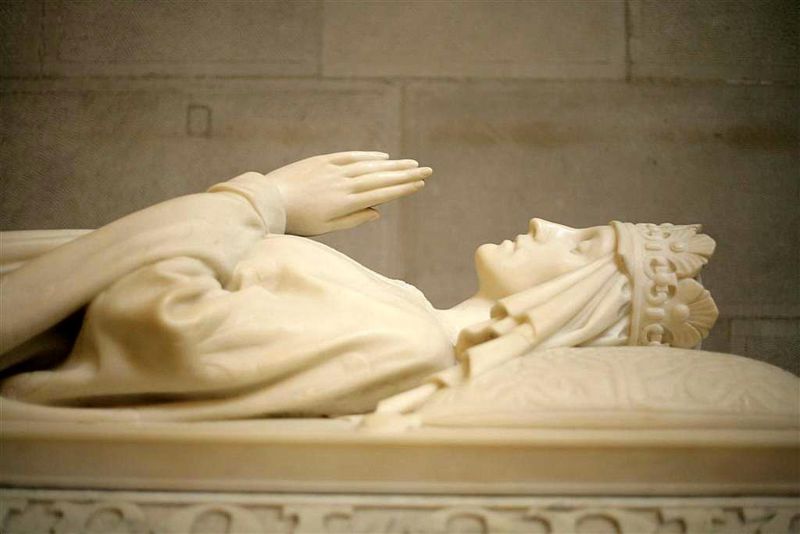
Sarcophagus of Jawdiga of Poland, Wawel Castle Cathedral
After Jadwiga died she was declared a saint by people, and her cult spread. Her relics are in the Wawel Cathedral under the crucifix at front of which she prayed. Even she was considered a saint and worshiped as such, her beatification happened as late as 1980, and she was officially declared a saint by Vatican in 1997, by the pope John Paul II as you may guess. He prayed at her sarcophagus. Pity I didn't take the picture, the sarcophagus sculpture includes a nice lap dog at Jadwiga's feet.Thank you Cezary Piwowarski for the picture. (Dog symbolized loyalty). Close to the sarcophagus her regal insignia are exhibited: the scepter and the globe. They are made of wood, painted gold. Maybe those were lighter for a child ruler to hold, but also she is remembered by her unusual generosity, she sold her jewels in order to support Krakow University (today Jagiellonian University) etc.

After Jadwiga's death it didn't mean that Jogaila as consort was now entitled to rule. There were several candidates, but he was considered the most suitable one, so, he became the king.

 As for pagans in Lithuania: they were left unmolested, their priests also. As officially Lithuania was a Christian country, crusades stopped after battle of Tannenberg in 1410.

Jadwiga's patronage of art and culture is continuation of  Angevin artistic patronage of the Neapolitan Angevin dynasty. She had good examples. In the article you will see also the image of funerary monument of Mary of Hungary, Queen of Naples, who was also patroness of arts, and like Jadwiga also connected to Hungarian Arpad dynasty. Mary's mother was a pagan of Cuman tribe who converted to Christianity in order to marry Stephen V, king of Hungary, and Dalmatia, Croatia, Rama, Bulgaria, Serbia, Galicia, Lodomeria and Cumania; Duke of Styria.

More about grail in Bezlawki, also historical background, soon, I hope, and I hope you enjoy it. Knowing the legend is one thing, but knowing the people in the legend can shed additional light, in my opinion. Again, we don't need to believe in the legend, that there are historical persons it doesn't make it automatically more credible. It is just a legend after all. Wasn't the legend  about Joseph of Arimathea who brought grail to Britain also a legend of Christianisation?


Monday, July 1, 2013

Saints who once were crooks, criminals and bad people in general

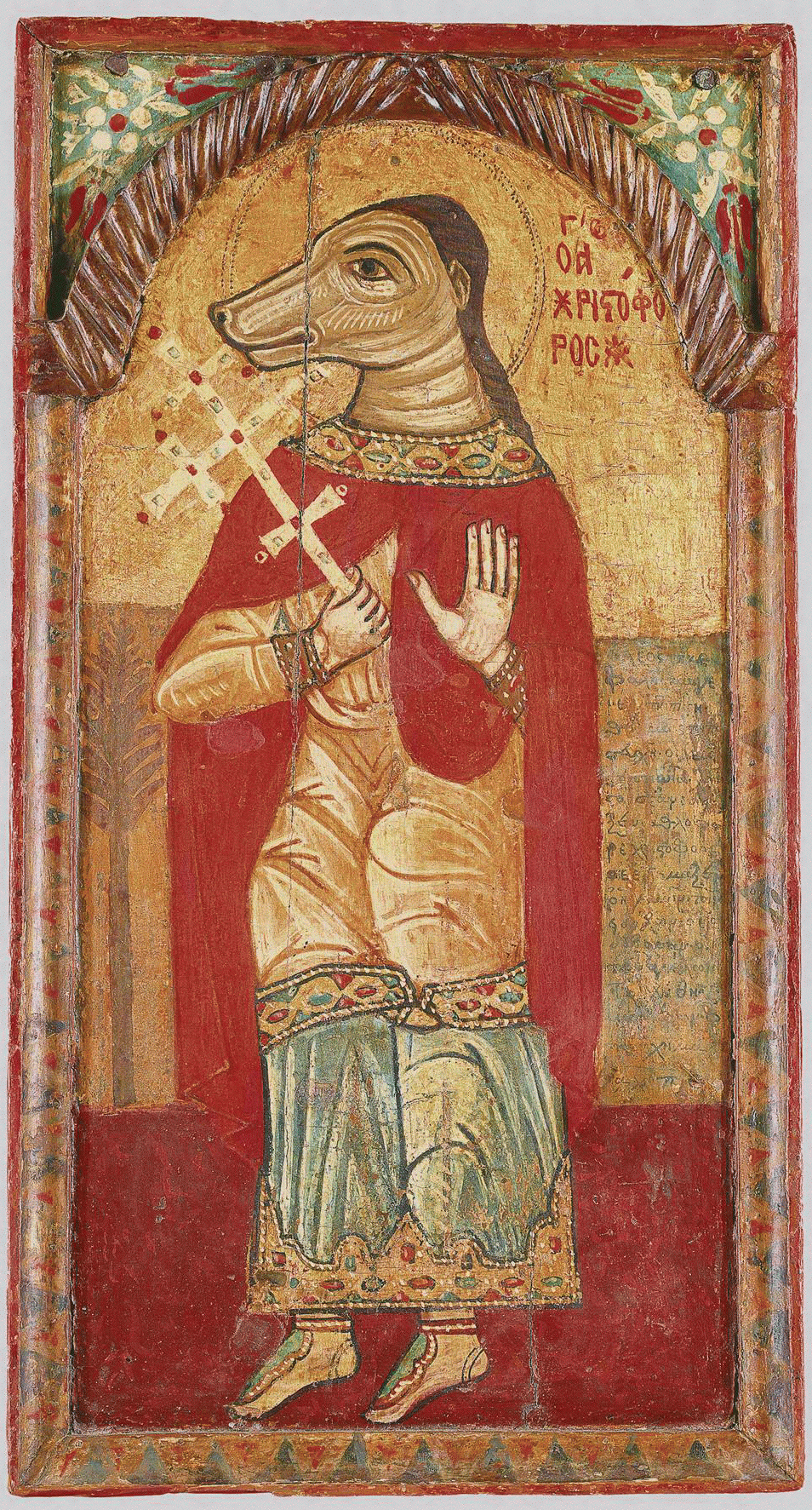
St Christopher, dog-headed saint,  icon
This entry will be not a light read partially, for it is about bad people who changed their ways and became saints, were reformed individuals.

 I was writing about Mary Magdalene and I see from my statistics that entries about her are quite popular. She was also an extremely popular saint, also in Catholicism which described her as a reformed prostitute for over a millennium.There is a disbelief, in general, regarding her alleged former profession and her super star status. It seems that branding someone as a prostitute would be a social death, and it was, normally. And here the logic of old days and logic of today clash: we talk today about erasing Mary Magdalene through smear campaign, all very upsetting. Logical point, not much to dispute from today's view point. After all we live in a society  in which  we can for example discredit a politician for marital infidelity. But she was a saint and she was worshiped by a society different than ours. She wasn't an average person: she was a saint.

We can't always apply our today logic to societies of days gone. Mary Magdalene was described as a  former prostitute, but also was called no less than Apostle to the Apostles. She was also the second most depicted saint: Virgin Mary was first. I know that modern day people struggle deeply with this paradox. Which is logical, of course. But keep in mind that societies of old were in some regards very, very different than ours, their beliefs, social mores, social system, in general their culture was different.

This maybe come as a surprise, but Mary Magdalene was not the only saint who "was a great sinner," as those saints were described relating to the phases in their lives before changing their ways. In her alleged status as a former sinner she wasn't even the worst one. There is over thirty saints who were very ungodly before they changed and after some time achieved saintly characters. (There were saints who had human lives on their conscience, for example). Hard to grasp? Maybe. If we don't know the cultural attitude toward transformation in earlier days, yes, those issues become incompatible, and it is surely  understandable that they are incompatible.

 Yet people during Medieval times,  Renaissance, and Baroque had different views. Actually as late as until Victorian times people were not shy about retelling the sins of the saints. Not at all. They told that St Olga had lots of blood on her hands, as she decided that revenge against murderers of her husband should be bloody and no ones life should be spared. St Paul, the one who authored parts of New Testament was forgiven prosecutor of Christians.  St Mary the Egyptian was a street prostitute. Margaret of Cortona was a sex addict. The first saint of all was the Good Thief:  he was one of the two criminals crucified with Jesus. St. Callixtus of Rome was convicted twice for felony, in addition embezzlement wasn't something he shied away from. St Moses the Egyptian was  boss of a violent gang, those men were killing people. St Camillus de Lellis was a con man, a mercenary, and card player for profit.And so on,this  list is not complete, and I don't see the reason to make it complete in this blog. You see the point anyway.

St Mary of Egypt, Russian icon, XVII c.
But Christianity isn't the only religion which has converted criminals as saints: Tibetan Buddhism has one such a person: Milarepa. He killed 35 people before he repented and became an example of goodness. Role of religious changes which emerged during  Axial Age was to tranform human ethics deeply on individual level.

So, not every saint was a paragon of virtue from early on. Some were examples of evil who later changed in the process of true alchemy of the soul. One of the last examples, from XX c. is a man who killed a policeman, and was the last person guillotined for his crime in France. He experienced conversion in prison and become unusually good and a shining example to others, his name was   Jaques Fesch. And here is the controversy for and against Jaques Fesch's case for sainthood as seen by the Catholics themselves.

Oscar Wild once said: "Evey saint has a past, every sinner has a future." For sure not every saint had "a past"  in sense of bad past, as there were some individuals who very immaculate from the beginning. But for sure path to sainthood wasn't excluding anyone. Mary Magdalene in her alleged profession was not paragon of virtue, but she was quite innocent in comparison to the others. So was another beloved saint,  Francis of Assisi, who according to  hagiography  was a bad boy who matured gradually to sainthood.Early on he wasn't a pacifist as he lived as a soldier, lead decadent life of revelry financed by his wealthy father. It was later when he changed his ways, and also married  "Lady Poverty." Word marriage symbolized his commitment to life in poverty.

Dog-Headed Cannibals, woodcut from Cartha Marina,  1530
What about the icon above, the saint with the head of a dog, adorning this post in a way so strange for us, the modern people? It is St Christopher, who was believed to belong to a cruel kind of people who were born with dog heads, and were extremely violent. In fact cannibals were depicted as dog-headed. Cane was Latin name for dog. St Christopher was such terrible man who after he met Jesus became a very good person, and one day he became saintly.

 Sainthood was and still is considered to be the life as most human and humane as it possibly can be. It was believed that every person without exception can become a saint, and the true miracles of transformation of a soul are possible. Miracle of changing water into wine was a miracle of transformation, and such transformation was considered possible for human soul with divine intervention and openness combined with willingness from the side of the sinner.

Today those things may appear difficult to grasp, but were quite simple for people of earlier days:  those saints were illustrations of great workings of divine grace. They were miracles in action and  embodiments of  hope given to every person, however imperfect a human being was, for sure there was hope. The hope was the promise that perfect transformation was possible because perfect forgiveness was possible, that God's love was all inclusive. If one abandoned for good the path of evil, the person could even become sanctified if the transformation was complete. The person was forgiven, and you didn't question divine forgiveness. To do so it would be to dwell on peoples' sins who were forgiven already, washed totally clean, no-existing. People went to confession and believed that their sins were forgiven also, that they were cleansed also.Accepting that this happened to others as well wasn't a big deal for them.It was the world in which confession and repentance was a sacrament of reconciliation, of giving freedom from sin.

Forgiveness as a concept and mystical experience is very prominent in Christianity. It makes transformation possible. Transformation into what? Into purity, life in sanctified grace.Mary Magdalene was considered completely transformed, and as someone who was pure she was also depicted as ascending to heaven. Those things need to be understood in relation to saints, specially those of them who had difficult past, who were not from the beginning like Mother Theresa. They had bad past but grew so far beyond it,that  they were not soiled by it anymore. Bad past was the memory of a  battle won, not something which was supposed to be held against them, as it showed the severe spiritual obstacles they overcame. You couldn't slander a saint, as the sins forgiven were considered erased forever, sins of any person, and not an object of discussion or doubt after they were removed.

 Holding their past against them would be like not accepting God's verdict of forgiveness, to be unforgiving against God's will, and people were warned that those who are unforgiving can't expect much forgiveness themselves. It was much deeper matter than we think about it today from our perspective, "oh, this saint had bad past, therefore was discredited." They couldn't be discredited, as their sins were considered forgiven, what was forgiven wasn't existing anymore.

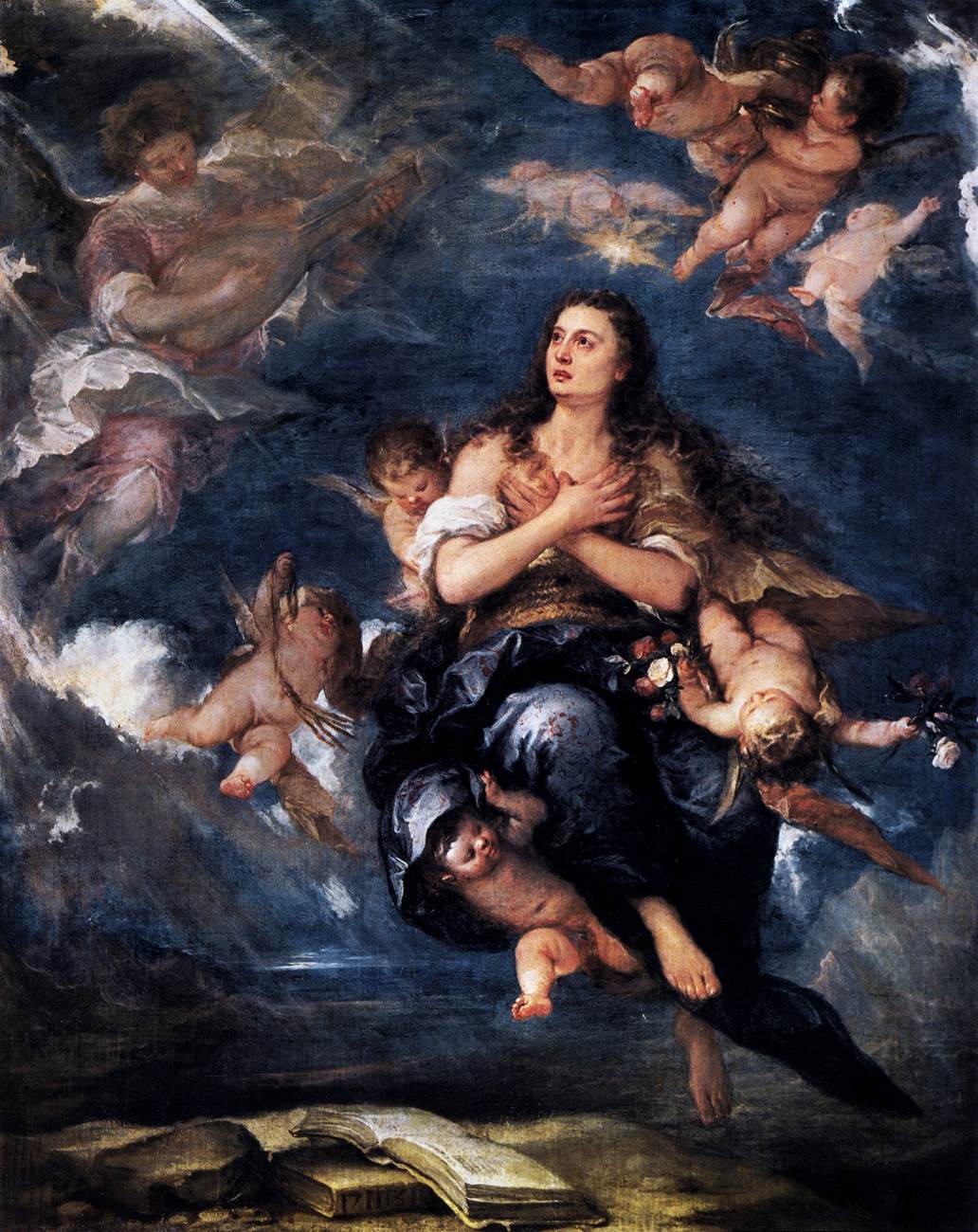
Assumption of Mary Magdalene by Jose Claudio Vicente Antolinez, XVII c.
Mary Magdalene has black hair here, not red. This is Spanish painting. Spanish artists depicted her with black hair, not as  a redhead.

As you see Mary Magdalene wasn't the only saint in Catholicism who had bad past, and who was sanctified in spite of it. Yes, early Christianity tried to figure out what to do with women, if they were allowed to be for example priests or not, etc. Misogyny was there. According to comparative religion scholar Karen Armstrong as long as Christianity was a secret and forbidden religion, when Christians met in catacombs or private homes, women were prominent. When Christianity became state religion, power was regarded as right  of men. And I say, no wonder, Mediterranean cultures were very misogynistic those days. People are very surprised when they read for example about position of women in Greece of Antiquity. And gender was not considered polarized, as we believe today. It was a different, kind of evolutionary concept which dealt with the belief what every thing was developing in nature. In this system which was linear and not polarized as today, man was the highest sentient being in the  hierarchy of life, woman was below him.She was the link between humans and animals. Yes, it was "really so bad." Religions as systems often adopt a lot of surrounding culture. Early Christianity maybe was socially very different at the beginning, but than normative  cultural prescriptions started to settle in. And for that no conspiracy was needed. People are not only products of their religions, but also of their cultures, and their times.