Showing posts with label relics. Show all posts

Sunday, June 23, 2013

Holy Grail in Bezlawki, part 1, Escape after Hastings


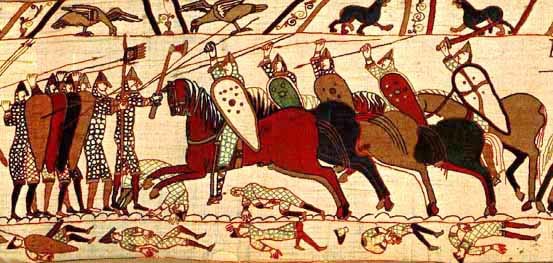
Bayeux tapestry, battle of Hastings. Via wiki commons, by Maxim

This blog has been neglected for long time. I planed and promised to write about the legend of the Holy Grail in Bezlawki, today's Poland. I mentioned before that it seems that Arthurian legends were very well received in Poland. But the legend of holy Grail in Bezalwki has some not very semi-historical events in it, and had people who are historical too. However, I am not saying here we need to believe the legend because of its historicity: it is just a legend based on real facts.

This is a story about a battle, escape, two chalices, two fighting brothers, the crusaders and a tower.
The battle in question was the battle of Hastings, when the last Anglo-Saxon king, the Harold II of England Harold II of England was killed. His children escaped to Denmark, as they were not safe anymore when  William the Conqueror became a new ruler. Short reminder: the mystical object of Medieval times, Holy Grail, was believed to be several things, one version was that it was the cup, or a chalice, into which Joseph of Arimathea collected blood of Jesus during the crucifixion. It became the ultimate  blood relic, which was brought by Joseph of Arimathea to the British Island. One version say that is connected to the Glastonbury Abbey.

 The tradition  also say that it was taken by escaping members of fallen dynasty more East, in order to save their lives, three people. They found refuge at the court of Danish king, their relative. They didn't escape empty handed, as you guess the story goes, they took  what they wanted, or rather what they thought was so precious they couldn't bear to leave behind. Among precious objects they considered worthy not to fall into the hands of William the Conqueror were two chalices, (from Britain and Greece). Finally  the grail was installed in this church, in Bezlawki, on the picture bellow. It stayed there for several centuries, still during the twenties of XX c. one travel book writer, Orlowicz, claimed he still saw one of the chalices in the church.

Church in Bezlawki today, empty, wiki commons, courtesy of Severus


Who were those three expatriate children of Harold II of England as real historical people? One of them was Gytha of Wessex Gytha of Wessex, who later became the wife of  Vladimir II Monomakh, the  ruler of  Byzantium influenced Kievan Rus. He is also known under name of Waldemar. Gytha's and Vladimir's son is mentioned in Norse sagas, there he is called Harald  his Slavic name was Mstislav. One of the brothers, Godwin, became the ruler of one of Lithuanian principalities, a duke. How it was possible? This was XI c. but Lithuania still was very similar to VI c. Britain: like at the court of king Arthur the knights took decisions during an assembly. Upward mobility was possible, still, during those days for a warrior who was considered worth of rule.

 Back to  Bezlawki: it was far away, actually when the chalices, (or chalice? ) first were installed there, the building which is the church today was not a church at all, but the fortified  tower of the crusaders. Not the Knights Templars, often they are associated in modern versions of the story with holy grail, but in this story we have Teutonic Knights, the worshipers of the Virgin Mary, with black crosses instead of red ones. They were  Order of Brothers of the German House of Saint Mary in Jerusalem. Knights form Europe joined them, not only from Germany. They were invited by pious Polish princes, Prussian Crusade was part of their military enterprise.


Church in Bezlawki, another view, wiki commons, courtesy of Jerzy Strzelecki

The Teutonic Knights came into the posession of the chalices later,but  it wasn't a war loot . It was a gift. From a rather pious ally.

Teutonic Knights, as a military order on a mission they  pressed East, however,  not South but  North, and who like those knights who went to the Holy Land got the blessing of  pope, they fought the  non-Christians, in this case the pagans, of today's Poland and Baltic states. They build a fortress which at the timescut the most east into the territories of the pagan Prussians, the Baltic people.  One  thing :  the English  version of article about Bezlawki mentions that the the fortress was a hunting lodge build by the Teutonic Knights. Not true, it was a fortified tower, a Wildhaus, as the knight called it, a house, a post in the wilderness. The forest was dense there, and I am sure there were hunters too, who hunted the wild  (it means game in German, also wilderness). However Jagd is hunting, hunting lodge is Jagdhaus. This was a fortress in which knights were stationed, not the hunters.

Two brothers, Lithuanian  dukes were in a bitter conflict. Jogaila, the older one,  who later became the king of Poland, was against the Teutonic Knights. His ascend to Polish throne happened after the Teutonic Knights were subdued and after Jogaila got baptized, it was the Christianisation of Lithuania. His younger brother,  Svitrigaila, sided with the Teutonic Knights, he also brought for them two mentioned chalices which were installed in the tower. Not too unusual, as the relics in the Medieval times were believed to help in difficult situations, and an outpost so far East probably was considered worth of help. Svitrigaila was invited to live in the tower together with his garrison. So, he didn't really give it away,  he moved with it. Svitrigaila still during XX c. was considered direct descendant of Harold II of England by Polish historians. Teutonic Knights promised him the crown of Lithuania.

More information follows soon.One Polish Medieval chronicle is somehow unusual,  it shows that Arthurian legend was taken seriously.Also two Lithuanian Grand Dukes were married to women who became divine: one was considered a goddess (she was a pagan), the other became a saint. Both were worshiped. Also the Nazis had it base very close: 30 buildings, 50 bunkers. It is today a tourist attraction, called Wolf's Lair.

As for the story, yes, it is kind of difficult to believe, it is a legend after all, we don't need to believe it. (I don't). Is it difficult to believe that such legend exists in Poland? Why? legends of escapes are not uncommon in Poland, it was a country to which refugees often went. And you can find this legend retold in polish on the net. Here are links to a website of a licenced tour guide (site in English) where the lady talks about  the legend, another is website of the town near Bezlawki. Not the only articles on net about this legend. This i part of tradition, really.

Blog entry by the tourist guide, she describes it well

Article in Polish, sorry, gmina Ketrzyn site, lots of hsitorical inforamtion


Saturday, August 11, 2012

The Holy Blood Relic of Reichenau: lost glory also?

 Relics, kind of strange to many of us, but they have important place in medieval history. And history of art too, as reliquaries have elaborate and artistic forms. Just a visit to the treasury of Constance cathedral, also located at the Lake of Constance, where is a collection of relics, not far from Reichenau, show abundance of gold, silver, glass and jewels and human creativity. A very good lesson about medieval mind.

 In Germany there are three holy blood relics, believed to be blood of Christ himself. The most famous one is in Weingarten, one in Rothenburg-ob-der Tauber, one in Reichenau. There are others also, but connected with host. On my art historical journey I visited those places,but  the relics were not my main purpose of visit, but history of art. Specially Rothenburg  and Reichenau are very special and feast for the eyes, not that Weingarten isn't impressive and beautiful. I write this because I know there are blood relic fans, and Reichenau isn't even mentioned on wikipedia. (Bruges, Mantua,Wiengarten are, but not all places).

 The Reichenau relic was very known and revered in the past. No legend is associated with it. It is the oldest surviving holy blood relic, recorded in history, without legends, rediscovery and claims. The name of the previous owner who belonged  to Byzantine nobility is included on reverse of the little golden cross holding the relic itself, it is part of inscription in Greek.We know his name and his family records. Seems like rather clear provenance. Claim is that the blood was collected by Joseph of Arimathea. Other blood relics claim that the blood was collected by Longinus (Wiengarten relic, brought from Mantua) and Mary Magdalene (Weissenau relic, brought from France).

The blood  relic is hosted in St Mary and Marcus church, on picture bellow. The church was important for keeping the relic of St Mark the Evangelist, still kept in the treasury of the church.

St Mary and Marcus church, Reichenau, Lake of Constance, Germany

The relic of Reichenau was presented by Schwanhilde, November 7th 925. Before she had the relic, it belonged to the emperor Charlemagne, this precious object was a gift  to the emperor by Arab Hassan. The story of the relic  was recorded by an  anonymous monk in Reichenau.  The relic contains soil said to be drenched with the blood of Christ, also part of fabric with blood and part of the cross.The relic parts are contained in a small golden cross with Greek writing on reverse. Interesting, for those of you who like blood relics, that the other place which  has blood relic, Weingarten- not too far from Reichenau, received it from Judith of Flanders, on May 31 1090. She was a relative, the step daughter of Baldwin V, Count of Flanders whose descendant, (grand grand-son) Thierry of Alsace, according to the legend, brought another blood relic to Bruges from the Second Crusade to the  Holly Land during XII c. Bruges relic is blood-stained piece of fabric.

Bruges is a popular tourist destination for a reason, and the procession during the day on which the relic is presented is an  impressive pagentry. Reichenau is just more mysterious, more off the beaten path. It is not as popular tourist destination, as the other places, specially for the sake of the relics. Streets of Bruges and Rotherburg are filled with joyful tourists, specially  during the Summer, as there is so much too see on every corner. In Reichenau, where walls and art is older than in Rotheburg and Bruges (the abbey was founded in VIII c.) were some tourists when I visited, and I am happy about it, but I also has time for peaceful contemplation, alone. And strolls on the island of vineyards, orchards and gardens, shore overgrown with reeds is an additional bonus.

 But going back to Bruges: recent historical research shows that most likely the Bruges relic was brought from the Fourth Crusade by Baldwin IX, Count of Flanders,  in which he and his army devotely  participated. It was most likely the loot taken when Constantinople was sacked during the Fourth Crusade, 1204, not earlier, from the the Second Crusade as the legend claims. The Fourth Crusade (1202-1204) was unusual in this sense that was directed toward Christians, not against Muslems as in previous crusades,  or pagans as in Northern Crusades.  Only five years later, 1209,  another  crusade against Christians in Europe-in today's Southern Franc followed. This was the second Albigenesian Crusade against the Cathars. The crusaders had lots to do: Constantinople, Southern France, for the sake of forgiveness of sins and for the sake of loot.

 Constantinople, than was the richest, most learned and most beautiful city of Europe from which culture flew and influenced others, where the tradition of Antiquity, philosophy and scholarship didn't dim was sacked by fellow Christians. Without Byzantium and its capital  Italian Renaissance wouldn't be complete. This splendid city influenced Ottonian renaissance, (and other medieval Renaissances), under which Reichenau flourished, St. Gallen, Chartres, Reims, and Glastonbury, from which Theophanu, the Byzantine princess, wife of the emperor Otto came. During three days of killing, looting, desacrating churches and burning the famous Library of Constantinople was burned. This library, similar to the Library ff Alexandria, was enormous, and continued traditions of Antiquity, preserving wisdom of ancient Greeks and Romans for almost one millenium. More about the famous library here. The Bruges relic was most likely stolen during those three horror filled days.


Interior of St Mary and Marcus church , Island Reichenau, on the Lake of Constance, Germany


And gift of relic of Reichenau is more more historically documented, not as legendary. I have to admit for my own comfort I prefer the story of a woman donor, learned and peaceful, than some crude crusader, most likely robbing some church of a very culturally advanced city. Was killing, destroying and  robing Constantinople erased from collective memory in Belgium? The legend mentions crusade to Jerusalem, as the counts of Flanders were participants. Sometimes is amazing how easy the collective memory erases important facts. Like How easy was for Belgium to erase the memory of atrocities committed in their colony in Africa, which is not too ancient history after all.(Will spare you the gory details). Those things need to be said, as Europe had not only burning the heretics and witches but also had crusades. I come from one of the countries, which like Occitania during the Albigenesian Crusade suffered the presence of crusading armies. I mentioned this in another post.

 The memory of crusades are often white washed  and idealized, all good and mysterious Templars, etc. Keep in mind the the surge in Templars popularity came also during XIX c. when many families were proud to have crusaders among their grand grand grands, and bragging about it was a fashion. We still probably feel the shadow of this fashion still.

 Behind the iron gate at the chapel in Gothic style, there is reddish Baroque altar, you see the cross on the top, visible above the gate. This is altar of holy blood relic.  Usually the places which held blood relics were famous on its own right, by the fact of keeping the relic. How telling that wikipedia doesn't even list it among the sites, even though the fact who gave the relics is better documented than in the case of Bruges, famous place with a legend of crusaders. If UNESCO wouldn't list Reichenau among world heritage sites, Reichenau would be even more obscure, the memory of its vibrant culture and its previous fame would be preserved only among some scholars and serious history and art history buffs.

 St Mary's and Marcus church pictures by Heidi Fuchs.

Monday, April 16, 2012

Mary Magdalene:Colors, Robes and Archetype History of Color # 8

I noticed in my blog's statistics that some of you came to my blog searching for info about the colors of Mary Magdalene's robes. I must have been a disappointment to see so little about it. I hope this entry will give you more of satisfying information.


Red was very common when she was depicted, but other colors were not rare either. I feel I need to move beyond the Middle Ages, as I was writing about vermilion robe of Mary Magdalene already. I am focusing in this post on Latin Christianity. Byzantine Christianity depicted her also in red robes, often with red egg in her hand. In this tradition she also she was considered extremely virtuous, one generation older than Jesus, died in Ephesus, her relics (body) were revered in Constantinople. Disappeared of course, maybe together with other relics after sack and looting of Constantinople they, tradition say were brought to Western Europe. But we don't know for sure what happened.

Mary Magdalene, Orthodox icon
 Red was often the color of choice by the later painters as well, but I would advise not to rely on red so much. Some people do, to some degree of annoyance of the well-educated art historians, when the non-art historians try to convince them, sometimes quite harshly,  they know it better because they read a few popular books. Thing can turn rather grotesque.About annoyances and my defence of art historians  later, in another entry, now I focus on colors and Mary Magdalene as a cultural phenomenon.

Magdalene was shown in red robes, quite often in a green dress. Green symbolized eternal life, color of paradise, hope and promise of eternal happiness in heaven. Green of the  paradise was shown already in the early Christian art. Shouldn’t be confused with non-religious matters, when green symbolized rebirth, Spring, fertility, hope in matters other than theological. It is important to know about such differences, not only for knowledge sake, but also for avoiding mistakes, for example reshaping Mary Magdalene into fertility goddess, as it sometimes happens in some books authored by some non-art historians. The context of the art matters, quite a lot.

 Red was common, yes, but not an exclusive color assigned to her only, nor she was shown in red only. This is a curious misconception, recently spreading. I would like to know about the sources of it. Assuming that she was shown only in red robes, isn't in relation with factual history of art, it is  huge over-simplification. Red in religious, not secular tradition  represented  love in sense of charity, (agape), martyrdom, sacrifice on the cross, redemption through crucifixion.

 But she was also depicted in lush and colorful robes, rich and beautifully embroidered, often golden. Look at this picture, which I got through twitter. One of many examples of colorful robes, from the collection in Kassel Museum, Germany. Cloak is elegant subtle shade of red.
Mary Magdalene and Jesus as Gardner

Or click to see life of Mary Magdalen at Chartres Cathedral stained glass window. Click on links to different images, and you will see range of colors, blue included.

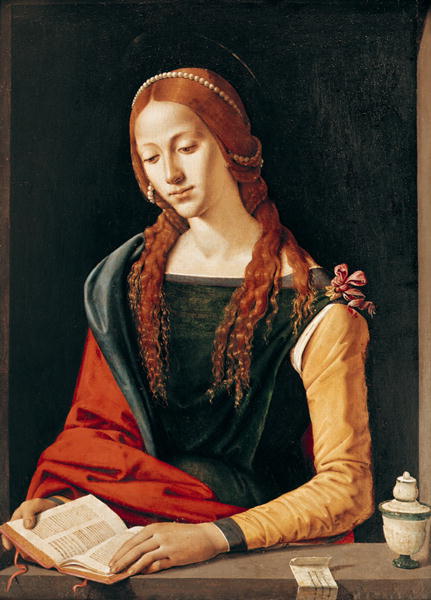
Form gold we go to yellow, which was in certain times the color assigned by law to the common prostitutes and courtesans. Red wasn't. There is another misconception that red was color of prostitutes, which is not true: yellow was. Red sometimes only. I wonder if this assumption comes from Scarlet Letter? Who knows. Mary Magdalene could be dressed in yellow, or only be a part of her garment, like for ex. the sleeves were yellow, the dress itself  is black and white, and no cloak. Etc.

Piero di Cosimo, Mary Magdalene, public domain, via Wikimedia Commons


Penitent Magdalene by Artemisia Gentileschi,via wikimedia commons


Colorful, rich robes were shown too, or in very subdued colors, when she was depicted as a meditating penitent. Or dressed in shiny silvery silk, XIX c. And I am glad she was not depicted in red only, and not in vermilion only. She captured the imagination of the people of Latin Christianity as a very colorful personality anyway, as someone who lived a whole spectrum of human emotion and full spectrum of ethics. Why she should be than depicted in one color only? It would be very limiting. She was considered the accessible saint, giver of hope to fallen humanity, and as a personality more a symphony than a simple melody. She was one of the Latin Christianity highly elevated persons who was somehow considered unclean at the beginning.

Mary Magdalene by Jan van Scorel, via wikimedia commons
To the masses of believers she was the embodiment of a phenomenon of transformation. From a women from whom seven demons were expelled, a prostitute by profession, who than became no less than "Apostle to the apostles," the title given her by the Catholics church, a base metal changed alchemically to gold. Transformation which Oscar Wilde one described as: "every saint had a past, every sinner has a future." Initially a bad girl, but with golden heart, also in accordance to some societal views about the harlot with a heart of gold. Europe loved such stories, Europeans were not Puritans. La Traviatta is one of those stories, for example. I don't think there is an equivalent in the US. Different cultures, different views, different archetypes.

And she was an embodiment of a loving, yet a very independent woman. Sometimes I am asked if I believe Mary Magdalene was the Grail. Depends what you understand as "grail". To me grail as an archetype can’t be confined to the ideas of biological reductionism. Grail of the legends itself is an archetype of a quest, and it is elusive, as quest is often about elusive goals. Many people are on quest, but don't know what the quest is about. And nothing wrong with it. Mary Magdalene: it is nothing wrong in being a parent, it is something very noble in parenthood. I respect that. But did she really need to be a mother, a cup bearing diving DNA in order to be more important to us?

Penitent Mary Magdalene, by Vaccaro, via wiki commons

We may find out that today we are less tolerant toward her than the people who didn’t believe that she was the mother of Jesus offspring. Those people loved her anyway, even when they believed she was a reformed fallen woman. It seems they were quite  forgiving. She was loved and venerated the way she was perceived, with all her imperfect humanity, the way she was seen. Imperfect saint? People didn’t mind. This is not about who she was historically, as stories were often confused. Mary the Egyptian for example, or dispute which body was the real Mary Magdalene, as at times there was more than one body claimed to be Mary Magdalene's. Holy relics were not such clear business, and there are also cases of spurious claims. Her story is not so much about her, but very much about us: how much were are willing to accept in a person, specially in a women, in order to consider someones contribution a worthy one.

 And how many prejudices we have. Her story is a very interesting case in social history, indeed. Interesting, unique perspective in a Guardian article by the novelist and  columnist who was herself a prostitute, Tracy Quan. She mentions her visit in Southern France to see the relics whom she considers to be her patron saint. Specially important, I think, is the quote engraved on the stone tablets along the steps leading to the cave said to be saint's meditation hermitage: "Blessed are those who have been persecuted." Quan noticed this quote as she climbed the stairs. To me Quan's article was a gentle reminder and a rebuke, to all, me including, calling to not forget those who are in need, no matter who they are, or how "lowly" they are. Over a millennium and half Latin Christianity's message regarding this saint was: stop marginalizing, be open to others. 

The founder of  the first church in Europe was Lydia. She was a business woman, dealing with luxury goods prohibitively expensive purple cloth. She was unusual for the place and times, when women were considered deficient human beings, with human rights comparable of that of children assigned to them. Why she is not talked about now, along with Mary Magdalene? Not sexy enough? Not enough of sensationalistic dramas? No way to focus on her genitals/womb, as it was done in Mary Magdalene's case, and still is today?

In general this turmoil about Mary Magdalene and women, being not given enough enough respect,  not given enough place for them in the church, as much as it is healthy and good has it own flaws: conveniently blaming the Catholics for everything evil seems to be a little bit displaced, when we take women as archetypes. In Orthodox Christianity there was no mention of her as prostitute, and there she also has churches devoted to her, and the legend saying that she traveled to Ephesus, stayed there and her grave is there. After the schism this is a competing legend, as the legend  of Mary Magdalene traveling to France is more well known, as Western Europe is more well known. To me the position of Mary Magdalene is more problematic in Protestantism. It seems to me that the Catholic sisters of Protestantism don't complain as much about women not given enough place in the church theology, except complaints that women can't be ordained. And other issues not relating to theology, which I omit know as they don't relate to the subject directly. Mary Magdalene was always a very popular saint, tin Catholicism, if not the most popular one after all.

Here is Mary Magdalene in brown robe of a penitent, those often were extremely crude, made of goat hair or crude wool (other races of those animal than today), or was she was supposed to be covered only by her long flowing hair.

Ascension of Mary Magdalene, Anonymous, via wiki commons
Mary Magdalene here taken to heaven is dressed in coarse penitent robe, or according to the legend, 
her naked body was covered by her very long hair.
Their (Catholics) equivalent of the Sacred Feminine, a term so often used now, is Virgin Mary, given the title of the co-saviour, as saving together with Jesus. Mary Magdalene is the  apostle to the apostles. And other women saints. They say those personages are just humans among the Protestants, who reject cult of Virgin Mary, etc. not divine enough. Should we reject their opinions as illogical? Given the number of the churches devoted to Virgin Mary and and Mary Magdalene in Catholic countries in general? Look at the picture above, is this disrespectful? The word "vilified" is often used in relation to Mary Magdalene. Is she as vilified as it is complained in popular opinion? I think we need to to look deeper, it is easy to repeat catchy phrases, which can be emotionally satisfying, but on the long run those phrases make things shallow. And the subject of Mary Magdalene is not shallow, not matter which tradition we analyse or which one we like.

Art history gives another picture. On the last example above she is rather glorified than vilified.And it was one of many kind of depictions of Mary Magdalene.